Marketing for Tradies That Generates Qualified Local Leads and Profitable Booked Jobs
SEO Agency for Tradies builds customer-acquisition systems for Australian trade businesses. We connect local SEO, Google Ads, conversion-focused websites, customer reviews, call tracking and lead follow-up with the services, locations and project types your business wants to sell.
Find out what's holding you back
Enter your number — we’ll call you with a free ranking report for your suburb.
We call within 2 business hours. No scripts. No pressure.
Businesses We Support Across Australia
We support trade and commercial service businesses with stronger local visibility, clearer lead generation and marketing systems connected to measurable commercial outcomes.







START WITH THE BUSINESS PROBLEM
Which Marketing Problem Does Your Trade Business Need to Solve?
The correct marketing scope depends on your current business stage, not on a standard agency package.
I Am Starting a Trade Business
A new owner-operator usually needs a credible local presence before investing heavily in promotion.
An established tradie may already receive work but experience unpredictable quiet periods.
I Need Enough Work for Several Crews
A growing trade company requires more than a higher lead count.
I Want Larger Residential or Commercial Projects
Builders, renovators, concreters, landscapers, shopfitters and civil contractors often need fewer enquiries with stronger commercial fit.
My Current Marketing Provider Is Not Delivering
A business may receive reports showing impressions, clicks or rankings without being able to identify calls, quotes or booked jobs.
What Is Marketing for Tradies?
Marketing for tradies is a customer-acquisition system that helps trade businesses become visible, generate qualified enquiries, convert prospects into booked jobs and retain customers across selected services and locations.
Tradie marketing, trade-business marketing and contractor marketing describe the same parent discipline. Its channel-level components include local SEO, paid search, website conversion, reputation management, content, CRM automation, referrals and customer retention.
Marketing Built Around Trade-Business Economics
A trade business does not benefit from more traffic when the traffic produces the wrong jobs. It does not benefit from more leads when the enquiries fall outside its service area, have unsuitable budgets or cannot be completed profitably.
Our campaigns are planned around business variables that affect commercial performance:
This approach replaces disconnected marketing activity with a controlled lead-to-job system.
A Measurable Commercial Sequence
The system follows a measurable commercial sequence:
- Each stage performs a different function.
- Demand represents an existing or potential customer need. Visibility allows the trade business to appear when that need becomes active.
- Conversion turns attention into a call, form or booking request.
- Qualification determines whether the opportunity fits the business.
- Follow-up moves the prospect towards a quote or appointment.
- Attribution connects the completed job with the campaign that generated it
- A campaign is incomplete when it measures only the first stages.
Commercial fit
Core service
Which services receive priority visibility and advertising investment.
Average job value
Which search terms, audiences and offers are commercially viable.
Customer type
Whether the campaign targets homeowners, builders, developers or property managers.
Gross margin
Which services can sustain the required acquisition cost.
Capacity and geography
Gross margin
Which services can sustain the required acquisition cost.
Crew capacity
How much demand the business can accept without reducing service quality.
Seasonality
When campaigns should expand, contract or change service focus.
Lead and conversion control
Sales cycle
Whether the prospect needs an immediate booking, site visit, quote or longer nurturing process.
Lead quality
Which enquiries are accepted, rejected or prioritised.
Conversion process
How calls, forms, quotes and follow-up are managed.
LEAD QUALITY BEFORE LEAD VOLUME
What Makes a Tradie Lead Commercially Qualified?
A phone call is not automatically a valuable lead. A quote request may still be commercially unsuitable. Lead quality must be assessed against defined acceptance criteria.
A qualified tradie lead matches the business’s service, location, customer type, job value, budget, timeframe and operational capacity.
Service requirement
The enquiry must relate to a service the business actively provides. Work outside the trade or current scope is not accepted.
Timeframe
The requested date must fit the business’s available schedule. Deadlines the team cannot meet are unsuitable.
Geographic location
The job must be within a profitable suburb, postcode or service territory. Locations requiring excessive travel are unsuitable.
Property type
The property must be residential, commercial or industrial work the business handles. Unsupported building or site categories are excluded.
Customer type
The enquiry must come from a target homeowner, builder, developer or manager. Customer segments outside the business’s market are unsuitable.
Intent
The prospect must be ready to book, arrange a site visit or request a serious quote. Research, employment, supplier and training enquiries are excluded.
Job size
The work must meet the business’s preferred minimum job value. Small jobs that cannot be delivered profitably are unsuitable.
Capacity fit
The work must be assignable to available staff and operational capacity. Demand exceeding safe delivery capacity is unsuitable.
Budget
The customer’s budget must be realistic for the required service. Budgets materially below the required scope are unsuitable.
THE COMPLETE ACQUISITION SYSTEM
What Do Our Marketing Services for Tradies Include?
Our marketing service connects strategy, digital visibility, conversion infrastructure, lead management and commercial measurement.
The service is modular. The recommended scope depends on the business problem, existing assets and growth target.
Strategy and positioning
Strategy is the decision system that determines what will be promoted, where it will be promoted and how performance will be judged.
Local SEO and Google Business Profile
Local SEO helps a service-area business appear when nearby customers search for a relevant trade service.
Website and conversion
A tradie website should help a suitable visitor understand the service, verify trust and take the next action.
Google Ads and demand capture
Google Ads can place the business in front of customers actively searching for a relevant service.
Reviews, CRM and follow-up
Review generation creates current public evidence from genuine completed work.
Attribution and performance reporting
Marketing attribution connects enquiries and customers with the channels and campaigns that influenced them.

The output is a prioritised acquisition plan. It defines which assets must be built, which campaigns must be launched and which metrics will determine whether the work is creating commercial value.
Detailed Service Scope
Strategy is the decision system that determines what will be promoted, where it will be promoted and how performance will be judged.
We begin by analysing the business rather than selecting channels in advance. This includes the trade category, priority services, customer types, service areas, margins, average job values, current lead sources, operational capacity and previous campaign data.
The research can identify:
- services with sufficient demand and commercial value;
- locations with realistic ranking or advertising opportunities;
- customer groups with different buying processes;
- search terms that indicate hiring intent;
- competitors controlling relevant organic, Maps and paid visibility;
- gaps in the existing website and Google Business Profile;
- services generating enquiries but weak profitability;
- locations consuming advertising spend without producing booked work; and
- points where enquiries are being lost after initial contact.
The output is a prioritised acquisition plan. It defines which assets must be built, which campaigns must be launched and which metrics will determine whether the work is creating commercial value.
Brand positioning explains why a suitable customer should select your business instead of a lower-priced or more visible competitor.
For a tradie, differentiation may involve service specialisation, response availability, project complexity, workmanship systems, trade licences, warranties, geographic expertise, customer type or documented project experience.
We convert those attributes into clear website and campaign messages. The aim is not to make unsupported claims of superiority. It is to make relevant differences visible and verifiable.
A generic message states:
Quality work at competitive prices.
A specific message states:
Licensed commercial electricians providing scheduled switchboard upgrades for strata and facilities teams across Greater Sydney, with after-hours implementation and documented compliance handover.
The second statement identifies the service, customer, location, delivery condition and evidence requirement. It gives the buyer information that can support a decision.
Positioning can be applied across:
- website copy;
- service pages;
- location pages;
- capability statements;
- advertisements;
- project case studies;
- quote documents;
- vehicle graphics;
- uniforms;
- social profiles; and
- customer-review requests.
Consistent positioning helps the business become recognisable across digital and physical customer touchpoints.
Local SEO helps a service-area business appear when nearby customers search for a relevant trade service.
The work can include Google Business Profile optimisation, local keyword research, service pages, suburb pages, location signals, citations, review processes, internal linking and local authority development.
Google Business Profile Optimisation
The Google Business Profile can display the company’s category, services, operating hours, service area, reviews, photographs and contact actions across Google Search and Maps.
Optimisation may include:
- selecting an accurate primary category;
- adding justified secondary categories;
- defining services and business information;
- reviewing address or service-area configuration;
- adding accurate operating and emergency hours;
- improving photographs and project evidence;
- monitoring questions and customer feedback;
- maintaining consistent contact details; and
- tracking calls, website visits and other available actions.
Profile optimisation does not guarantee a Maps position. Local visibility may vary according to relevance, distance, prominence, competition and the searcher’s location.
Service-Page Optimisation
A general services page rarely provides enough information for customers comparing a specific job.
We can create separate pages for commercially important services, such as blocked-drain repairs, switchboard upgrades, concrete driveways, roof restoration, commercial fit-outs or landscape construction.
Each page can explain:
- the service;
- the customer or property type;
- common project conditions;
- the delivery process;
- relevant qualifications;
- project evidence;
- service locations;
- exclusions;
- quote requirements; and
- the next conversion action.
This structure improves customer clarity while giving search engines a more precise understanding of each service entity.
Service-Area and Location Pages
Location pages can support visibility across selected suburbs, towns or regions when the business genuinely serves those areas.
A useful location page requires more than changing a suburb name. It should contain relevant information about available services, travel coverage, project types, local proof, operational conditions and contact options.
We do not recommend producing large numbers of thin, near-duplicate suburb pages. Google’s spam policies prohibit scaled content created primarily to manipulate rankings rather than help users.
Local Citations and Business Consistency
Local citations are references to the company’s business information across relevant directories, maps, industry profiles and partner websites.
We review the consistency of:
- business name;
- address where publicly applicable;
- telephone number;
- website;
- opening hours;
- service categories; and
- business description.
The objective is to reduce conflicting information and strengthen a coherent local business identity.
Internal Linking
Internal links connect related services, locations, projects and customer questions.
Anchor text must describe the destination clearly. For example:
- Local SEO for Tradies should link to the local SEO service page.
- Google Ads for Tradies should link to the Google Ads service page.
- Marketing for Builders should link to the builder marketing page.
Google recommends descriptive, crawlable links that help users and search systems understand the linked page.
A tradie website must establish trust, explain the service and make the next action easy on a mobile device.
The website is not only a digital brochure. It is the controlled conversion asset used by organic search, Google Ads, referrals, social profiles and vehicle signage.
A conversion-focused trade website may include:
- individual service pages;
- genuine location pages;
- clear service-area information;
- mobile click-to-call actions;
- quote or booking forms;
- project galleries;
- detailed case studies;
- reviews and testimonials;
- licences and relevant qualifications;
- workmanship or service guarantees;
- team and business information;
- commercial capability information;
- financing information where applicable;
- frequently asked questions; and
- privacy and contact information.
Mobile-First Conversion
Many trade-service searches occur while the customer is away from a desktop or dealing with an immediate problem. The mobile experience must therefore allow the visitor to understand the offer and contact the business without unnecessary interaction.
Google uses the mobile version of a page for mobile-first indexing and recommends equivalent primary content across mobile and desktop experiences.
We assess:
- text readability;
- tap-target size;
- click-to-call placement;
- form length;
- page speed;
- image size;
- content visibility;
- navigation;
- intrusive pop-ups; and
- accessibility of primary information.
Quote Forms and Qualification
Forms can collect enough information to support a useful first response without creating unnecessary friction.
Fields may include:
- required service;
- suburb or postcode;
- property type;
- residential or commercial requirement;
- project stage;
- approximate budget;
- target timeframe;
- photographs or plans; and
- preferred contact method.
An emergency plumber may need a short form and prominent phone action. A custom builder or commercial shopfitter may need a detailed project-enquiry form. Form design must reflect the customer’s urgency and the business’s qualification requirements.
Project Evidence
Before-and-after photographs, project galleries and case studies help a prospective customer assess workmanship and relevant experience.
A project entry becomes more useful when it identifies:
- the service completed;
- the project location;
- the customer or property type;
- the initial condition;
- the technical scope;
- materials or systems used;
- delivery constraints;
- completion timeframe; and
- documented outcome.
The page should not publish unsupported performance or compliance claims. Evidence must correspond with work the business can verify.
Google Ads can capture immediate search demand from customers actively looking for a trade service.
Paid search is often appropriate for urgent services, new service areas, schedule gaps and campaigns that require demand before organic visibility has developed.
Campaign structure may be divided by:
- service;
- customer type;
- suburb or territory;
- emergency versus planned work;
- residential versus commercial demand;
- device;
- operating hours; and
- landing page.
Search-Intent Targeting
High-intent searches indicate an active requirement. Examples include:
- emergency electrician near me;
- concrete driveway quote;
- commercial plumber Sydney;
- roof restoration company;
- office fit-out contractor; and
- excavation contractor for site cut.
Broader informational searches may have lower immediate conversion intent. Keyword selection must therefore reflect the campaign objective.
Negative Keywords
Negative keywords exclude searches that are unlikely to produce a suitable customer.
These may include:
- jobs;
- salary;
- apprenticeship;
- course;
- training;
- DIY;
- free;
- materials only;
- second-hand;
- definition; or
- services outside the business’s scope.
Negative-keyword management reduces irrelevant clicks but cannot eliminate every unsuitable enquiry.
Geographic Controls
Campaigns can target suburbs, postcodes, cities or defined regions. Geographic reports can then identify areas generating clicks, leads and booked jobs.
Targeting must reflect:
- crew locations;
- travel time;
- call-out fees;
- traffic conditions;
- minimum job value;
- emergency coverage; and
- commercial territories.
A large geographic radius may increase apparent reach while reducing profitability.
Landing Pages
Each important campaign should direct users to a page that closely matches the advertisement.
A plumbing campaign for blocked drains should not send customers to a generic home page that requires further navigation. A commercial electrical campaign should not use the same message as an emergency residential campaign.
Landing-page alignment can improve customer clarity and make conversion data easier to interpret.
Advertising Measurement
Advertising reports can include:
- search terms;
- clicks;
- calls;
- forms;
- qualified leads;
- cost per lead;
- cost per qualified lead;
- quotes;
- booked jobs;
- attributed revenue; and
- return on advertising spend.
Advertising expenditure is normally separate from agency management fees and must be disclosed separately in the proposal.
Social media is strongest when it demonstrates active work, builds recognition or re-engages people who already know the business.
Facebook, Instagram, LinkedIn, YouTube and other platforms perform different functions.
Project-led residential trades may use Facebook and Instagram to publish:
- before-and-after results;
- current projects;
- completed work;
- customer reviews;
- team introductions;
- service explanations;
- maintenance information; and
- local community involvement.
Commercial contractors may use LinkedIn and website content to support:
- capability positioning;
- project experience;
- industry accreditations;
- procurement visibility;
- professional relationships; and
- tender validation.
Social media does not replace high-intent search demand. A customer with an urgent electrical fault is more likely to use a search engine than wait to encounter an organic social post. Channel selection must follow buying behaviour rather than platform popularity.
Genuine customer reviews help prospects assess trust, communication, service quality and recent business activity.
A review process can request feedback after a completed job, direct the customer to the appropriate platform and notify the business when a response is required.
Review requests can be integrated with:
- job completion;
- invoice payment;
- service follow-up;
- CRM status changes;
- email;
- SMS; or
- job-management software.
The request must not fabricate, edit or misrepresent customer opinions. The ACCC states that reviews should reflect the genuine opinion of the person who experienced the service and that fake or misleading reviews are unlawful.
Reputation management may also include:
- monitoring new reviews;
- responding professionally;
- identifying recurring service problems;
- escalating legitimate complaints;
- displaying verified testimonials;
- improving review recency; and
- separating feedback by branch or service area.
Negative reviews must not be treated only as a marketing problem. Repeated concerns about punctuality, communication, quoting or workmanship may indicate an operational issue that marketing cannot correct.
A customer relationship management system records each enquiry and controls what happens next.
Without a defined pipeline, leads may remain in inboxes, personal phones, notebooks or disconnected software. The business cannot reliably determine whether the lead was contacted, quoted, won or lost.
A tradie CRM pipeline may include:
- New enquiry
- Acknowledged
- Contacted
- Qualified
- Site visit booked
- Quote required
- Quote sent
- Follow-up due
- Job won
- Job lost
- Job completed
- Review requested
- Repeat service due
Automation can support the process by sending:
- enquiry acknowledgements;
- missed-call text messages;
- booking confirmations;
- appointment reminders;
- quote reminders;
- follow-up tasks;
- review requests;
- maintenance reminders; and
- reactivation messages.
Automation cannot replace judgement. Complex quotes, complaints, commercial negotiations and sensitive customer concerns still require human handling.
Past customers can generate repeat work, maintenance revenue, reviews and referrals at a lower acquisition burden than continually finding unknown prospects.
Retention opportunities vary by trade.
Examples include:
- scheduled HVAC servicing;
- pest-control renewals;
- gutter or roof inspections;
- electrical safety checks;
- plumbing maintenance;
- pool servicing;
- landscaping maintenance;
- commercial facilities work; and
- warranty or aftercare communication.
Customer records can be segmented by service date, completed job, property type, location and future need.
A reactivation campaign should be relevant and permission-aware. It should not send the same generic promotion to every person in the database.
Attribution connects a marketing source with an enquiry, quote, booked job or customer.
The reporting system may combine:
- Google Analytics;
- Google Search Console;
- Google Ads;
- call tracking;
- form tracking;
- Google Business Profile data;
- CRM records;
- job-management software; and
- accounting or revenue data where appropriate.
The objective is not to place every available metric in a monthly report. It is to answer practical questions:
- Which channel generated the enquiry?
- Was the lead commercially qualified?
- Did the business contact the prospect?
- Was a quote issued?
- Was the job won?
- What revenue was recorded?
- What acquisition cost was incurred?
- Which services and locations produced the strongest commercial result?
How a Tradie Marketing System Improved Qualified Enquiries and Booked Work
This case study shows how a structured marketing system improved visibility, lead quality and booked-job opportunities for an Australian trade business. Client details remain confidential.
Plumbing
Western Sydney, NSW
TIMELINE
March 2026 – August 2026
CLIENT
Confidential trade business
Client name and URL withheld
Challenge
The business faced inconsistent lead flow, weak visibility for priority services and too many enquiries outside its preferred service mix or service area.
What We Did
We implemented service-priority targeting, improved local SEO across key service pages, updated website conversion elements, corrected tracking gaps and refined campaigns to attract higher-quality leads.
Client confidentiality notice: Identifying details have been intentionally withheld. Performance evidence is shown with sensitive information blurred.
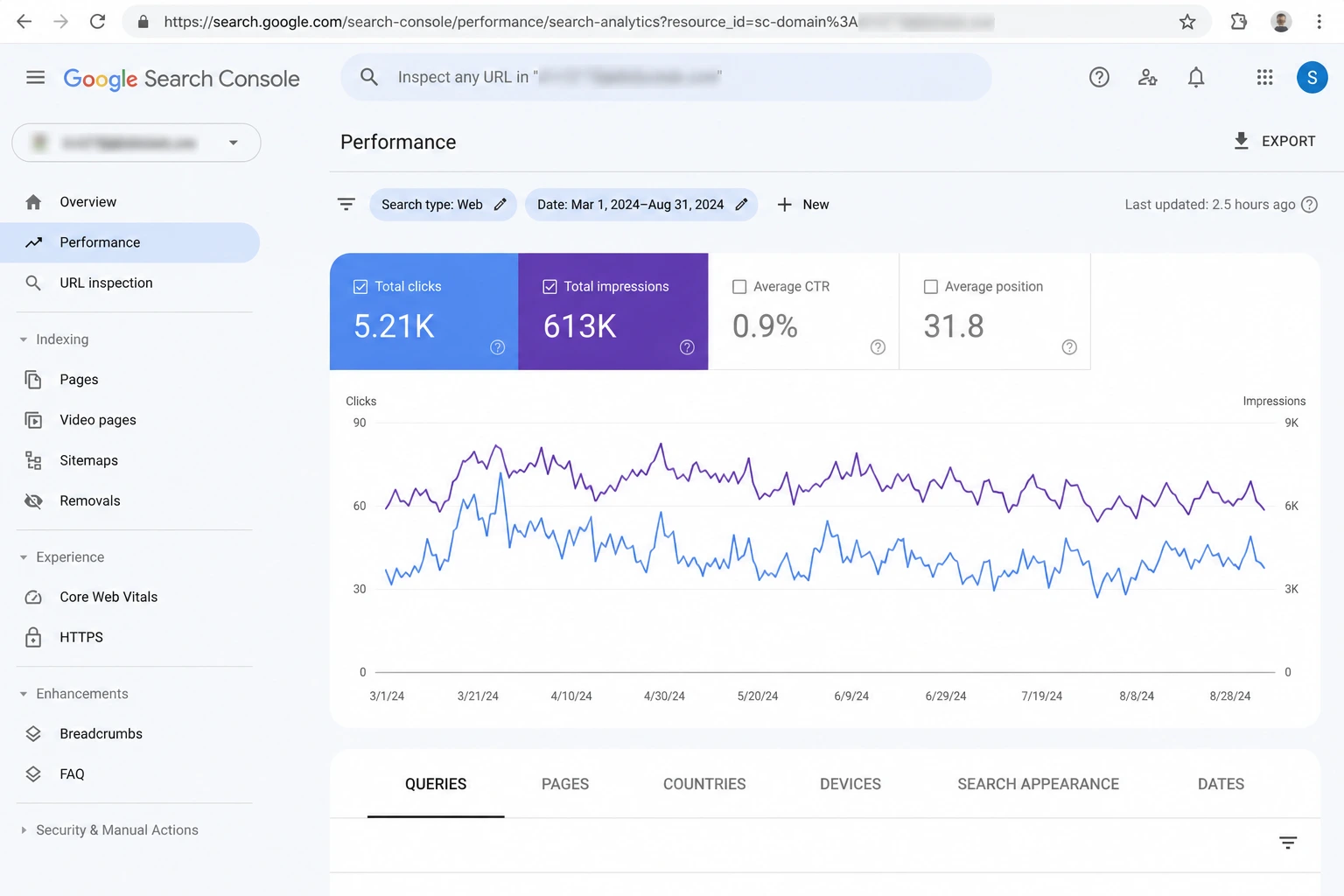
Google Search Console performance data with identifying client details redacted for confidentiality.
+68%
Qualified enquiries
+41%
Organic clicks
27
Booked-job opportunities
6 months
Measured period
Choose the Scope Around the Business Problem
The service is modular. The recommended scope depends on the business problem, existing assets and growth target.
DIAGNOSTIC MATRIX
Why Is Your Current Marketing Not Producing Enough Profitable Jobs?
Marketing underperforms when visibility, targeting, conversion and lead handling are not connected to the business’s commercial requirements.
A single weak point can reduce the value of the entire system. Strong search visibility cannot compensate for a slow website. A strong website cannot convert missed calls. High enquiry volume cannot improve revenue when most leads are outside the service area or below the minimum job value.
Irregular lead flow
Work arrives in irregular bursts when the business depends too heavily on referrals or one lead source. Building several controlled acquisition channels creates a more stable enquiry pipeline.
Leads from the wrong areas
Enquiries come from distant suburbs when geographic targeting is too broad. Restricting campaigns by service radius, suburb or postcode reduces travel and quoting waste.
Price-focused prospects
Most prospects request the cheapest quote when the messaging does not establish value or specialisation. Clearer positioning, proof and customer fit attract buyers who evaluate more than price.
Small or unsuitable enquiries
Generic service targeting produces enquiries for small or unsuitable work. Service-specific pages, advertisements and qualification fields increase average lead relevance.
Website traffic without calls
Traffic fails to generate calls when the mobile experience, proof or conversion paths are weak. Improving speed, trust elements and calls to action increases visitor-to-enquiry conversion.
Missed calls
Calls are frequently lost when no routing or recovery process exists. Call tracking and missed-call text-back help recover otherwise lost prospects.
These conditions require different interventions. Adding more advertising to a weak lead-handling system may increase wasted expenditure. Rebuilding a website without fixing geographic targeting may increase the same unsuitable enquiries.
CHANNEL FIT, NOT CHANNEL HYPE
Which Marketing Channels Work Best for Tradies?
The strongest channel depends on search urgency, job value, service area, buying cycle, competition and business capacity.
High-Intent Demand Capture
Local SEO captures existing search demand from people looking for relevant trade services in selected areas. It is most suitable for building sustainable visibility across priority services and locations, but it requires implementation time and ongoing authority development.
Google Ads
Google Ads captures immediate paid-search demand from customers actively searching for urgent services, schedule gaps or new-market coverage. It can generate visibility quickly, but traffic stops when advertising expenditure stops.
Website conversion turns existing traffic into calls, forms and quote requests through clear messaging, proof and conversion pathways. It improves the value of traffic from every channel, but it cannot create demand without visitors.
A Google Business Profile supports local discovery and trust for service-area businesses seeking Maps visibility. Its performance depends on market competition, location relevance, profile quality and supporting local signals.

We qualify and manage every lead to move only the right opportunities forward.
FROM ENQUIRY TO BOOKED JOB
How Do We Turn Tradie Leads Into Booked Jobs?
Leads convert into booked jobs when the business responds promptly, qualifies consistently, communicates value and follows up after sending the quote.
Marketing creates the opportunity. The sales and administration process determines whether that opportunity becomes revenue.
01 Enquiry acknowledgement
Every enquiry is captured and acknowledged quickly.
02 Lead routing
Enquiries are assigned to the correct service, location or team.
03 Lead qualification
The opportunity is checked against service, location, budget, timeframe and capacity.
04 Site visit or consultation
Suitable opportunities move to an inspection, discovery call or site consultation.
05 Quote presentation
The customer receives a clear quote or proposal covering scope, terms and the next step.
06 Quote follow-up
Important quotes are followed up according to the expected decision period.
07 Outcome recording
Every opportunity is recorded as won, lost, postponed, unsuitable or still under consideration.
08 Post-job retention
Completed jobs can lead to reviews, referrals, maintenance and repeat work.
BUSINESS MATURITY
What Marketing System Does Your Trade Business Need at Its Current Stage?
Business maturity changes the required assets, campaign complexity and measurement depth.
Launch
For a new sole trader or recently established company, the immediate priority is building trust and initial visibility.
The recommended system combines a Google Business Profile, a core website, reviews, local tracking and focused demand capture.
Stabilise
When work exists but monthly demand is inconsistent, the priority is reducing schedule gapsand referral dependence.
The recommended system combines Local SEO, Google Ads, service pages, call tracking and review
generation.
Grow
When employees and vehicles create fixed operating commitments,
the priority is building a controlled qualified-lead pipeline. The recommended system uses multi-channel acquisition, CRM, automation and service-level reporting.
Scale
When several crews or territories require coordinated demand, thepriority is matching marketing volume with operational capacity.
The recommended system uses territory campaigns, lead routing, capacity controls and job-level attribution.
Expand
When the business is entering new services, locations or customer types, the priority is establishing relevance in additional markets.
The recommended system uses new service architecture, location strategy, positioning and proof.
Defend
When an established company needs to protect its market position, the priority is strengthening authority, brand search and retention.
The recommended system uses multi-location SEO, reputation attribution.
management, advanced reporting
and customer programmes.
A start-up does not require the same marketing technology as a multi-location contractor. Conversely, a company with several crews cannot rely on a website and untracked phone number as its complete growth system.
TRADE-BUSINESS TYPE
How Does Marketing Change Between Different Types of Tradies?
Trade-business marketing changes according to urgency, project value, customer type and sales-cycle length.
Local Emergency Trades
Plumbers, electricians, locksmiths, drainage contractors and some HVAC businesses often serve customers with immediate needs.
Their marketing system usually prioritises:
- local Search and Maps visibility;
- paid search;
- emergency service pages;
- accurate operating hours;
- click-to-call actions;
- call tracking;
- rapid lead routing; and
- missed-call recovery.
The dominant conversion is usually a phone call rather than a long project form.
Routine Local Service Businesses
Pest controllers, appliance repairers, pool technicians, garage-door businesses and maintenance contractors may require frequent scheduled bookings.
Their system can combine:
- local SEO;
- online booking;
- service reminders;
- review generation;
- route-based geographic targeting; and
- repeat-service campaigns.
Recurring customers may be as important as first-time enquiries.
Planned Residential Project Trades
Concreters, roofers, painters, carpenters, landscapers, fencers, tilers and renovators usually serve customers who compare several providers before requesting or accepting a quote.
Their marketing should contain:
- service-specific pages;
- suburb relevance;
- detailed project photographs;
- before-and-after evidence;
- testimonials;
- quote qualification;
- site-visit booking; and
- structured follow-up.
The conversion is normally a qualified quote request rather than an immediate booking.
High-Value Residential Contractors
Custom builders, pool builders, major renovators and design-and-construct businesses have longer sales cycles and higher opportunity costs.
Their system should establish:
- project-type specialisation;
- client and property fit;
- budget range;
- design or construction process;
- detailed case studies;
- premium positioning;
- consultation criteria; and
- longer-term lead nurturing.
A generic promise of “more leads” is insufficient. The business requires suitable projects.
Commercial and Industrial Contractors
Shopfitters, commercial electricians, mechanical contractors, fire-protection businesses, demolition contractors, flooring companies and civil contractors may sell to builders, developers, facility managers, strata groups and procurement teams.
Their marketing may require:
- separate commercial service pages;
- capability statements;
- project documentation;
- accreditations;
- safety and compliance information;
- industry-specific case studies;
- tender support;
- account-based outreach; and
- professional relationship development.
Commercial marketing should not be mixed indiscriminately with domestic service messaging.
Multi-Location Trade Businesses
A multi-location or franchise operation needs central governance with local relevance.
The system may include:
- individual location profiles;
- non-duplicated location pages;
- branch-level reviews;
- location-specific call tracking;
- territory-based lead routing;
- centralised reporting;
- brand consistency; and
- account-access controls.
Each location must represent a genuine operational presence or service structure. Location assets must not be created solely to simulate coverage.
CUSTOMER AND PROJECT FIT
Which Customers and Projects Can the Campaign Target?
Campaigns can be segmented by customer, property, service, urgency, geography and project value.
Residential Customers
Residential targeting may focus on:
- homeowners;
- landlords;
- property investors;
- tenants where relevant;
- owner-builders;
- strata residents; and
- home buyers preparing renovations.
The message may emphasise availability, workmanship, communication, property protection, project evidence and clear quotation.
Commercial Customers
Commercial campaigns may target:
- builders;
- head contractors;
- developers;
- strata managers;
- body corporates;
- property managers;
- facility managers;
- architects;
- engineers;
- retail operators;
- hospitality businesses;
- industrial facilities; and
- government procurement teams.
The message may require capability, documentation, capacity, safety systems, service coverage and previous commercial experience.
Project Categories
Campaigns can distinguish between:
- emergency repairs;
- scheduled repairs;
- inspections;
- maintenance;
- installation;
- replacement;
- renovation;
- new construction;
- commercial fit-out;
- recurring service contracts;
- insurance-related work;
- tender opportunities; and
- subcontracting packages.
Each category may require different keywords, proof, qualification questions and conversion actions.
How Does Our Tradie Marketing Process Work?
Our process connects commercial planning, campaign implementation, lead feedback and continuous optimisation.
01 Business and Capacity Assessment
We document the services the business wants to sell, the work it wants to avoid, its service areas, ideal customers, job values, margins, team capacity and growth target. This assessment prevents the strategy from being built around traffic alone.
02 Marketing and Asset Audit
We review available assets, including: website; Google Business Profile; search visibility; advertising accounts; analytics; tracking; reviews; content; CRM; call handling; quote process; and customer database. Access and ownership issues are recorded before implementation begins.
03 Demand and Competitor Analysis
We assess how customers search for priority services and which businesses currently control relevant visibility. The analysis can examine: search intent; service terminology; local pack competitors; organic competitors; paid advertisers; content depth; review profiles; website conversion paths; and market differentiation. Competitor activity provides context. It does not determine the final strategy.
04 Marketing Plan and Scope
The plan defines: priority services; target locations; customer segments; required pages; channel allocation; tracking requirements; implementation responsibilities; reporting definitions; exclusions; and review schedule. The proposal should make clear what the agency will perform and what requires client input.
05 Tracking and Asset Preparation
Before campaigns are scaled, we configure the agreed measurement system and correct high-priority asset problems. This may include: analytics; call tracking; form tracking; advertising conversion actions; CRM stages; website changes; landing pages; Google Business Profile updates; and dashboard setup.
06 Campaign Implementation
Agreed work is implemented in a defined order. Immediate-demand channels may launch while longer-term organic assets are being developed. The sequence depends on risk, urgency and asset readiness.
07 Lead-Quality and Conversion Review
Campaign data is assessed with operational feedback. We review: search terms; calls; forms; qualification status; quote activity; booked jobs; lost-job reasons; service profitability; and geographic performance. This prevents campaign optimisation from relying only on platform conversions.
08 Capacity and Budget Adjustment
Marketing activity can be redirected when the business becomes fully booked, hires additional staff, enters a quieter season or changes service priorities. The objective is controlled demand, not maximum demand at every moment.
90-DAY ROADMAP
What Happens During the First 90 Days?
The first 90 days establish the baseline, repair priority assets, launch agreed campaigns and generate enough data for informed optimisation.
Days 1–30
• Business discovery,
• access collection
• audits
demand research and tracking
design form the primary work during
this phase. The practical output is a
prioritised strategy, a measurement
baseline and an implementation
schedule.
Days 31–60
• Website improvements
• landing pages,
• Google Business Profile work
campaign setup and CRM configuration become
the primary work during this phase.
The practical output is active acquisition
assets and a functioning lead-capture
system.
Days 61–90
• Search-term review
• content implementation
• lead-quality assessment
conversion review and budget adjustment become the primary work during this phase.
The practical output is initial performance evidence and revised campaign priorities.
CLEAR SCOPE AND EXCLUSIONS
What Is Included in a Tradie Marketing Engagement?
The written proposal defines the included deliverables, optional services, third-party costs and exclusions.
Included when stated in scope
- Marketing strategy and campaign plan
- Agreed local SEO implementation
- Agreed Google Ads management
- Website conversion improvements
- Call and form tracking setup
- Google Business Profile optimisation
- Review-request workflow
- Reporting and campaign review
- Agreed content production
- Account-access documentation
Optional services
- Complete website rebuild
- Professional photography
- Video production
- Brand identity development
- Advanced CRM implementation
- Additional location rollout
- Capability statement design
- Customer database migration
- Vehicle and site signage
- Tender-writing support
Not automatically included
- Google or social advertising expenditure
- CRM or job-management subscription fees
- Domain and hosting fees unless stated
- Sales staff or call-centre services
- Trade licensing or legal compliance advice
- Guaranteed rankings
- Guaranteed lead volume
- Guaranteed revenue
- Unapproved platform claims
- Work outside the signed scope
SCOPE BEFORE PRICE
How Much Does Marketing for Tradies Cost?
Tradie marketing costs depend on campaign scope, competition, service count, locations, website condition, advertising spend, content requirements, software and implementation responsibility.
A sole trader targeting one service category in several nearby suburbs does not require the same investment as a multi-location contractor targeting residential, commercial and emergency demand across several regions.
Get a Tradie Marketing Plan Built Around Your Business
Review a recommended marketing scope based on your trade, priority services, service areas, current lead sources, crew capacity and growth targets.
LOWER-PAGE TRUST CHAPTER
Risk Reduction and Provider Control
Account ownership, specialist capability, controlled campaign takeover and claims, reviews and data compliance reduce avoidable operational and commercial risk.
Account ownership
The proposal should identify who owns every account, asset, permission and data source before work begins.
Specialist capability
A specialist agency is useful only when its trade-market knowledge improves targeting, implementation and commercial measurement.
Controlled campaign takeover
An existing campaign can be audited and transferred through a controlled handover process.
Claims, reviews and data compliance
Marketing claims, reviews and customer communications must be accurate, supportable and handled under applicable Australian requirements.
Related SEO and Website Services for Tradies
Tradie marketing performs better when local visibility, Google Business Profile optimisation, service-page SEO, technical performance, website conversion and ongoing SEO audits support the same lead-generation system.
FAQ
Frequently Asked Questions About Marketing for Tradies
Use the questions below to review channel fit, lead quality, ownership, measurement and campaign expectations.
The best marketing combines high-intent demand capture, a conversion-focused website, genuine proof, fast lead handling and accurate tracking across the services and locations the business wants to sell.
Emergency trades may depend more heavily on local search and phone calls. Project contractors may require case studies, qualification and longer follow-up.
A tradie can improve lead quality by targeting specific services and locations, excluding irrelevant searches, clarifying the ideal customer and collecting project details before quoting.
The campaign must define what qualifies as a suitable lead before performance is measured.
SEO supports longer-term organic visibility, while Google Ads can capture immediate paid demand; many established tradies use both for different commercial purposes.
The correct choice depends on urgency, budget, competition, website quality and available capacity.
A professional website gives the business a controlled platform for explaining services, displaying proof, collecting enquiries and measuring traffic from search, advertising, referrals and offline promotion.
A social profile or marketplace listing does not provide the same ownership or flexibility.
SEO timeframes vary according to the website, target services, locations, competition, technical condition, existing authority and implementation speed.
No agency can guarantee a fixed organic ranking date.
Yes. Campaigns can focus on selected suburbs, postcodes, cities or service territories through website architecture, local SEO, paid geographic settings and lead-routing rules.
Targeting cannot prevent every out-of-area enquiry, but it can reduce geographic waste.
Low-quality leads are reduced through precise service targeting, geographic restrictions, negative keywords, qualification forms, clear messaging and regular feedback from call, quote and job outcomes.
Lead quality must be reviewed continuously because customer behaviour changes.
The budget should be based on target customer-acquisition cost, average job value, gross margin, available capacity, competition and the number of services and locations being promoted.
A fixed percentage of revenue is not automatically suitable for every trade business.
Ownership depends on the written agreement, so the domain, website, content, advertising accounts, analytics, tracking numbers and data rights must be confirmed before engagement.
We document account ownership and access in the proposed scope.
Yes, when the existing website is technically maintainable and capable of supporting the required pages, tracking and conversion functions.
A rebuild is recommended only where the existing platform creates material limitations or risk.
Yes. We can audit access, tracking, campaigns, website assets and data before preparing a controlled transfer and corrective roadmap.
Contract disputes or legal ownership questions may require independent professional advice.
We connect call and form sources with CRM stages, quotes, won opportunities and revenue records where the business can provide suitable data.
Attribution quality depends on consistent staff use of the tracking and job-management process.
No responsible provider can guarantee a particular organic ranking, lead volume or revenue outcome because market demand, competition, customer behaviour and business operations remain outside the agency’s complete control.
We define the work, reporting method and optimisation process.
Build a More Predictable Pipeline of Qualified and Profitable Trade Jobs
Your marketing system should target the services you deliver profitably, the locations your crews can serve efficiently and the customers most likely to book suitable work.


