
SEO Services for Gardeners in Australia
SEO Agency for Tradies provides specialist SEO services for gardeners across Australia. We improve your visibility in Google Search and Google Maps so nearby homeowners, property managers, strata managers and commercial buyers can find your services, request a quote and book work.
The campaign focuses on the gardening services you want to sell and the suburbs your team can serve profitably. This may include lawn mowing, regular garden maintenance, hedge trimming, pruning, garden clean-ups, irrigation maintenance, horticultural care and commercial grounds maintenance.
We do not measure success through traffic alone. We track local visibility, phone calls, quote forms, service requests and qualified gardening enquiries.
Find out what's holding you back
Enter your number — we’ll call you with a free ranking report for your suburb.
We call within 2 business hours. No scripts. No pressure.
Businesses We Support Across Australia
We support trade and commercial service businesses with stronger local visibility, clearer lead generation and marketing systems connected to measurable commercial outcomes.







Why Is Your Gardening Business Not Getting Enough Qualified Enquiries?
Most gardening businesses struggle to generate qualified Google enquiries because their website and local search information do not clearly explain what they offer, where they work and why a customer should contact them.
A gardener may appear when someone searches the business name but remain invisible for commercial searches such as “gardener near me,” “garden maintenance in Parramatta” or “hedge trimming in Brisbane.”
Other gardening websites receive impressions and visits but produce few calls. The problem is not always the ranking position. It may be weak service pages, an incomplete Google Business Profile, poor mobile usability or an unclear quote process.
Weak Google Maps visibility
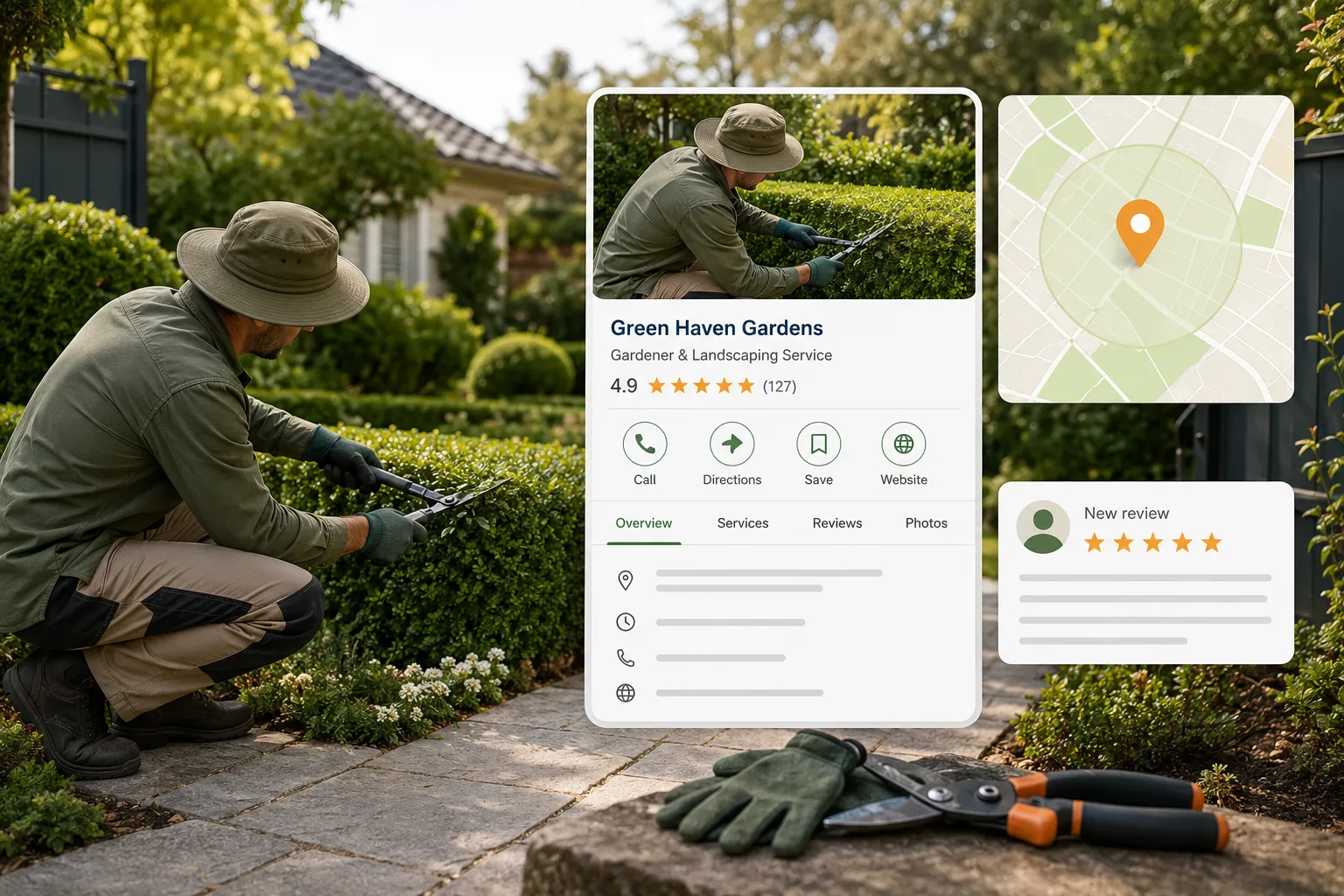
Google connects local searches with businesses through relevance, distance and prominence. A gardening business therefore needs accurate categories, genuine service areas, current opening hours, clear services, customer reviews, project photographs and consistent business information.
An incomplete profile gives Google and the customer less information. An inaccurate profile creates a different problem because it can associate the business with the wrong services or locations.
Local SEO improves these signals, but it cannot remove the distance between the business and the searcher. This is why suburb selection and service-radius planning matter.
Generic gardening service pages
Many gardening websites place mowing, pruning, weeding, hedge trimming and clean-ups on one short page.
That structure weakens relevance because each service has different customer questions and purchase conditions.
A person looking for fortnightly maintenance wants to know the service frequency, coverage area and ongoing scope. A tenant needing an end-of-lease garden clean-up wants to know availability, waste removal and quote requirements. A strata manager wants evidence of capacity, insurance and scheduled maintenance.
One generic paragraph cannot answer all three needs properly.
Unprofitable service-area targeting
More enquiries do not always produce more profit.
A distant one-off lawn cut may consume fuel, travel time and scheduling capacity. A recurring customer located near an existing route may have a higher lifetime value even when the first booking is smaller.
The campaign should therefore target profitable areas rather than every suburb within a city.
This requires information about:
- Current customer locations
- Travel time
- Crew capacity
- Average job value
- Recurring-service potential
- Commercial priorities
The intended outcome is not random lead volume. It is a stronger concentration of suitable work.
Traffic without calls or quote requests
SEO sends potential customers to the website. It cannot make them contact a business that looks inactive or difficult to reach.
Common conversion problems include a hidden phone number, a long contact form, no photographs of real work, unclear service areas, outdated information and broken mobile buttons.
These problems need to be fixed before additional traffic can create meaningful value.
Dependence on referrals and shared-lead platforms
Referrals can generate strong customers, but the flow is difficult to control. Lead platforms such as Airtasker, hipages and Oneflare may provide active enquiries, but several businesses can compete for the same job.
SEO creates an additional acquisition channel through assets your business can own. It does not replace referrals, vehicle signage, local partnerships or paid advertising that already works.
It reduces dependency on any one source.
Which Gardening Businesses Do We Help?
Our SEO services are designed for established gardening businesses that serve defined Australian locations and have capacity to accept additional work.
We work with residential gardeners, lawn-mowing contractors, garden-maintenance companies, hedge-trimming specialists, horticultural gardeners, irrigation-maintenance providers, strata contractors and commercial grounds-maintenance businesses.
Residential gardeners
Residential campaigns target homeowners, tenants, landlords, property investors and real estate agents.
Priority services may include lawn mowing, weeding, pruning, hedge trimming, garden clean-ups and regular garden maintenance.
Lawn-mowing businesses
A lawn-mowing campaign should focus on recurring customers and route density. It should not generate isolated low-value jobs across an entire metropolitan area.
Search targeting can prioritise weekly, fortnightly or monthly services in specific suburbs.
Horticultural specialists
Specialist gardeners need content that communicates expertise in plant health, native gardens, seasonal care, specialist pruning, soil improvement or garden restoration.
The campaign should separate this expertise from low-cost general mowing searches.
Strata and commercial providers
Commercial campaigns can target strata managers, body corporates, facilities managers, schools, offices, retail sites and industrial properties.
SEO supports discovery and supplier evaluation. It does not replace tendering, procurement requirements or relationship-based selling.
When SEO may not be suitable
Ongoing SEO may not be the right first investment when the business needs immediate work, cannot answer enquiries, has no available capacity or cannot define its profitable services and locations.
A new operator needing jobs this week may require direct outreach or controlled advertising before committing to a long-term organic campaign.
Gardener SEO Versus Landscaper SEO
Gardener SEO usually targets recurring maintenance and local service enquiries, while landscaper SEO more often targets design, construction and larger project-based work.
Gardeners and landscapers are related service providers, but the terms are not exact synonyms.
Commercial factor
Gardener SEO
Landscaper SEO
Primary work
Garden care and maintenance
Landscape design and construction
Service examples
Mowing, pruning, weeding, hedging
Paving, retaining walls, outdoor construction
Customer journey
Often short
Usually longer
Service frequency
Frequently recurring
Commonly project based
Geographic model
Compact service radius
Potentially broader project area
Conversion action
Call, booking or quote
Consultation, site visit or proposal
Main evidence
Reviews, recurring work and local projects
Detailed case studies and completed transformations
Some businesses offer both gardening and landscaping. In that case, the website needs separate keyword clusters and service pathways.
Garden maintenance should not be diluted by landscape-construction terminology. Landscape design should not be hidden inside a general gardening page.
A clear structure helps search engines and customers understand the actual offer.
What Is Included in Our SEO Services for Gardeners?
Our gardener SEO service combines local search optimisation, website improvement, gardening content, reputation signals and conversion measurement within one commercial strategy.
The exact scope depends on the website, services, locations, competition and current search visibility.
Local SEO and Google Business Profile Optimisation
Local SEO helps your business appear when nearby customers search for gardening services within your genuine service area.
We review how the business appears across Google Search, Google Maps, directories and relevant local references. The work can include business information, categories, services, operating hours, reviews, photos, website links and citation consistency.
Your Google Business Profile may be the first detailed interaction a customer has with the business. The profile needs to answer basic questions before the visitor reaches the website.
Can the business provide the requested service? Does it cover the customer’s suburb? Is the information current? Do the photos show genuine work? Do recent reviews support the offer?
We optimise the profile around factual business information. We do not add false locations, misleading categories or keyword-stuffed business names.
Review support focuses on a practical customer process. After a completed job, the customer can receive a direct review link. Requests should not offer rewards, demand a positive rating or provide scripted keyword language.
Natural review responses can mention the actual service and project context.
Useful response:
Thanks, Sarah. It was a pleasure helping with the front garden clean-up and hedge reduction before the property inspection.
Unhelpful response:
Thank you for choosing the best affordable gardener in Adelaide for gardening services Adelaide.
The first response sounds like a real business. The second sounds written for a ranking report.
Gardening Keyword, Service-Page and Suburb Strategy
Keyword research identifies how customers describe services, locations, property needs and purchasing intent.
Search volume is not the only value.
A lower-volume phrase such as “fortnightly garden maintenance in North Sydney” may be commercially stronger than a broad phrase attracting customers from outside the operating area.
Each target keyword is evaluated by service, location, customer, intent, lead value and operational fit.
Core service terms may include:
- Lawn mowing
- Garden maintenance
- Hedge trimming
- Garden pruning
- Weeding services
- Garden clean-ups
- Irrigation repairs
- Strata gardening
- Commercial grounds maintenance
These terms are then assigned to appropriate pages.
A separate service page is created or improved when the service has distinct search demand, customer questions, scope or commercial value.
Location pages follow the same discipline.
A useful suburb page explains genuine service availability, services completed in the area, nearby coverage, project evidence and a clear enquiry process.
A copied page that only replaces the suburb name provides little information.
We do not create 50 nearly identical pages describing every suburb as a “vibrant community with beautiful gardens.” The location needs to have a real relationship with the business.
Technical SEO and Website Conversion
Technical SEO improves how search engines crawl, process and index the website.
We review XML sitemaps, robots directives, canonical tags, redirects, broken links, duplicate pages, crawl depth, internal links and index coverage.
The technical work also needs to support the user.
Gardening customers frequently search on mobile devices. The page should load reliably, keep the layout stable and make the contact action easy to use.
The phone number should be visible. Buttons should work. Forms should not contain unnecessary fields.
A practical gardening quote form may request:
- Service required
- Suburb
- Property type
- Preferred frequency
- Brief job description
- Contact details
- Optional project photographs
Commercial enquiries may require a separate path because a strata or grounds-maintenance proposal involves different information from a residential quote.
Website redesigns require particular care. Existing URLs, content, internal links and tracking should be mapped before the new site launches.
A modern visual design does not automatically create a better search result. Rankings and enquiries can fall when valuable pages are removed without redirects.
Project Images, Reviews and Local Authority
Gardening is a visual service. Before-and-after photographs provide evidence that generic claims cannot.
Image optimisation helps customers and search engines understand the project.
The file name, nearby text, caption and alt text should describe the visible subject accurately.
Useful alt text:
Gardener trimming a tall boundary hedge at a residential property in Geelong.
Unhelpful alt text:
Best affordable gardener Geelong hedge trimming lawn mowing services near me.
We do not build unrelated backlinks simply to increase a third-party score.
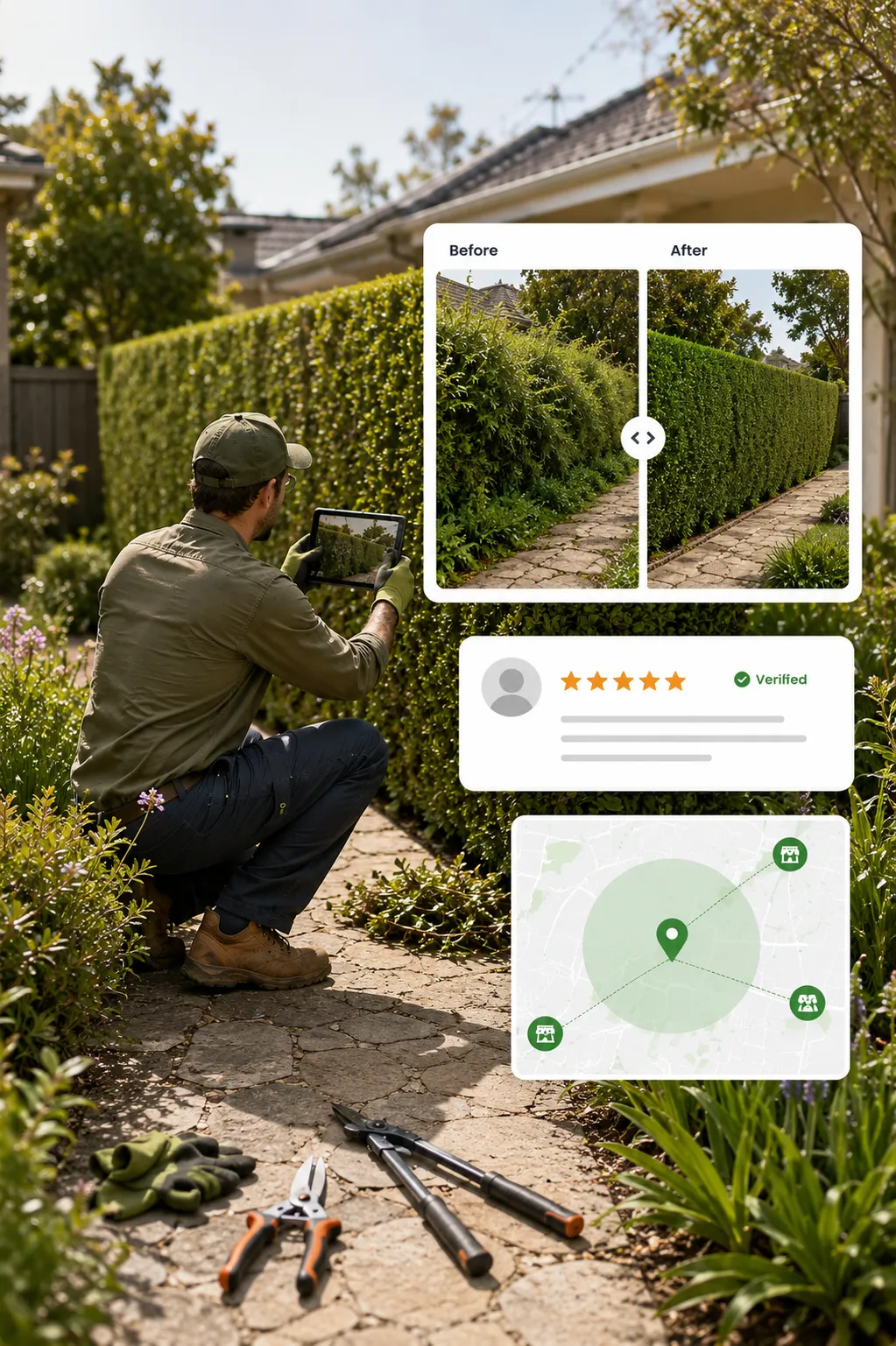
Project pages can connect the service, location, property type, scope, timeframe and practical outcome.
Reviews support customer trust. Citations help maintain consistent business information across directories and local platforms. Relevant links from suppliers, associations, community organisations and genuine business relationships can support local authority.
Call Tracking, Lead Attribution and Reporting
Rankings and traffic are supporting metrics. Calls, forms, quotes and booked jobs are commercial metrics.
We configure measurement through tools such as Google Analytics 4, Google Search Console, Google Tag Manager and call tracking where appropriate.
Each lead can be classified by:
Lead attribute
Example
Service
Garden maintenance
Location
Priority suburb
Customer type
Homeowner
Frequency
Fortnightly
Lead status
Qualified
Outcome
Quoted or booked
This lets the campaign answer useful questions.
Which suburbs produce booked customers? Which services attract poor-fit enquiries? Are recurring clients coming from Google Maps or organic pages? Which pages generate calls but no bookings?
A monthly report should explain what happened and what needs to change. A dashboard without interpretation is not a strategy.
Profitable Service-Area Targeting
We target areas where additional gardening work can support revenue, scheduling and crew efficiency.
A gardening business does not necessarily benefit from enquiries across an entire city.
Long travel distances can reduce the value of small jobs. Scattered bookings can make it difficult to build an efficient mowing or maintenance round.
We divide service locations into practical groups.
Primary areas
Primary areas are established suburbs where the business already works efficiently.
Expansion areas
Expansion areas are nearby locations that can support growth without creating excessive travel.
Excluded areas
Excluded areas are locations that are unprofitable, difficult to schedule or outside genuine coverage.
The strategy can also consider service value.
A company may accept a commercial grounds-maintenance opportunity from a broader radius while restricting one-off mowing enquiries to nearby suburbs.
This is why location targeting needs to follow the business model rather than a map of every postcode.
The objective is not maximum geographic coverage.
It is more suitable work around the routes, services and capacity the business already has.

Our Gardener SEO Process and 90-Day Roadmap
Our process connects search demand with profitable gardening services, real locations and measurable enquiry outcomes.
Step 1: Audit the current search presence
We review the website, Google Business Profile, rankings, service pages, location pages, reviews, citations, technical condition and existing tracking.
The audit identifies what is working, what is missing and what may create risk.
Step 2: Define commercial priorities
We confirm the services you want to sell, locations you want to target, crew capacity, customer types and average job value.
This stage prevents the campaign from targeting work the business cannot or does not want to complete.
Step 3: Build the keyword and page map
Each relevant search intent is assigned to a suitable page.
The map separates services, locations, residential customers, commercial buyers and supporting topics. It also identifies pages competing for the same keyword.
Step 4: Fix technical and conversion barriers
Critical crawling, indexing, speed, mobile and enquiry problems are prioritised before unnecessary expansion.
There is little value in publishing 20 pages while the main contact button fails on mobile.
Step 5: Improve local visibility and proof
We optimise the Google Business Profile, service information, reviews, photos, citations, service pages and genuine location content.
Step 6: Measure and refine
Calls and forms are tracked where technically possible. Lead feedback is used to improve keyword targeting, page content and service-area priorities.
First 90 days
Period
Main objective
Typical work
Days 1–30
Establish the baseline
Audit, tracking, keyword map and critical fixes
Days 31–60
Improve commercial relevance
Service pages, on-page SEO, profile work and citations
Days 61–90
Strengthen evidence and conversion
Project content, reviews, internal links and form improvements
After day 90
Expand proven opportunities
Additional services, locations and authority development
The order may change according to the website.
A site affected by a failed migration may require technical recovery first. A healthy website with a weak Business Profile may require local improvements earlier.
How Do We Measure Calls, Enquiries and Booked Work?
We measure search visibility, then connect it with customer actions and commercial outcomes where the required business data is available.
The report can include organic impressions, clicks, search terms, service-page performance, local rankings and Google Business Profile actions.
These metrics show whether visibility is changing. They do not prove that the campaign has generated profitable customers.
Lead tracking records calls and forms. Business feedback then identifies whether the lead was relevant, quoted, booked or rejected.
Useful calculations include:
Lead-to-booking rate = booked customers ÷ qualified leads × 100
Revenue and profit must remain separate.
Customer acquisition cost = SEO investment ÷ customers attributed to SEO
A campaign producing high-revenue jobs may still have weak returns if labour, materials and travel costs are excessive. A lower-value recurring customer may produce stronger lifetime profit.
The monthly report should state:
- Work completed
- Changes in visibility
- Calls and forms generated
- Lead quality
- Strong and weak service areas
- Next actions
- Information required from the business
We do not report obscure keyword rankings as proof of success when those searches produce no customers.

Gardener SEO Pricing and Return on Investment
The cost of gardener SEO depends on the number of services, locations, competitors, technical problems and monthly implementation requirements.
A solo gardener targeting six nearby suburbs does not require the same scope as a multi-crew company serving residential and commercial customers across several cities.
Pricing factors include:
- Website condition
- Number of target services
- Genuine service areas
- Competition
- Existing rankings
- Content requirements
- Technical work
- Review and citation needs
- Reporting requirements
The proposal should state setup work, monthly deliverables, third-party fees, contract length, cancellation terms and asset ownership.
We do not publish a low teaser price that excludes the work required to build a viable campaign.

Is SEO commercially viable?
SEO can be viable when the gross profit generated by attributable customers exceeds the campaign cost within an acceptable timeframe.
A simple break-even model is:
Required new customers = monthly SEO investment ÷ average gross profit per acquired customer
Recurring work needs a broader calculation.
Customer lifetime value = average visit value × annual service frequency × expected retention period
A fortnightly maintenance customer may produce more value than one initial visit suggests. A distant one-off mowing enquiry may produce less value after travel and labour are considered.
The commercial assessment should include job type, booking rate, repeat frequency, gross margin and travel requirements.
What Is Included, Excluded and Client-Owned?
Your proposal should state what will be delivered, what requires separate approval and which assets belong to your business.
Common inclusions
- SEO audit
- Keyword research
- Competitor analysis
- Google Business Profile optimisation
- On-page SEO
- Technical recommendations
- Service-page optimisation
- Location strategy
- Internal linking
- Conversion tracking
- Monthly reporting
Common exclusions unless stated
- Google Ads media spend
- Website hosting
- Complete website rebuild
- Photography and video
- CRM subscriptions
- Call-tracking platform fees
- Paid directory fees
- Fake locations
- Incentivised reviews
- Guaranteed rankings
- Unlimited content production
Account and asset ownership
Ownership needs to be documented before work begins.
This includes the domain, website, written content, Google Business Profile, Google Analytics 4, Google Search Console, Google Tag Manager, call-tracking data and reporting accounts.
You should not discover after cancellation that the provider owns your website, phone number or lead data.
Contract terms
The agreement should clearly state:
- Initial contract term
- Renewal conditions
- Notice period
- Cancellation method
- Final reporting
- Account access
- Asset handover
Insert verified company terms before publication.
Ranking guarantees
We do not guarantee a number-one Google ranking.
No SEO agency controls Google, competitor activity, customer distance or future algorithm changes.
We can guarantee only the work, access, communication and reporting written into the agreement.
14. Why Choose SEO Agency for Tradies?
We build gardener SEO around service areas, lead quality, route efficiency and commercial value rather than generic traffic targets.
Australian tradie SEO experience
Gardening businesses operate like local service businesses, not national publishers.
The strategy needs to account for travel, labour, scheduling, service radius and customer value.
Gardener-specific keyword models
We separate garden maintenance, lawn mowing, horticultural care, commercial grounds maintenance and landscape construction.
This prevents the page from attracting the wrong customer simply because the services appear related.
Lead-based reporting
Rankings and traffic remain visible, but they are not treated as the final outcome.
We report calls, forms, requested services and lead quality where tracking permits.
Client-owned assets
Your website, profiles, analytics and content need clear ownership terms.
The campaign should build your business asset rather than a system you lose when the contract ends.
Clear deliverables
“Building authority” is not a complete monthly deliverable.
The plan should state which pages, technical fixes, profile improvements, content updates and reporting tasks will be completed.
Realistic communication
We do not guarantee rankings or pretend every gardening business needs the largest package.
The strategy begins with your current capacity, profitable services and genuine operating locations.
15. Frequently Asked Questions
Meaningful SEO improvement commonly requires several months, although profile corrections, technical fixes and conversion changes may produce earlier operational gains.
The timeline depends on competition, website condition, location coverage, content quality, reviews and existing authority.
SEO can improve the relevance, accuracy and prominence signals connected with your business, but it cannot guarantee a specific Maps position.
Distance between the business and the searcher also affects local results.
Separate pages are useful when services have different customer needs, scope, proof or commercial value.
Lawn mowing, ongoing garden maintenance, clean-ups and commercial grounds maintenance normally require different information.
No.
Create location pages only for genuine service areas where the business can provide useful local information, evidence and availability. One strong regional page can be better than several copied suburb pages.
SEO can target recurring-service intent through keywords, page copy, location strategy and quote forms.
The business must still provide suitable pricing, reliable service and enough capacity to retain the customer.
SEO can work for lawn-mowing companies when it targets compact routes and recurring customers rather than scattered one-off jobs.
Customer lifetime value and travel costs need to be included in the ROI assessment.
SEO can support discovery and supplier evaluation, but it does not replace tenders, procurement requirements or commercial relationships.
Commercial pages need to communicate capacity, insurance, service scope and proposal requirements.
Yes.
Real project images demonstrate capability and support customer trust. Descriptive filenames, accurate alt text and contextual captions can also help search engines understand the work shown.
Calls and forms can be measured through analytics, tag management, call tracking and lead-status records.
Accurate ROI also requires the business to record which enquiries became quotes and bookings.
No ethical SEO provider can guarantee a specific organic or Google Maps position.
The agency can guarantee only the documented work, communication, access and reporting included in the agreement.
16. Get an SEO Plan Built Around Your Gardening Business
Your gardening business does not need more random traffic. It needs relevant enquiries for services you want to perform, in suburbs your team can serve profitably.
Our initial review examines your website, Google Business Profile, service pages, location coverage, competitors and conversion tracking.
You will receive a clear explanation of where visibility is being lost, which services deserve stronger pages, which locations have priority and what work needs to happen first.


