SEO for Shopfitters That Helps You Win Better-Fit Projects
SEO Agency for Tradies helps shopfitters across Australia attract better-fit commercial projects by improving visibility for relevant services, sectors and locations, with performance measured through search growth, qualified enquiries, quote opportunities and, where sales data is available, won-project attribution.
Find out what's holding you back
Enter your number — we’ll call you with a free ranking report for your suburb.
We call within 2 business hours. No scripts. No pressure.
Is Your Shopfitting Business Visible Where the Right Projects Start?
A shopfitting company can be established, capable and busy through referrals while still being almost invisible when a new property manager, retailer, franchise group or business owner begins comparing contractors online.
The problem is rarely one missing keyword. It is usually a mismatch between how the company sells its work and how the website presents its capabilities.
A business may service several cities but have no useful location coverage. It may deliver complex refurbishments but describe everything under one general “shopfitting” page. It may have an impressive portfolio but provide no information about scope, delivery constraints, specialist trades or project outcomes.
These gaps affect both search visibility and buyer confidence.
Your Business Is Hard to Find in Key Locations
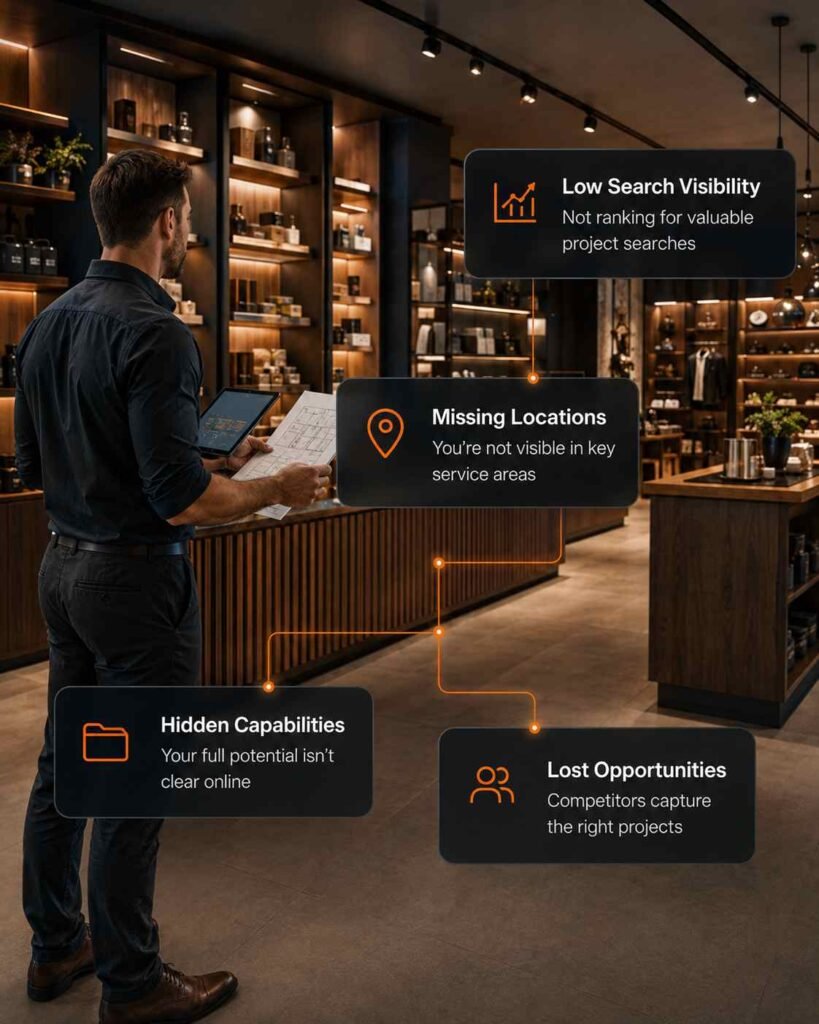
You may complete projects across Sydney, Melbourne, Brisbane, Perth or regional centres, but buyers searching within those markets may find competitors before they find you.
You Get Enquiries for Work You Do Not Want
Broad visibility can bring small jobs, work outside your service radius or projects that do not match your team size, delivery model or preferred contract value.
Your Strongest Capabilities Are Buried
Custom joinery, refurbishments, defits, make-good works or design-and-construct services may be hidden inside general pages instead of having clear commercial relevance of their own.
Your Project Pages Show Work but Do Not Explain It
Photos can demonstrate finish quality, but buyers also want to understand what your team delivered, where the project took place, what constraints were managed and how the project moved from scope to handover.
Competitors Appear for More Buying Searches
A competitor does not need a better delivery team to win more visibility. A clearer website structure can give them stronger coverage across services, locations and project types.
You Cannot See Which Enquiries Become Real Work
Knowing that SEO generated 20 enquiries is not enough. The commercial question is how many were suitable, how many reached quote or tender stage, and how many became contracted projects.
How Do Potential Clients Search for Shopfitters?
Commercial buyers do not all begin with the same search.
A business owner opening a first location may search for a shopfitter in a specific city. A property manager may need a refurbishment contractor. A franchise group may be comparing companies with rollout capability. A retailer may be researching custom joinery, defit works or full design-and-construct delivery.
The search pathway changes according to:
- project type
- location
- industry
- scope of work
- specialist capability
- delivery model
- stage of procurement

That means one page cannot carry the entire acquisition strategy.
A useful SEO structure gives buyers a clear path from the search that brought them to the site towards the service, project evidence and contact option most relevant to their requirements.
SEO Agency for Tradies maps this demand against the work the shopfitting business actually wants to grow. The campaign is then prioritised around commercial fit, rather than chasing every keyword that shows search volume.
What Is Included in Our SEO Services for Shopfitters?
Our SEO campaigns are built around one practical question:
Which searches can bring the business closer to the projects it is equipped and prepared to win?
The answer shapes the website structure, local strategy, content priorities, technical work and reporting.
Search Demand and Project-Market Mapping
We compare search demand with the commercial reality of the business.
This prevents the campaign from spending resources on traffic that does not match the company’s operational goals.
- preferred project types
- profitable service lines
- serviceable cities and regions
- specialist capabilities
- ideal customer groups
- project size and delivery capacity
We organise the website around the relationships buyers and search engines need to understand.
A commercial fitout page may connect to a refurbishment service, a city page and a completed project. A custom joinery page may connect to relevant sectors and case studies. A national operator may require a different structure from an independent Sydney shopfitter.
The goal is to remove ambiguity from the website.
For businesses competing within defined markets, we align the website with local search signals.
The focus stays on markets the business can genuinely service, rather than publishing thin pages for every suburb in Australia.
- Google Business Profile optimisation
- service and business information review
- local landing page strategy
- citation consistency
- review profile analysis
- service-area relevance
- local conversion tracking
Project Portfolio SEO
A completed project can do more than sit in a gallery.
This allows the portfolio to support search visibility while giving buyers stronger evidence during supplier evaluation.
- where the work was completed
- what type of premises was involved
- what services were delivered
- what constraints or requirements shaped the work
- what specialist capability was used
- what the completed outcome involved
Technical work is prioritised according to business impact.
The objective is not to produce a long audit full of low-priority warnings. It is to remove technical barriers that restrict commercially important pages.
- crawling
- indexing
- rendering
- mobile usability
- page speed
- duplicated URLs
- internal links
- template quality
- site architecture
- important landing pages
Enquiry and Revenue Tracking
SEO reporting becomes more useful when it follows the lead beyond the form submission.
Where the available systems allow it, we examine the path from:
organic visit → enquiry → qualified opportunity → quote or tender → won project
This helps identify whether a campaign is producing suitable opportunities rather than simply increasing the number of form submissions.
Why One Generic Shopfitting Page Is Usually Not Enough
A shopfitting company may provide several commercially different services, but many websites force all of them into one broad page.
That creates a relevance problem.
A buyer looking for a full commercial refurbishment is not necessarily looking for the same information as someone researching a defit. A franchise group evaluating rollout capability has different concerns from an independent retailer preparing one new location.
The website needs enough separation to explain these differences clearly.
Core Shopfitting Service Pages
Dedicated service pages can be created where a capability has its own commercial value and genuine customer demand.
The page structure needs to reflect the actual services offered by the business, not an artificial SEO template.
- commercial shopfitting
- retail fitouts
- refurbishments
- defits
- make-good works
- custom joinery
- design and construct
Location and Service-Area Pages
Location pages work best when each market has a legitimate business reason to exist.
This creates meaningful geographic relevance instead of duplicated city pages.
- actual service coverage
- regional project experience
- operational capability
- relevant service demand
- nearby completed work
- clear contact pathways
Project and Case Study Pages
Project pages connect claims with evidence.
A useful case study can show the project location, scope, work completed, delivery requirements, specialist involvement and final result.
These pages can then support related service, sector and location pages through clear internal links.
Sector-Specific Fitout Pages
A company with genuine sector experience can explain the parts of delivery that matter to those buyers.
A sector page can address relevant project requirements, approval environments, operational constraints, delivery expectations and evidence from completed work.
The purpose is differentiation, not replacing one industry word with another.
Who We Help
SEO Agency for Tradies works with shopfitting businesses that have different sales territories, delivery capacities and growth priorities.
The strategy changes according to how the company wins work.
Independent Shopfitters
For owner-led and growing businesses that need stronger visibility within a realistic service area and a steadier flow of suitable quote opportunities.
The campaign can prioritise the services and locations that fit the company’s crew size, delivery capacity and preferred project profile.
Established Commercial Fitout Companies
For experienced companies competing for larger projects and more complex commercial opportunities.
The website needs to do more than generate contact forms. It needs to help buyers assess whether the company belongs on the shortlist.
- capability discovery
- sector visibility
- supplier research
- project evaluation
- quote enquiries
- tender-stage research
Multi-Location and National Shopfitting Firms
For businesses working across several cities, states or national rollout programs.
The aim is to scale visibility without making every regional page look like a copied version of the national page.
- regional market coverage
- location differentiation
- rollout capability
- local project evidence
- multi-market reporting
- duplicate-content control
SEO Services for Shopfitters Across Australia
SEO Agency for Tradies supports shopfitting businesses targeting major Australian commercial markets and regional service areas.
Campaigns can be developed around markets including:
- Sydney and regional New South Wales
- Melbourne and regional Victoria
- Brisbane and the Gold Coast
- Perth and Western Australia
- Adelaide and South Australia
- Canberra and the ACT
The location strategy is based on where the company can deliver work profitably.
For a local operator, that may mean concentrating authority around one city and selected surrounding markets. For a multi-state company, it may involve separating regional demand, service capability and project proof across several locations.
The purpose is not to create the largest possible list of city pages.
It is to make each priority market understandable, defensible and commercially useful.
How Our SEO Process Works for Shopfitting Companies
Our process keeps technical work, content, location strategy and commercial measurement connected throughout the campaign.
Diagnose the Gap Between Search Demand and Business Capacity
We review how the website currently performs against the work the company wants to win.
This includes examining technical issues, search coverage, competitors, landing pages, location visibility, conversion paths and available sales data.
The outcome is a prioritised campaign plan rather than a generic SEO checklist.
Repair the Pages and Systems That Hold Back Growth
We address the issues creating the greatest commercial friction.
The foundation is strengthened before unnecessary expansion begins.
- technical corrections
- landing page improvements
- internal linking
- content consolidation
- on-page optimisation
- conversion tracking
- local SEO improvements
Build Coverage Around Validated Opportunities
Once the website foundation is stable, the campaign expands into areas supported by both demand and business capability.
That may involve new service pages, stronger location coverage, sector content or better project documentation.
Every expansion decision needs a commercial reason.
Measure Which Search Opportunities Produce Better Work
Performance is reviewed against more than traffic.
Campaign priorities can then shift towards the markets and services producing stronger commercial value.
- visibility growth
- non-branded demand
- qualified enquiries
- landing page conversion
- quote opportunities
- available sales outcomes
Common SEO Mistakes Shopfitting Companies Make
The most expensive SEO mistakes are not always dramatic technical failures. Many come from decisions that make the website broader, less clear and harder to measure.
Using the Same Message on Every Page
A service page, city page and project case study should not all communicate the same information.
Each page needs its own job within the buyer journey.
When multiple pages repeat the same message, the website becomes harder to understand and important pages can begin competing with each other.
Targeting More Locations Than the Business Can Properly Support
Publishing pages for every suburb or city may look like growth, but weak location pages rarely create strong local positioning.
A better strategy begins with markets the business can actually service and prove.
Making Mobile Enquiries Difficult
A potential client reviewing your site from a phone should not need to pinch, zoom, hunt for contact details or complete an unnecessarily long form.
A slow or awkward mobile experience can waste hard-earned visibility before an enquiry begins.
Publishing Content Without a Commercial Role
More content does not automatically create more business.
A page needs a reason to exist.
It may support a service, answer an important buyer concern, demonstrate capability, strengthen a location or provide project evidence.
Content without a clear role often becomes maintenance work rather than an acquisition asset.
Treating a Ranking as the Final Result
A ranking is useful only when it contributes to a valuable business outcome.
A keyword can reach page 1 and still generate poor-fit enquiries.
That is why rankings need to be reviewed alongside lead quality, landing page conversion, quote activity and available sales results.
Treating SEO as a One-Time Website Task
A campaign does not stop after title tags, service pages and technical fixes are completed.
Competitors publish new pages. Search demand changes. New projects create better proof. Business priorities move into different markets.
SEO needs an active decision-making process, not a one-off setup.
Typical First 90-Day Roadmap
The first 90 days are used to establish the baseline, correct high-priority issues and begin expanding into validated opportunities.
Days 1–30 — Diagnose and Map
The first stage identifies where the website is losing relevance, visibility and conversion opportunities.
- Technical SEO audit
- Search demand analysis
- Competitor gap review
- Conversion tracking check
- Priority page assessment
- Market and location mapping
Days 31–60 — Build and Correct
The next stage focuses on the pages and technical conditions with the strongest commercial impact.
- Fix critical technical issues
- Improve priority landing pages
- Strengthen internal linking
- Refine on-page optimisation
- Improve local search signals
- Correct content overlap and duplication
Days 61–90 — Expand and Measure
The third stage begins controlled expansion and evaluates early commercial signals.
- Launch priority new pages
- Strengthen selected location coverage
- Improve project content
- Develop relevant authority signals
- Review enquiry quality
- Adjust priorities using performance data
Case Study: Shopfitting Company in Sydney
Client type: Commercial shopfitting and fitout company
Location: Sydney, New South Wales, Australia
Date range: January 2025 – July 2025
Client name: Withheld for confidentiality
The Problem
The company delivered commercial fitouts, refurbishments, defits and custom joinery across Sydney, but the website did not reflect the way the business actually won work.
Most organic visits came through branded searches and a limited number of broad terms.
Important capabilities were difficult to find independently, project galleries contained little commercial context and the website gave weak signals about where the company operated.
This created three problems:
- priority services had limited search coverage;
- completed work provided weak support during buyer evaluation;
- local visibility did not match the company’s delivery footprint.
Tools Used
Google Analytics 4, Google Search Console, Google Business Profile Manager, Screaming Frog, Semrush, Ahrefs, PageSpeed Insights, Microsoft Clarity and Looker Studio.
Pages Improved
The campaign worked across:
- commercial shopfitting;
- retail fitouts;
- hospitality fitouts;
- office fitouts;
- refurbishments;
- defits;
- custom joinery;
- Sydney service-area content;
- project case studies;
- contact pathways;
- Google Business Profile.
What Changed
SEO Agency for Tradies reorganised the website around the relationships between services, project types, locations and completed work.
Internal links were improved so buyers could move from a service page to relevant projects and from a project page to the capability involved.
Broad service content was separated where demand and business capability justified a dedicated page.
Project pages were expanded to explain:
- location;
- project type;
- work completed;
- delivery requirements;
- specialist services;
- final outcome.
Conversion paths were also refined so buyers could move more easily towards a quote request or project discussion.
The Google Business Profile was aligned with the website through more accurate service information, project imagery and consistent business details.
Outcome
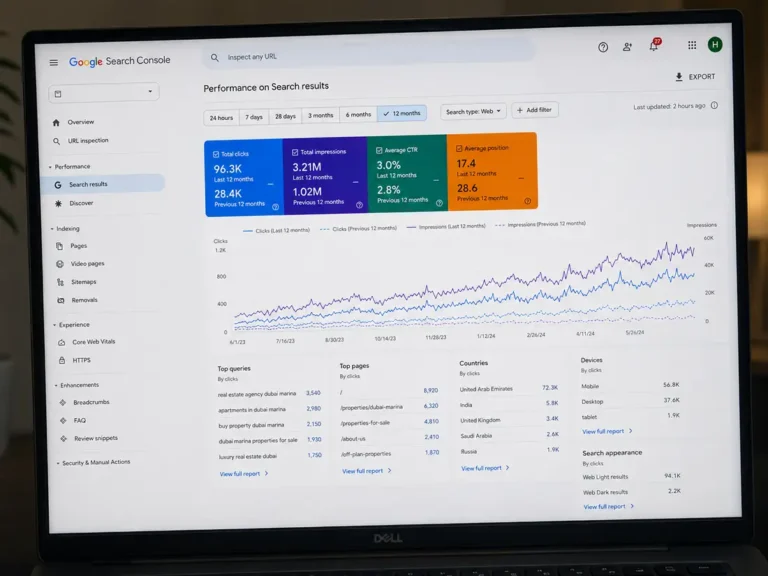
Within 6 months, qualified organic enquiries increased by 68% and non-branded organic traffic grew by 54%.
Several priority service pages moved from positions beyond page 3 to page 1 for commercially relevant shopfitting and fitout searches across Sydney.
Organic search generated 37 qualified quote opportunities, with 9 projects progressing to won work where sales-stage attribution was available.
Clear Scope for Our Shopfitter SEO Service
SEO Agency for Tradies defines the campaign scope before implementation so responsibilities, priorities and expectations stay clear.
| Service Area | What Is Included | What Is Not Included |
|---|---|---|
| Strategy | SEO planning, prioritisation and search opportunity analysis | Paid advertising strategy |
| Technical SEO | Crawlability, indexing, architecture and performance issues | Full website redevelopment |
| On-Page SEO | Page optimisation, metadata, content relevance and internal linking | Unlimited copywriting |
| Local SEO | Google Business Profile optimisation, local signals and location relevance | Physical address setup or virtual office services |
| Content | Content planning, briefs and agreed optimisation work | Photography and video production |
| Project Pages | Case study structure and SEO optimisation | On-site project photography |
| Tracking | Organic enquiry tracking and agreed performance reporting | Full CRM implementation |
| Authority Development | Relevant off-page SEO and authority development | Guaranteed placement on specific publications |
| Performance Analysis | Visibility, enquiries, conversion and agreed commercial metrics | Guaranteed rankings, lead volumes or revenue |
Work outside the agreed campaign scope is identified before implementation rather than added without clear approval.
Why Choose SEO Agency for Tradies?
SEO Agency for Tradies is built around trade and project-based businesses.
That matters because the economics of a shopfitting company are not the same as those of an online store or a SaaS company.
A shopfitter sells capacity, capability, geographic coverage and confidence in delivery. The SEO strategy needs to respect those commercial realities.
6+ Years of SEO Experience
Our team brings more than 6 years of experience across technical SEO, local search, website architecture, content strategy and organic lead generation.
That experience is applied through prioritised campaign work, not long reports filled with low-impact recommendations.
We Specialise in Tradies
We focus on trade and project-based businesses.
The strategy starts with the business model rather than forcing every client into the same SEO template.
- service areas
- project-based enquiries
- quote-driven sales
- local competition
- delivery capacity
- seasonal demand
- commercial lead quality
We Understand the Australian Market
Campaigns are planned around Australian cities, regional service areas and the way local trade businesses compete.
That includes deciding where geographic expansion is commercially realistic and where broader targeting would dilute the campaign.
In-House SEO Team
Strategy, technical SEO, on-page work, content planning, local SEO and reporting are coordinated by our in-house team.
This keeps the campaign connected from diagnosis through implementation and measurement.
SEO Pricing for Shopfitters
Shopfitter SEO pricing depends on the size and condition of the website, the number of priority markets, the level of competition and the amount of technical, content and local SEO work required.
SEO Agency for Tradies scopes campaigns around the actual work needed to compete in the markets the business wants to grow.
Related SEO Services
Frequently Asked Questions About SEO for Shopfitters
The cost depends on the current website, number of target markets, competitive conditions and amount of work required.
A company targeting one city with an established website needs a different scope from a national fitout business targeting several service categories across multiple states.
SEO Agency for Tradies reviews these factors before defining campaign scope and priorities.
SEO can support a move towards larger opportunities when the website and campaign are aligned with the buyers, services and project evidence relevant to that work.
This may involve stronger capability pages, better commercial case studies, clearer sector relevance and search coverage around higher-value service requirements.
SEO cannot control which company wins a contract, but it can improve the chances of being discovered and evaluated for relevant opportunities.
Yes.
A rebuild is not automatically required.
We first assess whether the current website can support the required service structure, technical improvements, content expansion and conversion tracking.
Where the existing platform can support the strategy, improving it may be more commercially sensible than rebuilding from the ground up.
No fixed publishing volume applies to every campaign.
Some websites need new service or location pages. Others already have enough URLs but need consolidation, stronger internal links, better project pages or technical corrections.
Content is planned according to the gap being solved, not a requirement to publish a set number of articles every month.
Yes.
Commercial buyers may visit the website before making contact, building a shortlist or inviting a company into a procurement process.
Clear capability information, relevant project evidence, accurate service coverage and a professional buyer journey can support that evaluation.
The SEO role is to make those assets discoverable and properly connected.
Access requirements can include: website CMS; Google Search Console; Google Analytics; Google Business Profile; existing call or enquiry tracking; relevant CRM or sales-stage information.
We also need commercial context from the business, including preferred services, target locations, project capacity and areas the company does not want to pursue.
That information helps prevent the SEO campaign from optimising for demand that has little operational value.
We turn useful completed projects into detailed case studies rather than leaving them as image-only galleries.
A strong project page can include: location; project type; scope of work; services delivered; delivery model; constraints; specialist requirements; completed outcome.
Relevant project pages are then connected to appropriate service, sector and location pages.
This helps buyers find evidence that matches the work they are researching.
Where tracking systems and sales data are available, organic enquiries can be followed into later stages of the sales process.
Depending on the client’s systems, this may include: form tracking; phone call tracking; landing page attribution; enquiry-source data; CRM stages; quote activity; won-project data.
The purpose is to understand which organic opportunities create real commercial value rather than judging the campaign only through rankings and traffic.
Turn Search Demand Into Better-Fit Shopfitting Opportunities
Your website should help serious buyers understand what your company does, where it works, what it has delivered and why it belongs in the project conversation.
SEO Agency for Tradies will review your visibility, service structure, location coverage, project content and conversion path to identify where commercially relevant search opportunities are being lost.
Get a clear SEO action plan built around the services, markets and projects your shopfitting business actually wants to grow.


