







SEO Agency For Tradies

Local SEO for Tradies In Australia That Brings More Local Jobs

SEO Agency for Tradies provides local SEO services for Australian tradies, helping plumbers, electricians, roofers, builders and other trade businesses appear in Google Search and Google Maps across the cities, suburbs and service areas they genuinely serve. We strengthen Google Business Profiles, service and location pages, reviews, citations, technical SEO and conversion tracking to connect your business with nearby customers actively searching for your services and generate more qualified calls, quote requests and booked jobs.

Find out what's holding you back

Enter your number — we’ll call you with a free ranking report for your suburb.

We call within 2 business hours. No scripts. No pressure.

TRUSTED BY TRADE BUSINESSES

Businesses We Support Across Australia

We support trade and commercial service businesses with stronger local visibility, clearer lead generation and marketing systems connected to measurable commercial outcomes.

Westlink Commercial Cleaning logo
Westlink Cleaning logo
Metro Electrical Group logo
AquaFlow Plumbing logo
Northline Construction logo
Shield Pest Solutions logo
Summit HVAC Services logo

120+ Clients Served

20x Average SEO ROI

90% Client Retention Rate

6+ Years SEO Experience

Dominate Local SEO

Clear Monthly Reporting

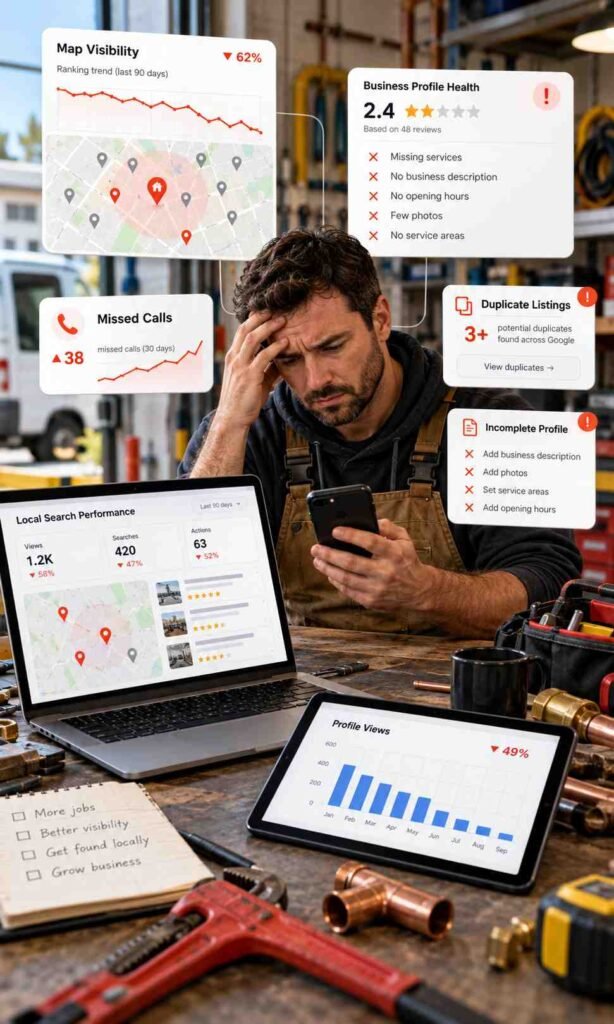
Why Is Your Tradie Business Still Missing Local Jobs From Google?

More website traffic will not solve the problem if your business is invisible for profitable services, weak in the suburbs you want, or attracting the wrong enquiries.

Google explains that local results are primarily determined by relevance, distance and prominence.

You cannot change where a customer is standing when they search.

What you can improve is how clearly Google understands:

who your business is → what services you provide → where you operate → why customers should trust you

For a plumber, that could mean connecting blocked drains, hot-water repairs and emergency plumbing with genuine service areas and completed jobs.

For an electrician, it could mean separating switchboard upgrades, fault finding, rewiring and emergency electrical work instead of relying on one broad “Electrical Services” page.

The same principle applies to roofers, builders, air-conditioning contractors and other trades: profitable services need enough relevance, local evidence and authority to compete where customers actually search.

What is happening?

What it usually indicates

What we work on

You rank near your base but disappear farther awayGeographic relevance and proximity limitationsService-area strategy, genuine local pages and Maps optimisation
Competitors dominate the Map PackStronger relevance, prominence or business signalsGBP, reviews, citations, local authority and website alignment
You receive low-value enquiriesThe strategy is targeting the wrong demandService-level intent mapping and conversion pages
You get traffic but few callsSearch intent or conversion path is weakMobile UX, click-to-call, proof, quote forms and CRO
Ads stop and enquiries disappearAcquisition depends heavily on paid trafficBuild organic local-search visibility alongside paid channels

If your crews have capacity, success is not simply “more rankings.”

It is capturing more demand for the services and locations that are commercially useful to your business.

Where Can Local SEO Make Your Tradie Business Visible?

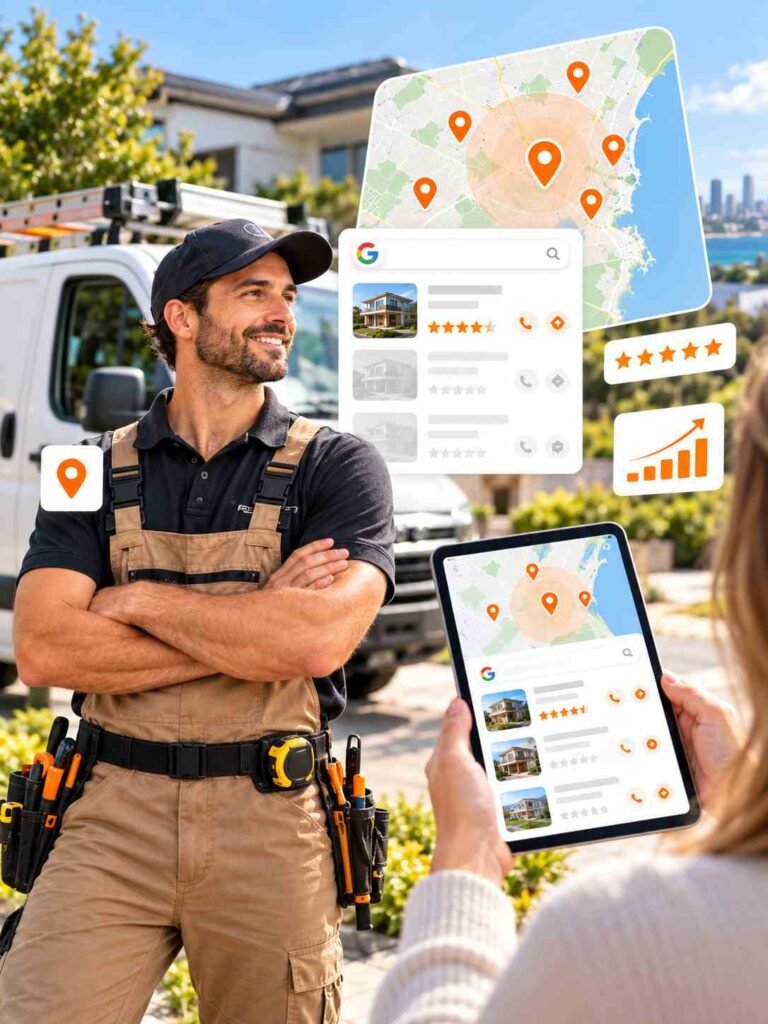
Local SEO helps a trade business appear across two primary local-search surfaces: Google Maps and the Local Pack, and local organic search results.

Google Maps & Local Pack

The Local Pack is the map-based group of businesses Google may display for searches with local intent, such as “electrician near me,” “emergency plumber Perth” or “roof repairs Brisbane.”

Visibility here is primarily influenced by relevance, distance and prominence. A complete and accurate Google Business Profile, appropriate business categories, services, reviews and consistent business information can help Google understand the business and its relevance to local searches.

Get found on Google Maps →

Local Organic Search Results

Local organic results are the standard website listings that appear in Google Search for location-based queries.

These rankings depend more heavily on the website itself, including service pages, location pages, internal linking, content relevance, technical accessibility, authority and search-intent alignment.

A strong Local SEO campaign therefore connects: Google Business Profile + Google Maps visibility + service pages + location relevance + website authority.

Grow your organic visibility →

The goal is not to rely on one search surface, but to improve visibility wherever local customers search for the services your business provides.

What Does a Local SEO Campaign Actually Include?

A complete local SEO campaign connects Google Business Profile optimisation, Google Maps SEO, local website architecture, reputation, authority, technical SEO and lead measurement around one clear relationship: tradie → provides service → in location → to customer. Every campaign component should reinforce who the business is, what it provides, where it operates and who it serves, making that relationship easier for both customers and search systems to understand.

We optimise the business information Google uses to understand your trade, services, operating area and customer relevance, including categories, services, hours, contact details, service areas, description, photos and profile accuracy. The primary category defines the main business activity, while secondary categories and services clarify additional work and search intent. For service-area businesses such as plumbers and cleaners, we follow Google’s real-world operating requirements and use genuine service areas rather than fake locations or unstaffed virtual offices.

Service Page SEO

Commercially important services need enough dedicated relevance to compete for customers searching specifically for that job. A plumber may require separate pages for blocked drains, leak detection, hot-water systems and emergency plumbing, while an electrician may need pages for switchboard upgrades, fault finding, rewiring and emergency work. We structure these pages around real search demand and commercial value rather than creating a URL for every keyword variation, then strengthen them through search-intent mapping, entities, internal links, project evidence, FAQs, metadata and clear conversion paths.

Suburb & Service-Area SEO

We build geographic relevance around areas you genuinely service instead of producing dozens of pages that simply replace one suburb name with another. A strong local page should have a genuine reason to exist, supported by elements such as completed jobs nearby, locally relevant services, project photographs, customer evidence, operating considerations and links to relevant service pages. Google’s people-first guidance prioritises original, substantial content that adds value, which is why one genuinely useful suburb page can be more defensible than twenty near-identical templates.

Reviews & Local Reputation

We help create a legitimate process for earning and using customer reviews as trust, reputation and local relevance evidence. Google states that more reviews and positive ratings can help local ranking, while strong reviews also influence customers after your business appears in Search or Maps. We focus on requesting genuine feedback after completed jobs and do not buy reviews, offer incentives in exchange for reviews or tell customers what their review should say, in line with Google’s review policy.

Local Citations & Business Entity Consistency

We check whether major platforms and directories describe the same business consistently so Google and potential customers are not receiving conflicting information about your trading identity. Business name, address where applicable, phone number, website and other core details should remain consistent across important sources. Citation work can involve correcting inaccurate listings, consolidating inconsistent information and identifying legitimate local or industry directories. The objective is not to submit the business to hundreds of low-quality directories, but to strengthen entity consistency across trusted sources.

We build local authority through legitimate links and mentions from organisations that are genuinely connected to your market, location or industry. Potential sources can include suppliers, trade associations, manufacturers, local organisations, community partnerships and genuine media coverage. The objective is to strengthen relevance, business authority and trust rather than inflate backlink counts with unrelated placements. We do not judge a link-building campaign by how many random links can be purchased each month; quality, context, legitimacy and commercial relevance matter more than raw volume.

Local pages cannot perform reliably if search engines cannot crawl, index and understand them, so we review technical issues such as crawlability, indexability, canonicalisation, redirects, XML sitemaps, mobile usability, page speed, Core Web Vitals, URL architecture and internal linking. Structured data may also be implemented where appropriate. Google recommends using the most specific applicable LocalBusiness subtype and ensuring structured information reflects visible page content. Schema helps describe entities, but it does not compensate for weak content, poor authority or an inaccurate Google Business Profile.

Local Conversion & Lead Tracking

Ranking improvements matter only when they contribute to commercially useful actions, so we measure outcomes such as phone calls, quote forms, website enquiries and other agreed conversion events. The reporting model should connect Google visibility to website visits or profile interactions, then to enquiries, quotes, booked jobs and revenue where sales data is available. Google Analytics 4, Google Search Console, UTM parameters, call tracking and CRM data can be connected according to the attribution required. BrightLocal’s 2026 consumer research found that 73% of respondents began their latest local-business search on a mobile phone, making a frictionless mobile enquiry path essential.

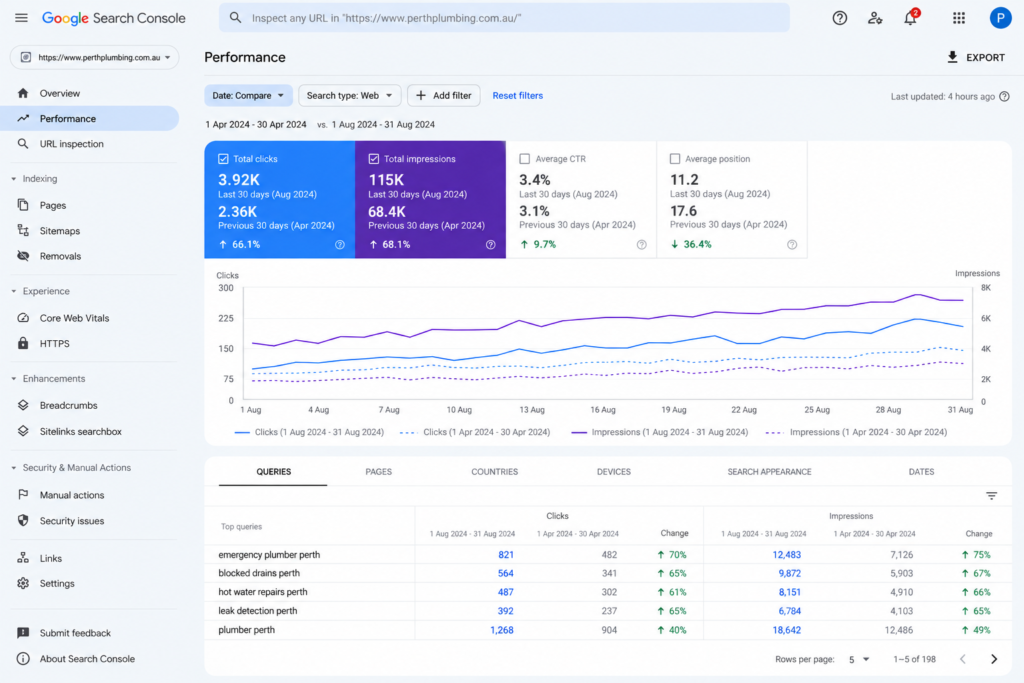
Perth Plumbing Local SEO Case Study

A Perth plumbing company wanted more non-branded enquiries for high-value services such as emergency plumbing, blocked drains, hot-water repairs and leak detection.

The main problem was weak service-page differentiation, limited local relevance and poor alignment between the website and Google Business Profile.

What We Changed

We improved priority plumbing service pages, strengthened internal linking, refined service-area relevance and aligned the Google Business Profile with the website and target services.

Call and enquiry tracking was also configured to measure performance by service.

Recorded Results
Metric
Recorded outcome
Emergency plumbing calls +64%
Blocked-drain enquiries +52%
Non-branded organic leads +47%
Emergency plumbing calls Page 4 → Page 1 for several tracked Perth searches
Campaign period 4 months

The campaign showed that stronger Local SEO performance came from connecting:

service relevance + service areas + Google Business Profile + internal linking + lead tracking. The objective was not simply more traffic, but more qualified enquiries from local customers searching for specific plumbing services. Read the Full Plumbing SEO Case Study. Results vary by competition, starting visibility, website condition, service area and campaign scope.

Which Tradies Are a Good Fit for Local SEO?

Local SEO is best suited to trade and service businesses whose customers search locally and that serve defined suburbs, cities or operating areas.

That includes plumbers, electricians, builders, roofers, air-conditioning contractors, painters, carpenters, landscapers, locksmiths, pest-control companies, cleaners, mechanics, solar installers, fencing contractors and other service-area businesses.

Owner-Operator Tradies

If you run one or two vehicles, the goal may simply be a more reliable flow of good local work.

You do not need an enterprise SEO programme.

You need strong Maps visibility, priority-service pages, a credible website, customer reviews and clear measurement of calls and enquiries.

Growing Trade Businesses

Businesses with several technicians or vehicles face a different challenge.

Unused capacity still creates wages, vehicle, fuel, equipment and administration costs.

The SEO strategy therefore needs to support a repeatable flow of enquiries for the services and operating areas that can keep crews productive.

Emergency & High-Urgency Trades

Emergency plumbers, electricians, locksmiths, drainage businesses and repair contractors compete when customers need help immediately.

The page must make the service, operating area, availability and phone number obvious.

There is little value in ranking an emergency page that makes customers work to find out how to contact you.

Multi-Suburb & Multi-Location Trade Businesses

Larger trade businesses need a scalable relationship between services, locations, Google Business Profiles and reporting. The main risk is not too little content, but uncontrolled expansion: publishing large numbers of near-identical location pages can create duplication, intent overlap and internal competition. We therefore build location architecture around genuine operating areas, service capacity, search demand and measurable commercial value.

How Do We Build Local SEO Across Multiple Australian Service Areas?

We target the cities, suburbs and service zones your business genuinely wants to serve based on service profitability, search demand and operating practicality, rather than treating every postcode as equally valuable. Google Business Profile service areas do not automatically improve rankings in every suburb and should remain separate from your website’s location strategy.

Business Locations, Service Areas & Location Pages

A business location is a genuine operating base, a service area is where the business travels to work, a branch location is a separate staffed operation that may qualify for its own Google Business Profile, and a location page explains service availability in a specific city, suburb or region.

business location → operating base
service area → geographic coverage
location page → website relevance
branch location → separate operation

We expand geographic coverage only where there is enough search demand, operating capacity and unique local evidence to justify it, keeping the focus on areas where your team can realistically and profitably win work.

How Do We Build a Local SEO Campaign for a Tradie Business?

We diagnose the current search footprint first, map services and locations second, then improve the highest-priority issues.

Audit the Current Local Search Footprint

We review the website, Google Business Profile, Maps visibility, Search Console data, technical condition, indexation, reviews, citations, competitors, location coverage and conversion paths.

The output is a prioritised problem map rather than a generic 70-page audit.

Map Services, Locations & Commercial Intent

We identify what you sell, where you want to sell it and which searches represent meaningful purchase intent.

A high-volume service with poor margins may deserve less attention than a lower-volume service that frequently becomes a valuable booked job.

We map:

service → problem → location → search intent → landing page → conversion

Fix Local SEO Foundations

We address critical GBP, NAP, indexing, technical, internal-linking and page-level issues.

Where tracking is missing, we establish the measurement baseline before drawing conclusions about performance.

Build Service & Geographic Coverage

We strengthen priority service pages first, then develop local landing pages where meaningful geographic differentiation is possible.

Reviews, citations, project evidence and local authority work support the same strategy.

Measure Enquiry Quality & Expand What Works

Rankings are monitored, but not in isolation.

We compare visibility with calls, forms, quote opportunities and lead quality.

When a service or suburb begins producing commercially useful enquiries, that evidence helps determine what should be expanded next.

What Do You Receive From a Managed Local SEO Campaign?

The campaign covers the agreed organic local-search work needed to improve visibility, relevance and lead generation. Unrelated advertising, software and major development projects are scoped separately.

✓

Included in the agreed Local SEO scope

✓ Google Business Profile audit and optimisation
✓ Local keyword and search-intent research
✓ Service and location opportunity mapping
✓ Priority service-page optimisation
✓ Genuine suburb/location-page strategy
✓ On-page SEO and internal linking
✓ LocalBusiness structured-data recommendations
✓ Citation consistency and cleanup
✓ Review-acquisition process
✓ Local authority/link opportunities
✓ Technical SEO within agreed campaign scope
✓ Search Console and analytics measurement
✓ Conversion and enquiry tracking where configured
×

Not included by default

× Google Ads media spend
× Paid social advertising
× Full website redesign or rebuild
× Branding and logo development
× Professional photography unless quoted
× CRM subscription costs
× Third-party call-tracking fees
× Fake directory submissions
× Purchased or fabricated reviews
× Fake Google Business Profile locations
× Unlimited development work
× Guaranteed #1 or Map Pack positions
× Work outside agreed locations/services

Local SEO Mistakes That Cost Tradies Leads

A complete local SEO campaign connects Google Business Profile optimisation, Google Maps SEO, local website architecture, reputation, authority, technical SEO and lead measurement around one clear relationship: tradie → provides service → in location → to customer. Every campaign component should reinforce who the business is, what it provides, where it operates and who it serves, making that relationship easier for both customers and search systems to understand.

Building 30 Suburb Pages From One Template

Changing only the suburb name while leaving most of the page unchanged creates weak local relevance. A location page should have a genuine reason to exist, supported by local demand, completed work, customer proof, operating knowledge or meaningful service differences. Google prioritises useful, unique content over mass-produced pages created mainly to capture search traffic.


Adding service areas does not give your business a physical presence in every suburb. Virtual offices, false addresses and fake locations can create unnecessary Google Business Profile risk. Your profile should accurately represent where the business genuinely operates and the areas it legitimately serves.


Chasing Rankings Without Controlling the Enquiry Mix

A high ranking for a broad keyword means little if it produces low-value, irrelevant or unprofitable enquiries. Local SEO should measure which services and locations generate the right calls, quote requests and booked work—not just whether one headline keyword moved up.


Using Reviews as Keyword Containers

Reviews should reflect the customer’s genuine experience, not a pre-written paragraph stuffed with services and suburb keywords. Strong reviews naturally reinforce service quality, trust, location relevance and customer experience without looking manufactured.

Treating GBP Activity as a Ranking Hack

Photos, updates and accurate Google Business Profile information can improve the usefulness and conversion potential of your listing. But routine posting alone does not guarantee higher Maps rankings. We separate documented ranking factors and genuine optimisation from Local SEO folklore.

Ranking is wasted if mobile visitors cannot easily become customers. Buried phone numbers, slow pages, poor layouts and difficult forms can turn qualified search traffic into lost enquiries. Local SEO has to connect visibility with a frictionless path to call, enquire or request a quote.

Reporting Traffic Instead of Business Outcomes

Organic traffic is useful diagnostic data, but sessions are not revenue. The campaign should measure whether search visibility is progressing through the commercial funnel:

visibility → qualified enquiry → quote → booked job → revenue

That is the difference between reporting SEO activity and measuring whether Local SEO is actually producing business growth.

What Happens During the First 90 Days of Local SEO?

The first 90 days should establish measurement, fix major weaknesses and build priority service and geographic relevance before expansion.

Period Primary work What should exist by the end of the phase
Days 1–30 Audit, baseline, GBP review, technical diagnosis, service/location mapping, competitor analysis and conversion setup Clear priorities, benchmark data and defined strategy
Days 31–60 Priority service optimisation, internal linking, initial location work, citation cleanup, structured data, mobile/CRO improvements and review process Stronger commercial landing pages and cleaner local signals
Days 61–90 Priority service optimisation, internal linking, initial location work, citation cleanup, structured data, mobile/CRO improvements and review process Evidence showing which services and areas deserve further investment

Local SEO does not operate on a fixed ranking clock.

Initial movement can sometimes appear within a few months, while broader gains may require sustained work over several months or longer.

Competitive metropolitan markets, weak websites, new domains and businesses targeting many locations can take more work.

The roadmap therefore defines work and measurement milestones, not promised ranking dates.

Why Does Local SEO for Tradies Need a Different Strategy?

 Tradie SEO works differently because service type, urgency, geography, operating capacity, mobile behaviour and job profitability all influence whether a search visit becomes worthwhile work. A tradie usually travels to the customer, so the strategy must connect the right service, the right location and the right enquiry rather than simply increasing traffic.

Service + Location Must Work Together

Tradies rarely compete for one service in one fixed location. A plumber, electrician or roofer may need visibility for several high-value services across different operating areas, so the website must connect service intent with genuine geographic relevance instead of relying on one broad service page or dozens of duplicated suburb pages

Service Area Is Not the Same as a Business Location

A service-area business travels to customers, a hybrid business serves customers both on-site and off-site, and a storefront primarily receives customers at its premises. That distinction matters because working in a suburb does not create a physical business location there, and Local SEO should reflect the business’s real operating model rather than manufacture false proximity.

We Start With the Jobs You Actually Want

The campaign starts with profitable services, priority job types, genuine service areas, search demand and operational capacity. This prevents SEO from chasing every possible keyword and suburb and instead focuses resources on searches that are more likely to produce qualified enquiries, viable quotes and profitable booked work.

Maps SEO and Website SEO Need Separate Strategies

Your Google Business Profile and website support the same customer journey, but they perform different functions. Maps visibility helps customers discover and evaluate the business locally, while service and location pages establish deeper relevance for specific jobs and geographic searches, so each asset requires its own optimisation strategy.

Distance Cannot Be Optimised Away

Google uses distance as a core local-ranking factor, which means no legitimate agency can make a tradie physically closer to every searcher. The practical strategy is to strengthen what can be influenced: service relevance, local prominence, authority, reviews, geographic evidence, website quality and conversion performance.

Mobile Conversion Can Decide Who Wins the Job

High-intent tradie searches often happen on mobile when the customer wants an answer quickly. A strong ranking can still fail commercially if the page is slow, the phone number is difficult to find, trust signals are weak or the quote form creates friction, so Local SEO must make the path from search to call, quote or booking as direct as possible

We Measure Jobs, Not Just Rankings

Rankings, impressions and organic sessions help diagnose search performance, but they are not the final business outcome. We connect Search Console, analytics, call tracking and CRM data wherever practical to understand which services and locations are producing qualified enquiries, quotes, booked jobs and revenue.

visibility → qualified enquiry → quote → booked job → revenue

What Determines the Cost of Local SEO for Tradies?

Pricing depends on the number of services, competitive locations, Google Business Profiles, website condition, content requirements, technical work and level of lead attribution required.

A one-van electrician targeting several nearby suburbs should not automatically pay for the same scope as a plumbing company running several crews across a metropolitan market.

SEO Pricing
Engagement Best suited to Pricing approach
Local SEO Audit Tradies who want to identify what is blocking visibility before committing to management One-off custom quote
Managed Local SEO Owner-operated and growing trade businesses targeting ongoing local enquiries Monthly custom quote
Multi-Location Local SEO Businesses with multiple genuine locations, GBPs, teams or large service footprints Custom strategy and scope

SEO pricing across Australia varies because campaign scope, competition, website condition, service coverage and implementation requirements differ.

A higher monthly fee is not automatically better SEO.

A lower fee is not automatically better value.

The useful comparison is:

scope → execution → qualified enquiries → booked jobs → commercial return

FAQs for Local SEO for Tradies

Referrals are valuable, but they are not always predictable. Local SEO helps you appear when new customers search on Google, so you are not relying only on word of mouth.

That usually happens when the strategy is too generic. Tradie SEO needs Google Maps work, service-area targeting, review signals, local pages, and lead tracking, not just keywords and blog posts.

Strong competitors can be beaten, but not with guesswork. We first check their Google profiles, reviews, pages, backlinks, citations, and service areas, then build a realistic plan to close the gap.

That is common for many tradies. We help you build a simple review request process so happy customers can leave fresh, service-specific feedback that supports trust and local visibility.

That can work well for local SEO. The key is building clear service-area signals without creating thin, copied suburb pages that look spammy or unhelpful.

Local SEO is a long-term growth channel, not an instant switch. For faster enquiries, you may combine SEO with Google Ads while SEO builds stronger organic and Maps visibility over time.

You do not need a huge campaign to start. A focused plan can improve your Google Business Profile, main service pages, reviews, and local listings first.

You should not need to decode technical reports. We explain what changed, why it matters, and how it connects to calls, forms, quote requests, and local visibility.

That means the wrong searches are being targeted or the website is not converting. We focus on high-intent local searches and clear contact paths, not random traffic.

Start with a local SEO audit. It shows what is holding your business back on Google and what should be fixed first before you commit to a larger plan.

Don’t Let the Next High-Value Job Go Elsewhere

Your next customer may already be searching today. Let Seo Agency For Tradies make your trade business easier to find, easier to trust, and easier to contact before they choose another local trade.