SEO Services for Builders in Australia That Generate Better Project Enquiries
SEO Agency for Tradies helps builders compete for specific project types in genuine service areas by connecting search demand with service capability, geographic coverage and completed project evidence. The campaign is structured around the work you want to win, the locations where that work is commercially viable and the search journeys prospects use before requesting a consultation or quote.
Find out what's holding you back
Enter your number — we’ll call you with a free ranking report for your suburb.
We call within 2 business hours. No scripts. No pressure.
Businesses We Support Across Australia
We support trade and commercial service businesses with stronger local visibility, clearer lead generation and marketing systems connected to measurable commercial outcomes.







Why Your Builder Website Misses High-Value Project Enquiries

A gallery proves that work exists but rarely explains project type, scope, location, constraints or construction approach. We turn suitable projects into evidence pages that connect completed work with the related service and market, helping prospects evaluate relevant experience instead of scrolling through disconnected images.
A traffic increase has limited commercial meaning when the resulting enquiries fall outside your service area, project type or minimum job fit. We review which pages and search themes generate suitable enquiries, then connect performance with consultations, quote opportunities and won work where the business has the required data.
You Get Visibility for the Wrong Searches
A builder can attract traffic from house plans, construction costs, DIY questions or employment searches while remaining invisible for the projects the business actually wants. We separate research demand from commercial project intent, then prioritise searches by service fit, project type, location relevance and likelihood of becoming a suitable enquiry.
Your Website Pages Work in Isolation
A service page without project proof, a location page without service evidence and a project page without contextual links create separate information silos. We connect these assets into deliberate paths so prospects can move from search intent to service information, geographic relevance, completed-work evidence and enquiry.
Google Cannot Connect Your Services With Your Locations
A list of suburbs does not explain which services are genuinely available in each market. We connect priority services with valid operating areas, relevant project pages and internal links so each geographic claim is supported by a clearer relationship between service capability, service area and completed work.
What’s Included in Our SEO Services for Builders
Your campaign is organised around 5 connected systems: demand selection, technical access, geographic relevance, project evidence and commercial measurement. Each system answers a different question, from which projects deserve search investment to which pages and markets are generating suitable enquiry opportunities.

Search Demand and Opportunity Mapping
We assess project type, service area, search intent, competition and available proof before recommending a target. This prevents the campaign from chasing volume without business fit and helps determine whether demand belongs on a service page, location page, project page or supporting decision-stage resource.
Technical SEO and Website Architecture
We review whether search engines can reach priority service pages, whether overlapping location URLs compete with one another, whether image-heavy project pages create performance problems and whether important pages sit too deep in the site. Technical work is prioritised by its effect on commercially important search assets.
Local SEO and Google Business Profile Optimisation
We align your verified business information, Google Business Profile services, genuine operating areas and relevant website pages. Local targeting is based on actual coverage and supporting evidence, not fake offices, virtual-location signals or large groups of suburb pages created without a distinct search purpose.
Service, Location and Project Content
We build explicit relationships between what you build, where you build it and which completed projects support the claim. A priority service can connect to valid geographic markets and relevant project evidence, creating a clearer path from commercial search demand to proof and enquiry.
Authority Building and Performance Tracking
We evaluate authority opportunities for topical relevance, editorial quality, contextual fit and risk, then measure performance beyond rankings. Reporting examines which service themes, markets and landing pages produce useful visibility, suitable enquiries and quote opportunities where downstream sales data is available.
Want to See Which Parts of Your SEO Need the Most Work?
We review whether your biggest constraint sits in technical access, page architecture, location relevance, project evidence, authority or enquiry measurement, so priorities are based on the actual bottleneck rather than a generic monthly activity list.
SEO for Different Types of Builders Across Australia

Custom Home Builders

Renovation and Extension Builders

Knockdown Rebuild Specialists

Granny Flat and Duplex Builders

Residential Builders

Commercial Construction Companies
Areas We Serve Across Australia
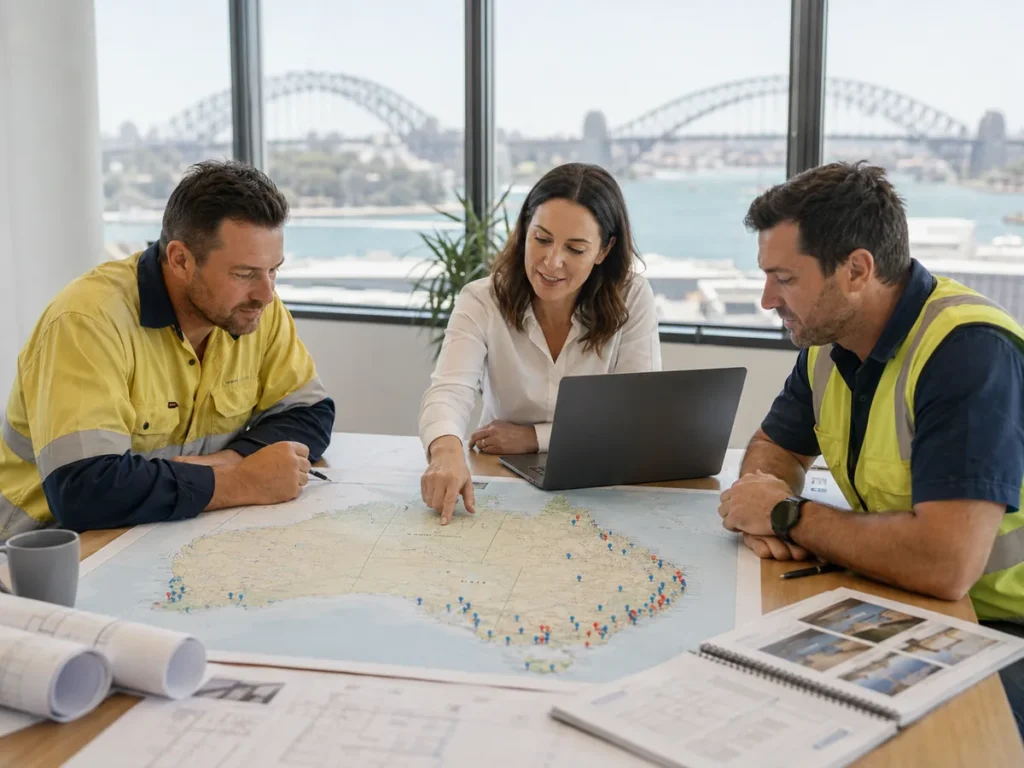
SEO Agency for Tradies works with builders across major Australian cities and selected regional markets. Geographic expansion is based on 3 conditions: genuine service coverage, commercially relevant search demand and enough business evidence to support the location without creating repetitive pages.
Sydney
Sydney campaigns can separate metro-wide services from region-specific or suburb-cluster opportunities. A custom home service may justify broader coverage, while renovation work may need tighter geographic targeting based on travel radius, project economics and available project evidence.
Melbourne
Melbourne campaigns prioritise the overlap between service demand, market competitiveness, operating capability and completed work. A location receives investment when the builder can service it credibly and the search opportunity matches a project category the business wants to grow.
Brisbane
Brisbane campaigns connect priority services with growth markets, local search signals and completed project evidence. Geographic expansion follows demand and business fit, preventing the site from accumulating location pages that add URL volume without improving relevance.
Perth
Perth campaigns align service radius, project category and market opportunity before new location assets are recommended. This keeps search targeting consistent with the builder’s actual operating capacity and prevents investment in areas the business cannot support efficiently.
Adelaide
Adelaide campaigns focus on service-market combinations where genuine coverage, search demand and supporting evidence overlap. Location content is built around a distinct role and business relationship rather than repeating the same service copy under different place names.
Gold Coast
Gold Coast campaigns distinguish broad regional visibility from location-specific searches that require stronger local evidence. Project types, service areas, Google Business Profile signals and completed work are connected according to the actual markets the builder serves.
Your geographic SEO strategy is built around where you actually work, where demand exists and where your project experience can support stronger local relevance.
What Is Included and Not Included
Know exactly what your SEO engagement covers, what sits outside the core scope and how each activity supports search visibility, market relevance and better project enquiries.
Included
- Search Strategy: Project types, services, locations, intent and competition are assessed before campaign priorities are set.
- Technical SEO: Issues are prioritised by their effect on important services, project pages, location assets and enquiry paths.
- Local SEO: Google Business Profile signals, verified business data and genuine service coverage are aligned with the website.
- Page Optimisation: Each service, location and project page is given a defined search and decision-making role.
- Location Strategy: New geographic pages require genuine coverage, distinct demand and enough context to avoid duplication.
- Project Content: Suitable projects are structured around project type, scope, location, constraints and relevant service capability.
- Authority and Measurement: Relevant authority signals, search performance, enquiry fit and commercial progression are reviewed.
- Campaign Prioritisation: Work follows the biggest constraint or strongest commercial opportunity identified in the campaign.
Not Included
- Ranking Guarantees: Exact positions, lead volumes and revenue outcomes are never promised.
- Vanity Technical Work: Low-impact warnings are not fixed merely to improve an automated score.
- False Location Signals: No fake offices, misleading addresses or fabricated local presence.
- One Page per Keyword: Minor keyword variations do not automatically justify separate URLs.
- Mass-Produced Suburb Pages: No near-identical location pages created only to increase page count.
- Thin Galleries: Image collections without useful project context are not treated as a complete SEO asset.
- Risky SEO Tactics: No PBNs, hacked links, spam directories or manipulative link schemes.
- Unrelated Services by Default: Google Ads, social media, full redesigns and CRM work require separate scope.
You get a defined SEO scope, clear responsibilities and work tied to the services, markets and project opportunities that matter to your business.
Our Proven SEO Process for Builders Across Australia
Your SEO campaign follows a clear 4-step process. Each stage produces a different decision: which opportunities deserve investment, which obstacles limit visibility, which page relationships need strengthening and where future expansion is commercially justified.
1. Identify Your Priority Projects and Markets
We score opportunities against project type, service area, search demand, competitive difficulty and available proof. This identifies where demand and business capability overlap, giving the campaign a clearer target than a generic keyword list sorted only by monthly search volume.
2. Fix the Issues Limiting Search Visibility
We identify technical and structural bottlenecks affecting priority search assets, including indexation problems, weak crawl paths, overlapping pages, poor internal links and image-heavy project templates. Fixes are ordered by their effect on important services, locations and enquiry journeys.
4. Measure Enquiries and Expand What Works
We compare visibility, landing-page performance, enquiry fit, service relevance and geographic fit before deciding what to expand. A market that gains traffic but produces poor-fit enquiries is treated differently from a lower-volume service page generating suitable quote opportunities.
3. Build Relevance Around Services, Locations and Projects
We connect service capability, valid geographic coverage and completed project evidence. Each important cluster is structured so a prospect can move from a relevant search to the service, location context, project proof and next enquiry step without navigating through disconnected pages.
Clear priorities, connected implementation and evidence-led expansion keep your SEO campaign focused on the services, locations and project opportunities that matter to your business.
30/60/90-Day SEO Roadmap for Builders in Australia
The first 90 days establish the decision system for the campaign. The work moves from identifying commercially relevant opportunities to repairing important search assets, connecting services with markets and project evidence, then using early performance signals to determine the next expansion priorities.
First 30 Days: Research, Diagnosis and Priority Planning
In the first month, we build a clear picture of which project types and markets deserve attention, which current pages can support them and which technical, content or tracking gaps are blocking progress.
Main Focus Areas:
✓ Search demand and intent mapping
✓ Builder competitor architecture analysis
✓ Technical SEO audit
✓ Crawlability and indexation review
✓ Service and location page assessment
✓ Google Business Profile review
✓ Project and portfolio evidence audit
✓ Internal linking analysis
✓ Enquiry and tracking review
✓ Prioritised SEO action plan
Expected Outcome:
You receive a clear opportunity map showing which services and locations deserve investment, which pages need improvement, which URLs overlap, where project evidence is missing and which measurement gaps prevent reliable enquiry analysis.
Days 31–60: Technical Improvements, Local Relevance and Page Optimisation
After priorities are established, we improve the search assets closest to commercially relevant demand and connect them more clearly with the markets and project evidence supporting them.
Main Focus Areas:
✓ Priority technical SEO fixes
✓ Service-page optimisation
✓ Genuine location-page improvements
✓ Google Business Profile optimisation
✓ Website architecture refinement
✓ Internal linking improvements
✓ On-page SEO updates
✓ Project-page framework improvements
✓ Local signal alignment
✓ Enquiry path improvements
Expected Outcome:
Priority services, locations and projects become part of a more coherent search architecture. Important pages are easier to discover, geographic claims are supported more clearly and prospects can move from relevant search demand to proof and enquiry with less friction.
Days 61–90: Project Evidence, Authority and Performance Refinement
Once the foundation and priority pages are stronger, we use project evidence, relevant authority signals and early performance data to determine where the next phase of investment needs to go.
Main Focus Areas:
✓ Project and case study optimisation
✓ Priority content gap development
✓ Contextual internal linking
✓ Relevant authority-building activity
✓ Google Search Console performance review
✓ Google Business Profile performance review
✓ Search visibility movement review
✓ Enquiry and lead-quality review
✓ Page-level opportunity analysis
✓ Next 90-day growth plan
Expected Outcome:
The campaign moves from setup into evidence-led expansion. The next 90-day plan is based on which services, locations and page relationships show genuine opportunity, where project proof needs strengthening and which search assets are producing suitable enquiries.
Common Builder SEO Mistakes That Limit Growth
Builder SEO often underperforms because decisions are based on search volume, URL quantity or software scores rather than project economics and buyer fit. These mistakes create more activity without necessarily creating better search assets.
Chasing Search Volume Instead of Project Value
A high-volume keyword can attract broad research traffic without producing suitable project opportunities. Search priorities need to account for project type, service fit, geographic relevance and commercial value so the campaign targets demand the business can realistically quote and deliver.
Creating Pages for Every Keyword or Suburb
A new URL needs a distinct purpose. When minor keyword variations or suburb names are turned into separate pages without unique intent or evidence, the site accumulates overlapping content that competes internally and weakens the clarity of the architecture.
Treating Project Pages as Photo Galleries
A completed project can support service relevance, geographic evidence and buyer confidence, but only when enough context is provided. Project type, general location, scope, constraints and outcome turn original business work into useful evidence instead of leaving it as an isolated image collection.
Fixing Audit Scores Instead of Business-Critical Issues
Technical tools report symptoms, not business priorities. We focus first on problems affecting discovery, indexation, important commercial pages, project-page performance, internal links and enquiry paths before spending effort on low-impact warnings with limited commercial consequence.
Measuring Success at Rankings and Leads
Rankings show visibility and form submissions show activity, but neither proves lead quality. Better measurement examines whether enquiries match the right service, geographic market and project type, then tracks progression into consultation and quote stages where business data allows.
Better builder SEO comes from stronger decisions: target commercially relevant demand, create only useful pages, connect project evidence, fix the highest-impact constraints and measure outcomes beyond rankings.
Why Builders Choose SEO Agency for Tradies
Builder SEO needs more than a different keyword list. The campaign must account for service radius, project economics, proof requirements, page architecture and lead qualification. Our approach is built around observable operating practices rather than generic claims about traffic or rankings.
Built Around the Projects You Want More Of
Campaign priorities are mapped by project category, service area, search intent and available proof before expansion is recommended. This keeps search investment tied to work your business wants to quote rather than traffic that looks positive in analytics but has weak commercial fit.
Service, Location and Project Pages Work Together
Completed projects are not left inside isolated galleries. Relevant work is connected with the services and geographic markets it can credibly support, giving prospects a clearer route from search intent to capability, local relevance, project evidence and enquiry.
Reporting Goes Beyond Rankings
Where tracking allows, campaign analysis separates total enquiry activity from service fit, geographic fit and quote opportunity. This provides a stronger basis for deciding which services, markets and search assets deserve continued investment.
SEO Decisions Follow Commercial Priorities
A new page or target market is recommended only when it has a distinct search role, genuine business relevance and enough information or evidence to avoid duplication. This prevents the campaign from expanding simply because more keywords or suburb names can be found.
SEO Decisions Follow Commercial Priorities
A new page or target market is recommended only when it has a distinct search role, genuine business relevance and enough information or evidence to avoid duplication. This prevents the campaign from expanding simply because more keywords or suburb names can be found.
Reporting Goes Beyond Rankings
Where tracking allows, campaign analysis separates total enquiry activity from service fit, geographic fit and quote opportunity. This provides a stronger basis for deciding which services, markets and search assets deserve continued investment.
Builder-Focused SEO Without Generic Templates
A custom home builder, extension specialist and commercial contractor require different search journeys, page structures and proof assets. The campaign architecture changes according to project type, buyer evaluation process, operating area and the evidence needed before a prospect is ready to contact the business.
Clear Scope and Transparent Priorities
Campaign work follows an explicit priority order based on commercial opportunity and current constraints. You can see which search assets are being worked on, what problem each action addresses and what evidence will be reviewed before the next phase is chosen.
You get an SEO strategy shaped around your building business, your service areas and the project opportunities you want to grow.
Questions Builders Ask Before Starting SEO
Still unsure whether SEO fits your building business or growth goals?
Ready to Turn Search Visibility Into Better Project Enquiries?
Your website needs to connect 4 commercial relationships: the projects you want to win, the markets where you can deliver them, the completed work that proves your capability and the enquiry path that moves a suitable prospect into your sales process.
SEO Agency for Tradies builds SEO campaigns around those relationships so technical work, page architecture, local relevance, project evidence and measurement support the same commercial objective.
The goal is not more traffic from everyone searching for building information. The goal is stronger visibility for the work your business is equipped and willing to win.


