Google Ads Management for Tradies Focused on Qualified Local Jobs
Get your trade business in front of Australians who are actively searching for the services you provide.
SEO Agency for Tradies builds and manages Google Ads campaigns around the jobs your business actually wants. That means targeting the right services, customers and suburbs while considering your availability, job values, margins and capacity.
Our goal is not to generate the highest possible number of clicks. It is to help your business receive more qualified calls, worthwhile quote requests and booked jobs from locations your team can serve profitably.
Find out what's holding you back
Enter your number — we’ll call you with a free ranking report for your suburb.
We call within 2 business hours. No scripts. No pressure.
Reach Local Customers at the Moment They Need a Tradie
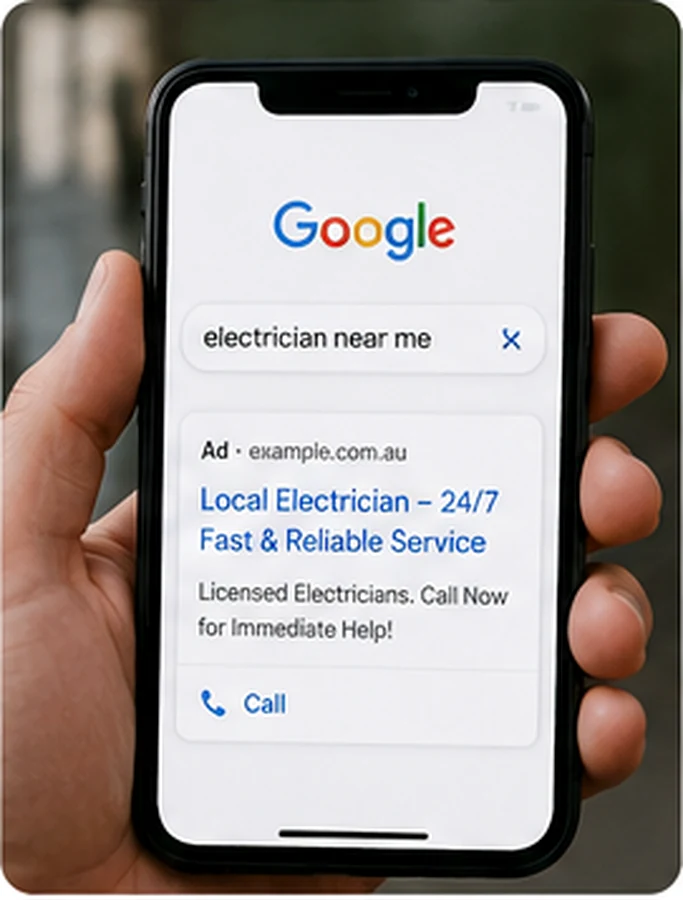
Google Ads allows your business to appear when a potential customer searches for a service, repair, installation, inspection or contractor.
A homeowner searching for an emergency plumber, a property manager looking for a commercial electrician or a business owner comparing shopfitters already understands that work needs to be completed. They are not simply browsing for entertainment. They are actively evaluating who to contact.
A properly structured campaign connects that demand with the most relevant part of your business. The customer searches for a specific service, sees an advertisement that matches the problem, visits an appropriate landing page and takes the next step by calling, requesting a quote or booking an inspection.
The objective is not to purchase traffic for its own sake. The objective is to create a clear path from customer demand to a profitable job opportunity.

Google Ads Built Around the Work You Want More Of
Many trade businesses offer a wide range of services, but not every service has the same value.
A plumber may want more blocked-drain and hot-water work while avoiding minor maintenance jobs. An electrician may prefer switchboard upgrades and commercial maintenance over low-value call-outs. A builder may only want renovation projects above a defined budget.
Your campaigns should reflect those priorities.
We plan campaigns around the services you want to grow, the jobs your team can deliver and the type of customer you want to attract. This helps prevent high-value work from competing for the same budget as services that are less profitable or difficult to fulfil.
Target the Suburbs Your Business Can Serve Profitably
A large service area does not always mean a profitable service area.
Travel time, fuel, traffic, parking, technician availability and average job value can all affect whether an enquiry is worth pursuing. A suburb may appear close on a map but still create excessive travel time or scheduling problems.
We structure location targeting around the areas your team can realistically serve. Different services can also use different geographic boundaries. A small repair may only be worthwhile within a tight local area, while a large commercial project or full roof replacement may justify travelling farther.
Location exclusions and ongoing lead reviews help reduce enquiries from areas that are technically reachable but commercially unsuitable.
Generate Calls That Are More Likely to Become Jobs
A phone call is not automatically a qualified lead.
Tradie campaigns can generate calls from job seekers, suppliers, existing customers, people outside the service area and customers requesting work the business does not provide. Counting all of these calls as successful conversions can make an underperforming campaign appear healthy.
Our approach focuses on the quality of the conversation. Where suitable tracking and business feedback are available, we distinguish between total calls, genuine service enquiries, qualified opportunities, quotes and booked jobs.
This creates a more accurate picture of which campaigns are producing meaningful work.
Improve the Quality of Your Quote Requests
A generic contact form often provides too little information to determine whether an enquiry is suitable.
A well-designed quote form can collect relevant details such as the required service, suburb, property type, urgency, project size and preferred contact method. Higher-value project forms may also ask about budget, timing or supporting photographs.
The form should collect enough information to help your team respond effectively without making the process frustrating for a genuine customer.
The right level of qualification depends on the service. Emergency work normally requires a fast contact pathway, while renovations, commercial projects and installations may justify a more detailed enquiry process.
Reduce Wasted Google Ads Spend
Wasted spend often comes from small targeting problems that accumulate over time.
A campaign may appear for job seekers, apprenticeships, DIY searches, free-advice requests, products, tools, services you do not provide or suburbs outside your operating area. Broad campaign structures can also allow low-value services to consume budget intended for more profitable work.
We reduce waste through careful keyword selection, search-term reviews, negative keywords, location controls, campaign separation and advertising schedules.
These controls are not treated as a one-time setup. Search behaviour changes, new irrelevant terms appear and business priorities shift. Ongoing management is required to keep the account aligned with the work your business wants.
Is Your Campaign Producing Jobs or Just Clicks?
A low cost per click does not necessarily mean a good campaign.
A cheap click that generates an unsuitable customer can be less valuable than a more expensive click that becomes a profitable installation, repair or commercial contract.
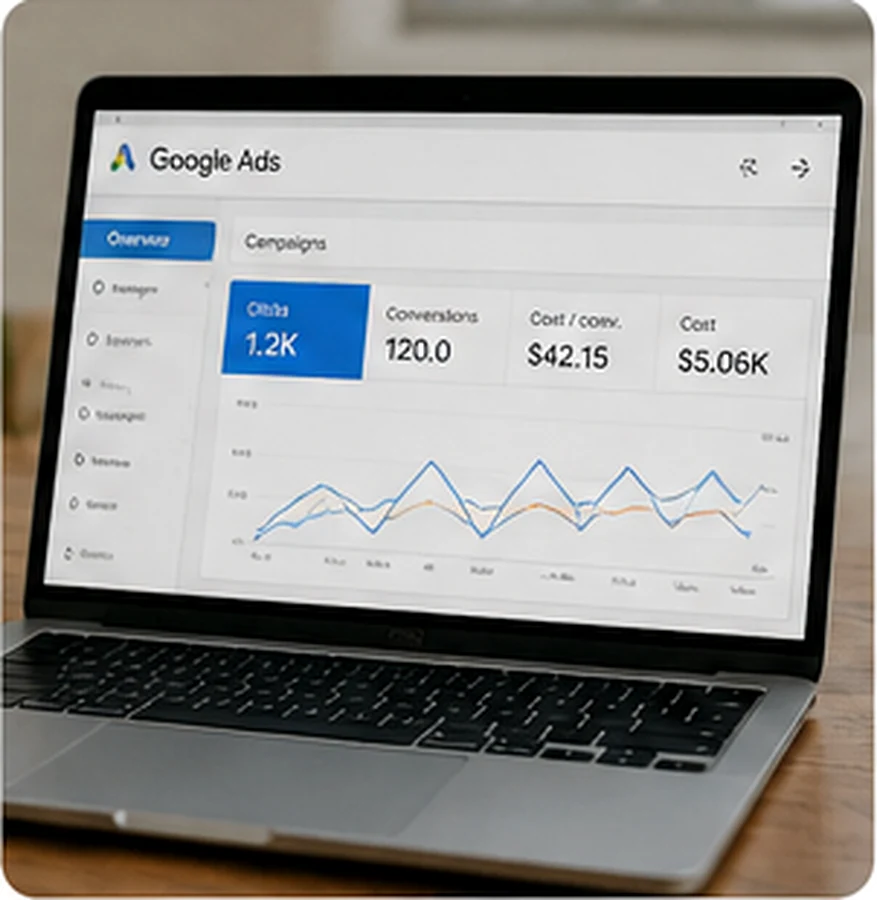
Clicks, impressions and conversion totals are useful for diagnosing campaign activity, but they do not tell the whole story. A stronger reporting process connects advertising activity with what happened after the enquiry.
The most useful measurement path moves from advertising spend to enquiries, qualified leads, quotes, booked jobs and completed revenue.
Not every business can track every stage immediately. We begin with the strongest reliable data available and improve the measurement system as the campaign develops.

Common Reasons Tradie Google Ads Campaigns Underperform
Emergency repairs, planned installations, small maintenance jobs and large projects often have different customer intent, click costs, conversion paths and job values.
Combining them in one campaign makes it difficult to control budgets or understand which services are creating value. We separate campaigns where differences in service, location, urgency, customer type or job economics require independent control.
Residential customers and commercial decision-makers do not always search in the same way.
A homeowner may want an immediate repair or quote. A facility manager, strata manager or builder may require documentation, insurance, technical capability and a longer sales process.
Separate campaign and landing-page treatment allows the advertising to reflect those differences.
Advertising can create demand, but it cannot compensate for missed calls and slow follow-up.
An urgent customer may contact the next visible provider within minutes. A project customer may request several quotes in the same session.
Campaign schedules should reflect when someone can answer, qualify and progress an enquiry. This is particularly important for emergency services, owner-operators and businesses with limited office support.
A homepage needs to explain the entire business. A Google Ads campaign usually promotes one particular service or customer need.
Sending every visitor to the homepage creates extra work for the customer. They have to search through the site again to confirm that the business provides the service they requested.
A relevant service or landing page reduces that friction by continuing the same message from the search and advertisement.
A click on a phone number, a visit to a contact page or a short accidental call should not necessarily be treated as a valuable conversion.
Campaigns can become distorted when automated bidding is trained to optimise towards actions that do not represent genuine customer opportunities.
We review which actions are marked as primary conversions and whether those actions reflect the outcomes the business actually values.
Advertising every service in every location may appear ambitious, but it can weaken the entire account when the available budget is limited.
Each campaign needs enough visibility and data to be evaluated. We normally prioritise the services and areas with the clearest commercial opportunity before expanding into additional campaigns.
What Is Included in Our Google Ads Management?
Campaign management is organised around commercial control, lead quality and transparent measurement.

An existing account is reviewed before major recommendations are made.
We examine campaign structure, search terms, keywords, negative keywords, locations, schedules, devices, bidding, budgets, advertisements, assets, landing pages and conversion actions.
The audit also considers account ownership, administrative access and whether tracking has been duplicated, omitted or configured around low-value actions.
The outcome is a prioritised explanation of what should be retained, corrected, restructured or rebuilt.
Campaign planning begins with the way your trade business operates.
We look at the services you want to promote, the work you want to exclude, target customers, service areas, operating hours, average job values, approximate margins, minimum project values and available capacity.
This prevents the account from being optimised around demand that your business cannot serve or does not want.
Keyword research focuses on the meaning behind the search.
A customer may search for a specific service, describe a problem, include a suburb, communicate urgency or request a quote. Those signals help determine whether the search is likely to produce a genuine customer opportunity.
We identify relevant service, problem, location, urgency and contractor-related searches while separating them from research, employment, training and product intent.
Campaigns and ad groups are organised around closely related services and customer needs.
This improves the relationship between what the customer searches, what the advertisement promises and what the landing page confirms.
Campaigns may be separated by service, location, urgency, residential or commercial intent, customer type or branch. Separation is used when it creates useful control rather than unnecessary account complexity.
Negative keywords reduce exposure to searches that are unlikely to produce suitable work.
These can include employment, apprenticeship, course, salary, DIY, free advice, product, tool and unavailable-service searches.
Negative keywords are applied carefully because an exclusion that is appropriate for one campaign may block a valuable search in another.
The negative-keyword system develops over time as actual customer searches reveal additional sources of waste.
We map the suburbs, postcodes, cities or service zones your business wants to target.
Location decisions are connected to travel time, technician availability, job value and customer demand. Areas that do not fit your operating model can be excluded.
Location reports and lead feedback are reviewed because no digital location system is perfectly precise.
Advertisements are written to communicate the service, location, availability and next step clearly.
The copy may include licence status, insurance, years of experience, warranties, response times or review information when those claims are accurate and verifiable.
Emergency campaigns may use a direct call-focused message, while installation and project campaigns may encourage the customer to request a quote or book an inspection.
The advertisement should make a realistic promise that the landing page and business can fulfil.
Advertising assets add useful information and conversion pathways to an advertisement.
Call assets can help mobile customers contact the business. Sitelinks can direct customers to individual services, emergency information, commercial capabilities, service areas or quote pages.
Callouts and structured snippets can communicate genuine business benefits and service categories. Location and image assets may also be used when suitable and eligible.
Assets are chosen according to customer intent rather than added solely to improve platform scores.
Budgets can be divided by service, location, urgency, customer type or strategic priority.
The bidding strategy depends on the amount and reliability of available conversion data. A new account may require a different approach from an established campaign with reliable qualified-lead and revenue information.
Budget decisions are based on lead quality, acquisition cost, job values and available capacity. Spending is not increased merely because an automated recommendation suggests that more traffic is available.
The landing page is reviewed to determine whether it provides a relevant path from the advertisement to the enquiry.
The page should clearly explain the advertised service, relevant locations, business credibility and next step. It should also work well on mobile devices and make the phone number or quote action easy to find.
Where the existing website cannot support the campaign, a dedicated landing page may be recommended as a separate project.
Tracking can measure calls made directly from advertisements, calls made after a website visit, quote forms, contact forms and confirmed bookings.
The setup is reviewed for duplicate events, broken submissions and low-value actions that may be incorrectly counted as primary conversions.
Tracking creates the foundation for optimisation, but actual lead quality still depends on feedback from the business.
Search terms are reviewed after launch to identify irrelevant traffic, new keyword opportunities, location patterns and changes in demand.
Advertisements, keywords, negatives, budgets and landing pages can then be refined according to the quality of the enquiries being generated.
The objective is not to increase lead volume endlessly. It is to improve the proportion of enquiries that become quotes and booked jobs.
Reports explain where the budget went, what enquiries were created and what changes were made.
Where reliable business data is available, reporting can progress from clicks and total leads to qualified leads, quotes, booked jobs and attributed revenue.
The reporting process should help the business make decisions rather than simply present a dashboard of advertising metrics.
What Is Included & Not included in Our Google Ads Management?
Included in management
- Google Ads account audit
- Campaign strategy and setup
- Keyword and search-term research
- Negative-keyword management
- Location and schedule targeting
- Ad copy and advertising assets
- Budget and bidding management
- Basic call and form conversion tracking
- Ongoing search-term reviews
- Campaign optimisation
- Lead-quality reviews using your feedback
- Monthly performance reporting
Not included
- Google Ads media spend
- Website hosting and maintenance
- CRM or software subscription fees
- Third-party call-tracking fees
- Answering calls and responding to enquiries
- Preparing and following up quotes
- Sales or booking guarantees
- Guaranteed leads, jobs or revenue
- Landing-page development unless included in your proposal
- Advanced CRM and offline conversion integrations unless separately scoped
- Photography, video and custom graphic production
- SEO and social-media advertising services
Your proposal will confirm the exact campaign scope, management fee, advertising budget and any optional services before work begins.
Campaigns Built Around Service, Location, Intent and Outcome
Our planning model connects four important elements.
Service
The service defines the work you want to sell.
A campaign may focus on emergency repairs, maintenance, installation, inspection or large projects. Advertising every service equally can dilute the available budget and weaken the message.
We prioritise services according to demand, job value, margins, capacity and strategic importance.
Location
The location defines where the work can be completed efficiently.
Different services may justify different geographic boundaries. A small repair may require tight local targeting, while a higher-value project may support a larger service area.
The campaign structure reflects these differences.
Customer Intent
Customer intent explains what the searcher is trying to achieve.
Someone describing an urgent fault is at a different stage from someone comparing project costs or researching contractors. Advertisements and landing pages should reflect whether the customer needs immediate help, a quote, an inspection or detailed project information.
Business Outcome
The business outcome defines what success means.
That outcome may be a qualified call, inspection, quote opportunity, booked job or completed project.
Campaign decisions should be based on the stage where advertising creates commercial value, rather than only the number of clicks generated.
Google Ads for Different Types of Tradie Businesses
An owner-operator may answer calls, prepare quotes and complete the work personally.
The campaign needs to remain focused enough to produce a manageable number of suitable enquiries. Advertising schedules and service areas become especially important when the owner cannot answer while driving or working on-site.
A small number of profitable services and nearby suburbs will often create a stronger starting point than a broad campaign.
A growing trade business needs enough qualified demand to support wages, vehicles, equipment and scheduling.
Campaigns can be separated by service, team, location or job type. Budgets can be adjusted according to available crew capacity and the mix of work required.
The priority is not simply obtaining more leads. It is creating the right mix of jobs for the people and equipment currently available.
Emergency campaigns require immediate visibility, direct contact options and strict operating controls.
Ads should only run when the service is genuinely available. Service areas must support realistic response times, and calls need to be answered promptly.
Mobile landing pages should make the service, availability and phone action immediately clear.
Builders, roofers, shopfitters, landscapers, concreters, excavation contractors and renovation businesses may require fewer leads than an emergency-service company.
Their challenge is lead qualification.
Landing pages and forms may need to clarify project type, preferred areas, minimum values, timing and customer readiness. Tracking also needs to reflect a longer sales cycle because the enquiry may take weeks or months to become revenue.
Commercial customers may include builders, developers, strata managers, property managers and facility managers.
These customers often evaluate more than price. They may require evidence of insurance, licences, compliance, resources, documentation and previous project capability.
Commercial campaigns therefore need different search terms, advertisements, proof and follow-up processes from residential campaigns.
An existing advertiser may already believe in Google Ads but lack confidence in how the account is being managed.
Common concerns include restricted account access, irrelevant search terms, broad geographic targeting, duplicate conversion tracking and reports that do not connect leads with jobs.
We begin with an audit, preserve useful history where possible and prioritise changes according to business risk and potential impact.
Google Ads for Australian Trade Industries

Plumbing campaigns can separate emergency repairs, blocked drains, hot-water systems, leak detection, bathroom plumbing and commercial maintenance.
Urgent work needs direct phone access and tight service areas. Planned installations may need stronger landing-page information and quote qualification.
Electrical campaigns can target emergency faults, switchboard upgrades, rewiring, lighting, inspections and commercial maintenance.
A customer searching for an urgent power fault should receive different messaging from a facility manager searching for an electrical maintenance contractor.
Builder campaigns generally require detailed project qualification.
Renovations, extensions, new builds and commercial fit-outs may need separate campaigns because they attract different customers, budgets and sales cycles.
The landing page should make the project scope, preferred service area and minimum requirements clear.
Roofing campaigns can target leaks, repairs, restoration, replacement, storm damage and commercial projects.
Emergency leak work benefits from fast phone pathways, while replacement campaigns need stronger proof, warranties, project examples and quote qualification.
HVAC campaigns can promote repairs, servicing, replacement, installation and commercial maintenance.
Demand may change quickly with the season and weather. Budgets and schedules can be adjusted according to customer demand and technician availability.
Landscaping campaigns can distinguish design, construction, paving, retaining walls, turf, irrigation and ongoing maintenance.
A broad landscaping enquiry can represent anything from a small garden task to a major outdoor project, so service and project qualification are important.
Concreting and excavation enquiries are influenced by project size, access, site conditions, equipment requirements and location.
Campaigns and forms should collect enough information to determine whether the work fits the contractor’s capabilities and minimum project value.
These trades can attract a mixture of minor repairs, residential projects, renovations and commercial contracts.
Campaigns should distinguish the services and customer types the business wants rather than treating every enquiry as equally valuable.
Shopfitting campaigns often target a smaller number of high-value opportunities.
The landing page should demonstrate industry experience, completed projects, operating areas, technical capability and the quotation process.
Tracking should follow the enquiry beyond the first form submission because the final contract may be awarded much later.

Landing Pages That Turn Paid Traffic Into Enquiries
A Google Ads landing page should confirm that the customer has found the right business for the right service.
The page needs to continue the message established by the search and advertisement. A customer searching for emergency roof repairs should immediately see information about roof repairs, relevant areas, availability, credibility and how to contact the business.
A customer searching for a commercial concreter should see commercial capabilities, project types, service areas and quotation requirements.
The page does not need to repeat the keyword mechanically. It needs to continue the same customer decision.
Many local trade searches occur on mobile devices.
The page should load quickly, explain the core service clearly and make the primary action easy to find. Phone numbers should be easy to tap, and forms should be simple to complete on a smaller screen.
Emergency pages normally need a direct phone pathway. High-value project pages may support a more detailed quote form because the customer is making a considered decision.
Trust and Risk Reduction
Customers hiring a tradie are evaluating risk as well as price.
Relevant trust evidence may include accurate licence details, insurance information, customer reviews, completed-project photographs, workmanship warranties, business contact information and clearly defined service areas.
Only current and verifiable claims should be included. Unsupported badges, invented guarantees and exaggerated results can damage trust rather than improve it.
Track Calls, Quotes, Booked Jobs and Revenue
Conversion tracking connects advertising activity with customer actions.
Basic tracking can show whether a call or form submission occurred. More developed tracking can show whether the enquiry was qualified, quoted, booked and completed.

Phone tracking can identify calls made directly from advertisements and calls made after a website visit.
Campaign, keyword, timing and duration information may provide useful context. However, call duration alone does not prove quality.
Where suitable feedback is available, calls can be classified according to whether they were missed, unsuitable, qualified, quoted or booked.
Forms and booking systems should count a confirmed successful submission rather than every click on a button.
Duplicate conversions, broken forms and repeated thank-you-page visits can distort campaign data. These problems need to be checked before automated bidding is allowed to rely heavily on the conversion information.
A customer may begin with a phone call and later become an inspection, quote, accepted proposal, booked job and completed invoice.
Where suitable technology and data-handling processes are available, these later stages can be connected with the original advertising interaction.
This helps distinguish campaigns producing raw enquiries from campaigns producing real business value.
A CRM or job-management platform may store the service, suburb, lead source, status, quote value, booking value and completed revenue.
Where an appropriate integration is possible, that information can improve reporting and campaign optimisation.
The level of integration depends on the software, data quality, technical access and agreed project scope.
A useful report should explain what happened, why it happened and what should happen next.
Traffic metrics remain important because they help diagnose visibility and engagement. They are not presented as proof that the campaign is profitable.
Early-stage reporting may focus on impressions, clicks, calls, forms and conversion rates. As tracking improves, reporting can include qualified leads, quotes, booked jobs, attributed revenue and acquisition costs.
The goal is to develop a reporting system that reflects the way your trade business actually earns money.
Our Google Ads Management Process
Commercial Discovery
The process begins by identifying the work your business wants more of.
We discuss priority services, excluded services, customer types, operating areas, business hours, job values, margins, minimum project values, available capacity and lead-handling processes.
This prevents the campaign from being built around demand that does not fit your business.
Account and Website Audit
Existing campaigns, tracking and landing pages are reviewed.
We identify wasted spend, irrelevant searches, weak account structure, location problems, conversion errors and website friction.
The audit determines whether the current account should be improved, restructured or rebuilt.
Search-Demand Mapping
Relevant customer searches are organised according to service, problem, urgency, location, customer type and buying intent.
Each important search theme is connected with an appropriate advertisement and destination page.
Campaign Build
Campaigns, ad groups, keywords, negative keywords, advertisements, locations, schedules, budgets, assets and conversion actions are created or improved.
The initial build focuses on the services and areas with the clearest commercial opportunity.
Quality Assurance
Before launch, phone numbers, forms, final URLs, locations, schedules, budgets and conversion events are checked.
This reduces the risk of paying for traffic while important contact or tracking functions are broken.
Controlled Launch
Campaigns launch with defined budgets and monitoring.
Early decisions focus on technical accuracy, customer relevance, location quality and obvious sources of wasted spend.
Small amounts of early data are interpreted carefully because one or two leads can create misleading averages.
Lead-Quality Optimisation
Actual search terms and enquiry outcomes are used to refine the campaigns.
Keywords, negative keywords, advertisements, locations, schedules, budgets and landing pages can all be adjusted according to the quality of the work being generated.
Profitable Growth
Campaigns can be expanded when suitable enquiries are being generated at a commercially realistic acquisition cost and the business has capacity for more work.
Growth may involve additional services, suburbs, customer types or campaign formats.
Expansion follows evidence rather than automated platform recommendations alone.
What Happens During the First 90 Days?
Days 1–30: Build the Foundation
The first month establishes the campaign structure, landing-page pathway and measurement system.
The business model, priority services and service areas are reviewed. Existing accounts and tracking are audited. Campaigns, advertisements, assets and negative keywords are prepared.
After launch, early checks focus on technical accuracy, search relevance and obvious wasted spend.
Days 31–60: Improve Lead Quality
The second month uses actual search terms and enquiry feedback to improve targeting.
Irrelevant searches are excluded, converting customer language is identified and suburb or schedule performance is reviewed.
Advertisements, budgets and landing pages can be adjusted according to the quality of calls and forms.
Days 61–90: Connect Advertising With Booked Work
The third month strengthens the connection between campaign activity and commercial outcomes.
Where enough data is available, qualified leads, quotes and bookings are analysed. Budgets can then move towards the services, locations and search themes producing stronger business value.
The first 90 days are a structured implementation and learning period. They are not a guaranteed-results deadline.
Google Ads Management Pricing for Tradies
Google Ads involves an advertising budget and a management fee.
The advertising budget pays Google for eligible traffic and interactions. It is normally paid directly through the client’s own billing profile.
The management fee covers the agreed strategy, setup, tracking, optimisation, reporting and account administration.
The required scope depends on the number of services, locations, campaigns, landing pages, tracking requirements and business systems involved.
A focused owner-operator campaign will normally require a different level of management from a multi-location campaign supporting several crews and service categories.
Landing-page development, CRM integration, advanced call tracking, offline conversion setup and other technical work may require a separate project scope.
There is no universal daily budget suitable for every trade business.
A workable budget depends on the trade, services, target locations, competition, search demand, click costs, website conversion rate, lead quality, booking rate, job value and gross margin.
A small budget may be effective when it focuses on a limited number of profitable services and suburbs. The same budget may perform poorly when spread across a large city, multiple trades and dozens of service categories.
We assess whether your proposed advertising range is realistic before recommending a campaign structure.
A campaign forecast should connect advertising costs with the economics of the work.
The calculation begins with estimated click costs and the amount of traffic a proposed budget may purchase. It then considers the percentage of visitors who may enquire, the proportion of enquiries likely to be suitable and the percentage of suitable leads that may become booked jobs.
The final comparison is between the estimated customer-acquisition cost and the gross profit generated by the work.
A forecast is an estimate rather than a promise. Actual performance depends on competition, demand, website quality, reputation, pricing, call handling, follow-up and service delivery.
The value of the forecast is that it makes the assumptions visible before the business commits to a campaign.
Why Choose SEO Agency for Tradies?

Campaigns Built for Tradie Economics
We structure campaigns around the relationship between services, locations, job values, margins and team capacity.
This helps prevent high-value work from competing with low-value jobs and stops emergency campaigns from being managed like long-cycle projects.
Lead Quality Before Lead Volume
A higher number of leads does not always create a better result.
We focus on whether enquiries match the required service, location, customer type and minimum job criteria.
Optimisation decisions are based on the quality of the opportunity rather than the number of form submissions alone.
Client-Owned Google Ads Accounts
Your Google Ads account remains under your ownership with appropriate administrative access.
This protects campaign history, billing visibility and long-term control. It also makes future agency transitions easier when business requirements change.
Transparent Cost Structure
Advertising spend, management fees and optional implementation work are explained separately.
You should understand what is paid to Google, what is paid for management and what requires separate approval.
Local Service-Area Control
Campaigns are targeted towards the suburbs, postcodes and regions that fit your operating territory.
Location decisions consider travel time, job value and available capacity rather than map size alone.
Tracking Beyond Clicks
Where your business systems allow it, measurement can progress from clicks and enquiries to qualified leads, quotes, booked jobs and revenue.
This creates a more useful basis for future campaign decisions.
Plain-English Reporting
Reports explain where the budget went, what was generated, what was changed and which issues need attention next.
You should not need to interpret a dashboard full of advertising terminology to understand whether the account is moving in the right direction.
Evidence Instead of Guarantees
No agency completely controls search demand, competition, customer decisions, pricing, call handling, quoting or service delivery.
We do not guarantee a fixed number of leads, booked jobs or revenue.
Recommendations are based on campaign evidence, customer demand and the operating requirements of your business.
When Google Ads May Be a Strong Fit
Google Ads may be suitable when your business provides services people actively search for, has clearly defined priority services and can respond to new enquiries consistently.
The business should also understand which locations it wants to serve, have capacity for more work and be able to estimate whether a new customer is commercially valuable.
Reliable lead feedback improves campaign performance because it allows optimisation to move beyond calls and forms.
When Google Ads May Not Be the Right Fit
Google Ads may not perform sustainably when the business cannot answer or follow up enquiries.
It may also be unsuitable when the service area is unclear, the budget is spread across too many services or the work has margins too small to support paid acquisition.
Advertising is unlikely to fix serious reputation problems, weak sales follow-up, unrealistic pricing or a lack of operational capacity.
Google Ads can create opportunities. It cannot replace good service, clear communication and effective business operations.
Frequently Asked Questions About Google Ads for Tradies
Open the questions that match your campaign, budget, tracking or account concerns.
Google Ads can work for tradies when there is enough local demand and the campaign connects suitable searches with relevant advertisements, serviceable locations and effective landing pages.
Performance also depends on competition, budget, reputation, pricing, call handling, quote follow-up and the business’s capacity to complete additional work.
The required budget depends on the trade, services, locations, search demand, competition, click costs, job values and desired lead volume.
A realistic budget should be evaluated against the potential value of the jobs rather than selected as an arbitrary daily amount.
Yes. Advertising spend pays Google for eligible traffic and interactions.
The management fee covers the agreed campaign strategy, setup, tracking, optimisation and reporting work.
The account should remain owned by the client, with the agency receiving the access required to manage it.
This protects your campaign history, billing visibility and long-term control.
Yes. Existing accounts can be reviewed for campaign structure, search terms, keywords, negative keywords, locations, bidding, advertisements, tracking and landing-page performance.
The audit determines whether the account needs optimisation, restructuring or rebuilding.
Yes, provided appropriate account access is available.
We review the account before making major changes so that useful data and campaign history are not removed without a clear reason.
Campaigns can target and exclude suburbs, postcodes, cities, regions and radius-based areas.
Different services can also use different boundaries according to travel time, urgency and job value.
Location performance still needs ongoing review because digital location signals are not perfectly precise.
Negative keywords and search-term reviews help reduce employment, apprenticeship, training, course, DIY, free-advice, product and tool searches.
Exclusions are adapted to the individual business so valid customer searches are not accidentally blocked.
A dedicated page may not be necessary when the existing service page clearly matches the advertised service, works well on mobile and contains strong contact options.
A new landing page may be recommended when the current website is too broad, slow, difficult to use or unable to qualify the customer effectively.
Booked-job tracking may be possible when the business records lead outcomes and those outcomes can be matched with call, form, CRM or job-management information.
The accuracy of the reporting depends on the systems being used and how consistently lead outcomes are recorded.
Campaigns can begin receiving visibility after launch and approval.
The timing and quality of enquiries depend on demand, budget, competition, targeting, advertisements, landing pages and customer behaviour.
Immediate visibility does not guarantee immediate profitable work.
Yes. Budgets and campaign activity can be adjusted according to available capacity.
Advertising may also be redirected towards services that can be booked in advance or towards other areas of the business that still need work.
No responsible provider can guarantee a fixed number of profitable leads or booked jobs.
We can manage campaign structure, targeting, tracking, optimisation and reporting. Customer demand, competition, pricing, call handling and buying decisions remain outside complete agency control.
Contract length, cancellation notice, account access, handover and final reporting arrangements are explained in the service agreement before work begins.
You should review these terms before approving the campaign.
Get a Free Google Ads Audit for Your Trade Business
A Google Ads audit can identify whether your campaigns are aligned with the services, locations and job values your business wants.
We review the account structure, search terms, keywords, negative keywords, location targeting, advertising schedules, budgets, bidding, conversion tracking, landing pages and account ownership.
You receive a prioritised explanation of what appears to be working, where the budget may be leaking and which improvements deserve attention first.
We do not promise guaranteed leads, jobs or revenue. Recommendations are based on available account data, customer demand and your business requirements.

Other Ways We Help Tradies Generate Local Work
Google Ads can work alongside SEO, local search visibility, landing-page development, call tracking and website improvements.


