
SEO Services for Concreters in Australia
SEO Agency for Tradies helps Australian concreters generate qualified enquiries for profitable services, including concrete driveways, house slabs, exposed aggregate and commercial concrete. We combine Google Maps optimisation, service-page SEO, genuine location targeting, project evidence and lead tracking around the jobs and areas your crews can serve profitably.
Find out what's holding you back
Enter your number — we’ll call you with a free ranking report for your suburb.
We call within 2 business hours. No scripts. No pressure.
Businesses We Support Across Australia
We support trade and commercial service businesses with stronger local visibility, clearer lead generation and marketing systems connected to measurable commercial outcomes.







Why Is Your Concreting Website Not Generating Profitable Jobs?
Most concreter websites underperform because they do not connect a specific concrete service, profitable location, completed project and clear quote path.
Higher traffic does not automatically produce suitable work. Rankings can improve while crews remain underutilised. The commercial gap usually exists between the search query, landing page, project requirement and sales response.

Your Website Attracts the Wrong Jobs or Locations
A homeowner comparing exposed aggregate driveways needs different information from a builder sourcing a house-slab contractor or a facility manager planning concrete replacement.
Each priority service needs a defined page when it serves a distinct search intent, customer type or conversion action.
- Small jobs below your minimum viable scope
- Repair enquiries for services you do not provide
- Projects outside your travel area
- Residential enquiries when you want commercial work
- Plain concrete requests when you specialise in decorative finishes
- Price-shopping leads with no realistic budget
One Generic Page Covers Every Concrete Service
A page stating “we do all types of concreting” does not clearly answer separate customer requirements.
A homeowner searching for an exposed aggregate driveway has a different need from a builder searching for a house slab contractor. A property manager needing concrete replacement has a different problem from a developer sourcing commercial hardstands.
Each important service needs enough information to explain:
- What work is completed
- Who the service is for
- Where the service is available
- What preparation is required
- Which finishes are offered
- What completed projects prove
- How the customer requests a quote
Your Business Is Missing From Google Maps
Customers searching for a concreter may see the local map results before standard website listings.
A weak Google Business Profile can limit your visibility when it contains:
- An inaccurate business category
- Incomplete service information
- Incorrect operating hours
- Unrealistic service areas
- Old or generic photographs
- Inconsistent contact details
- Too few recent customer reviews
Your Reporting Stops at Rankings and Traffic
Rankings, impressions and sessions are diagnostic metrics. They do not prove commercial performance.
A useful reporting system connects:
Search query → landing page → call or form → qualified enquiry → site visit → quote → booked job
Traffic has limited value when you cannot identify the requested service, project location, lead quality or sales outcome.
You Depend on Referrals and Shared Lead Platforms
Referrals can produce valuable work, but their volume is difficult to control. Shared lead platforms can fill short-term gaps, but several tradies may compete for the same customer.
Hipages states that homeowners can receive up to three quotes for a posted job. SEO creates a separate acquisition channel in which customers find and contact your business directly through Google.
Which Concreting Businesses Do We Work With?
Our SEO services are designed for Australian concreting businesses that need direct, measurable enquiries for defined services and genuine operating areas.
Residential Concreters
Residential campaigns target homeowners, renovators, builders and landscapers searching for services such as concrete driveways, house slabs, shed slabs, patios, pool surrounds, paths and crossovers.
The website must demonstrate workmanship because residential customers often compare photographs, finishes, reviews, service coverage and quote requirements before contacting a contractor.
Decorative Concrete Specialists
Decorative concrete campaigns target design-led services such as exposed aggregate, honed concrete, coloured concrete, polished concrete and decorative pool surrounds.
These campaigns depend on original project photography. Generic copy cannot demonstrate aggregate exposure, colour consistency, joint placement, edging or finish quality.
Multi-Crew Concreting Companies
Multi-crew companies require controlled demand rather than enquiries from every service and suburb.
The campaign can prioritise:
- Services with available crew capacity
- Areas with acceptable travel costs
- Projects above a minimum job value
- Higher-margin residential work
- Light-commercial opportunities
- New locations supported by operational coverage
Reporting can then compare enquiries by service, location and lead quality.
Commercial Concrete Contractors
Commercial SEO can support discovery by builders, developers, property managers and facility managers.
Relevant services may include commercial slabs, factory floors, warehouse floors, hardstands, car parks, loading areas and concrete replacement.
Commercial buyers need evidence of capacity, completed projects, geographic coverage, compliance and the correct enquiry route for an estimator or project manager.
Fit qualification: Large civil contractors that rely mainly on procurement panels, tenders and major-project relationships may require a separate B2B and capability-led search strategy.
What Does a Qualified Concreting Enquiry Look Like?
A qualified enquiry matches the services you provide, the areas you serve, the project sizes you accept and the capacity available within your business.
We do not treat every Google enquiry as equally valuable.
| Qualification factor | Suitable enquiry | Unsuitable enquiry |
|---|---|---|
| Service | Work your team performs | A service you do not offer |
| Location | An area you can serve profitably | A location that removes project margin |
| Project size | Meets your minimum viable scope | A minor job below your minimum size |
| Customer | A homeowner, builder or manager you serve | A buyer outside your target market |
| Timing | Fits your realistic capacity | An unworkable deadline |
| Budget | Aligns with the scope and finish | Does not reflect the required work |
We Prioritise Commercial Value, Not Search Volume Alone
A keyword with higher search volume is not automatically a better target.
We assess:
- Gross-profit potential
- Average project value
- Crew availability
- Required equipment
- Project duration
- Travel cost
- Close rate
- Search demand
- Competitive difficulty
A lower-volume term may produce more value when it represents a larger slab, a premium finish or a commercially suitable project.
We Target Profitable Operating Areas
A service area is an operational boundary, not a list of suburbs added for rankings.
Location priorities must account for:
- Crew travel time
- Fuel and vehicle costs
- Quoting time
- Concrete supply logistics
- Local competition
- Minimum project value
We target locations your business can serve efficiently. We do not claim areas that exist only on a website. Google’s service-area guidelines require businesses to define accurate areas they genuinely serve.
We Reduce Low-Quality Enquiries Before Contact
Lead quality improves when the landing page and quote form explain:
- Services provided
- Services excluded
- Minimum project requirements
- Residential or commercial capability
- Geographic coverage
- Information needed for a quote
This gives unsuitable prospects a clear answer before they use your team’s time.
What Is Included in Our SEO Services for Concreters?
Our service covers the search, website, local visibility, authority and conversion work required to turn relevant Google demand into measurable quote opportunities.
Concreter SEO Strategy
We begin with your operating model rather than a fixed keyword package.
The strategy covers:
- Concrete services supplied
- Preferred project types
- Minimum project size
- Target customers
- Profitable service areas
- Crew capacity
- Current rankings
- Competitor visibility
- Search demand
- Page requirements
The output is a keyword-to-page and service-to-location plan based on commercial priorities.
Google Maps and Local SEO
Local SEO improves the relationship between your business, services and operating areas.
The work can include:
- Google Business Profile review
- Primary and secondary categories
- Service configuration
- Operating hours
- Website and contact links
- Genuine service areas
- Project photographs
- Review-request processes
- Review responses
- Citation consistency
- Local map-grid tracking
Google Business Profile optimisation improves accuracy and relevance. It does not guarantee map-pack placement in every target suburb.
Concreting Service-Page SEO
Distinct services require distinct pages when the customer need, project information and search intent differ.
Pages may target:
- Concrete driveways
- House slabs
- Shed and garage slabs
- Exposed aggregate
- Decorative concrete
- Pool surrounds
- Concrete repairs
- Concrete replacement
- Commercial concrete
- Industrial hardstands
Each page is built around the service, buyer, location, process, proof and quote requirement.
Genuine Location SEO
Location pages target cities, regions or suburbs that the business genuinely serves.
A useful location page can include:
- Services available in the area
- Completed local projects
- Original photographs
- Nearby testimonials
- Relevant coverage information
- Links to service pages
- A location-specific quote route
We do not create hundreds of near-identical pages with only the suburb name replaced.
Technical SEO
Technical SEO removes barriers that prevent search engines or customers from reaching the correct page.
The work can include:
- Crawling and indexing checks
- Website architecture
- Internal linking
- Redirect correction
- Canonicalisation
- XML sitemap improvement
- Broken-link repair
- Mobile usability
- Core Web Vitals
- Image compression
- Appropriate structured data
Technical improvements support access and usability. They do not replace relevant service content or business proof.
Project and Content SEO
Your completed work is a first-hand information source.
We can turn project information into:
- Completed-project pages
- Service-specific galleries
- Before-and-after comparisons
- Local case studies
- Finish comparisons
- Quote-preparation guides
- Cost-factor guides
- Customer FAQs
Each project can connect the service, location, property type, site condition, preparation, finish and completed result.
Conversion Optimisation
Ranking a page is not enough. The page must make the next action clear.
Conversion work can include:
- Mobile click-to-call buttons
- Service-specific calls to action
- Quote-request forms
- Project-location fields
- Service selectors
- Residential or commercial routing
- Approximate project-size fields
- Budget and timeline fields
- Photograph or plan uploads
- Trust-signal placement
- Form-completion tracking
The goal is not to maximise form volume. It is to improve the completion of suitable enquiries.
Lead Tracking and Reporting
We configure measurement around customer actions rather than traffic alone.
Reporting can include:
- Organic phone calls
- Quote-form submissions
- Landing pages
- Service requested
- Project location
- Qualified and unsuitable leads
- Quotes issued
- Booked work where sales data is available
| SEO discipline | Main output | Commercial purpose |
|---|---|---|
| Local SEO | Google Maps visibility | Reach nearby customers |
| Service SEO | Dedicated service pages | Attract relevant project demand |
| Location SEO | Genuine area pages | Reach profitable operating areas |
| Technical SEO | Accessible website | Remove ranking and usability barriers |
| Project content | Verified evidence | Support trust and relevance |
| Conversion optimisation | Calls and forms | Increase suitable enquiries |
| Lead tracking | Source attribution | Measure commercial value |
How Should a Concreter Website Organise Services, Locations and Projects?
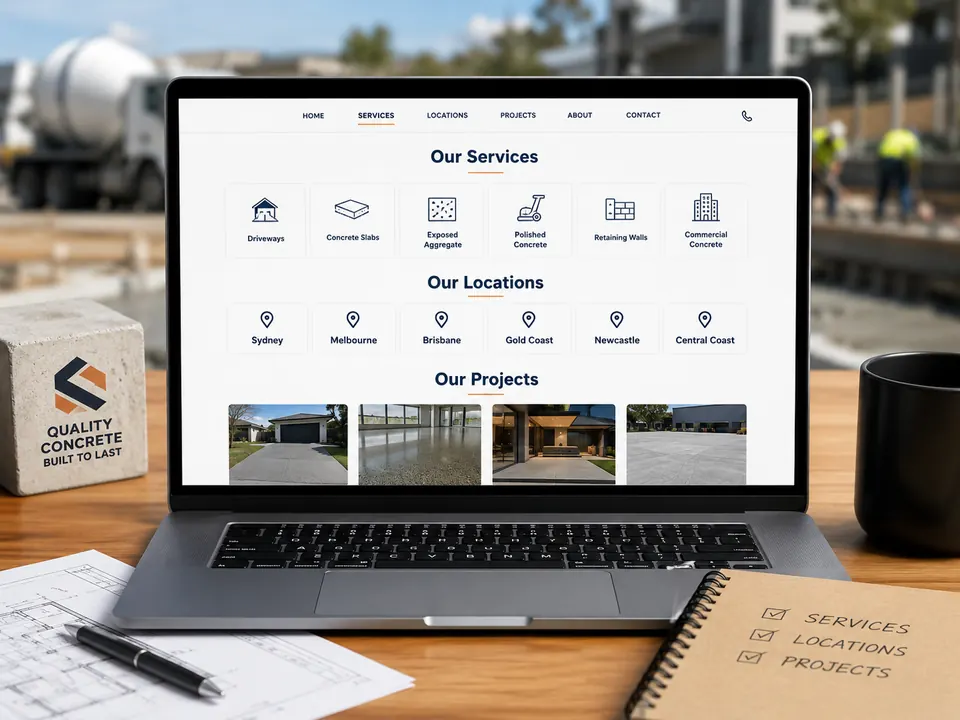
A concreter website should move customers from the broad business entity to a specific service, relevant location, completed project and quote action.
The recommended architecture is:
Concreting business → service page → location page → completed project → quote request
Core Service Pages
A separate page is justified when the service represents a distinct need.
Examples include:
- Concrete driveways
- House slabs
- Shed slabs
- Decorative concrete
- Pool surrounds
- Commercial concrete
- Repairs and replacement
Each service page should answer:
- What work is provided?
- Who is the service for?
- Where is it available?
- What preparation is required?
- Which finishes are available?
- What completed work proves experience?
- How does the customer request a quote?
Priority Location Pages
A useful location page must contain more than a changed place name.
It should demonstrate:
- Genuine service availability
- Real project experience
- Relevant concrete services
- Original local photographs
- Coverage and travel information
- Nearby customer evidence
- Contextual links to service pages
Google’s spam policies prohibit doorway abuse and scaled low-value content. We therefore build location coverage according to operating reality and available evidence.
Completed-Project Pages
A project page can connect several entities in one verifiable record:
Concrete service + location + property type + site problem + preparation + finish + completed result
For example:
Exposed aggregate driveway + residential property + failed existing surface + demolition and sub-base preparation + selected aggregate finish + completed vehicle access
This gives prospective customers more evidence than an unexplained image gallery.
Internal Linking
Internal links help users move between relevant pages.
A project page can link to its service page. A location page can link to services available in that area. A service guide can link to the appropriate quote page.
Anchor text must describe the destination. Descriptive links such as Local SEO for Tradies or SEO Pricing for Tradies provide more context than “click here.”
Why Choose SEO Agency for Tradies?
Our campaigns connect search visibility with job economics, operating areas, project proof and lead attribution.
We Start With the Work You Want to Win
We do not begin with a fixed keyword count or a generic content calendar.
We first identify:
- Preferred concrete services
- Minimum project value
- Crew capacity
- Profitable locations
- Customer types
- Excluded work
- Current close rate
- Lead-response process
This defines the type of demand the campaign needs to attract.
We Use Real Concreting Evidence
Your completed projects, customer questions, photographs, finishes and service locations become part of the search strategy.
Content connects:
- Service
- Customer
- Property type
- Location
- Site condition
- Preparation
- Finish
- Completed result
This creates more useful information than generic claims about “quality concreting solutions.”
We Track Enquiries Beyond Traffic
Reports can separate:
- Organic search
- Google Ads
- Direct traffic
- Referrals
- Social media
- Shared lead platforms
Where sales data is available, we can also compare qualified leads, quotes and booked projects.
You Retain Access and Ownership
Your proposal identifies who controls:
- Domain registration
- Website hosting
- Website administration
- Google Business Profile
- Google Search Console
- Google Analytics
- Published content
- Reporting data
Ownership and handover terms are documented before the campaign begins.
How Does Our Concreter SEO Process Work?
Our five-step process moves from commercial diagnosis to implementation, measurement and continuous improvement.
1. Commercial Discovery
We define:
- Profitable services
- Excluded services
- Target customers
- Genuine operating areas
- Minimum project size
- Current capacity
- Business goals
This prevents the campaign from targeting demand your team cannot or does not want to fulfil.
2. Website, Competitor and Local Audit
We assess:
- Existing rankings
- Website architecture
- Google Business Profile
- Service pages
- Location pages
- Competitor coverage
- Technical barriers
- Project evidence
- Reviews
- Citations
- Conversion tracking
The audit separates urgent problems from longer-term opportunities.
3. Technical and Conversion Foundation
We improve priority elements such as:
- Indexing
- Mobile usability
- Page speed
- Internal linking
- Calls to action
- Quote forms
- Analytics
- Phone tracking
This creates a measurable base before expanding the site.
4. Service, Location and Project Growth
We create or improve:
- Core service pages
- Priority location pages
- Completed-project pages
- Google Business Profile content
- Review processes
- Citations
- Relevant authority links
Every new page must represent a real service, location or project requirement.
5. Lead Analysis and Continuous Improvement
Monthly analysis compares:
- Organic visibility
- Google Maps coverage
- Calls
- Forms
- Lead quality
- Service demand
- Location demand
- Quotes and booked work where available
The next actions depend on evidence rather than an identical monthly checklist.
What Happens During the First 90 Days?
The first 90 days establish measurement, correct priority barriers and build the initial service and location foundation.
| Period | Main work | Client receives |
|---|---|---|
| Days 1–30 | Discovery, audit, tracking and opportunity mapping | Prioritised SEO roadmap |
| Days 31–60 | Technical, local and conversion improvements | Corrected campaign foundation |
| Days 61–90 | Service pages, project proof and authority work | Initial growth assets |
Days 1–30: Audit and Commercial Prioritisation
We complete:
- Business discovery
- Account-access review
- Website crawl
- Google Business Profile audit
- Competitor assessment
- Keyword-to-page mapping
- Conversion-tracking setup
- Priority roadmap
You receive a clear explanation of what requires immediate attention, what can wait and which opportunities have the strongest commercial justification.
Days 31–60: Foundation Improvements
We can implement:
- Technical corrections
- Core-page optimisation
- Internal-link improvements
- Google Business Profile updates
- Quote-form changes
- Citation cleanup
- Tracking validation
We improve existing assets before creating unnecessary new pages.
Days 61–90: Service and Location Growth
We begin:
- Missing service pages
- Priority location pages
- Project case studies
- Review-request workflows
- Authority development
- Initial performance comparison
The first 90 days establish the campaign foundation. Competitive ranking and enquiry growth develop at different rates according to starting condition, competition, location and implementation speed.
How Much Does SEO for Concreters Cost?
Concreter SEO packages currently start from $997 per month.
Your recommended package will depend on your website, competition, services, locations and growth goals.
What Determines Your Concreter SEO Investment?
- Your current website condition
- The concrete services you want to promote
- The number of genuine operating areas
- Local search competition
- Your existing Google visibility
- Your Google Business Profile condition
- Technical SEO problems
- Missing or underdeveloped content
- Available project photographs and evidence
- Call, form and lead-tracking requirements
- Residential or commercial targeting
- The size and complexity of the campaign
Local Starter SEO
From $997 per month
Suitable for an owner-operator or smaller concreting business that needs a stronger local-search foundation.
Package inclusions:
- Google Business Profile optimisation
- Core keyword and location mapping
- Homepage and priority service-page review
- Basic technical SEO corrections
- Call and form tracking where available
- Google Business Profile action reporting
- Monthly performance summary
Best for a concreting business with a limited number of priority services and a clearly defined local operating area.
Choose Local StarterGrowth SEO
From $1,497 per month
Suitable for an established concreting business targeting several profitable services, locations or customer types.
Everything in Local Starter SEO, plus:
- Detailed service-page optimisation
- Expanded keyword and location mapping
- Local-content planning
- Internal-link planning and improvement
- Citation and trust-signal guidance
- More detailed call and form tracking
- Ongoing service and location growth priorities
Often the best fit for concreters targeting driveways, slabs, exposed aggregate, decorative concrete or commercial projects across several suburbs.
Choose Growth SEOAuthority SEO
From $2,497 per month
Suitable for multi-service, multi-crew or multi-location concreting companies competing in larger and more difficult markets.
Everything in Growth SEO, plus:
- Deeper topical-authority planning
- Advanced technical SEO review
- Detailed competitor-gap analysis
- Broader service and location planning
- More extensive content architecture
- Looker Studio performance reporting
- Greater support for competitive search markets
Best for companies targeting several high-value services, wider geographic coverage, or both residential and commercial concrete opportunities.
Choose Authority SEOYour proposal will clearly identify the recommended package, monthly investment, included deliverables, initial priorities and any work that requires separate approval. SEO results vary according to competition, location, website condition and implementation.
What Is Included and What Is Not?
| Included | Separately scoped | Not included |
|---|---|---|
| SEO strategy | Complete website rebuild | Guaranteed rankings |
| Local SEO | Google Ads management | Guaranteed lead volume |
| Technical SEO | CRM implementation | Fake reviews |
| On-page optimisation | Professional photography | Purchased spam links |
| Priority service pages | Extensive video production | Duplicate suburb-page generation |
| Priority location pages | Tender writing | Hidden account ownership |
| Internal linking | Advanced sales automation | Unverified performance claims |
| Call and form tracking | Complex integrations | Keyword-stuffed content |
| Monthly reporting | Brand redesign | Traffic-only reporting |
Is SEO Better Than Google Ads or Shared Lead Platforms?
No channel is best in every condition. The correct choice depends on urgency, capacity, budget and the type of work required.
| Channel | Best use | Main limitation |
|---|---|---|
| SEO | Long-term direct search visibility | Requires sustained implementation |
| Google Ads | Immediate demand and service testing | Visibility stops when spending stops |
| Shared lead platforms | Filling short-term calendar gaps | Several contractors may compete |
| Social media | Visual proof and brand awareness | Lower immediate search intent |
| Referrals | Trust-led opportunities | Difficult to scale predictably |
When Does SEO Make Sense?
SEO suits concreting businesses that want to:
- Build direct Google visibility
- Target selected concrete services
- Develop genuine location relevance
- Reduce dependence on one lead source
- Retain control of their website and data
- Measure long-term organic demand
When Do Google Ads Make Sense?
Google Ads may be suitable when:
- Work is needed sooner
- A new service needs immediate exposure
- Seasonal capacity is available
- Organic visibility is still developing
- Landing pages and conversion tracking are ready
Can SEO and Google Ads Work Together?
Yes.
Paid search can test services, areas, keywords and landing pages. SEO can then build long-term assets around validated demand.
Both channels must use shared tracking so the business can compare cost per qualified enquiry and booked job.
Frequently Asked Questions About SEO for Concreters
SEO may be commercially viable when customers search for the services and locations your business can profitably serve.
The decision depends on project margin, search demand, competition, website condition, close rate and capacity. Traffic alone does not justify the investment.
Priority technical and local improvements can begin within the first 90 days, but competitive visibility and consistent enquiry growth usually require continued work.
The timeframe depends on your starting position, competition, location, website authority, content and Google Business Profile.
SEO can improve profile accuracy, service relevance, reviews and prominence, but it cannot guarantee map-pack placement.
Google also considers distance. Your business may have stronger visibility near its verified base than across distant service areas.
A separate page is useful when the service represents a distinct customer need and requires different information.
Concrete driveways, house slabs, exposed aggregate and commercial hardstands can justify separate pages. Minor wording variations do not.
Useful suburb pages can rank when they represent genuine service availability and contain original local information.
Pages with only the suburb name replaced provide little value and may fall within Google’s doorway-abuse policy.
Yes, when the current website can support the required technical, content and conversion changes.
A rebuild is considered only when the existing system creates persistent problems involving speed, mobile usability, architecture, security or editing access.
Call tracking and form-event tracking can identify the source, landing page, service and location connected with an enquiry.
Where your sales process records quotes and completed work, this data can be connected with booked jobs and attributed revenue.
Yes, ownership and handover terms are defined in writing before the campaign starts.
The agreement identifies control of the domain, website, Google Business Profile, analytics, paid content and reporting data.
Build a More Predictable Pipeline of Profitable Concrete Jobs
Your SEO campaign should target the services your crews complete profitably, in areas your business can serve efficiently, with reporting that connects Google visibility to qualified calls and quote requests.
You will receive a clear explanation of what needs attention, what can wait and which opportunities may have the strongest commercial value.


