
SEO for tradies improves a trade business’s visibility in unpaid search results for relevant services and locations. It connects useful website content, accurate business information, technical accessibility and credible evidence with the searches potential customers make.
A homeowner looking for a switchboard upgrade needs more than a page saying “electrical services”. They need to know whether the business performs that work, covers their suburb and has the qualifications and process to assess the job.
That is where useful SEO begins. The website and Google Business Profile need to describe the business clearly enough for search engines to understand it and for customers to assess it.
For an Australian trade business, the work follows a practical sequence: identify suitable jobs, understand the searches behind them, build useful information, establish credibility and measure the enquiries that follow.
Understanding How Tradie SEO Works
Tradie SEO connects local customer demand with a business that can fulfil it. The approach changes with the trade, service, operating area and type of customer.
An emergency plumber needs accurate availability and a direct contact route. A renovation builder needs project evidence, scope information and a clear quotation process. A commercial maintenance contractor needs to demonstrate capability for ongoing work. Treating all 3 as the same search problem produces generic pages.
The main SEO components work together. On-page SEO covers titles, headings, copy, images and internal links. Technical SEO concerns access, indexing, site responses and performance. Off-page SEO includes relevant external links and business references. Local SEO connects the website and business identity with geographic searches.
Customers encounter that information through different results. Google Maps and local results present business listings. Organic website results link to pages such as services, projects and articles. Paid advertisements are separate placements.
Google explains local ranking through relevance, distance and prominence. Relevance concerns the match to the search. Distance concerns the business’s proximity to the searcher. Prominence concerns how well known the business is. These factors explain why there is no single Maps position for every person searching across a city. See Google’s local-ranking guidance.
The practical implication is to define what the business does and where it operates before choosing keywords or publishing pages.
Keyword Research Starts with the Jobs You Want

Keyword research identifies the language customers use for work the business genuinely provides. Its purpose is to connect search demand with suitable jobs, rather than collect the largest possible keyword list.
Start with a service inventory. For an electrician, this might include switchboard upgrades, lighting installation, fault finding and EV charger installation. Add the actual operating area, customer type and availability for each service.
Those attributes shape the research. Residential installation work differs from commercial maintenance. Planned work differs from emergency assistance. A broad service region also needs closer examination of travel time and operational capacity.
The examples below illustrate likely search needs. They are not measured search-volume findings.
| Query pattern | Illustrative search | Likely information need |
|---|---|---|
| Service and location | switchboard upgrade Newcastle | Understand the service and find a suitable provider |
| Problem | hot water system leaking | Understand the issue and an appropriate next step |
| Urgency | emergency plumber Parramatta | Check coverage, availability and contact details |
| Project research | bathroom renovation process | Understand scope, stages and preparation |
| Commercial requirement | commercial roof maintenance Geelong | Assess capabilities, evidence and ongoing service |
The distinction between wording and need matters. The Stanford-hosted textbook Introduction to Information Retrieval explains relevance in relation to the user’s information need, rather than simply the presence of query words. Applied to content planning, this means explaining the task behind the phrase.
Use Search Console to examine queries already associated with your website. Use Keyword Planner for demand estimates under selected geographic and date settings. Review competing search results to understand which page types answer the query.
Interpret tool metrics correctly. Google’s Keyword Planner documentation defines competition as advertiser competition. It is not a measure of organic ranking difficulty. Third-party difficulty scores also need interpretation within the tool that produced them.
Prioritise service relevance, customer intent and area fit alongside estimated volume and seasonality. A specialised query can be useful even when its estimated volume is lower than a broad trade term.
Group related wording into keyword clusters, then assign each cluster to an existing or justified new page. “Switchboard upgrade” and “switchboard replacement” might share a destination when the business uses them for closely related work. Explain any technical distinction rather than automatically creating another URL.
Build a Website Structure Around Services and Genuine Coverage
A clear website structure gives each page a distinct purpose. It also helps readers move from a general question to the specific information they need.
The homepage introduces the business, its main services and its operating market. Service pages explain individual areas of work. Location pages address genuine geographic needs. Project pages provide evidence, while supporting articles explain subjects that need more depth.
For example, a switchboard project can link to the upgrade service. The service page can link to a useful explanation of assessment or quotation factors. Breadcrumbs show where a page sits within the website hierarchy.
A separate service page is justified by a distinct customer task and enough useful information to answer it. Blocked-drain clearing and bathroom renovations have different scopes and processes. Minor wording variations alone provide a weaker reason for separate pages.
Location pages need the same discipline. Include genuine coverage, relevant projects, applicable service details and useful operational information. A suburb name inserted into repeated copy contributes little local value. Google’s doorway abuse policy addresses substantially similar pages created for similar searches.
Internal links then connect the structure. Use anchors that accurately describe their destinations and place them where the next page helps the reader continue.
Before publishing, check for an existing page serving the same purpose. Two URLs appearing for one query do not automatically prove harmful keyword cannibalisation. Investigate duplicated intent, overlapping content and which destination best satisfies the task.
A canonical tag helps identify a preferred version of duplicate or similar content. It does not replace the editorial decision to improve or consolidate competing pages.
Create Service Pages That Explain the Work

An effective service page answers the questions a customer needs resolved before making a relevant enquiry. Search terms identify the subject; the explanation establishes usefulness.
Consider a hypothetical switchboard upgrade page for Newcastle. The service is the main entity. Its important attributes include the property type, assessment process, scope, operating area, relevant qualifications and quotation requirements.
Develop those details into connected copy. Explain the work available, what the assessment establishes and how the business handles the next step. Add verified project evidence where available. Technical trade statements need review by someone qualified to confirm them.
The page title, main heading and URL make the subject clear. A descriptive title could be “Switchboard Upgrades Newcastle — Business Name”, with an H1 such as “Switchboard Upgrades in Newcastle”. Supporting headings organise the process, evidence and common customer questions.
Write a factual meta description that summarises the page. Google can generate title links and snippets from several sources, so supplied wording is not always displayed unchanged. Its title-link guidance and snippet guidance explain this distinction.
Images contribute information when they show relevant work. Use appropriate dimensions and compression to reduce unnecessary file weight. A descriptive filename identifies the subject, while alt text communicates the image’s purpose. Decorative images generally use empty alt text.
The contact route belongs within that explanation. Provide a working telephone link or form and explain what information the business needs. A completed form needs to reach the correct destination; a visible button alone does not establish a functional enquiry process.
These are the relationships addressed through On-Page SEO Services for Tradies: the page’s subject, supporting evidence, search presentation and route to contact.
Keep Google Business Profile Accurate and Useful

Google Business Profile represents the business on Search and Maps. Its information needs to match the real operation, including the business identity, category, services and eligible location model.
Begin with ownership and verification. Keep appropriate access with the business and follow the verification options Google provides. Verification confirms authorised representation; it does not guarantee a ranking.
Use the recognised real-world name. Promotional phrases and added suburb keywords do not belong in the name field unless they are genuinely part of that name. Google’s business representation guidelines explain these requirements.
Review the profile’s core attributes together:
- Category: accurately identifies the main business type.
- Services: describe work actually available, such as fault finding or switchboard upgrades.
- Hours: reflect regular, holiday and emergency availability.
- Contact details: connect to the correct business and website destination.
- Photographs: accurately represent the team, premises where applicable and completed work.
The location model requires particular care. A service-area business visits customers. Customer-facing premises receive customers at an eligible location. Google’s service-area guidance requires businesses that do not serve customers at their address to remove that address from the profile.
List genuine coverage. Treat the setting as accurate customer information, while recognising that local ranking also depends on relevance, distance and prominence.
Coordinating profile details with website services, local evidence and measurement is part of Local SEO for Tradies.
Establish the Technical Foundation

Technical SEO establishes whether important pages are accessible, eligible for indexing and usable. It also helps distinguish a content problem from a technical barrier.
Search Access and Indexing
Google retrieves content through crawling, processes information for its index and selects eligible results for individual queries. These are different stages.
A roofing page can exist without being indexed. An indexed page can receive little visibility for its intended searches. Use Search Console’s URL Inspection tool to investigate the actual condition before rewriting the page.
The controls below perform different functions.
| Element | Function | Check |
|---|---|---|
| robots.txt | Controls access for compliant crawlers | Is an intended page blocked from fetching? |
| XML sitemap | Lists URLs for discovery | Are the intended canonical URLs included? |
| noindex | Requests exclusion from indexing when processed | Is the exclusion intentional? |
| Canonical URL | Signals a preferred version of similar content | Does it identify the intended destination? |
| Redirect | Sends a request to another URL | Is the destination relevant and permanent where appropriate? |
| HTTP status | Describes the response, such as success or a missing page | Does it reflect the actual page condition? |
Google explains that a robots.txt block does not reliably remove a URL from search. It also needs crawler access to process a noindex directive. Blocking access and requesting exclusion are different controls.
Use redirects for relevant replacements. Keep genuine missing-page responses where no suitable replacement exists. Keep internal links and sitemap entries consistent with the intended URLs. Google’s canonicalisation guidance explains how preferred-version signals work.
Mobile Performance and Enquiry Functionality
A mobile page needs readable content, usable navigation and a working route to contact. HTTPS encrypts the connection, while performance measures describe specific parts of the experience.
Google’s Web Vitals documentation defines 3 Core Web Vitals. Largest Contentful Paint (LCP) measures loading performance, with a good threshold of 2.5 seconds or less. Interaction to Next Paint (INP) measures responsiveness, with a good threshold of 200 milliseconds or less. Cumulative Layout Shift (CLS) measures visual stability, with a good threshold of 0.1 or less.
Assessment uses the 75th percentile, segmented by mobile and desktop. These measures describe experience; passing them does not establish a particular search position.
Test the actual customer task as well. Open the service page on a phone, tap the number, submit a valid enquiry and verify delivery. Record the result separately from the performance score.
Technical SEO Services for Tradies covers investigation of these access, indexing and performance conditions.
Use Real Work to Develop Supporting Content
Supporting content adds depth where a service page cannot answer the whole learning task. It connects customer questions with relevant trade knowledge and documented experience.
Start with questions raised during enquiries and quotations. A brief clarification belongs on the service page. A detailed explanation of renovation quotation inputs can justify an article. Link each article to its related service so readers can continue naturally.
Project case studies provide a different form of evidence. Record the service, general location, original problem, scope, constraints, work completed and verified outcome. Add photographs with the necessary permission.
The distinction between observation and inference matters. A project record can establish what was installed and which checks were documented. Claims about savings, lifespan or future performance need their own evidence.
Give technical content an identifiable author or qualified reviewer. Record meaningful updates when specifications, processes or guidance change. These details make the source of the information easier to assess.
Seasonality also informs planning when supported by enquiry history, search trends or relevant operating knowledge. Air conditioning demand in one region does not establish the same pattern across Australia.
A useful content plan connects each proposed article to a customer need, service, evidence source and existing destination. This keeps the website focused as it grows.
Build Local Credibility Through Evidence and Relationships
Customers assess whether a business is suitable for their work. Search engines also use information about businesses across the web. Accurate identity, genuine reviews and relevant external references support that assessment in different ways.
Reviews and Verifiable Business Details
A review records a customer’s reported experience. Assess its content, date and business response alongside the rating. Google states that review count and positive ratings can contribute to local ranking.
Request honest feedback without incentives or selective requests for positive reviews. Google’s review policies explain the restrictions.
Credentials support specific claims. An ABN identifies business registration; it does not establish a trade licence. A membership confirms an association relationship; it does not prove every capability listed on the website.
Publish current, relevant details and check licences through the applicable trade authority and jurisdiction. Connect each claim with the evidence that supports it.
Citations and Relevant Backlinks
A citation mentions the business on another website. NAP refers to its name, address and phone information. A backlink provides a clickable reference to the website.
For example, a supplier page naming an installer is a citation. If it links to the installer’s website, it also provides a backlink.
Review substantive accuracy across relevant listings. An old number or false location misdirects customers. Represent a service-area business appropriately rather than presenting a private address as customer-facing premises.
Genuine relationships provide relevant link opportunities. These include authorised-installer listings, trade-association directories and documented project features. Evaluate the source, audience, placement, destination and reason for the reference.
An Australian domain alone does not establish quality. Google’s link-spam policies address manipulative practices, including purchased ranking links. Paid sponsorship links require appropriate qualification.
Add Structured Data with Clear Expectations
Structured data describes information in a machine-readable format. Its purpose is to represent accurate information using applicable properties and supported guidelines.
LocalBusiness markup can describe attributes such as the business name, URL, telephone, type and operating hours. Google’s LocalBusiness documentation specifies requirements for its supported feature, including physical address information.
Keep feature eligibility and private-address decisions separate. Inventing an address to satisfy validation misrepresents the business. Valid markup also does not guarantee a particular search appearance.
Check that structured data agrees with the visible page. Validate it after implementation and review it when business details change.
Review stars require separate consideration. A testimonial widget does not automatically qualify the business for stars in Google results. Google’s review-snippet guidelines restrict self-serving reviews for LocalBusiness and Organisation markup.
AI search needs the same evidence-based approach. Google’s AI features guidance states that established SEO practices remain relevant and that no special AI schema is required for AI Overviews or AI Mode.
Keep information clear, accessible and supported. Record AI inclusion when observed, without treating it as a guaranteed deliverable.
Measure Qualified Enquiries Alongside Search Visibility
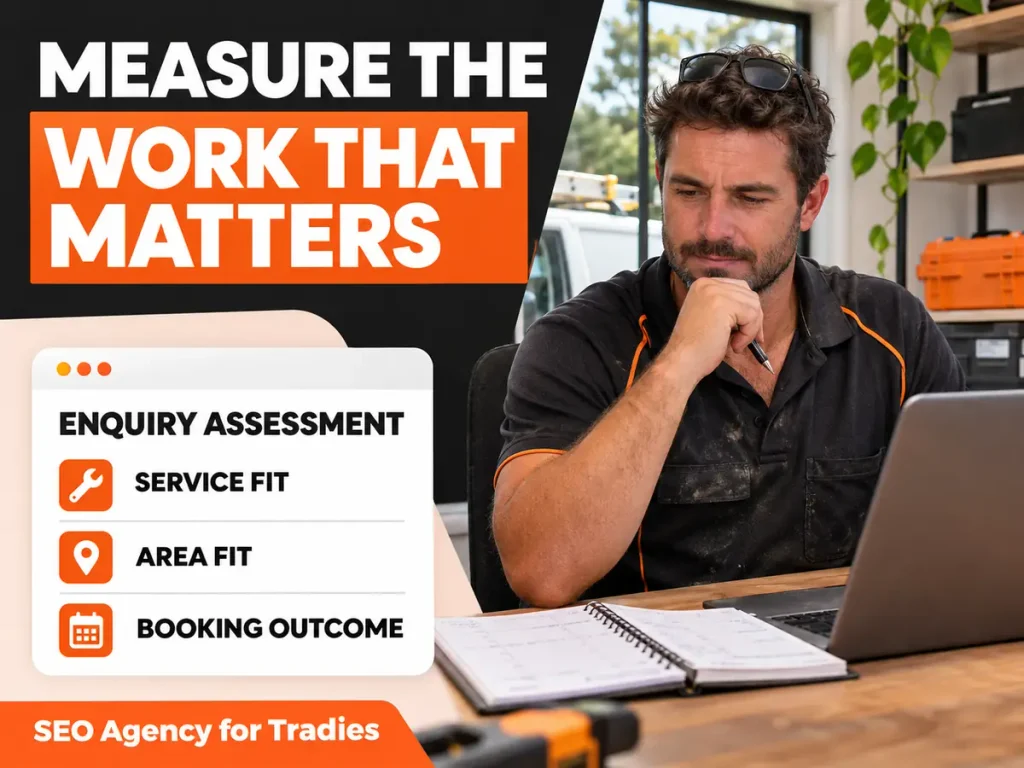
SEO reporting needs to distinguish exposure, visits, contact and confirmed work. Each stage answers a different question.
Search Console reports search queries, pages, impressions, clicks, click-through rate and average position. GA4 records configured website activity. Business Profile reporting records supported profile interactions. Call tracking and enquiry records add information about contact and subsequent outcomes.
| Measurement | Useful question | Interpretation limit |
|---|---|---|
| Search impressions | Is the website appearing for relevant queries? | An appearance is not a visit |
| Search clicks and CTR | Are searchers choosing the result? | A click is not an enquiry |
| Website events | Are visitors completing the intended action? | An event needs reliable configuration |
| Qualified enquiries | Does the requested work match the business? | An enquiry is not a booked job |
| Booked work and contribution | Is suitable work being won profitably? | Revenue alone does not establish profit |
Google’s Search Console performance documentation explains its metrics. Review queries and landing pages together so an increase in traffic can be assessed for service and location relevance.
Configure form measurement around successful submissions. A telephone-link click needs separate treatment from a connected call. Use campaign URL parameters where useful to distinguish tagged link sources.
Consider an illustrative month with 20 enquiries, of which 12 match the service and operating area. If 6 of those become booked jobs, the qualification rate is 60% and the qualified-enquiry booking rate is 50%.
These are calculations, not industry benchmarks. Record the reporting period, definitions and attribution limits. Review actual job costs when assessing commercial contribution.
This measurement also guides the next task. Unsuitable-area enquiries point towards coverage and targeting checks. Relevant visits followed by failed submissions point towards the enquiry process.
Turn the Findings into a Prioritised Action Plan
A practical SEO plan starts with the current condition of the business and website. The work needs a reason, an owner and a completion test.
Use this sequence to establish the priorities:
- Confirm access and ownership. Identify who controls the domain, website, Business Profile, Search Console and analytics.
- Record the baseline. Preserve important page status, relevant query performance and available enquiry data.
- Investigate barriers. Check indexing restrictions, inaccessible pages and failed contact routes.
- Improve relevance and evidence. Develop core service information, genuine coverage and verified project detail.
- Review outcomes. Record completed work and examine visibility, qualified enquiries and booked jobs over suitable periods.
The order depends on the evidence. A technically accessible website with weak service content needs different work from a site with unintended indexing exclusions.
Make completion checks specific. A form repair is complete when a valid test reaches its destination. A content task is reviewable when the service scope, coverage and supporting evidence are present. Search effects require observation after implementation.
The same standard helps assess outside support. A useful proposal identifies the affected pages or profile details, explains the reason for the work and defines how progress will be reported.
Frequently Asked Questions
How long does SEO take for a trade business?
SEO has no fixed completion date or universal ranking timetable. Google explains that changes can show effects within hours or take several months. Competition, the starting condition and implementation all affect the assessment. Record completion dates and review suitable reporting periods rather than accepting a guaranteed ranking deadline.
Can a tradie manage SEO without an agency?
A business owner can manage tasks such as updating accurate profile details, collecting project evidence and reviewing customer questions. Technical diagnosis, website restructuring and measurement configuration require the corresponding skills and access. The choice depends on available time, capability and the complexity of the work.
How much does SEO for tradies cost?
The cost depends on the work required, competition, service range, operating areas and delivery scope. A defined audit differs from ongoing implementation. Compare the tasks, evidence, ownership and reporting included in each proposal. Our SEO cost guide for Australian tradies examines those considerations separately.
Is Google Business Profile enough without a website?
An eligible Business Profile provides a presence on Search and Maps, while a website offers space for detailed services, projects and supporting information. The appropriate next step depends on the business’s current visibility and customer needs. A profile alone does not replace the functions of a useful website.
Get a clear starting point for your website. Request an assessment through SEO Audits for Tradies to identify the affected pages, relevant opportunities and checks needed to confirm progress. For coordinated implementation, explore SEO for Tradies.


