

SEO for an Australian trade business commonly costs between $1,000 and $3,000 per month for a managed local campaign. Smaller packages are publicly advertised from roughly $300 to $1,000 per month, while campaigns covering competitive cities, several services or multiple locations can cost $3,000 to $5,000+ per month.
Those figures are a guide, not an official industry average. Public Australian pricing varies from HeyTradie’s advertised starting price of $300 per month to retainers above $5,000 on broader agency pricing pages. StudioHawk publishes tiers from $500–$1,000 for entry-level work to $5,000+ for comprehensive campaigns. Websites That Sell reports a still wider Australian range, but its figures include local, national and enterprise campaigns that should not be treated as equivalent products.
The useful question is therefore not simply, “How much does SEO cost?” It is:
What work does my trade business need, what commercial opportunity can that work address, and how will I know whether it produces qualified enquiries?
A $700 package can be expensive if it changes a few title tags and sends an automated ranking report. A $2,500 campaign may be commercially sensible if it fixes a damaged website, develops profitable service pages, improves genuine local visibility and tracks enough qualified calls to cover its cost. Price only becomes meaningful when it is connected to scope, accountability and business economics.
All prices in this guide are in Australian dollars. Public prices may exclude GST. Competitor prices were checked in September 2026 and can change. Examples in this guide are illustrations, not forecasts or guarantees.
SEO pricing for Australian tradies at a glance
The table below combines publicly advertised Australian prices with the type of work normally associated with each level. It is a scope guide, not a universal market rate.
| Indicative monthly investment | Likely campaign scope | Possible fit | Main limitation to check |
|---|---|---|---|
| Under $500 | Basic setup, software-led reporting or a tightly limited task | A new sole trader needing foundations | Usually too little implementation for a competitive market |
| $500–$1,000 | Foundational on-page work, limited local optimisation and reporting | One service area with modest competition | Content, technical development and authority work may be limited |
| $1,000–$2,500 | Local SEO, service-page improvements, Google Business Profile work, technical fixes and tracking | An established local trade business | Exact monthly content and link scope can vary substantially |
| $2,500–$5,000 | Multi-service or metro campaign with sustained content, technical work, authority building and conversion tracking | A growing multi-crew business | Requires the capacity and margins to turn extra leads into profitable jobs |
| $5,000+ | Multi-location, franchise, national or technically complex campaign | A larger contractor or multi-location operator | Higher spend is not automatically better; governance and attribution matter |
Paramark places most small-business SEO between $1,200 and $2,500 per month, while Safari Digital publishes a $1,400–$2,500 small-business range. WebApex specifically places trades and construction SEO at $1,500–$2,500+ per month. These ranges overlap, but they remain claims published by providers with different inclusions and methodologies.
This is why a tradie should compare the work behind the number. Ask how many services and locations will be addressed, which pages will be created or improved, whether Google Business Profile work is included, what technical implementation is covered, and how calls and forms will be attributed.
Why two tradies can receive very different SEO quotes
SEO is ongoing professional work, not a standard unit that every business consumes equally. A useful simplified model is:
SEO investment = required work × specialist resources × market difficulty
Consider two plumbing companies. The first is an owner-operator serving four nearby suburbs. Its website is technically sound, it has a verified Google Business Profile and it wants more hot-water replacement enquiries. The second company has five crews, covers Greater Melbourne and wants to rank for emergency plumbing, blocked drains, pipe relining, gas fitting and commercial maintenance.
Both are plumbers, but their campaigns are not comparable. The second business needs a larger keyword map, more service content, more location decisions, stronger authority, deeper tracking and more ongoing coordination. A fair quote should reflect that difference.
The same applies across trades. A builder seeking a small number of high-value renovation enquiries has a longer customer journey than an emergency electrician trying to win calls within minutes. A landscaper may depend heavily on project imagery and design-led service pages. A pest controller may face seasonal peaks and urgent mobile searches. A fixed package based only on “ten keywords” ignores these commercial differences.
The Eight Factors That Have The Greatest Effect On Cost
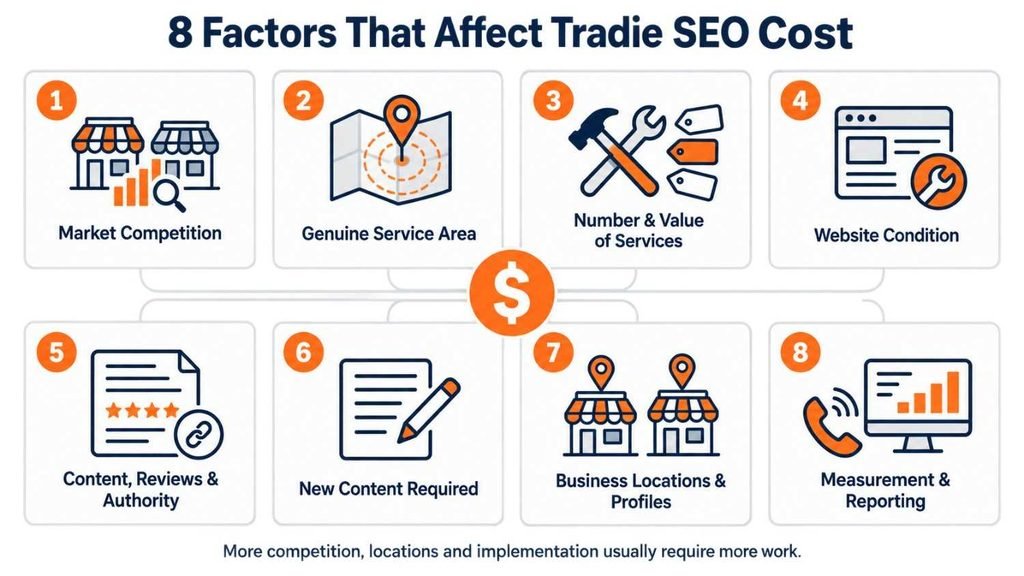
1. Competition in your trade and market
SEO becomes more expensive when several capable businesses are already competing for the same searches. The agency may need to close gaps in content, website quality, local prominence, reviews and relevant links before meaningful visibility is possible.
Competition must be assessed at query level. “Electrician” is not one market. Emergency call-outs, switchboard upgrades, EV charger installation, rewiring and commercial maintenance have different competitors and customer intent. The same distinction applies to blocked drains versus bathroom plumbing, roof repair versus roof replacement, and residential painting versus commercial painting.
The correct analysis asks which services generate acceptable margins, where the business can deliver them and which companies currently hold visibility. It should not multiply a generic keyword list to make a package look larger.
2. Your genuine service area
Targeting one town is different from targeting an entire capital city. Every extra location creates decisions about relevance, evidence, internal linking, Google Business Profile coverage and whether a dedicated page is justified.
Google says local results are mainly influenced by relevance, distance and prominence. Google also says there is no way to request or pay for a better local ranking. Complete business information, reviews, links and wider recognition can contribute, but distance remains a condition an agency cannot remove. These points are documented in Google’s official local-ranking guidance.
That matters for service-area businesses. Publishing 100 near-identical suburb pages cannot manufacture genuine proximity, and it can create a large maintenance and quality problem. A better campaign maps profitable services to areas the team can consistently reach, then uses local evidence where a location page is genuinely useful.
3. The number and value of services being promoted
One broad services page is rarely the best answer for every job a tradie performs. A potential customer searching for “burst pipe repair” needs different information from someone comparing whole-house repiping. Search intent, urgency, proof and the required call to action differ.
More services may require more research, page planning, writing, imagery, internal links and conversion paths. But more pages are not automatically valuable. The campaign should prioritise services using demand, profitability, team capability and competitive feasibility.
This is where a specialised SEO service for tradies should differ from a generic content package. The work should connect search visibility with jobs the business wants and can fulfil.
4. The condition of the existing website
A healthy website gives an SEO campaign something to build on. A damaged or disorganised site consumes budget before growth work can begin.
Common cost drivers include pages that cannot be indexed, duplicate location content, redirect chains, broken internal links, slow mobile templates, poor navigation, competing URLs and a previous migration that lost valuable pages. Google describes Search as a process involving crawling, indexing and serving results. A page cannot produce organic enquiries if Google cannot reliably discover or understand it. See Google’s explanation of how Search works.
A proper technical SEO service for tradies should distinguish diagnosis from implementation. A report identifying 200 problems is not equivalent to developers correcting the templates, redirects, structured data and internal architecture causing them.
5. Your existing content, reviews and authority
An established business may already have useful service pages, local links, project evidence and customer reviews. A new domain may have none of these assets. The new business needs more foundational work even if both companies target the same market.
Authority work also varies in quality and cost. Directory listings can help maintain consistent business information, but they are not a complete link strategy. Genuine supplier relationships, trade associations, local sponsorships, original resources and digital PR take more judgement and effort than buying bulk links.
Google’s Search Essentials recommends creating helpful, reliable, people-first content and using clear words in titles, headings and link text. It does not provide a required word count or a shortcut based on publishing volume. Google’s Search Essentials is a better reference point than an agency claiming that a fixed number of blog posts guarantees rankings.
6. The amount of new content required
Content cost depends on what must be produced and who must contribute. Improving an existing service page can require less work than interviewing a licensed contractor, documenting a process, sourcing project photographs and building a new location-service resource.
Useful tradie content may include service pages, project profiles, comparison guides, maintenance information, pricing explanations and location pages supported by real work. It should answer the question behind the search and help the customer decide whether the business is suitable.
Cheap content becomes costly when it creates cannibalisation, incorrect technical statements or dozens of pages that need to be rewritten. Ask how the agency verifies trade-specific claims and prevents several URLs from targeting the same intent.
7. The number of legitimate business locations and profiles
A company with one Google Business Profile requires less administration than a business with several eligible locations. Each legitimate profile can require accurate hours, categories, services, photographs, review processes, landing-page alignment and performance monitoring.
Google expects Business Profile information to be complete and accurate. It also states that more reviews and positive ratings can help local ranking, while useful replies and current photos help customers assess the business. That makes profile work more substantial than adding a few keywords to a description.
Review the scope of Google Business Profile optimisation separately. Some SEO retainers include initial setup only; others include ongoing management, review support and performance analysis.
8. Measurement and commercial reporting
Rankings are diagnostic data, not the final business outcome. A tradie ultimately needs qualified phone calls, quote requests and booked work from suitable locations.
Reliable measurement may include Google Search Console, GA4, form-event tracking, source-specific phone tracking, Google Business Profile actions and CRM outcomes. More advanced setups connect the original source with lead quality, quoted value and booked revenue. That work costs more, but it answers the question that a ranking report cannot: did the campaign create commercially useful opportunities?
Tracking has limitations. Some customers call later, switch devices or discover the brand through several channels. Good reporting should explain those limits instead of pretending every lead has perfect attribution.
What should be included in a managed tradie SEO campaign?
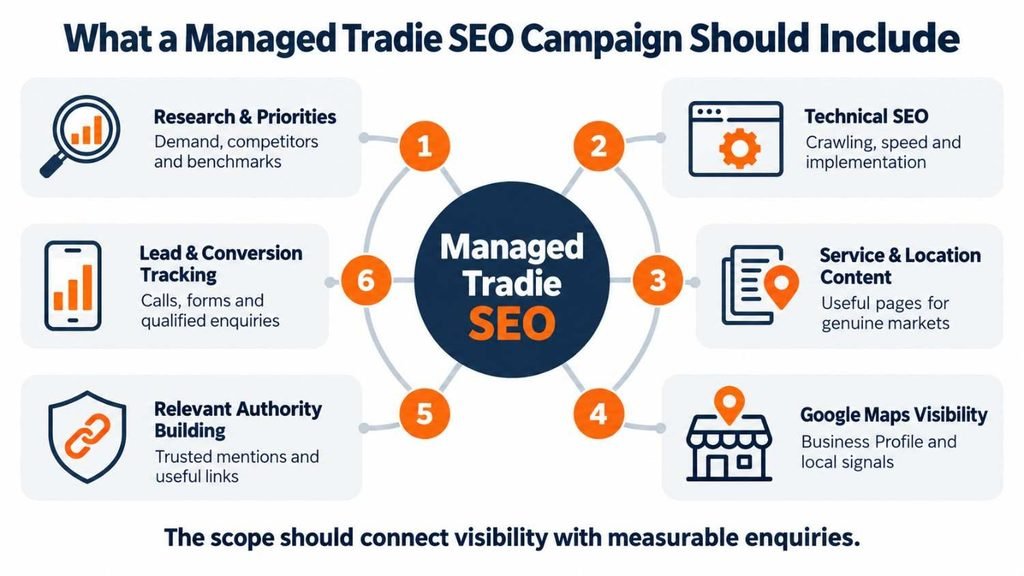
No package needs every possible SEO activity every month. It should, however, cover the constraints preventing the business from competing and converting.
Research, benchmarking and prioritisation
The opening stage should define the business problem before prescribing pages or links. That normally includes:
- Priority services and gross-profit potential
- Genuine service areas and travel limits
- Competitor visibility across Search and Maps
- Current rankings, impressions, clicks, calls and forms
- Website crawling, indexing and conversion issues
- A page-to-keyword map that reduces internal competition
This stage should produce a ranked implementation plan. An audit that lists problems without showing their commercial priority is incomplete. If you need diagnosis before committing to ongoing work, a dedicated SEO audit for tradies may be the cleaner purchase.
Technical implementation
Technical work helps search engines discover and interpret the site while keeping the customer experience usable. Depending on the website, it may include crawl controls, indexing fixes, canonicalisation, redirects, structured data, mobile performance, Core Web Vitals, sitemap review and architecture changes.
Ask who implements the changes. Some agencies provide recommendations for your developer. Others include WordPress or development work. These are not the same scope, even when both proposals say “technical SEO.”
Service and location content
Content should organise the website around real services and customer decisions. A good campaign may improve existing pages before recommending new ones. It should also distinguish a city hub from an individual service page, and use suburb pages only when they can provide unique value.
The cost rises with the number of pages, the depth of expert input, design requirements and approval process. A page built from a template with a location name swapped is cheaper to produce, but it also offers little evidence that the company understands or serves that area.
Google Maps and local visibility
For many trade businesses, the website and Google Business Profile work together. The campaign may address primary and secondary categories, services, hours, attributes, images, review processes, business information, website alignment and local citations.
This work should remain within Google’s rules and the business’s genuine operating model. No agency controls distance or can sell a guaranteed Map Pack position. A useful local SEO campaign for tradies manages the signals the business can legitimately improve.
Relevant authority building
Authority can come from real-world relationships as well as publisher outreach. Suppliers, manufacturers, trade associations, local organisations, project partners and community activity may create legitimate mention and link opportunities.
The proposal should state how links are evaluated and acquired. “Ten backlinks per month” says nothing about relevance, placement or risk. Low-quality links can produce a large activity count without building a defensible brand.
Conversion and lead tracking
The website should make the next step obvious. Emergency services often need prominent mobile calling. Higher-consideration projects may need galleries, qualifications, service boundaries, a detailed quote form and evidence near the enquiry point.
Tracking should capture the actions that matter for that journey. A builder may value qualified form submissions and scheduled consultations. An emergency plumber may depend on answered calls. Reporting both businesses with the same traffic dashboard misses the commercial difference.
What should you expect at each budget level?
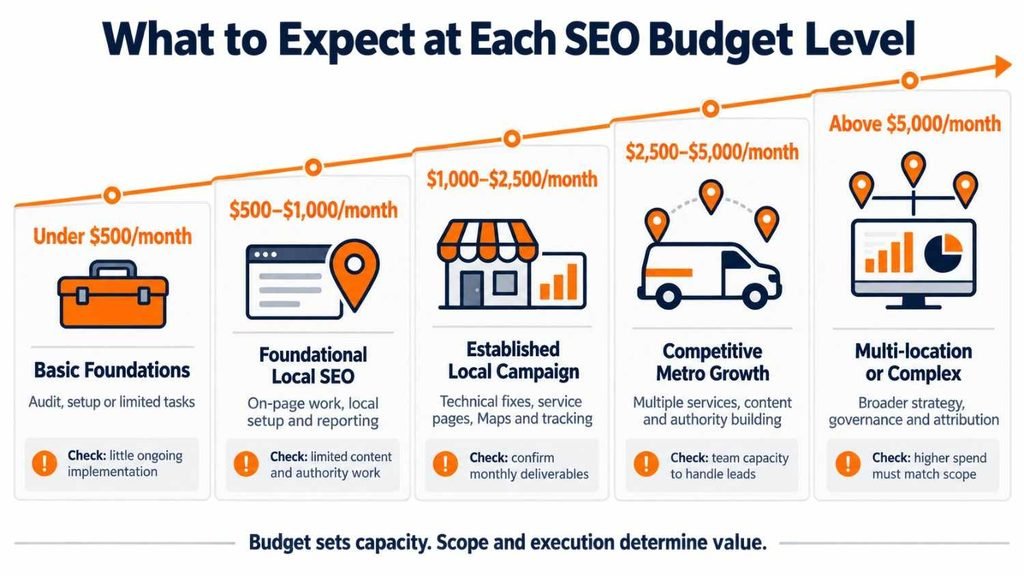
Under $500 per month
At this level, the work must be narrow. It may cover software monitoring, basic reporting, a small amount of on-page optimisation or an initial Google Business Profile task. A provider could also offer a low introductory price that changes after setup.
This level is not automatically fraudulent or useless. It can suit a defined maintenance task or a sole trader in a low-competition market. The weakness appears when the provider promises full technical SEO, continuous content, quality links, local management and strategic support within a budget that cannot fund those activities.
Ask for the monthly hours, named deliverables and exclusions.
$500–$1,000 per month
This budget may support foundational local work for a smaller business. Public examples include 21 Webs packages at $549 and $999 per month and Social Space plans starting from $449 per month.
Compare their actual inclusions, contract periods and target markets rather than treating the price as proof of value. At this level, expect prioritisation. The agency may improve a limited number of pages and local assets, but substantial monthly content, development and outreach may sit outside the package.
$1,000–$2,500 per month
This is where several Australian providers place small-business or trades SEO. A campaign may combine ongoing on-page work, technical fixes, service content, Google Business Profile optimisation, citations, reporting and some authority development.
The range is still too broad to assume equal value. One provider may include development and call tracking; another may bill those separately. One may produce a researched service page; another may count a short templated article as the same deliverable.
This budget often fits an established local business with a defined service area and a small group of profitable services. It becomes less realistic when the business wants to target an entire capital city, dozens of services and several locations simultaneously.
$2,500–$5,000 per month
This level can support a more competitive metro campaign, multiple service clusters, sustained content, technical implementation, stronger authority work and deeper reporting. It can also support coordination between SEO, development, content and analytics specialists.
The business case matters. A multi-crew company with spare capacity and high-value jobs may be able to justify this investment. A solo operator already booked six weeks ahead may not benefit until capacity or pricing changes.
Above $5,000 per month
Higher retainers are more common when the website, market or organisation is complex. Examples include multi-location operators, franchises, national contractors, large migrations, digital PR campaigns and sites needing custom analytics or ongoing development.
Do not assume a larger team or higher fee guarantees better execution. Ask who owns the strategy, who completes the work, how priorities are approved and which business outcomes are reviewed.
Monthly retainer, project or hourly SEO?
The right pricing model depends on the job.
| Pricing model | Best suited to | Advantage | Limitation |
|---|---|---|---|
| Monthly retainer | Ongoing competition and growth | Supports continuous implementation and learning | Requires sustained investment and clear accountability |
| One-off audit | Diagnosing a known or suspected problem | Provides a defined assessment | Recommendations still need implementation |
| Fixed project | Migration, rebuild or a set group of pages | Clear scope and end point | New issues and ongoing competition continue after completion |
| Hourly consulting | Advice, training or internal team support | Flexible access to expertise | Disconnected hours may not create a complete campaign |
| Performance-related model | Carefully defined and attributable outcomes | Can align incentives | Attribution, lead quality and contract terms can become contentious |
StudioHawk lists $150–$300 per hour and $2,000–$10,000 for audits or migrations. Safari Digital publishes an indicative hourly range of $140–$200. These are provider-published ranges rather than regulated rates.
Per-keyword pricing deserves special caution. A keyword count can be easy to report, but it can encourage low-value terms and ignore how pages rank for groups of related searches. A better scope connects services, locations, pages, technical work and measurable enquiries.
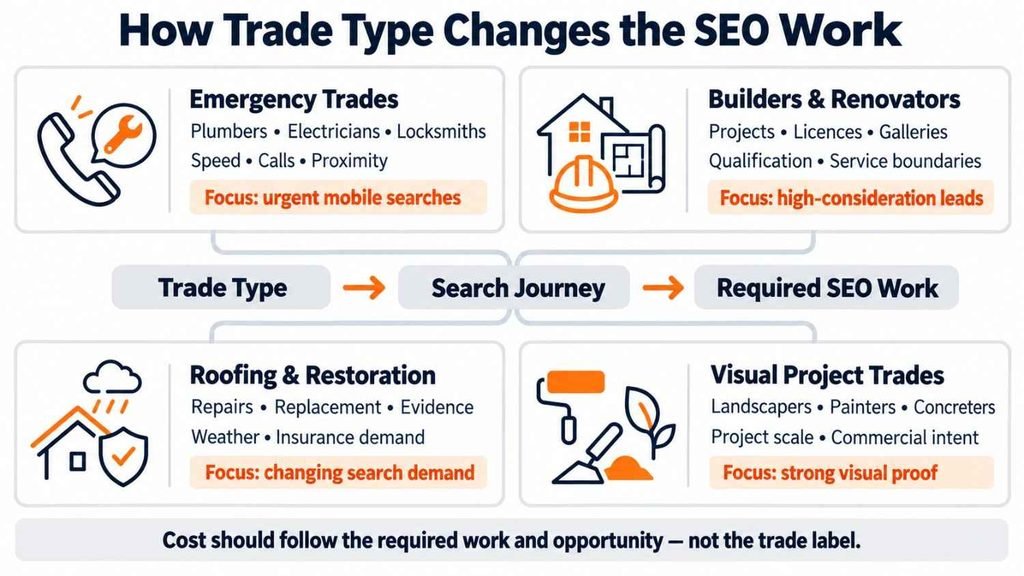
How trade type changes the work, but not through a simple price chart
There is no credible rule that every plumber should pay one price and every painter another. Trade type affects the search journey and competitive work required.
Emergency plumbers, electricians and locksmiths
Urgent searches have short decision windows. Mobile speed, tap-to-call design, opening hours, proximity, reviews and accurate service information can influence whether visibility becomes a call. Campaigns may need specific emergency pages and careful call tracking.
Builders and renovators
Construction enquiries tend to involve more consideration. Project type, licence information, service boundaries, galleries, case evidence and qualification forms can matter more than immediate call volume. A smaller number of suitable leads may carry substantial value.
Roofers and restoration companies
Demand can change with weather and insurance events. Repair, restoration and replacement searches require different content. Evidence such as project images, material experience, licences and response coverage can affect conversion.
Landscapers, painters and concreters
Visual evidence, project scale and residential-versus-commercial intent are important. A campaign may need a strong project structure and service differentiation rather than a large volume of general blog content.
SEO cost should follow the required work and opportunity, not a superficial industry label.
Regional and metropolitan campaigns need different plans
A regional tradie may face fewer direct competitors but lower search demand. A metropolitan company can access more demand while competing against businesses with established websites, hundreds of reviews and stronger backlink profiles.
The number of target suburbs is only one difference. Travel time, crew location, job margin and the ability to serve the area consistently should shape the campaign. A company based in western Sydney may not want low-value enquiries from the other side of the city, even if “Sydney-wide” visibility looks impressive in a report.
Use a city page only when the campaign has genuine city-level value. Your strategy can then connect it with relevant service pages and carefully selected location coverage. See how this principle is applied in our guides to tradie SEO in Sydney, Melbourne, Brisbane, Perth and Adelaide.
Calculate affordability using job economics, not rankings
The most useful budget starts with the value and capacity of the trade business.
Step 1: Estimate gross profit per completed job
Gross profit per job = job revenue − direct cost of delivering the job
Direct costs might include labour directly assigned to the job, materials, subcontractors and other costs that rise when the job is completed. Use figures from your accountant or job-management system rather than revenue alone.
Step 2: Calculate the estimated value of a qualified lead
Estimated lead value = gross profit per job × lead-to-job rate
Suppose an electrical service produces $1,000 in gross profit per completed job and the business converts 25% of qualified enquiries into jobs.
$1,000 × 0.25 = $250 estimated gross-profit value per qualified lead
That does not mean every lead is worth exactly $250. It is an average for planning under the stated assumptions.
Step 3: Calculate break-even leads
Break-even qualified leads = monthly SEO cost ÷ estimated lead value
With a $1,500 monthly SEO investment and the $250 estimated lead value above:
$1,500 ÷ $250 = 6 qualified leads
Under those assumptions, approximately six additional qualified leads would need to be generated and handled at the established close rate to cover the monthly SEO cost at a gross-profit level.
Step 4: Stress-test the assumptions
Change the model before relying on it:
- What happens if only 15% of leads become jobs?
- What happens if half the enquiries are outside the service area?
- Can the team complete the additional work?
- Are calls answered during peak periods?
- Does the average hide a small number of unusually profitable projects?
- How long can the business fund the campaign before break-even?
This calculation does not prove that SEO will generate the required leads. It identifies the commercial threshold the campaign must be measured against.
SEO or Google Ads: where should a tradie put the next dollar?
SEO and Google Ads solve different timing problems. Ads can create immediate visibility while the advertiser continues paying for eligible clicks. SEO generally develops more gradually and can retain value through improved pages, authority and local assets, although rankings are never permanent or guaranteed.
| Decision factor | SEO | Google Ads |
|---|---|---|
| Speed | Usually gradual | Can begin after campaign approval and launch |
| Cost mechanism | Professional work and campaign resources | Media spend plus management and production |
| Control | Less direct control over organic placement | More control over targeting, budgets and scheduling |
| Residual value | Improved assets can continue producing visibility | Paid visibility stops when spend stops |
| Best fit | Sustainable coverage of profitable services | Immediate, seasonal or tightly controlled demand |
Many tradies use both. Ads can test services and generate demand while organic assets develop. SEO can reduce dependence on a single paid channel over time. Read the scope of Google Ads for tradies before comparing the two budgets.
Red flags in a cheap or unclear SEO proposal
Guaranteed rankings
Google explicitly says businesses cannot request or pay Google for better local ranking. Organic and local results depend on systems an agency can influence but does not control. A guarantee of a particular position should be treated cautiously.
A large keyword count with no commercial map
Fifty keywords can include irrelevant suburbs, low-value questions or minor variations of the same phrase. Ask which services, pages and customer actions the terms support.
No access to your own data
The business should retain appropriate access to its website, Google Business Profile, Search Console, Analytics and advertising accounts. A provider should explain ownership and access before work begins.
Rankings without enquiry tracking
A campaign can improve a low-value ranking without producing a single suitable job. Reporting should connect visibility to calls, forms and lead quality where measurement permits.
Copied suburb pages
Mass-produced location pages can create duplication, weak customer value and internal competition. Ask what unique evidence each page will contain and why it deserves to exist.
Unexplained backlinks
Ask where links come from, how sites are assessed and whether placements are paid. Google’s guidance requires paid links to be qualified appropriately and warns against manipulative practices through its spam policies.
Vague contracts and exit terms
Read the service agreement, renewal conditions, cancellation process, asset ownership and exit fees. Australian law can protect eligible small businesses from unfair terms in standard-form contracts. The ACCC explains current unfair-contract-term protections, including changes that prohibit proposing, using or relying on unfair terms in covered contracts. This is general information, not legal advice; obtain professional advice about a specific agreement.
How to compare two SEO quotes fairly
Put both proposals into the same scope table. If an item is unclear, mark it “not stated” rather than assuming it is included.
| Question | Evidence a useful proposal should provide |
|---|---|
| Which services are priorities? | Named services connected to demand, margin and business capacity |
| Which locations are included? | Genuine service areas with a reason for prioritisation |
| What happens in the first 90 days? | Baseline, fixes, page priorities, GBP actions and measurement setup |
| What is delivered each month? | Specific implementation categories and decision process |
| Who produces and approves content? | Named responsibility and fact-checking process |
| Who implements technical fixes? | Agency, client developer or a separately billed provider |
| Is Google Business Profile work included? | Setup, optimisation, ongoing management or clearly stated exclusion |
| How are calls and forms measured? | Tools, attribution limits and reporting method |
| How is lead quality reviewed? | Location, service, qualification and booked-job feedback |
| How are backlinks obtained? | Method, relevance checks and disclosure of paid placements |
| Who owns accounts and content? | Written ownership and access terms |
| What is the minimum term? | Start date, renewal, cancellation and exit conditions |
Then compare cost. A $1,200 proposal that includes implementation may provide more value than a $900 proposal that sends recommendations to a developer charging separately. Conversely, a business with an internal content and development team may only need specialist strategy and review.
How long should a tradie budget for SEO?
There is no universal month in which SEO “starts working.” The initial condition, competition, implementation pace and search systems all affect the timeline. Google also states that following best practices does not guarantee that a page will be crawled, indexed or served.
A campaign can still use observable milestones:
- Foundation: access, measurement, technical diagnosis and commercial priorities.
- Implementation: technical corrections, page improvements and profile work.
- Visibility development: improved indexation, relevant impressions and query coverage.
- Enquiry development: qualified calls and forms from target services and areas.
- Commercial refinement: better lead quality, conversion paths and budget allocation.
Judge early work by whether important foundations and agreed deliverables are completed. Judge mature work by qualified visibility, enquiries and commercial contribution rather than the age of the contract alone.
When SEO is not the next investment your business needs
SEO is not automatically the best use of every tradie’s next marketing dollar.
Fix the operating constraint first when:
- Calls regularly go unanswered.
- The business has no capacity for additional jobs.
- Profitable services and service boundaries are unclear.
- Quotes are rarely followed up.
- Reviews reveal a persistent service problem.
- The website cannot be edited and a rebuild decision is imminent.
- The business needs leads within days and has no existing organic foundation.
- Cash flow cannot support a campaign long enough to test and improve it.
In these situations, call handling, reputation, sales follow-up, capacity planning, website infrastructure or a controlled paid-search test may produce more immediate value. An ethical provider should be willing to say that SEO is premature.
How much should your trade business spend?
Sole trader with a limited service area
Start with a narrow scope. Prioritise the Google Business Profile, core technical health, one or two profitable services, accurate tracking and a usable mobile enquiry path. Avoid paying for dozens of location pages you cannot support with genuine evidence.
Growing local team
A growing business may justify a managed campaign across several services and carefully selected suburbs. Budget for content, technical implementation, local authority and lead tracking. Confirm the team can answer and fulfil additional enquiries.
Established metropolitan business
Metro competition may require sustained service content, stronger authority, conversion testing and deeper reporting. The budget should be connected to job margins, crew capacity and competitive gaps rather than an arbitrary city package.
Multi-location operator
Multiple legitimate locations add profile governance, landing pages, review processes and reporting complexity. A larger retainer may be justified, but only with clear ownership, location-level measurement and a system for preventing duplicate content.
You can compare our published SEO packages for tradies, but a package should be selected after reviewing the website, competition, priority jobs and service area.
Frequently asked questions about tradie SEO pricing
How much does local SEO cost in Australia?
Australian providers publicly advertise local SEO from a few hundred dollars per month to several thousand. For a managed small-business campaign, several current agency guides place the range around $1,000–$2,500 per month. The final cost depends on locations, services, competition, website condition and included implementation.
Is $500 per month enough for tradie SEO?
$500 can fund a limited or foundational scope. It is unlikely to fund extensive technical development, expert content, ongoing Google Business Profile work, quality authority building and advanced tracking at the same time. Ask the provider to state exactly what is included and excluded.
Can I pay for SEO once?
Yes, when the requirement is a defined audit, migration, training session or fixed group of improvements. A one-off project does not remove ongoing competition, website changes or the need to measure results. It should not be sold as equivalent to continuous campaign work.
Does SEO pricing include Google Business Profile optimisation?
Sometimes. Some providers include initial profile optimisation but charge separately for ongoing management. Others exclude it. The proposal should state whether categories, services, hours, photos, reviews, local citations and performance reporting are included.
Is content included in a monthly SEO retainer?
Content may be included, limited or separately quoted. Ask how many pages are created or improved, their expected depth, who verifies technical trade information, whether design and uploads are included, and who owns the final content.
Do I need to sign a long SEO contract?
SEO requires time, but that does not make every long contract fair or necessary. Review the minimum term, renewal, cancellation, ownership, deliverables and exit fees. Seek legal advice if a term is unclear or appears one-sided.
How long does SEO take for a trade business?
There is no fixed timeframe. A healthy established site in a smaller market differs from a new site competing across a capital city. Use staged milestones covering implementation, visibility, qualified enquiries and commercial performance instead of accepting a guaranteed ranking date.
How do I know whether SEO is profitable?
Track qualified calls and forms, lead-to-job rate, gross profit and attributable booked work. Compare those results with campaign cost while allowing for attribution gaps and the time required to develop organic assets. Traffic and rankings help diagnose progress, but they do not establish profitability alone.
Get a price based on your actual market
SEO pricing should reflect your profitable services, genuine service area, competition, website condition and capacity to handle more work. A package selected without that information is only a guess.
Request your free SEO audit to identify the work required, the pages and local assets that matter most, and the measurements needed before you commit to a campaign.


