
Want more profitable plumbing jobs from Google? This guide gives Australian plumbing businesses 17 practical strategies to improve local visibility, reach customers with strong service intent and convert more searches into qualified calls and bookings.
You will see which SEO actions matter first, which mistakes waste budget and how to connect rankings with real job revenue.
Rankings are one stage in this path. They are not the final business outcome.
What Is Plumbing SEO?
Plumbing SEO is the process of improving a plumbing business’s website, Google Business Profile, online reputation and local authority so the company can appear for relevant plumbing searches and attract serviceable enquiries.
Plumbing SEO is a specialised form of search engine optimisation, which is a component of the broader plumbing marketing system. Plumbing marketing can include search optimisation, Google Ads, social media, referral marketing and offline promotion. Plumbing SEO focuses specifically on unpaid search visibility.
Its main hyponyms include:
- Local SEO for plumbers, including Google Maps and Local Pack visibility.
- Plumbing website SEO, including service pages, internal links and technical performance.
- Emergency plumber SEO, including urgent and after-hours search demand.
- Commercial plumbing SEO, including property, strata and facility-maintenance enquiries.
- Multi-location plumbing SEO, including separate branches, profiles and service territories.
These are not interchangeable page topics. An emergency plumbing page targets immediate repair intent. A commercial maintenance page targets recurring contract intent. A suburb page represents geographic relevance. Each page needs a separate search purpose.
The complete system contains five principal assets:
| Search asset | Primary function | Example |
| Google Business Profile | Supports local and Maps discovery | Plumber category, hours, services and reviews |
| Service page | Represents a specific plumbing service | Blocked-drain cleaning |
| Location page | Represents genuine operating coverage | Plumbing services in Parramatta |
| Informational resource | Answers a problem or decision question | Causes of recurring drain blockages |
| Measurement system | Connects search activity to business outcomes | Call tracking and booked-job records |
Google states that its systems are designed to prioritise helpful, reliable and people-first content. Its content guidance asks whether a page provides original information, substantial coverage and a complete description of the topic.
For a plumbing company, originality does not mean inventing a new plumbing theory. It means publishing evidence that another website cannot copy without access to the business. Examples include technician observations, completed projects, local service constraints, call data, common diagnostic findings and real customer questions.
How Does Plumbing SEO Generate Booked Jobs?
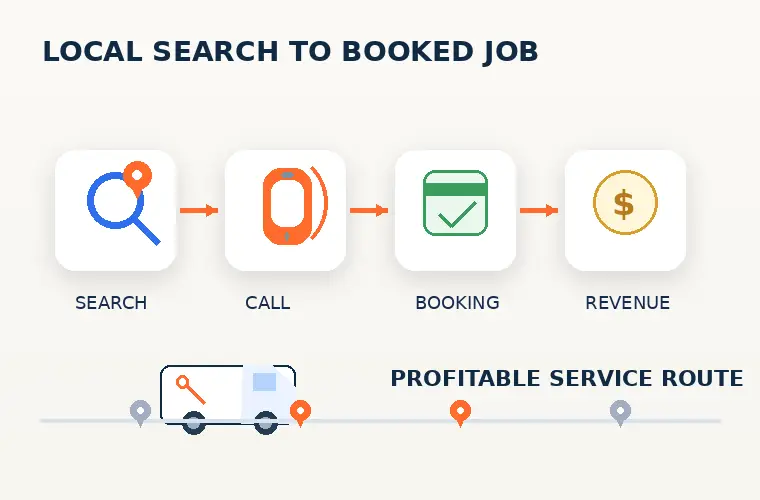
Plumbing SEO generates booked jobs by matching a customer’s service need and location with a relevant search asset, then giving the customer enough evidence and a clear contact path to choose the business.
The complete commercial sequence is:
Search demand
→ relevant Google visibility
→ qualified website or profile visit
→ phone call or quote request
→ lead qualification
→ appointment or site inspection
→ booked plumbing job
→ completed work
→ revenue and review
A page can rank and still fail commercially. This happens when the query, service, location or conversion action does not match the business.
For example, a plumbing company may rank for “how to unblock a drain” and receive substantial traffic. Most visitors may want a do-it-yourself answer. The same company may receive fewer visits from “blocked drain plumber Newcastle,” but those visitors have stronger service intent and geographic relevance.
The difference is not traffic volume. It is commercial eligibility.
A qualified plumbing enquiry normally has several attributes:
| Lead attribute | Suitable value |
| Service | Offered and licensed |
| Location | Inside the operating area |
| Timing | Matches current availability |
| Property | Residential, commercial or strata work the company accepts |
| Job value | Meets the company’s minimum viable value |
| Capacity | Can be assigned to an available plumber or crew |
| Intent | Customer is seeking diagnosis, repair, installation or maintenance |
A growth-stage plumbing company may value a $1,500 hot-water replacement more than ten small enquiries outside its operating radius. A commercial contractor may value a facilities-maintenance enquiry more than a residential tap-repair request. The SEO plan must reflect these differences.
This is the part generic SEO guides often miss: visibility must be connected to minimum job value, gross margin, service radius, crew capacity, call-answer rate and quote-to-job conversion. Those operational entities determine whether search demand becomes profitable work.
How Do Plumbing Customers Search?
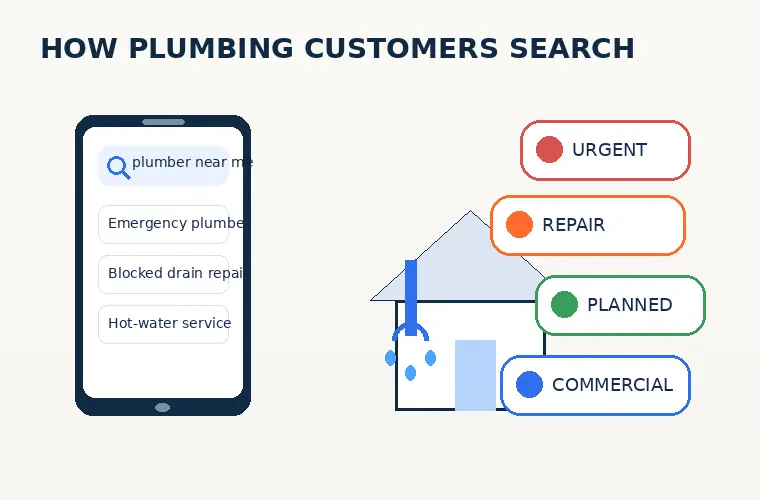
Plumbing customers search by problem, service, urgency, location, property type, system and price. The correct page depends on the combination of those attributes.
A person rarely begins with an abstract interest in plumbing. A trigger creates the search.
The trigger may be a blocked drain, a leaking pipe, a failed hot-water system or a planned bathroom renovation. The customer then converts that condition into a query.
How does emergency intent differ from planned intent?
Emergency plumbing searches require immediate availability, local relevance and a fast call path, while planned searches allow more time for comparison, quotations and provider evaluation.
Emergency queries include:
- Emergency plumber near me
- Burst pipe plumber
- Gas leak plumber
- Overflowing toilet repair
- After-hours plumber
- No hot water emergency
Consumer Affairs Victoria classifies conditions such as a burst water service, gas leak and loss of essential hot water as urgent repairs in relevant rental contexts. These conditions involve materially different time pressure from planned installation work.
An emergency landing page must therefore answer four questions immediately:
- Is the service available now?
- Does the plumber serve this location?
- Is the provider qualified for the problem?
- What contact action should the customer take?
The page should not lead with a long company history. It should state the service, operating coverage, availability and phone action.
Planned installation queries work differently. Examples include toilet installation, bathroom plumbing, dishwasher connection and hot-water replacement. These searchers may compare systems, installation processes, warranties, qualifications and pricing factors before requesting a quote.
How does residential intent differ from commercial intent?
Residential intent concerns household repairs and installations, while commercial intent concerns operating continuity, compliance, response coverage and recurring maintenance.
Residential searchers include homeowners, tenants and landlords. Commercial searchers include property managers, strata managers, facilities managers, builders and business owners.
A commercial plumbing page should not repeat a residential page with the word “commercial” added. It needs commercial attributes such as:
- Service-response coverage
- Preventive maintenance
- Multi-site capability
- Fleet and technician capacity
- Compliance documentation
- Site-access procedures
- Emergency escalation
- Invoicing and reporting
- Recurring service agreements
This distinction determines the page, proof and conversion action. A homeowner may tap a call button. A facilities manager may request a capability statement or maintenance proposal.
What search patterns should a plumbing company map?
A useful keyword model covers six connected search forms:
| Search form | Example | Likely page |
| Service | Drain cleaning | Service page |
| Problem | Drain keeps backing up | Problem guide |
| Service and location | Drain cleaner in Geelong | Service or genuine location page |
| Urgent service | Emergency plumber near me | Emergency page and GBP |
| Customer type | Strata plumbing services | Commercial service page |
| Cost or comparison | Hot-water replacement cost | Cost guide |
This structure creates a semantic network between a customer need and the service that resolves it.
Where Can a Plumbing Company Appear on Google?
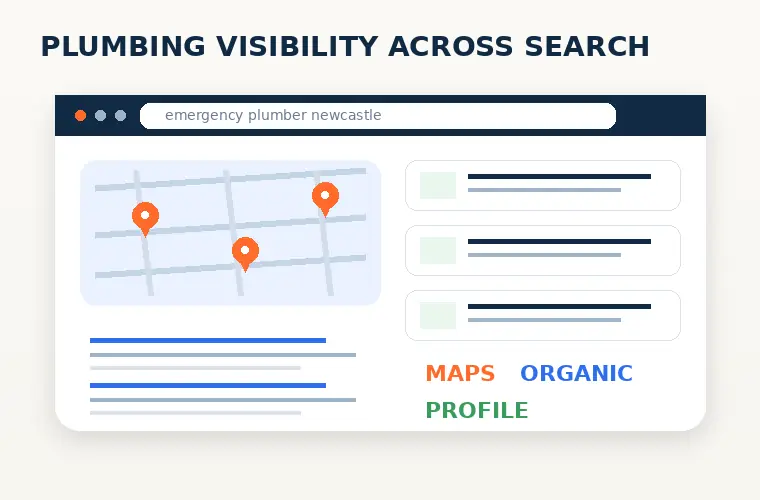
A plumbing company can appear in Google Maps, the Local Pack, standard organic results, branded results, image results, video results and AI-generated search features.
Each search surface uses different assets.
Google Maps and the Local Pack rely heavily on the Business Profile and local business information. Organic results rely on crawlable website pages. Branded results may show the website, profile, reviews and other recognised business references. Informational results may include articles, videos, images and AI-generated summaries.
What is the difference between Google Maps and organic search?
Google Maps represents local business entities, while organic search represents indexed web documents such as service pages, location pages and guides.
A plumbing business can rank in one area without ranking strongly in the other.
A complete local campaign therefore needs both:
- A valid and accurately managed Google Business Profile.
- A website that represents services, problems, locations, expertise and proof.
The relationship can be expressed as:
Plumbing company
→ owns
Google Business Profile
→ represents
business identity and local availability
Plumbing company
→ publishes
website pages
→ represent
services, locations, problems and expertise
The Business Profile should link to the relevant business website. The website should confirm the same business name, phone number, service offering and operating context. Contradictory information weakens entity clarity and customer trust.
How Does Google Evaluate Local Plumbing Businesses?
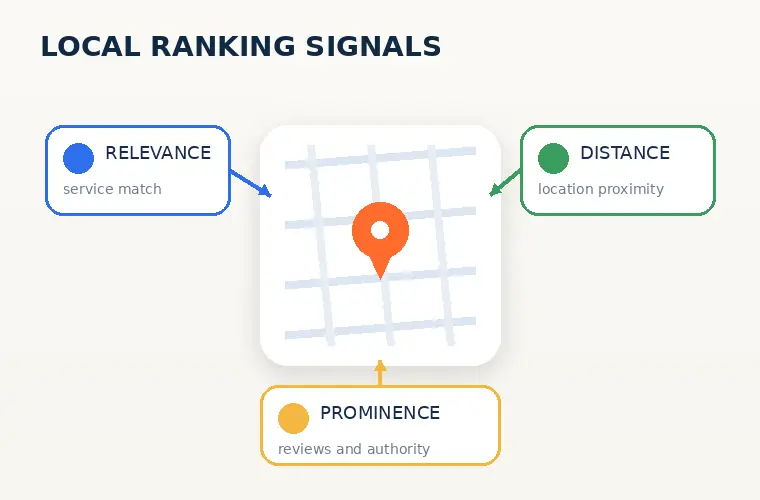
Google describes local results through relevance, distance and prominence or popularity. Complete business information, accurate locations, reviews and web references can support those signals, but no business can pay Google for a better organic local ranking.
Google defines the concepts as follows:
- Relevance concerns how closely the profile matches the search.
- Distance concerns how far the business is from the searcher or inferred search location.
- Prominence concerns how well known the business is, including information such as links and reviews.
Google also states that more reviews and positive ratings can help local ranking.
How does relevance apply to plumbing SEO?
A plumbing company creates relevance by accurately representing:
- The business category, such as plumber.
- The services, such as drain cleaning and leak detection.
- The customer need, such as emergency repair.
- The geographic coverage, such as a genuine city or suburb.
- The page content, such as a detailed blocked-drain service page.
Relevance is not created by repeating “plumber” twenty times. It is created by representing the service entity and its connected attributes.
A blocked-drain page can cover:
- Symptoms: slow drainage, wastewater backup and gurgling.
- Causes: grease, foreign objects, tree roots and damaged pipes.
- Systems: sinks, toilets, stormwater drains and sewer lines.
- Diagnostic methods: visual inspection and CCTV drain inspection.
- Service methods: mechanical clearing and hydro jetting.
- Outcomes: restored flow and identified pipe damage.
The page becomes relevant because it describes the complete service, not because it reaches a target keyword density.
How does distance affect service-area businesses?
Distance limits local visibility. Adding twenty service areas does not create twenty physical locations.
Google allows a service-area business to specify up to 20 areas using cities, postcodes or other recognised areas. Google also advises that the overall boundary generally should not extend beyond about two hours of driving time from the business base.
These settings communicate operating coverage to customers. They do not remove proximity from local ranking.
A plumber should therefore choose service areas from operational evidence, including:
- Accepted booking locations
- Travel time
- Route density
- Call-out economics
- Plumber availability
- Existing customer concentration
An unrealistic service area can create unsuitable enquiries even when it does not improve rankings.
How does prominence apply to plumbers?
Prominence is supported by external and customer-generated evidence.
Relevant evidence includes:
- Customer reviews
- Local citations
- Supplier references
- Trade-association profiles
- Local media coverage
- Builder and property-manager partnerships
- Community sponsorships
- Relevant backlinks
- Consistent brand mentions
The strongest evidence identifies the same real business across multiple trusted sources.
How Should a Plumbing Business Audit Its Current SEO Position?
A plumbing SEO audit should examine search demand, business capacity, Google Business Profile eligibility, website architecture, technical accessibility, conversion paths and booked-job measurement.
A technical crawl alone is incomplete. It may identify a broken link but miss the fact that the business is targeting low-margin services outside its service radius.
The audit begins with business constraints.
Document the services the company wants to sell, services it does not offer, locations it can serve, operating hours, emergency availability, current crew capacity and minimum viable job value.
Then examine search performance.
Google Search Console records clicks, impressions, click-through rate and average position. Google cautions that average position is a complex metric and recommends paying attention to trends in clicks and impressions rather than position alone.
The audit should connect four datasets:
| Dataset | Main question |
| Search Console | Which queries and pages receive visibility and clicks? |
| Google Business Profile | Which local actions occur from the profile? |
| Call or form records | Which visits produce enquiries? |
| CRM or job system | Which enquiries produce booked and completed jobs? |
A useful audit does not end with “the page ranks at position eight.” It determines whether the page generates serviceable enquiries and what happens after the enquiry.
How Should Plumbers Perform Keyword Research?
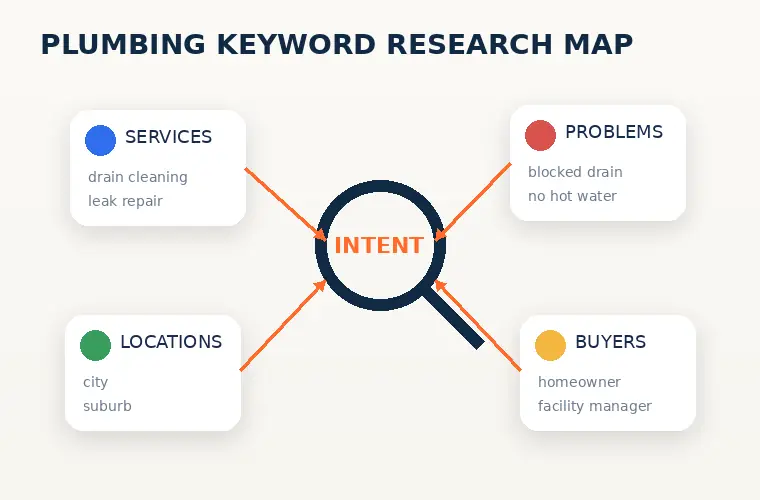
Plumbing keyword research should begin with business services and customer problems, then add intent, location, commercial value and operating capacity.
Do not begin by exporting thousands of terms from a keyword tool. Begin with the business.
Create a verified service inventory. Examples include emergency plumbing, blocked drains, leak detection, burst-pipe repair, hot-water repair, fixture installation, gas fitting where licensed, commercial maintenance and stormwater plumbing.
For each service, record:
| Attribute | Example value |
| Service entity | Blocked-drain cleaning |
| Problem | Wastewater backup |
| System | Sewer or household drain |
| Customer | Homeowner or property manager |
| Urgency | Same-day |
| Location | Serviceable suburb |
| Commercial value | High, medium or low |
| Required proof | Drain camera, project image or review |
| Correct page | Dedicated service page |
Then classify queries by intent.
An informational query asks for an explanation. A commercial-investigation query compares providers, prices or methods. A transactional query indicates contact or booking intent. A local query adds geographic relevance.
The useful keyword is not always the term with the largest volume. A lower-volume term may have a higher booking rate, larger average job value or stronger operational fit.
How should keywords be mapped to pages?
Map one dominant intent to one primary page, then support it with related entities and internal links.
For example:
Blocked drain plumber
→ primary service page
Why does my drain keep blocking?
→ informational article
Drain cleaning cost
→ cost guide
Blocked drain plumber in Newcastle
→ service page or genuine location page
Commercial drain maintenance
→ commercial plumbing page
Do not create a separate page for every minor wording variation. “Blocked drain plumber,” “drain blockage plumber” and “plumber for blocked drain” may express the same intent.
Creating separate pages for synonyms can cause cannibalisation and weak content. Use synonyms naturally within one complete page when they share the same search purpose.
What Website Structure Does a Plumbing Company Need?
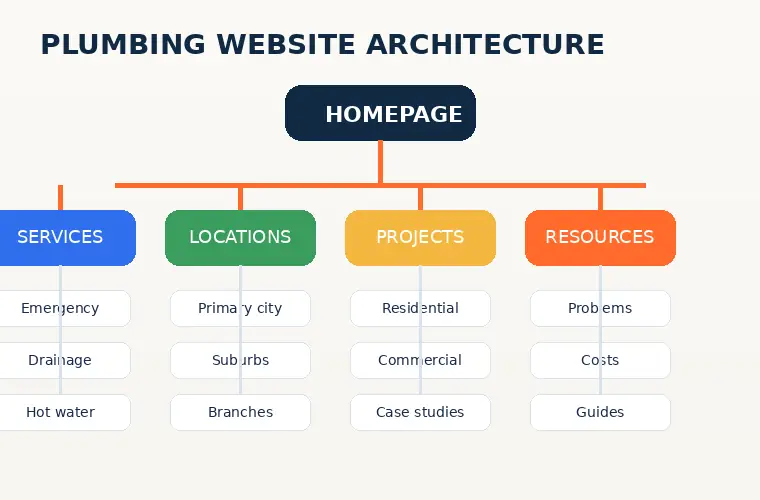
A plumbing website needs a clear hierarchy that separates services, locations, plumbing problems, commercial capabilities, project evidence and informational resources.
The broad hypernym is plumbing services. Its hyponyms include emergency plumbing, drainage services, hot-water services, fixture services, gas services and commercial plumbing.
A practical hierarchy is:
Homepage
│
├── Plumbing Services
│ ├── Emergency Plumbing
│ ├── Drainage Services
│ ├── Leak and Pipe Repairs
│ ├── Hot-Water Services
│ ├── Fixture Services
│ ├── Gas Services
│ └── Commercial Plumbing
│
├── Service Areas
│ ├── Primary City
│ ├── Secondary City
│ └── Genuine Suburb Pages
│
├── Projects
│ ├── Residential Projects
│ └── Commercial Projects
│
└── Resources
├── Plumbing Problems
├── Maintenance Guides
├── Cost Guides
└── Comparison Guides
This architecture represents semantic relationships instead of arbitrary menu labels.
The internal links should also represent relationships:
Problem article
→ links to
relevant service page
Service page
→ links to
affected plumbing system and related service
Location page
→ links to
services genuinely available in the area
Project
→ links to
service, location and method
Guide
→ links to
commercial page when professional work is required
The uploaded frame analysis recommends connecting problems to services, services to systems, systems to symptoms, locations to available services and case examples to methods and outcomes.
How Should a Plumber Optimise a Google Business Profile?
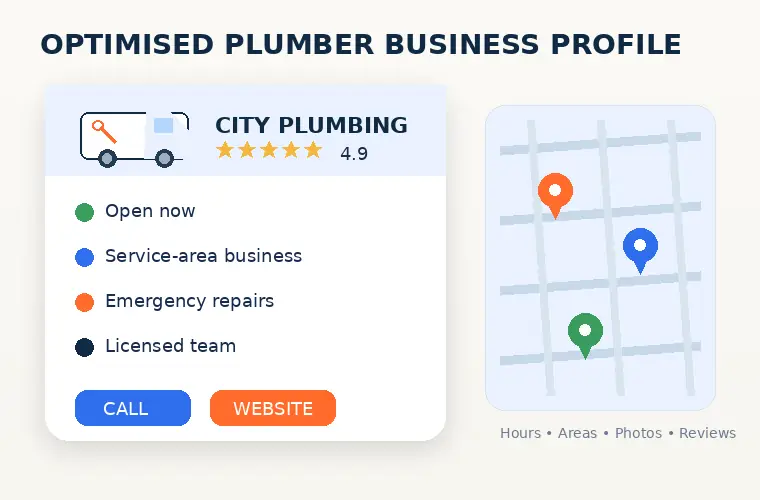
A plumber should verify profile eligibility, use the real business name, select accurate categories, define genuine service areas, maintain correct hours and publish authentic service and reputation evidence.
The first task is not adding keywords. It is confirming the correct business type.
Is the plumbing business a storefront or service-area business?
A plumbing business that travels to customers and does not receive customers at its address should operate as a service-area business and hide the address from public display.
Google identifies plumbers as an example of service-area businesses. It states that a service-area business can have one profile for the area it serves and should remove the public address when customers are not served there.
A hybrid business can show an address when it serves customers at that location and also travels to customers. The location needs permanent signage, staff and customer access during stated hours.
A virtual office is not a valid substitute. Google states that a virtual office is ineligible unless the location meets its specific staffed and customer-facing requirements.
What business name should a plumber use?
Use the real-world name displayed on signage, stationery, vehicles and the website.
Do not add a service or city to the profile name unless it is genuinely part of the recognised business name. Google prohibits unnecessary information in profile names and states that violations can result in suspension.
What profile fields require attention?
The profile should accurately represent:
- Primary and secondary categories
- Phone number
- Website
- Normal hours
- After-hours availability
- Service areas
- Plumbing services
- Business description
- Photos
- Reviews
- Appointment or booking links where supported
Choose the fewest categories required to describe the core business. Categories are classifications, not a place to insert every target keyword. Google gives the same guidance in its profile-editing documentation.
What photos provide useful evidence?
Use real images from the business.
Useful images include service vehicles, uniformed plumbers, diagnostic equipment, drain cameras, hot-water installations, repaired systems and completed commercial work.
Each image needs context. Record the service, general location, property type, problem, method and outcome. Do not claim a stock image is completed work.
What Should a Plumbing Service Page Contain?
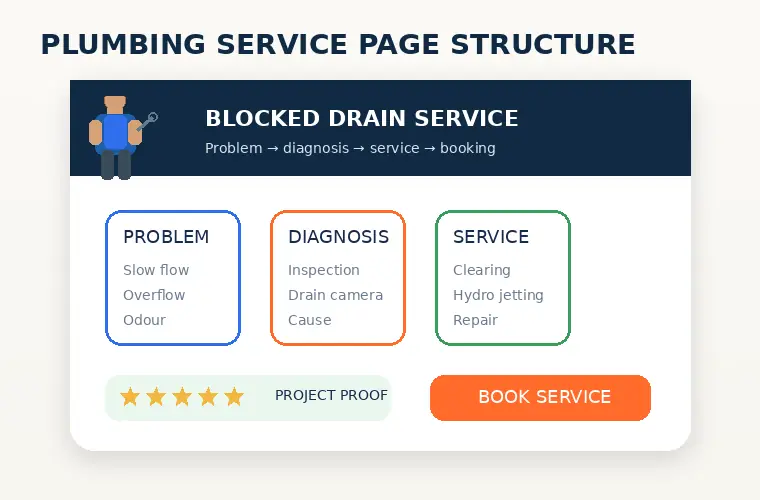
A plumbing service page should define the service, describe the customer problems it resolves, explain the diagnostic and service process, show proof and provide a clear contact action.
The page must represent the complete service frame.
For a blocked-drain service, the relevant entities include:
- Provider: licensed plumber or drainage specialist.
- Customer: homeowner, landlord or property manager.
- Problem: slow drainage, overflow or wastewater backup.
- System: sink drain, toilet drain, sewer or stormwater system.
- Cause: grease, roots, damaged pipe or foreign material.
- Diagnosis: inspection or CCTV drain camera.
- Method: mechanical clearing or hydro jetting.
- Outcome: restored flow or identified structural damage.
- Location: operating area.
- Assurance: licence, review, project evidence and guarantee.
- Conversion: call or booking request.
Recommended service-page sequence
Start with a direct answer.
Then explain who the service is for, common symptoms, likely causes, diagnostic methods, available solutions, service process, pricing factors, operating areas, professional evidence and FAQs.
The page should not promise a fixed repair before diagnosis. A recurring blockage may require more than clearing. It may indicate pipe damage, tree-root intrusion or an installation defect.
This distinction adds information gain. It also prevents a misleading one-solution page.
How should service pages handle licensing?
Only advertise plumbing, drainage or gas services that the business is licensed or otherwise legally authorised to perform in the relevant jurisdiction.
Australian requirements vary by state, territory and work category. For example, current NSW guidance states that the correct licence or certificate is required for plumbing, draining and gasfitting work, and that practitioners need authorisation for every category in which they work.
The page should show relevant licence details and avoid implying that one credential covers unrelated work.
How Should Plumbing Location Pages Be Written?
A plumbing location page should prove genuine service coverage with local operating information, relevant services, completed work and a useful contact path.
A location page is not a search-and-replace template.
Changing “Sydney” to “Parramatta” does not create local information. The location entity needs attributes.
Useful attributes include:
- Services provided in the area
- Typical dispatch or operating coverage
- Property types served
- Completed projects
- Local customer reviews
- Nearby areas
- Commercial or residential focus
- Relevant booking restrictions
- Genuine location-specific questions
A location page may describe the actual relationship between the company and the area:
The plumbing team accepts residential drainage, hot-water and emergency repair bookings across [area]. Commercial maintenance work is scheduled separately because site access, invoicing and compliance requirements differ from household repairs.
That sentence communicates services, customer types and operating conditions. “We are the best plumbers in [area]” communicates an unsupported opinion.
When does a suburb page become a doorway page?
A suburb page becomes a quality risk when it is substantially similar to other pages and exists mainly to rank for a location query before sending users to the same generic destination.
Google defines doorway abuse as creating pages for similar queries or regions that funnel visitors toward another page, including substantially similar pages positioned closer to search results than a clear site hierarchy.
A genuine suburb page needs original utility. That may include real project evidence, area-specific availability, property context, unique FAQs and relevant service coverage.
Do not fabricate local jobs, offices, reviews or response times.
How Should Plumbing Pages Be Optimised On-Page?
On-page optimisation should make each page’s subject, service, location and intended action clear to users and search systems.
The title tag should state the main service or topic. Add a location only when the page genuinely targets that location.
The H1 should describe the page’s primary subject. Supporting headings should divide the subject into meaningful subtopics.
The opening answer should appear before background information. This helps the reader confirm that the page addresses the query.
A useful page sequence is:
Definition
→ customer problem
→ affected system
→ diagnosis
→ service options
→ process
→ proof
→ pricing factors
→ location
→ contact action
Use synonyms to improve natural language, not to create repeated keyword blocks. “Blocked drain,” “drain blockage” and “clogged drain” can appear where each phrase fits the sentence.
Use antonyms or contrasts when they clarify a decision:
- Emergency versus scheduled plumbing
- Repair versus replacement
- Residential versus commercial plumbing
- Service area versus physical location
- Qualified lead versus unsuitable enquiry
- Ranking metric versus revenue metric
How should images be optimised?
Use descriptive filenames, suitable dimensions, compressed formats and accurate alt text.
The alt text should describe the visible image and its context. It should not repeat a target query unnecessarily.
Example:
Licensed plumber using a drain camera to inspect a blocked residential sewer line in Newcastle.
The text identifies the provider, diagnostic tool, problem, system and location.
How Can a Plumbing Business Build Topical Authority?
A plumbing business builds topical authority by publishing connected content about services, problems, systems, causes, diagnostic methods, solutions, costs, maintenance and locations.
The objective is not to publish frequently. It is to cover the business’s genuine subject area completely.
A drain-cleaning cluster may contain:
Drain Cleaning Service
├── Signs of a Blocked Drain
├── Why Drains Keep Blocking
├── Drain Camera Inspection
├── Hydro Jetting
├── Tree Roots in Sewer Lines
├── Drain Cleaning Cost
└── Drain Maintenance
Each supporting article answers a distinct question and links to the relevant service page.
What makes plumbing content non-commodity?
Non-commodity content contains first-party detail, operational constraints or expert evidence that generic competitors cannot reproduce accurately.
Examples include:
- The three blockage causes technicians find most often in a defined area.
- When a drain camera changes the recommended repair.
- Which hot-water problems require repair or replacement.
- How after-hours calls are triaged.
- What information a strata manager needs before dispatch.
- Why certain jobs fall outside the operating radius.
- How commercial maintenance records are documented.
- Before-and-after project data with a verified location and method.
Google’s people-first guidance asks whether content demonstrates first-hand expertise and whether the site has an intended audience that would find the content useful directly.
A generic article can explain that blocked drains have several causes. An experienced plumbing business can explain which symptoms appeared, what the camera showed, what method was used and what condition remained after the work.
What Technical SEO Matters for Plumbing Websites?
Technical SEO enables search systems and customers to access, render, understand and use the website. The priorities are indexability, mobile usability, performance, security, canonicalisation and structured data.
A plumbing website does not need technical complexity for its own sake. It needs reliable access.
Check that important service and location pages:
- Return a successful status code.
- Are not blocked by robots.txt.
- Do not contain an unintended noindex directive.
- Use the correct canonical URL.
- Appear in the XML sitemap.
- Receive internal links.
- Load correctly on mobile devices.
- Provide functional call and form actions.
What Core Web Vitals targets apply?
Google’s current guidance defines three Core Web Vitals targets:
| Metric | Measures | Recommended threshold |
| Largest Contentful Paint | Loading performance | Within 2.5 seconds |
| Interaction to Next Paint | Responsiveness | Below 200 milliseconds |
| Cumulative Layout Shift | Visual stability | Below 0.1 |
Google recommends good Core Web Vitals for search success and general user experience, while making clear that page experience works alongside other ranking considerations.
For a plumbing website, performance problems often come from oversized hero images, third-party scripts, sliders, page-builder code and unoptimised fonts.
The commercial impact is direct. A customer with an overflowing toilet should not wait for a decorative video background before seeing the phone number.
What Structured Data Should a Plumbing Website Use?
Use structured data that accurately represents visible page content, including the business, articles, breadcrumbs and eligible local-business information.
Google supports LocalBusiness structured data for communicating details such as business type, hours and location information. It recommends using the most specific valid subtype, and its example allows Plumber as a business type.
Possible types include:
- Organization
- LocalBusiness
- Plumber
- Article
- BreadcrumbList
- Person
The markup must match visible content.
Do not add a review rating that is not displayed or eligible. Do not create a false address. Do not mark every page as a local business location.
Structured data helps classify content. It does not guarantee a rich result or ranking.
How Do Customer Reviews Support Plumbing SEO?
Customer reviews support provider evaluation, business credibility and local prominence, especially when reviews describe the service, response and outcome in authentic language.
Reviews are not only star ratings. They contain attributes.
A useful review may mention:
- Service performed
- Customer problem
- Punctuality
- Communication
- Cleanliness
- Location
- Emergency response
- Final outcome
Academic evidence supports the decision role of online reviews. A 2024 meta-analysis covering 156 studies, 214 effect sizes and 69,006 observations found that review-related factors significantly affected purchase intention, with review valence showing the strongest effect in that model.
Northwestern University’s Medill Spiegel Research Center also found that review impact varies by rating, review content, price and purchase risk. Its evidence came from retail rather than plumbing services, so the exact conversion percentages should not be transferred directly to plumbers. The relevant conclusion is narrower: reviews can reduce uncertainty during higher-consideration decisions.
How should plumbers request reviews?
Request a review after confirming that the work is complete and the customer has had a genuine opportunity to evaluate the service.
A simple workflow is:
Job completed
→ outcome confirmed
→ review link sent
→ optional reminder
→ review received
→ business response published
→ service insight recorded
Do not provide customers with scripted review text. A large number of reviews containing the same service and suburb wording looks artificial and provides little decision value.
Do not use fake reviews, review gating or undisclosed incentives that conflict with platform policies.
Respond to positive and negative reviews professionally. Do not reveal private customer, property or dispute information.
How Can a Plumber Build Local Authority?
A plumbing business builds local authority through accurate citations, relevant links, genuine partnerships, recognised qualifications and documented local work.
A citation is a business reference containing identifying information such as name, address where applicable, phone number and website.
The purpose is entity consistency, not directory volume.
Correct inaccurate listings first. Then prioritise relevant sources, including:
- Trade associations
- Suppliers and manufacturers
- Builder or property-management partners
- Local business organisations
- Genuine community sponsorships
- Relevant industry publications
- Local media
A backlink from a relevant supplier or local organisation has clearer contextual value than hundreds of unrelated directory links.
The relationship should make sense:
Supplier
→ recognises
approved contractor
Property manager
→ references
maintenance provider
Local organisation
→ lists
sponsor or member
Industry publication
→ cites
technical contribution
Avoid paid link networks, irrelevant guest-post sites, automated directory submissions and exact-match anchor manipulation.
How Should a Plumbing Website Demonstrate E-E-A-T?
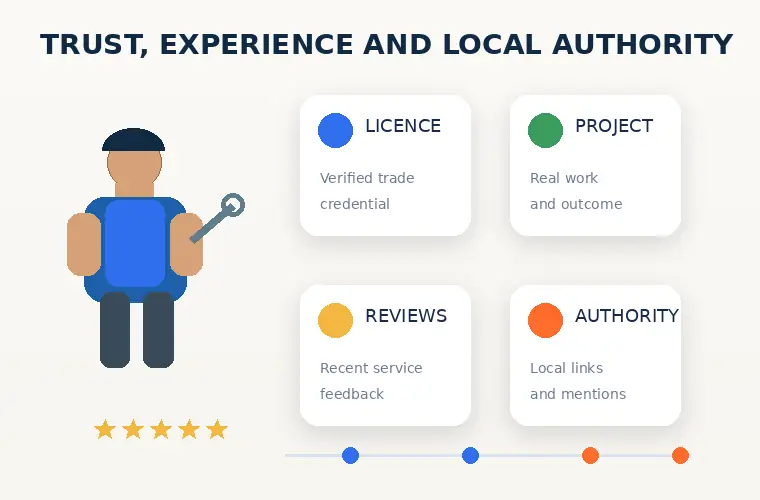
A plumbing website demonstrates experience, expertise, authoritativeness and trust through verifiable business details, qualified contributors, first-party project evidence and accurate claims.
Experience is shown through completed work, diagnostic observations and technician insights.
Expertise is shown through licences, qualifications, service knowledge and accurate technical explanations.
Authoritativeness is supported by relevant external recognition, citations, links and professional associations.
Trust is supported by consistent business information, secure forms, transparent policies, real reviews and honest limitations.
What should a plumbing project example contain?
A useful project example records:
| Entity | Example attribute |
| Property | Residential house or commercial facility |
| Location | City or suburb |
| Problem | Recurring sewer blockage |
| Diagnosis | CCTV inspection found tree-root intrusion |
| Service | Mechanical clearing and hydro jetting |
| Limitation | Structural pipe damage remained |
| Recommendation | Sectional repair or replacement |
| Outcome | Flow restored and repair scope documented |
Do not invent the location, result, customer statement or project image.
The guide itself also needs transparent authorship. Add:
Written by: [SEO author name and relevant experience]
Technical review: [Licensed plumber name, licence category and jurisdiction]
Last reviewed: [Date]
A licensed plumber should review plumbing safety, diagnosis, compliance and service claims before publication.
How Can Plumbing Pages Convert Visibility Into Calls?
A plumbing page converts when it confirms service relevance, reduces uncertainty and gives the visitor a suitable contact action.
The contact action depends on intent.
An emergency page needs a visible phone number and accurate availability. A planned installation page may need an assessment form. A commercial page may need a capability or maintenance enquiry.
Place the phone number where a mobile user can reach it without searching through the page. Use a real telephone link. Test it on mobile devices.
The conversion section should state:
- Service offered
- Area served
- Availability
- Qualification
- Next action
- What happens after contact
For example:
Call [phone number] for an urgent blocked-drain assessment in [service area]. The team will confirm your location, the affected fixture or drain, current symptoms and available attendance time before dispatch.
That statement tells the customer what information is required and what the business does next.
Why do plumbing leads fail after the click?
Calls may be missed. Forms may not send. Staff may not record the source. The service may be unavailable. The customer may be outside the operating area.
SEO cannot correct those operational failures by itself.
Track:
- Answered calls
- Missed calls
- Callbacks
- Qualified calls
- Quotes
- Bookings
- Lost-lead reasons
A missed-call recovery process may include an immediate SMS acknowledgement, a callback target and a lead record. Do not claim 24-hour service when calls are not monitored for 24 hours.
How Should Plumbing SEO Performance Be Measured?
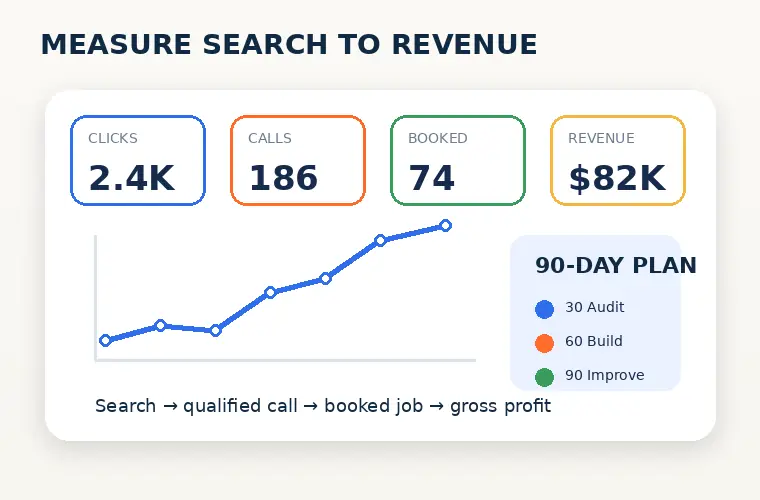
Measure plumbing SEO through meaningful search visibility, qualified calls, booked jobs, revenue and gross profit rather than rankings alone.
Search Console provides clicks, impressions, CTR and average position. It assigns those metrics according to specific reporting rules, so property-level and page-level totals can differ.
Those are search metrics. They are not sales metrics.
The measurement chain should continue:
Search query
→ landing page
→ phone call or form
→ qualified lead
→ quote
→ booked job
→ completed job
→ revenue
→ gross profit
A useful reporting table contains:
| KPI | Definition | Business use |
| Non-branded clicks | Clicks from queries without the company name | Measures new discovery |
| Qualified call rate | Qualified calls ÷ tracked calls | Measures lead quality |
| Call-answer rate | Answered calls ÷ incoming calls | Measures operational response |
| Quote-to-job rate | Booked jobs ÷ quotes | Measures sales conversion |
| Cost per booked job | SEO cost ÷ SEO-attributed bookings | Measures acquisition efficiency |
| Revenue by service | Revenue linked to a service cluster | Measures service value |
| Gross profit by source | Gross profit linked to acquisition source | Measures commercial return |
Google itself advises site owners to seek meaningful impressions rather than visibility among users who do not find the content useful.
A plumbing campaign should apply the same logic. More impressions for irrelevant DIY searches are not automatically an improvement.
How Should SEO Be Aligned With Plumbing Capacity?
SEO demand should be matched with profitable services, realistic travel areas, available plumbers and call-handling capacity.
This creates the connection between marketing and operations.
A company should not expand location targeting because a keyword tool shows volume. It should first determine whether the area can be served profitably.
Calculate:
Expected job revenue
− labour cost
− travel cost
− material cost
− acquisition cost
= estimated contribution
Then review route density.
Three jobs in one suburb may be more efficient than three jobs spread across a large region. The ranking opportunity is not the only variable.
Seasonal capacity also matters. A business may want more emergency work during a quiet period but may not have after-hours staff during another period.
The campaign should document:
- Preferred service categories
- Minimum job value
- Maximum practical travel time
- Crew or van availability
- After-hours coverage
- Commercial capacity
- Unwanted enquiry types
This information determines the keyword priorities and page roadmap.
Is SEO Better Than Google Ads for Plumbers?
SEO and Google Ads solve different acquisition problems. SEO develops cumulative organic and local visibility, while paid search buys immediate visibility for selected queries and budgets.
Neither channel is automatically better.
| Dimension | Plumbing SEO | Google Ads |
| Payment | No payment for each organic click | Advertiser pays for clicks or interactions |
| Speed | Usually requires implementation and evaluation time | Can begin producing traffic after launch |
| Durability | Pages can continue attracting demand | Traffic normally stops when spend stops |
| Control | Limited control over ranking and display | Stronger control over bidding and targeting |
| Learning | Builds website, content and local assets | Produces rapid query and conversion data |
| Risk | Poor implementation can waste time | Poor targeting can waste budget quickly |
A plumbing business can use paid search for immediate demand while developing long-term organic assets.
Compare the channels using qualified leads and booked jobs, not click cost alone.
A $60 click that produces a profitable booked job may be viable. A $10 click that produces an out-of-area call may not be.
Can a Plumbing Business Do SEO Without an Agency?
A plumbing business can manage basic profile accuracy, reviews, photographs and service information internally, but technical, architectural and attribution work may require specialist support.
An owner or office manager can usually maintain:
- Business hours
- Service descriptions
- Authentic photographs
- Review requests
- Customer questions
- Job and lead records
Specialist support may be needed for:
- Website migration
- Technical audits
- Multi-location structure
- Analytics and call attribution
- Structured data
- Content consolidation
- Large-scale internal linking
- Recovery from spam or manual actions
The question is not simply “Can this be done internally?” The useful question is:
Who owns each task, how much time is available, and how will the result be verified?
A hybrid model often works. The plumbing team supplies operational knowledge and project evidence. The SEO provider handles research, architecture, optimisation and measurement.
How Much Does Plumbing SEO Cost?
Plumbing SEO cost depends on market competition, website condition, service count, location complexity, content requirements, technical work and measurement scope.
A single owner-operator targeting one city does not require the same system as a multi-location plumbing company with residential and commercial divisions.
Separate one-off and ongoing work.
One-off work may include a technical audit, tracking setup, website restructuring or profile repair. Ongoing work may include service content, local optimisation, review systems, authority development and reporting.
Evaluate cost using business outcomes:
SEO investment ÷ qualified leads
SEO investment ÷ booked jobs
SEO-attributed gross profit ÷ SEO investment
Do not evaluate a proposal by the number of keywords included. A list of 500 tracked keywords does not prove that the provider has improved a service page, generated a qualified call or attributed a booking.
Before signing an agreement, confirm:
- Exact deliverables
- Account ownership
- Website and content ownership
- Link-building methods
- Reporting metrics
- Contract term
- Cancellation process
- Communication schedule
- Lead-quality definition
How Long Does Plumbing SEO Take?
Plumbing SEO has no fixed ranking timeline because results depend on the starting website, local competition, physical location, implementation speed, authority, content and search demand.
Avoid guaranteed timeframes.
Use staged indicators.
Early indicators may include corrected indexation, more relevant impressions, improved profile completeness and increased non-branded query coverage.
Later indicators may include stronger service-page visibility, qualified calls and bookings.
A ranking increase without enquiry growth requires investigation. The page may target the wrong intent, attract the wrong location or fail to convert.
What Plumbing SEO Mistakes Waste the Most Budget?
The most expensive plumbing SEO mistakes create irrelevant visibility, duplicate local pages, inaccurate business profiles or untracked leads.
One common mistake is using one general services page for every service. Drain cleaning, gas fitting, hot-water installation and commercial maintenance involve different problems, buyers, qualifications and conversion actions.
Another mistake is creating hundreds of suburb pages with the same content. This adds URLs without adding local value and may create doorway-abuse risks.
Other high-cost errors include fake office locations, keyword-stuffed profile names, inaccurate opening hours, stock images presented as projects, unlicensed service claims and purchased irrelevant links.
A less visible mistake occurs after the lead arrives: the phone is not answered, the source is not recorded or the business accepts enquiries outside its operating model.
The campaign then reports “more leads” while the owner sees no increase in profitable bookings.
How Should a Plumbing Business Choose an SEO Provider?
Choose a plumbing SEO provider that can explain how services, locations, pages, calls and booked jobs will be connected and measured.
Industry experience is useful only when it produces better decisions.
The provider should understand emergency versus planned demand, service radius, route density, licensing, residential versus commercial intent and call attribution.
Ask the provider to show:
- Keyword-to-page mapping
- Google Business Profile work
- Service and location architecture
- Technical priorities
- Content evidence requirements
- Review workflow
- Tracking specification
- Reporting model
- Ownership terms
Avoid providers that guarantee a ranking, refuse account access, hide their link methods or propose hundreds of location pages before confirming genuine coverage.
The main audience for this guide is sceptical of agency retainers that report visibility without demonstrating booked jobs. The provider-selection section must therefore connect deliverables with ownership, lead quality and revenue.
What Should a Plumbing SEO Case Study Show?
A plumbing SEO case study should show the business baseline, implemented changes, measurement period, qualified leads, booked jobs and commercial limitations.
A credible case study records:
- Business size
- Service mix
- Target area
- Starting website condition
- Starting profile condition
- Search baseline
- Implementation dates
- Pages published or improved
- Calls and forms
- Lead qualification
- Bookings
- Revenue where available
It should also disclose limitations.
Seasonality, paid advertising, new staff, pricing changes or improved call handling can affect results. SEO should not receive credit for every business improvement that occurred during the same period.
Do not fabricate screenshots, rankings, customer names or revenue.
What Is a Practical 90-Day Plumbing SEO Plan?
The first 90 days should establish measurement, correct business information, resolve critical technical issues, publish priority service pages and begin building reviews and local evidence.
Days 1–30: Establish the operating model
Confirm profitable services, service areas, crew capacity and lead-qualification rules.
Audit the website, Business Profile, citations, rankings and conversion paths.
Configure Search Console, analytics, call tracking and form events. Record baseline calls, leads, bookings and revenue where available.
Correct critical profile and website issues before producing large amounts of content.
Days 31–60: Build service relevance
Optimise the Google Business Profile.
Publish or improve priority service pages. Build a clear service hierarchy. Add internal links between problems, services, systems and locations.
Improve mobile phone actions and forms.
Start the review-request process. Add authentic project evidence, licence details and team information.
Days 61–90: Strengthen local evidence and measurement
Publish the first genuine location pages and project examples.
Correct important citations. Pursue relevant supplier, trade and local references.
Review Search Console query data, profile interactions, call quality and booked jobs.
Consolidate weak or competing pages. Prioritise the next service and location cluster using business value rather than keyword volume alone.
Plumbing SEO Checklist
A complete plumbing SEO system needs accurate business data, clear service pages, genuine local coverage, technical accessibility, customer proof and booked-job measurement.
Use this checklist during implementation:
| Area | Required control |
| Business strategy | Profitable services and realistic service areas documented |
| Google Business Profile | Eligibility, name, category, hours and areas verified |
| Website architecture | Services, locations, projects and resources separated |
| Service pages | Problems, systems, methods, proof and CTA included |
| Location pages | Genuine coverage and local evidence included |
| Technical SEO | Indexation, canonicals, sitemap, speed and mobile use checked |
| Reputation | Ethical review request and response process active |
| Authority | Accurate citations and relevant links pursued |
| Conversion | Calls and forms tested on mobile |
| Measurement | Qualified calls, bookings and revenue recorded |
Frequently Asked Questions
What is plumbing SEO?
Plumbing SEO improves a plumbing business’s visibility for relevant service and location searches to generate qualified calls, quote requests and booked jobs.
Why is local SEO important for plumbers?
Local SEO matters because plumbing services are delivered within defined geographic areas and customers often need a nearby provider who can attend their property.
How does Google rank plumbers locally?
Google describes local results mainly through relevance, distance and prominence, supported by accurate business information, reviews and web references.
Can a plumber rank without showing a home address?
A service-area plumber can hide a residential address and display genuine service areas when customers are not served at that address.
Should every plumbing service have a separate page?
Create a separate page when the service has distinct search intent, customer problems, methods, commercial value and enough evidence to support a complete page.
Should plumbers create a page for every suburb?
Create suburb pages only for genuine operating areas where the business can provide unique service information, proof and a useful customer experience.
How many service areas can a Business Profile contain?
Google currently allows a service-area business to specify up to 20 areas using cities, postcodes or other supported geographic units.
Do reviews improve plumbing SEO?
Reviews can support local prominence and customer trust, while detailed and authentic review content helps customers evaluate service quality and risk.
What structured data should a plumber use?
Use accurate business, article, person and breadcrumb structured data that matches visible page content and current Google eligibility requirements.
How long does plumbing SEO take?
There is no fixed timeline because results depend on competition, location, website condition, implementation, authority and demand.
Is SEO better than Google Ads?
SEO creates cumulative organic assets, while Google Ads buys immediate visibility; compare both channels through qualified calls, booked jobs and acquisition cost.
What is the most important plumbing SEO metric?
Booked-job value is the strongest commercial metric, but it must be supported by query, page, call, qualification, quote and revenue attribution.
Get a Plumbing SEO Growth Plan
A plumbing SEO campaign should not begin with a generic keyword package. It should begin with your services, operating capacity, profitable locations and current lead data.
SEO Agency for Tradies can assess:
- Google Maps and organic visibility
- Google Business Profile eligibility and configuration
- Missing or competing service pages
- Genuine service-area opportunities
- Technical and mobile conversion problems
- Call and booking attribution gaps
- Competitor coverage
- A prioritised 90-day implementation plan


