
Plumbing Website Design That Turns Local Searches Into Booked Jobs
SEO Agency For Tradies design and develop plumbing websites for Australian contractors that need more qualified calls, quote requests and scheduled jobs. Each website combines mobile-first design, plumbing service architecture, local search foundations, trust signals, booking functions and conversion tracking.
Your website will be structured around the services you sell, the locations you cover and the actions customers need to complete. These actions include calling your office, requesting an estimate and booking a plumbing service.
6+ Years of Experience
Plumbing and Home-Service Specialists
Australia-Wide Website Delivery
SEO-Safe Website Architecture
Full Website Ownership
Post-Launch Technical Support
Find out what's holding you back
Enter your number — we’ll call you with a free ranking report for your suburb.
We call within 2 business hours. No scripts. No pressure.
What Are Plumbing Website Design Services?
Plumbing website design services create and develop websites for plumbing businesses that need stronger local visibility and more enquiries. The service combines strategy, user experience, content architecture, local SEO, contact functions, software integrations and performance tracking.
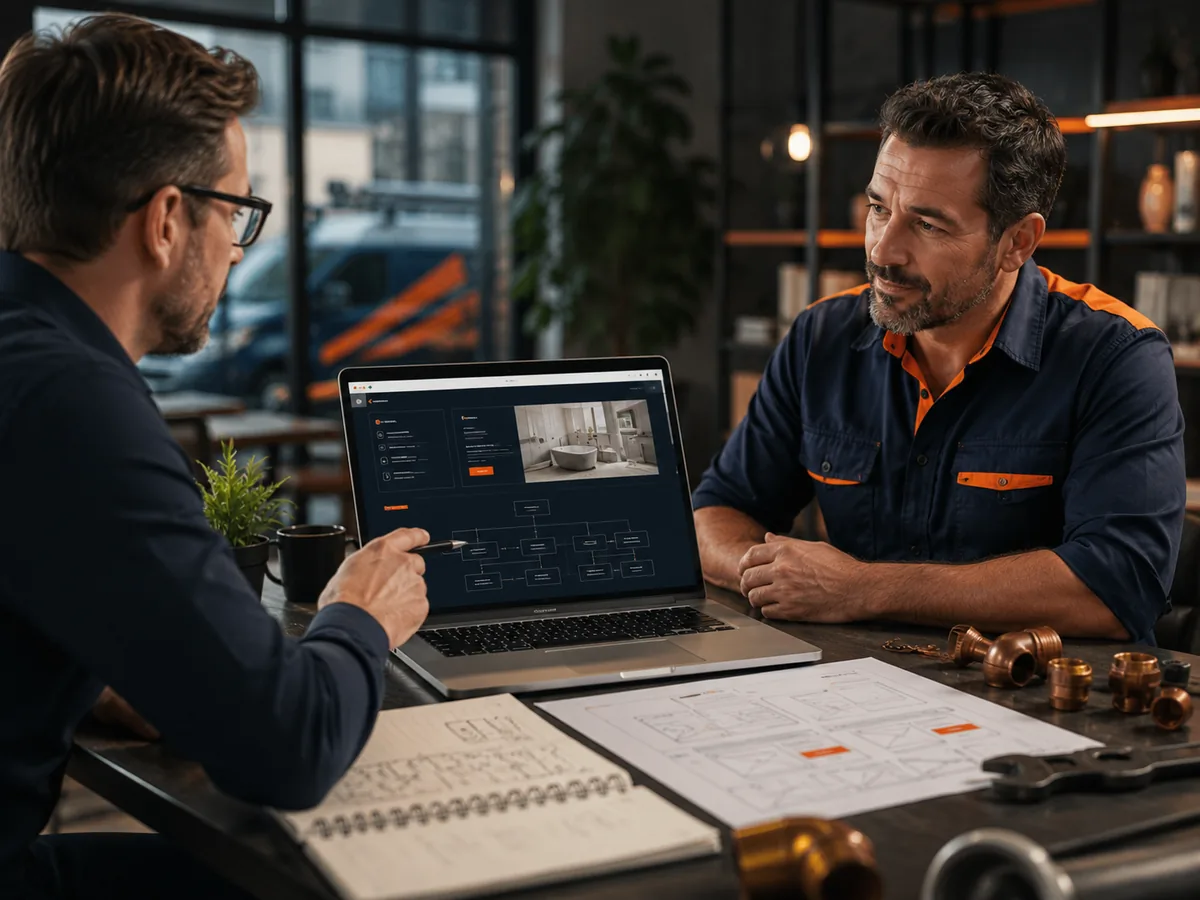
A complete service covers more than visual design. It defines how homeowners, landlords, property managers and commercial buyers find a relevant service, verify the plumber’s qualifications and complete a contact action.
The central commercial sequence is:
A website that breaks this sequence may receive visits without generating enough work. The supplied audience research identifies inconsistent enquiries, weak Google visibility, missed emergency calls, poor conversion rates and dependence on paid leads as primary buying triggers.
Businesses We Support Across Australia
We support trade and commercial service businesses with stronger local visibility, clearer lead generation and marketing systems connected to measurable commercial outcomes.





What Makes a Plumbing Website Different From a General Business Website?
A plumbing website must organise urgent problems, planned services, geographic coverage and immediate contact options within one clear customer journey.
A general brochure website may describe a company. A plumbing lead-generation website must help a customer answer five questions quickly:
| Customer question | Website response |
|---|---|
| Do you provide the required service? | Dedicated plumbing service page |
| Do you cover my location? | Service-area information |
| Can I trust your business? | Licences, reviews, insurance and project evidence |
| How quickly can I contact you? | Click-to-call, quote and booking options |
| What happens after I enquire? | Response-time and booking information |
The website must support urgent plumbing needs, such as burst pipes, blocked drains and water leaks. It must also support planned work, such as water-heater installation, bathroom plumbing and commercial maintenance.
These user journeys require different information. Urgent customers need an immediate contact path. Planned-service customers need scope, evidence, options and estimate information.
Can You See Plumbing Website Examples Before Starting?
Yes. Relevant website examples allow you to assess design quality, mobile usability, information architecture and conversion functionality before commissioning the project.
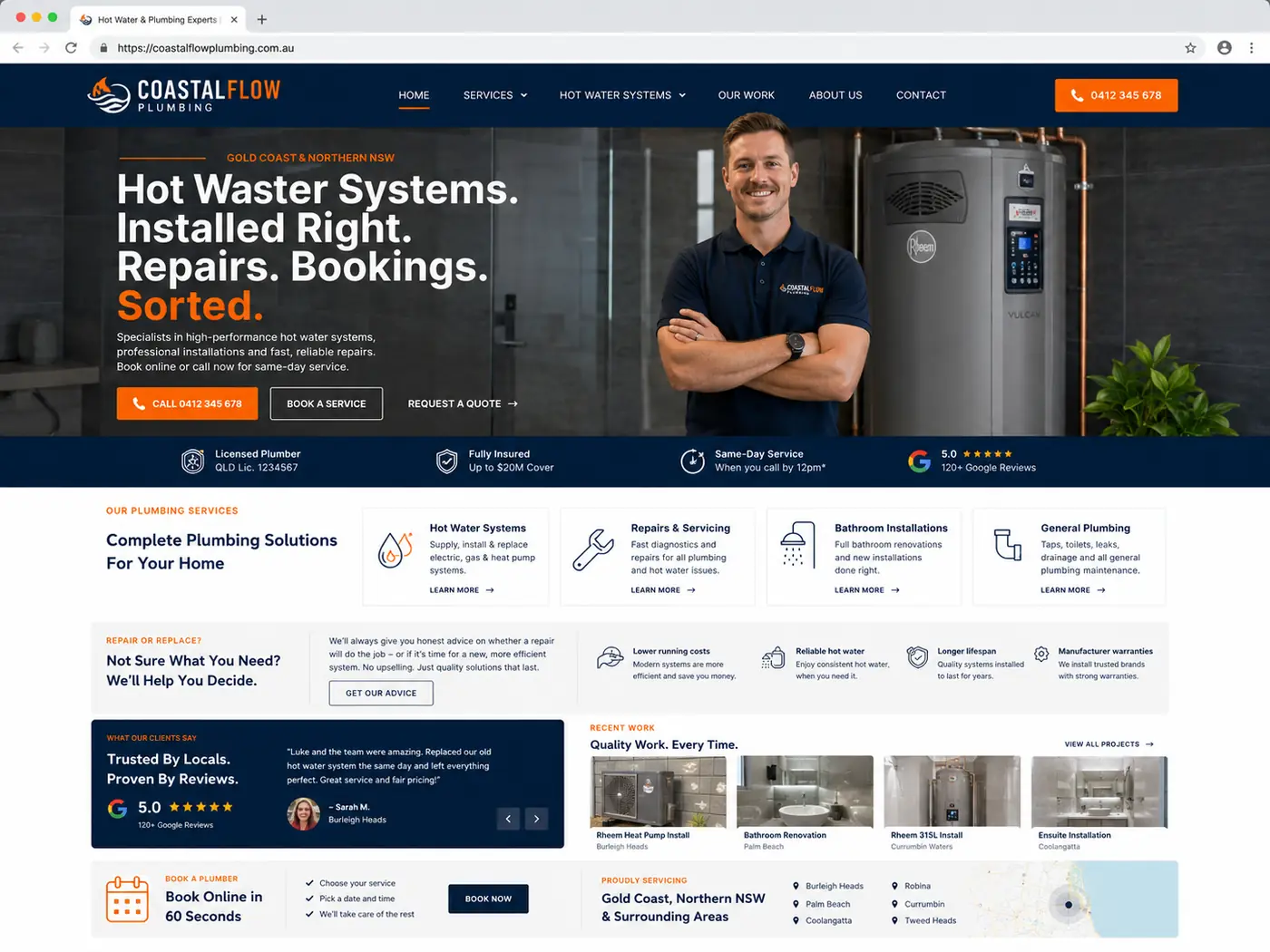
Each portfolio entry must show more than a homepage screenshot. It must explain the business problem, page structure, functionality and measurable outcome.
[Plumbing Website Example One]
Business type: Residential and emergency plumbing company
Market: Sydney, New South Wales
Primary objective: Increase qualified emergency calls from mobile users
Scope: [Homepage, emergency service pages, service-area pages and call tracking]
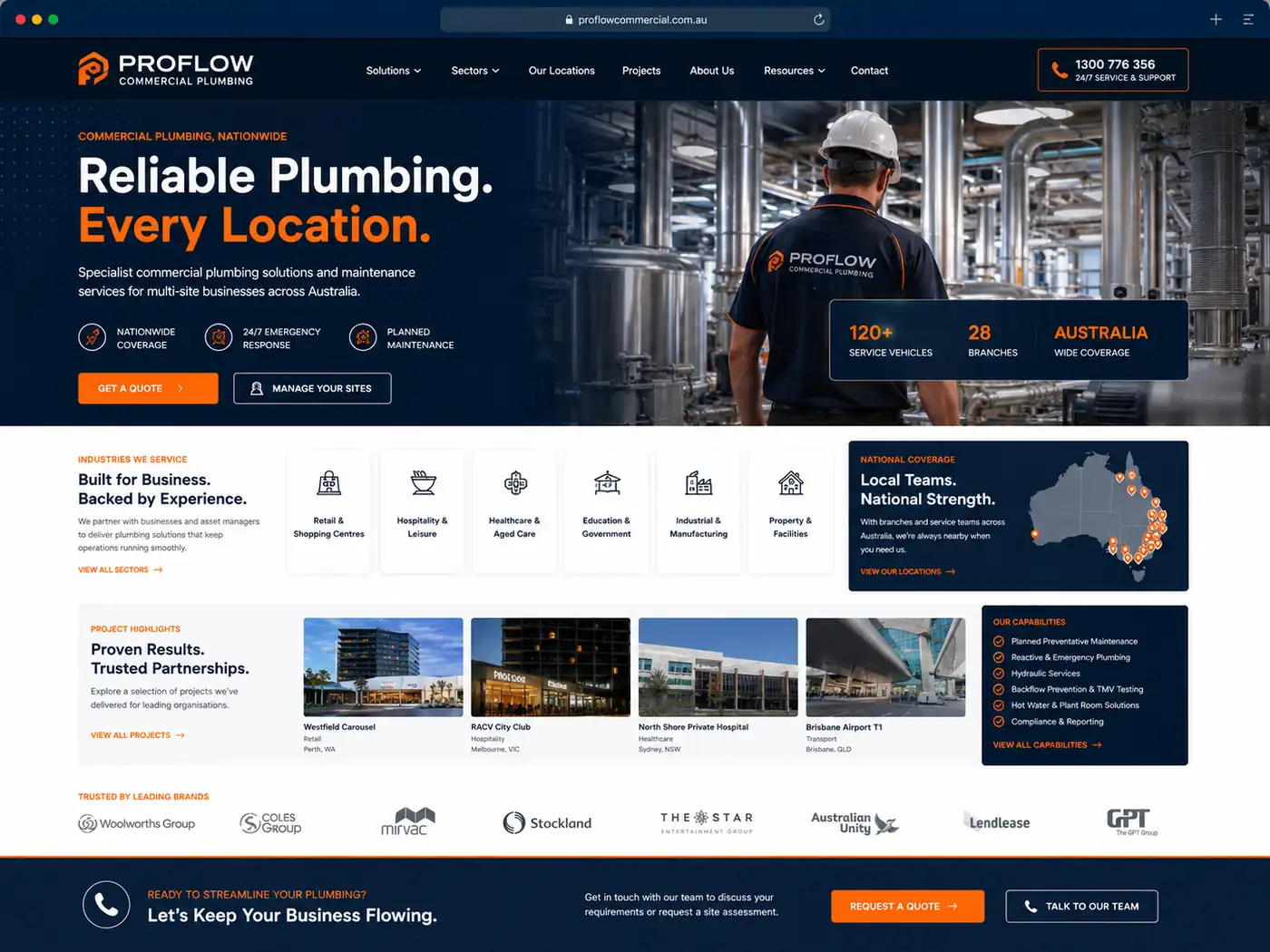
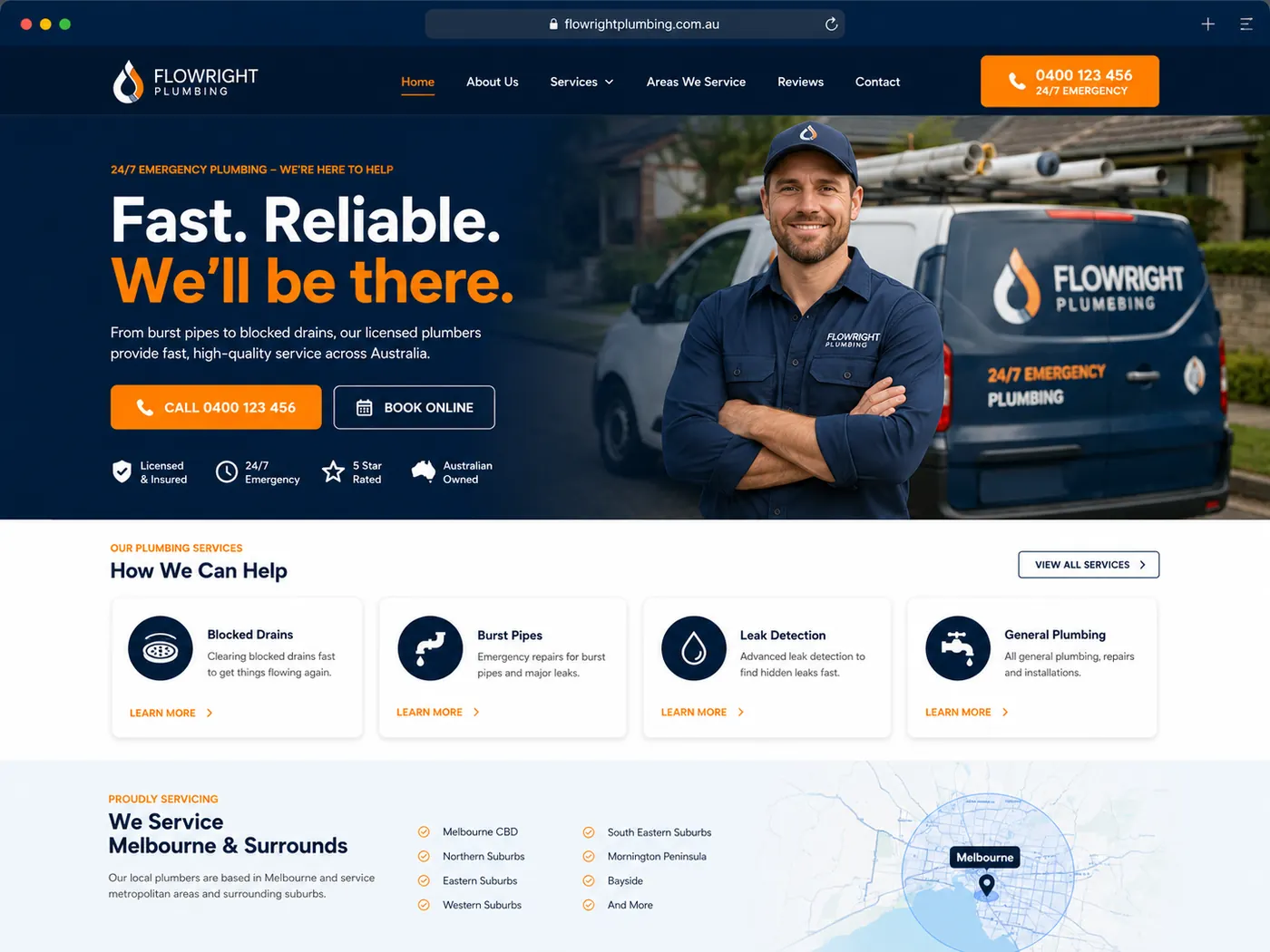
The mobile layout places the phone action above the first scroll point. Emergency services use separate pages for burst pipes, blocked drains and leak detection. Each page connects the plumbing problem to a clear call or quote pathway.
[Plumbing Website Example Two]
Business type: Growth-stage plumbing contractor with multiple technicians
Market: Brisbane and South East Queensland
Primary objective: Generate higher-value hot-water repair, replacement and installation enquiries
Scope: [Website redesign, water-heater pages, booking integration and analytics]
The website separates repair intent from installation intent. This distinction helps visitors reach the correct page and allows the business to measure calls, forms and bookings by service category.
[Plumbing Website Example Three]
Business type: Commercial and multi-location plumbing contractor
Market: Melbourne, Geelong and Ballarat, Victoria
Primary objective: Support facilities-management enquiries, commercial maintenance contracts and branch growth
Scope: [Location architecture, commercial sector pages, project evidence and CRM integration]
The website directs household customers and commercial buyers into separate paths. Facilities managers can access capability information, accreditations, project experience and maintenance enquiry forms without navigating through residential content.
How Does the Website Generate Plumbing Enquiries?
The website generates enquiries by reducing the number of decisions and actions required between landing on a page and contacting the plumbing business.
This reduction is called conversion-friction control. It involves clear information scent, visible contact controls, relevant proof and short forms.
| Website input | Visitor action | Commercial output |
|---|---|---|
| Service-specific page | Confirms service relevance | Better-qualified enquiry |
| Visible service area | Confirms geographic coverage | Fewer out-of-area leads |
| Click-to-call control | Starts a phone call | Faster urgent contact |
| Short quote form | Submits job details | More estimate requests |
| Online booking | Selects an appointment | Scheduled service request |
| Reviews and credentials | Verifies business legitimacy | Lower perceived risk |
| Call and form tracking | Records the lead source | Stronger marketing attribution |
A visually modern website can still underperform if its phone number is hidden, service pages are generic or forms request unnecessary information. Plumbing buyers consistently prioritise lead-generation evidence, mobile call conversion, SEO-safe architecture and transparent scope over design awards.
Is Your Current Plumbing Website Losing Potential Jobs?
Your website may be losing potential jobs when visitors cannot confirm the service, location, credibility or next action without additional searching.
The Website Covers Every Service on One Page
A single services page creates weak topical separation. Drain cleaning, pipe repair, hot-water installation and commercial plumbing represent different customer problems. Each service requires its own search intent, evidence and conversion path.
Mobile Visitors Cannot Contact the Business Quickly
A small phone link, hidden contact page or long form increases task-completion time. Urgent visitors need a visible call action, a short service summary and immediate service-area confirmation.
The Website Receives Traffic but Produces Few Enquiries
Traffic does not become revenue automatically. The visitor must reach a relevant offer, trust the provider and complete a measurable action.
The Website Cannot Support Business Growth
A basic website may become restrictive when the plumbing company adds technicians, services, suburbs, branches or booking software. The content management system and URL structure must support controlled expansion.
Leads Cannot Be Attributed
Untracked calls and forms prevent accurate evaluation. The business cannot identify which service page, location page, advertisement or organic search produced the enquiry.
The highest-intent problems reported by plumbing business owners include outdated one-page sites, poor mobile contact, weak local rankings, missing software integrations and uncertainty about website ownership.
Which Plumbing Businesses Is This Service Designed For?
The service is designed for plumbing businesses that need a website aligned with their current operating model and future growth requirements.
Owner-Operator Plumbers
An owner-operator normally needs a concise website with clear services, service areas, reviews, click-to-call functionality and a simple quote form. The website must reduce technical management because the owner is often responsible for both plumbing work and enquiries.
New Plumbing Businesses
A new plumbing business needs a credible digital identity. The website can establish the brand, introduce services, present licence information and connect the business with Google Business Profile, analytics and lead-capture systems.
Growth-Stage Plumbing Companies
A company with 4–15 technicians often needs separate service pages, structured location pages, campaign landing pages, call tracking and booking integration. Its primary requirement is improved conversion from existing SEO, paid search and referral traffic.
Emergency Plumbing Companies
An emergency plumbing website needs immediate phone access, urgent-service pages, availability information, service-area confirmation and a low-friction mobile journey.
Residential Plumbing Businesses
A residential website can cover repairs, installations and maintenance for homeowners, landlords and property managers. Examples include leaking toilets, blocked drains, water-pressure faults and water-heater replacement.
Commercial Plumbing Contractors
A commercial website must support longer evaluation cycles. It can include capability statements, project case studies, insurance documents, safety information, sector experience and commercial maintenance forms.
Drain and Sewer Specialists
A specialist website can separate drain cleaning, CCTV inspection, hydro jetting, sewer repair and trenchless services. This structure communicates equipment, process, suitability and project scope.
Plumbing and HVAC Companies
A combined trade website must preserve clear service taxonomy. Plumbing, heating, cooling and indoor-air services require distinct navigation paths and internal links.
Multi-Location and Franchise Businesses
A multi-location platform needs central brand control, branch-level content, local proof, controlled templates, location analytics and scalable schema implementation.
What Is Included in the Plumbing Website Design Service?
The service includes the strategic, visual, technical and measurement components required to launch a functional plumbing lead-generation website.
| Service category | Included deliverables | Commercial purpose |
|---|---|---|
| Research and strategy | Business analysis, competitor review, service mapping and audience research | Define the correct offer and page structure |
| Information architecture | Sitemap, navigation, URLs, service pages and location framework | Make content discoverable |
| User-experience design | Wireframes, mobile layouts, forms and contact paths | Reduce conversion friction |
| Visual design | Brand colours, typography, imagery, icons and interface components | Present a consistent identity |
| Website development | CMS, responsive templates, forms and integrations | Produce the working website |
| Search foundations | Metadata, internal links, crawl controls and structured data | Support discovery and interpretation |
| Measurement | Analytics, call tracking and form events | Attribute enquiries |
| Launch support | Testing, redirects, training and monitoring | Reduce launch risk |
Research and Strategy
We document the services you want to sell, the areas you can serve and the job types your team can fulfil. This prevents the website from generating demand for unsuitable services or locations.
Information Architecture
We organise the website from broad service categories to specific service pages. For example, plumbing services may divide into emergency plumbing, drainage, water systems, installations and commercial plumbing.
User-Experience Design
We map customer actions before creating the visual interface. The process identifies where a phone button, quote form, booking control, review or licence statement must appear.
Visual Design
We apply the company’s logo, colours, typography, photographs and interface elements within a consistent design system. Visual decisions must support legibility and task completion.
Development
We convert approved layouts into responsive web pages. Development can include templates, custom fields, forms, booking software, CRM connections, analytics and security controls.
Search Foundations
We configure descriptive URLs, titles, headings, internal links, image text, canonical references and indexation settings. Google recommends descriptive URLs, useful titles and crawlable links because these elements help users and search systems understand page relationships.
What Is Included and What Requires a Separate Scope?
The final proposal states which pages, integrations, revisions and ongoing services are included before development begins.
| Deliverable | Standard inclusion | Scope condition |
|---|---|---|
| Website discovery | Included | — |
| Sitemap and page plan | Included | — |
| Custom page design | Included | Number of templates varies |
| Responsive development | Included | — |
| Contact or quote form | Included | Advanced qualification may cost more |
| Basic on-page SEO | Included | Ongoing SEO is separate |
| Copywriting | Package-dependent | Page quantity must be stated |
| Service pages | Package-dependent | Quantity must be stated |
| Location pages | Package-dependent | Quantity must be stated |
| Booking integration | Package-dependent | Third-party fees are separate |
| CRM integration | Package-dependent | API complexity affects cost |
| Website hosting | Optional | Renewal fee must be disclosed |
| Website maintenance | Optional | Monthly scope must be stated |
| Professional photography | Optional | Quoted separately |
| Google Ads management | Excluded | Landing-page design can be included |
| Guaranteed rankings | Excluded | Search performance cannot be guaranteed |
| Guaranteed lead volume | Excluded | Results depend on demand, visibility and operations |
The proposal must also identify domain ownership, website ownership, content ownership, analytics access and software renewal costs.
How Will Customers Contact the Plumbing Business?
Customers can contact the business through phone, quote, booking and message pathways selected for the service type and level of urgency.
Phone Enquiries
The website can use tap-to-call controls in the header, hero, service pages and mobile navigation. Call tracking can record the source, campaign, landing page and time of the call.
Quote Requests
A quote form can collect the customer’s name, suburb, service type, problem description, preferred contact method and optional photographs. Fields that do not affect qualification can be removed.
Online Bookings
A booking system can collect the service, preferred date, time range and contact information. The booking can pass into a calendar, CRM, field-service platform or office workflow.
Message Enquiries
SMS, live chat, email and WhatsApp can support customers who cannot call immediately. These channels require a defined response process. Adding more contact methods without operational ownership can create lost or duplicated enquiries.
The correct contact mix depends on the plumbing company’s office coverage, technician capacity and scheduling process.
How Does Mobile-First Plumbing Website Design Work?
Mobile-first design prioritises the information and controls required by visitors using small screens, touch input and variable connection speeds.
The first mobile screen can show the plumbing service, service area, primary trust signal and contact action. Navigation remains short. Buttons use sufficient target size. Forms use labelled fields and suitable input types.
Emergency and planned-service journeys remain separate. An urgent customer can call without reading a long page. A customer planning an installation can review options, process, warranties and project evidence before requesting an estimate.

Mobile-first design does not mean removing useful content. It means placing information in the correct sequence.
Which Plumbing Service Pages Can Be Created?
Dedicated service pages can be created for each commercially important plumbing problem, solution and customer group.
Emergency Plumbing Services
Emergency pages can cover burst pipes, active leaks, blocked drains, overflowing toilets and loss of hot water. Each page must explain the immediate action, service boundary and contact process.
Drain and Sewer Services
Drainage pages can cover drain cleaning, CCTV inspection, hydro jetting, sewer repair and trenchless methods. Each page can define the problem, diagnostic process, equipment, limitations and expected next step.
Water-System Services
Water-system pages can cover water-heater repair, hot-water installation, low water pressure, leak detection and repiping. Repair and replacement intent must remain separate because the customer’s questions differ.
Fixture and Installation Services
Installation pages can cover toilets, taps, sinks, dishwashers, water filters and bathroom plumbing. Each page must define which fixtures, property types and installation conditions are covered.
Commercial Plumbing Services
Commercial pages can cover scheduled maintenance, facilities management, strata plumbing, hospitality plumbing, retail sites and construction projects. These pages require capability evidence, compliance information and a suitable commercial enquiry form.
The primary services receive permanent pages. Low-demand or closely related tasks can remain within a broader service page when a separate page would not add distinct value.
How Are Service Areas Structured?
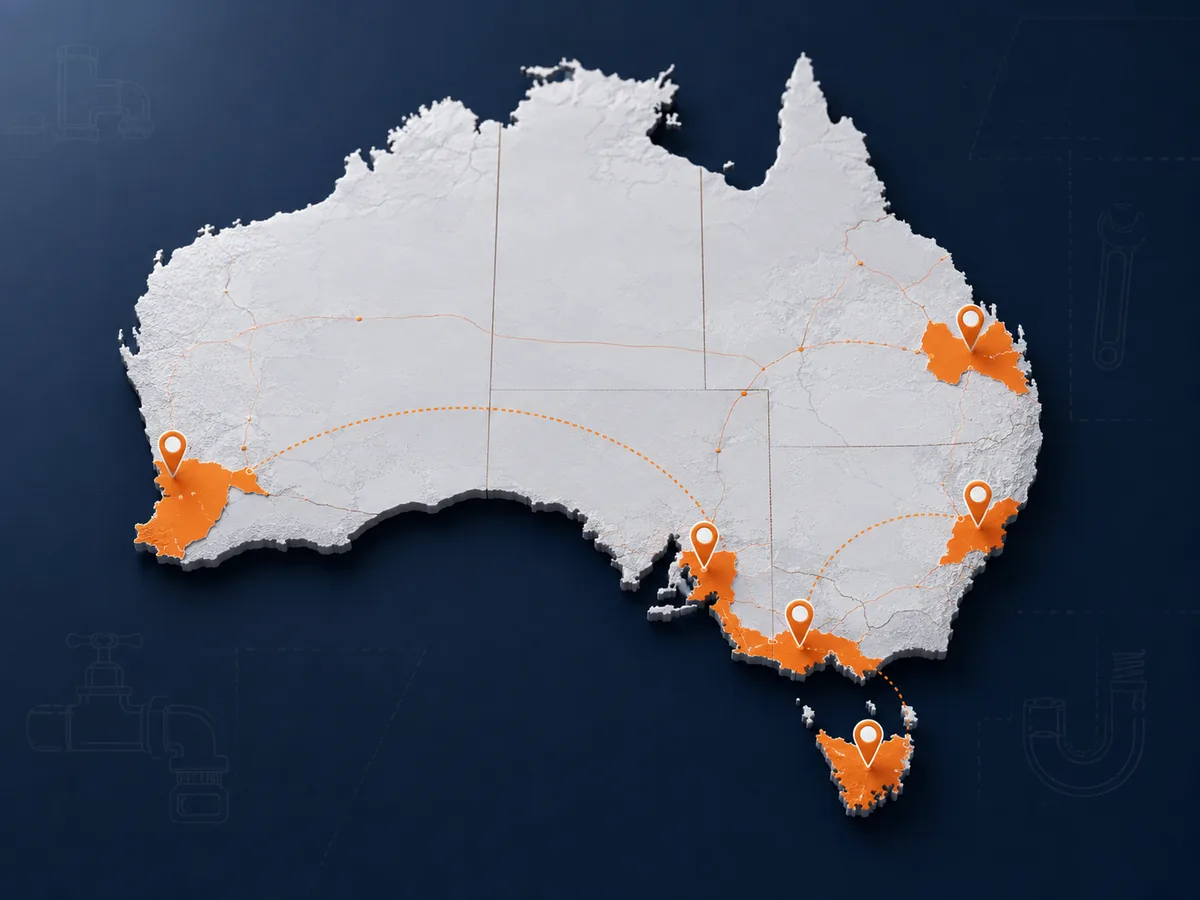
Service areas are organised through a controlled geographic hierarchy that connects legitimate locations with available plumbing services.
The broad geographic entity may be a state, region or metropolitan area. It can then divide into cities, suburbs, towns or branch territories.
A valid location page includes:
- Services available in that area
- Operating or response information
- Local contact details where applicable
- Relevant reviews or project evidence
- Internal links to service pages
- Accurate business-profile information
The page must not be produced by changing only the location name. Google classifies large-scale pages created without sufficient user value as a potential form of scaled content abuse.
Service-area architecture also needs to reflect the company’s Google Business Profile. Google recognises service-area and hybrid businesses and allows them to define the areas they serve.
Is Local SEO Included in the Website Build?
The website includes local SEO foundations, while ongoing ranking work requires a separate recurring scope.
Keyword and Intent Mapping
Keywords are assigned to pages according to the customer’s task. Examples include emergency plumber, blocked drain service, hot-water installation and commercial plumbing maintenance. The same page must not target several unrelated intents. A drain-cleaning page cannot fully satisfy water-heater installation or commercial tender intent.
Each target page receives a descriptive URL, title, primary heading, structured subheadings, internal links and relevant image text.
The build can include XML sitemaps, canonical references, redirect mapping, crawl controls, HTTPS, mobile testing and indexation checks.
Structured Data
Structured data describes the real entity represented on the page. A plumbing business website may use the relevant LocalBusiness subtype, such as Plumber, when the visible content supports it. An agency selling websites to plumbers must not identify itself as a plumbing contractor. Google states that structured data must match visible content and does not guarantee a rich result, even when the markup validates.
Measurement
The website can connect with Google Analytics 4, Google Tag Manager, Google Search Console, call-tracking software and a CRM. Events can measure phone clicks, form submissions, booking completions and other defined actions.
Which Trust Signals Belong on a Plumbing Website?
The website must provide verifiable evidence that the plumbing business is legitimate, qualified and suitable for the requested work.
Relevant evidence includes:
| Trust category | Examples |
|---|---|
| Legal and professional | Plumbing licence, insurance and accreditation |
| Operational | Service areas, operating hours, team and fleet |
| Reputation | Verified reviews, ratings and testimonials |
| Performance | Case studies, project photographs and completed work |
| Commercial | Written guarantees, warranty terms and pricing policy |
| Identity | Business address, company history and team profiles |
Stanford University’s Web Credibility Project developed its credibility guidelines from research involving more than 4,500 people. The guidance includes making claims easy to verify and showing that a real organisation exists behind the website.
Trust elements must remain specific. “Fully qualified” carries less information than a visible licence number, insurance status or named accreditation. “Trusted locally” carries less evidence than verified reviews connected to real services and locations.
Is Plumbing Website Copywriting Included?
Copywriting can be included when the package defines the number of pages, research scope, revision limit and approval process. The copy must explain the plumbing problem, available service, customer eligibility, service area, process, proof and next action. It must not rely on repeated phrases such as “high-quality service” or “customer satisfaction”.
Homepage Copy
The homepage defines the company, services, locations, proof and primary contact routes.
Service-Page Copy
Service copy explains one clear problem and solution. It can include symptoms, diagnostic methods, service process, equipment, property types and contact criteria.
Location-Page Copy
Location copy connects real service availability with geographic evidence. It must not be a duplicate service page with a different suburb name.
Commercial Copy
Commercial content can cover sectors, project capacity, safety, insurance, maintenance arrangements and tender requirements.
Technical Review
The plumbing business reviews technical claims before publication. The copywriter controls clarity, structure and search alignment. The licensed trade professional confirms service accuracy, legal terminology and operational limits.
Google’s people-first guidance asks whether content provides original value, demonstrates first-hand expertise and leaves the user with enough information to achieve a goal.
Can the Website Connect With Booking and Field-Service Software?
Yes. The website can pass qualified enquiry data into compatible booking, CRM, call-tracking and field-service systems.
Potential integrations include Jobber, ServiceTitan, Housecall Pro, Google Calendar, HubSpot and other compatible platforms.
A typical workflow is:
- The customer selects a plumbing service.
- The form checks the service area.
- The customer submits contact and job information.
- The website sends the data to the selected platform.
- The office receives a notification.
- The customer receives a confirmation.
- The lead source is stored for reporting.
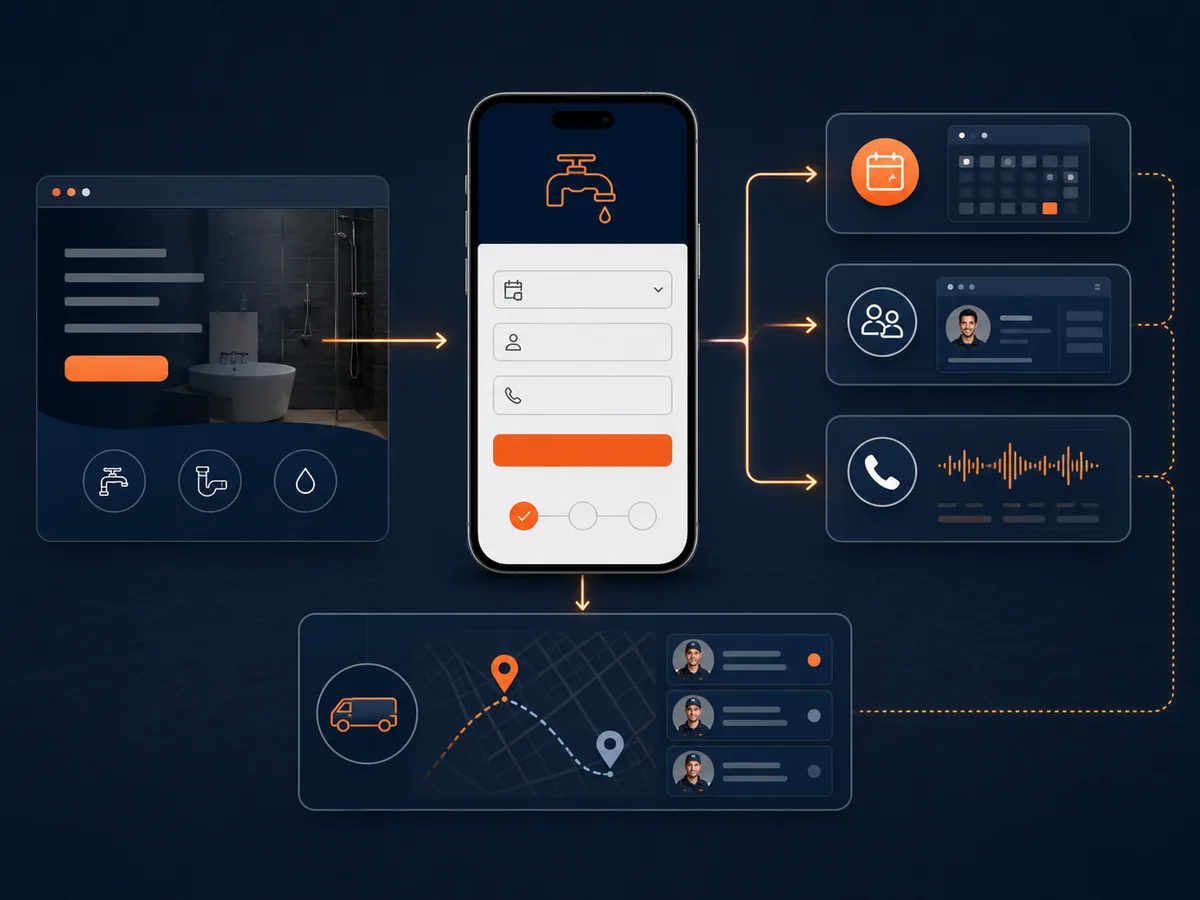
Integration scope depends on the software’s application programming interface, subscription plan, authentication method and available data fields.
A software logo does not confirm a working integration. The proposal must define which fields move between systems, which event starts the workflow and how failures are monitored.
Which Website Platform Will Be Used?
The platform is selected according to editing requirements, integration complexity, search control, scalability and ownership.
| Platform model | Suitable use | Main constraint |
|---|---|---|
| WordPress | Service and location growth with broad integration options | Requires controlled updates and maintenance |
| Webflow | Managed visual system with structured design control | Some complex integrations require external services |
| Managed website platform | Small business requiring low technical involvement | Portability and feature control may be limited |
| Custom CMS | Multi-location or operationally complex website | Higher development and support cost |
| DIY builder | Basic initial presence with a limited budget | Owner manages structure, content and optimisation |
The platform decision must follow the website requirements. Selecting a builder before mapping services, locations, integrations and ownership can create avoidable migration costs.
Who Owns the Website, Domain and Data?
The plumbing business must retain documented control of the domain, website content, analytics and business accounts after payment conditions are met.
The proposal must state:
- Domain registrant
- Hosting account owner
- Website administrator access
- Design and code ownership
- Copy and image rights
- Analytics ownership
- Search Console ownership
- Call-tracking ownership
- CRM ownership
- Migration rights
- Software renewal obligations
A proprietary platform is not automatically unsuitable. The restriction must be disclosed before purchase. The buyer needs to know whether the website can be exported, transferred or maintained by another provider.
Will the Website Be Fast, Accessible and Secure?
The build includes performance, accessibility and security controls that support task completion across devices and user needs.
Performance
Performance testing can measure Largest Contentful Paint, Interaction to Next Paint and Cumulative Layout Shift. Google’s current “good” Core Web Vitals thresholds are:
| Metric | Good reference value | Measures |
|---|---|---|
| LCP | 2.5 seconds or less | Main-content loading |
| INP | 200 milliseconds or less | Interaction responsiveness |
| CLS | 0.1 or less | Visual stability |
These values are evaluation references, not ranking guarantees.
Performance work can include image compression, WebP files, caching, lazy loading, script control and database maintenance.
Accessibility
The interface can apply WCAG 2.2 principles for contrast, keyboard access, visible labels and accessible controls. W3C guidance includes keyboard operation and label requirements for interactive elements.
Security
Security controls can include HTTPS, firewall protection, form validation, spam protection, backups, malware monitoring and controlled administrator access.
No website can be described as permanently secure. Security requires updates, monitoring and incident response after launch.

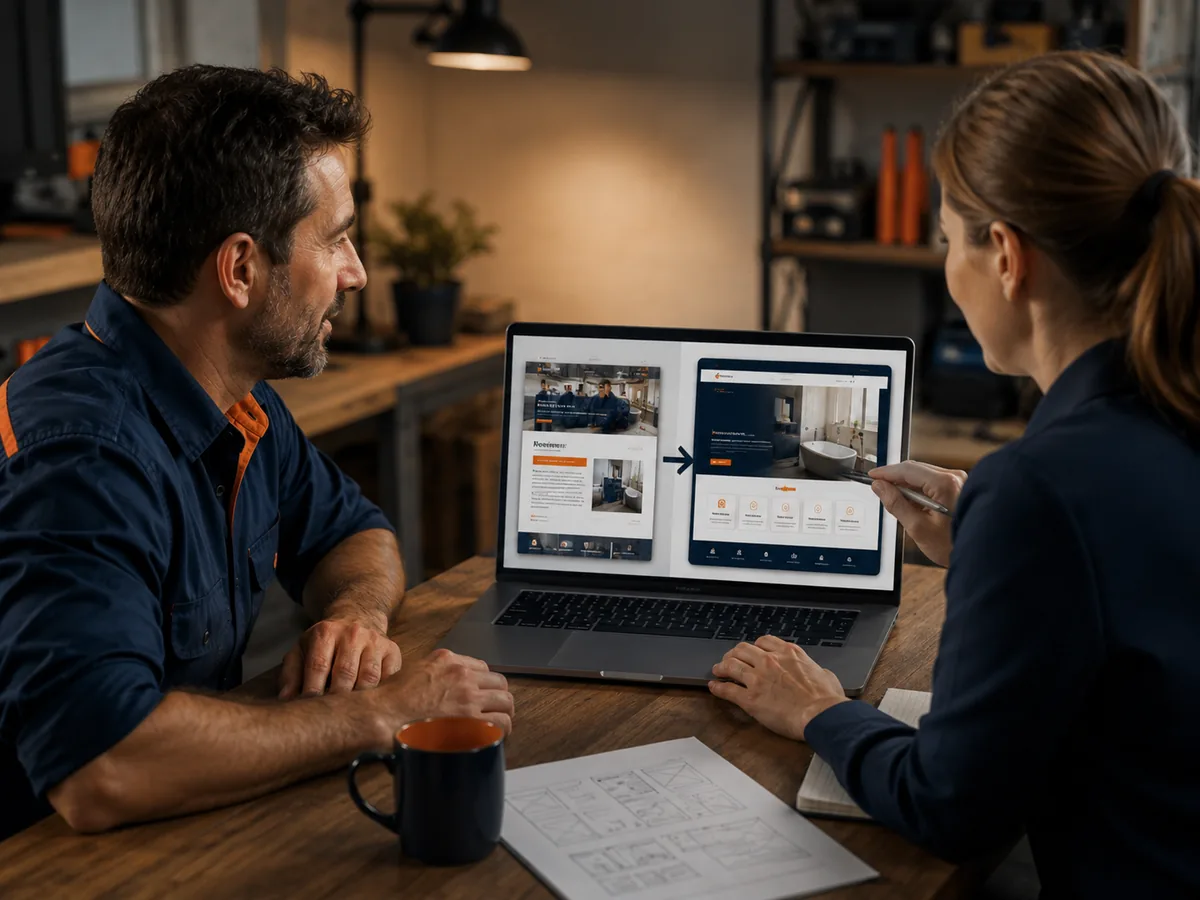
Can an Existing Plumbing Website Be Redesigned Safely?
Yes. A redesign can preserve valuable URLs, content and measurement systems when migration planning begins before development.
The migration follows this sequence:
- Audit the existing website.
- Export all indexable URLs.
- identify pages with traffic, rankings and links.
- Map retained content to the new architecture.
- Prepare page-level redirects.
- Preserve titles, metadata and structured information where relevant.
- Test forms, calls, analytics and booking functions on staging.
- Launch during a controlled deployment window.
- Inspect redirects, indexation and errors.
- Monitor Search Console and analytics after launch.
A redesign cannot guarantee zero ranking movement. Search systems must crawl and interpret the changed website. The correct objective is to preserve relevant signals, remove technical errors and monitor changes quickly.
Choose a Website Package Built for Your Plumbing Business
Select a clear starting scope based on your services, locations, lead pathways and integration requirements. Final pricing is confirmed after the website review and project scoping process.
Essential Plumbing Website
A professional foundation focused on service clarity, mobile contact, trust and local relevance.
- Up to 5 professionally designed pages
- Custom mobile-first Elementor design
- Core plumbing service structure
- Service-area summary
- Click-to-call and quote form
- Basic on-page SEO setup
- Google Analytics 4 and Search Console setup
- Two revision rounds
- 30 days of post-launch technical support
Growth Plumbing Website
Built for multiple services, stronger location coverage, booking workflows and measurable lead attribution.
- Up to 12 professionally designed pages
- Priority plumbing service pages
- Initial suburb or location pages
- Custom conversion-focused page templates
- Booking or CRM integration
- Call, form and booking-event tracking
- SEO-safe URL and internal-link architecture
- Existing website redirect mapping
- Three revision rounds
- 60 days of post-launch technical support
Multi-Location Plumbing Platform
A scalable platform for branches, territories, service taxonomies, approval workflows and advanced integrations.
- Custom website and information architecture
- Reusable service and location templates
- Full plumbing service taxonomy
- Branch and territory page framework
- Multi-location contact and enquiry routing
- CRM, booking and field-service workflows
- Branch-level analytics and attribution
- Full technical migration where required
- Role-based website training
- Post-launch support agreement
Pricing note: Hosting, maintenance, premium plugin licences, third-party software, professional photography, ongoing SEO and additional content are quoted separately unless they are expressly included in the written proposal.
Not Sure Which Package Fits?
Request a website review and receive a recommended page structure, scope, timeline and investment range.
How Long Does a Plumbing Website Take to Build?
A standard custom website normally moves through strategy, design, development, testing and launch; the exact duration depends on approvals, content and integrations.
| Phase | Main output | Indicative duration |
|---|---|---|
| Discovery | Requirements and commercial goals | [X working days] |
| Architecture | Sitemap and page mapping | [X working days] |
| Wireframes | Page structure and user journeys | [X working days] |
| Copy and assets | Approved content and images | [X–X weeks] |
| Visual design | Approved page system | [X–X weeks] |
| Development | Functional website | [X–X weeks] |
| Testing | Technical and conversion checks | [X working days] |
| Launch | Deployment and monitoring | [X working days] |
Delayed content, photography, access credentials or approvals can extend the schedule. The project plan must identify who owns each approval and when feedback is required.
What Is the Plumbing Website Design Process?
The process converts business requirements into a tested website through eight controlled stages.
1. Define the Commercial Goal
We identify the job categories, service areas, customer groups and lead actions that matter to the business.
2. Research the Search Market
We review competitor structures, service terminology, customer questions and geographic demand.
3. Build the Information Architecture
We assign services, locations and customer intents to pages. We then define URLs, navigation and internal links.
4. Create Wireframes and Content
We determine the order of information, trust evidence, calls to action, forms and page relationships.
5. Design the Visual System
We apply branding, typography, images and interface components to approved wireframes.
6. Develop and Integrate
We build the responsive website and connect forms, booking systems, analytics and required software.
7. Test and Launch
We test browsers, devices, performance, accessibility, redirects, forms and tracking before deployment.
8. Monitor and Improve
We review errors, indexation, form delivery and user behaviour after launch. Ongoing testing can then improve pages using collected evidence.
Why Choose a Plumbing Website Specialist?
A plumbing website specialist connects design decisions with trade services, local search behaviour and lead-management requirements.
A general designer can create a functional website. A specialist scope adds plumbing-specific service architecture, emergency contact paths, geographic targeting, trust requirements and job-management integrations.
Our delivery model includes:
Plumbing Service Understanding
Pages are structured around actual services, such as blocked drains, leak detection, hot-water systems and commercial maintenance.
Search-Safe Architecture
Services and locations receive controlled URLs, headings and internal links before development begins.
Conversion Measurement
Phone calls, forms and bookings can be recorded as separate actions.
Transparent Ownership
The proposal identifies control of the domain, website, hosting, analytics and data.
Scalable Delivery
The website can add services, locations, staff profiles, commercial sectors and landing pages without rebuilding the core system.
Post-Launch Accountability
Support terms state the response process, covered tasks and service period.
Is a DIY Builder, General Designer or Plumbing Specialist More Suitable?
The suitable provider depends on budget, internal expertise, growth plans and the commercial importance of the website.
| Decision factor | DIY website builder | General web designer | Plumbing website specialist |
|---|---|---|---|
| Initial investment | Usually lower | Moderate | Moderate to higher |
| Internal work required | High | Moderate | Lower |
| Plumbing architecture | Owner-created | Varies | Included in strategy |
| Local SEO foundations | Self-managed | Varies | Scope-defined |
| Emergency conversion | Template-dependent | Varies | Planned directly |
| Copywriting | Owner-written | General | Trade-specific |
| Tracking | Self-configured | Varies | Calls, forms and bookings |
| Integration planning | Application-dependent | Quoted separately | Workflow-based |
| Scalability | Platform-dependent | Provider-dependent | Defined before build |
| Ownership | Platform terms apply | Contract terms apply | Must be documented |
A DIY platform may suit a new business with a restricted budget and enough internal time. A custom specialist website is more relevant when the business depends on search traffic, serves multiple areas or needs measurable integrations.
Which Website Mistakes Reduce Plumbing Enquiries?
The most damaging mistakes disconnect customer intent from the service, evidence or contact action required to complete an enquiry.
| Mistake | Commercial effect | Corrective action |
|---|---|---|
| One page covers all services | Weak relevance | Create priority service pages |
| Phone number is hidden | Slower urgent contact | Add visible tap-to-call controls |
| Location coverage is unclear | Unqualified enquiries | State service areas early |
| Form contains excessive fields | Higher friction | Request only useful information |
| Reviews lack verification | Weak trust | Display sourced reviews |
| Stock images replace business proof | Lower authenticity | Use team, fleet and project images |
| Emergency and planned work share one path | Mixed intent | Separate contact journeys |
| Calls are not tracked | Unknown lead source | Configure call attribution |
| Location pages repeat the same text | Thin content | Add local service evidence |
| Redesign ignores current URLs | Migration loss | Create page-level redirect mapping |
| Agency controls business accounts | Operational dependency | Document ownership |
| Maintenance is undefined | Increased technical risk | Agree post-launch responsibilities |
What Happens After the Website Launches?
Post-launch support keeps the website operational, measurable and capable of controlled growth.
Maintenance can include CMS updates, security updates, backups, uptime monitoring, malware checks, form testing, broken-link monitoring and technical support.
Growth work can include new service pages, new locations, campaign landing pages, conversion testing and reporting.
Maintenance and SEO are separate services. Maintenance protects website operation. SEO develops search visibility through content, technical improvements, authority and ongoing market analysis.
| Support area | Example task | Reporting evidence |
|---|---|---|
| Availability | Uptime monitoring | Uptime record |
| Security | Updates and malware checks | Maintenance log |
| Conversion | Form and phone testing | Test record |
| Performance | Speed monitoring | Performance report |
| Content | Service-page updates | Change history |
| Search | Indexation and error review | Search Console data |
| Leads | Calls, forms and bookings | Attribution report |
Plumbing Website Design FAQs
How much does a plumbing website cost?
The cost depends on page architecture, copywriting, integrations, migration and support; a written proposal must separate build fees, software costs and recurring charges.
How long does a plumbing website take to build?
The timeline depends on content, approvals and technical complexity, but each project must include strategy, design, development, testing and launch stages.
How many pages does a plumbing business need?
The required page count depends on the number of priority services, legitimate locations, customer groups and legal information the business needs to present.
Is website copywriting included?
Copywriting is included only when the package states the number of pages, research scope, revisions and technical approval responsibilities.
Is local SEO included?
The build includes local SEO foundations, while ongoing rankings, content growth and authority work require a separate SEO scope.
Are suburb or location pages included?
Location pages are included when stated in the package and when each page can provide distinct service, operating and local evidence.
Can you redesign an existing plumbing website?
Yes. The redesign process can preserve valuable content, URLs, tracking and links through auditing, mapping, redirects and post-launch monitoring.
Will a redesign affect existing rankings?
Rankings can change after a redesign, but migration planning reduces avoidable losses by preserving relevant URLs, content, links and technical signals.
Who owns the website and domain?
Ownership must be stated in the agreement, with the plumbing business retaining documented access to its domain, content, analytics and business accounts.
Can I update the website myself?
Yes, when the selected CMS and permission structure allow authorised staff to edit services, locations, team information and basic content.
Which platform will be used?
The platform is selected after reviewing editing needs, SEO control, integrations, ownership, maintenance and future expansion.
Can the website integrate with Jobber or ServiceTitan?
Integration is possible when the selected software plan and API support the required booking, lead and customer-data workflow.
Can phone calls and forms be tracked?
Yes. Call tracking, form events, booking completions and campaign data can be configured as separate measurable conversions.
Are hosting and maintenance included?
Hosting and maintenance are included only when listed in the package, with renewal costs, support tasks and response terms stated separately.
Can you build a multi-location plumbing website?
Yes. A multi-location build can include branch pages, controlled templates, location-level analytics, approval workflows and service-area management.
Can you guarantee rankings or leads?
No responsible provider can guarantee rankings or lead volume because results also depend on demand, competition, reputation, marketing investment and lead response.
Get a Plumbing Website Plan Built Around Your Services
Request a website plan that defines the pages, functionality, integrations, timeline and investment required for your plumbing business.
The initial review covers:
- Current website condition
- Priority plumbing services
- Service areas
- Customer groups
- Booking process
- Existing search visibility
- Required integrations
- Website ownership
- Measurement requirements
- Launch objective
After submission, we review the current website and business requirements. We then prepare a recommended page structure, delivery scope, project timeline and investment range.


