WordPress SEO Services for Tradies That Drive More Leads
We provide WordPress SEO services for Australian tradies who want stronger organic visibility and more profitable work. Using evidence-led website optimisation and performance measurement, we help trade businesses turn relevant search demand into qualified calls, quote requests, booked jobs and revenue.
Find out what's holding you back
Enter your number — we’ll call you with a free ranking report for your suburb.
We call within 2 business hours. No scripts. No pressure.
Businesses We Support Across Australia
We support trade and commercial service businesses with stronger local visibility, clearer lead generation and marketing systems connected to measurable commercial outcomes.




Why Is Your WordPress Website Not Generating Enough Qualified Leads?
A WordPress website usually underperforms when search engines cannot access the right pages, those pages target the wrong search intent, or visitors reach the site without a clear path to enquire.
Technical SEO problems eventually become lead-generation and revenue problems.
Google Cannot Reliably Access the Pages That Matter
Important service pages can become difficult to crawl or index because of poor internal links, noindex settings, conflicting canonicals, redirects or sitemap issues.
Our technical SEO process audits crawl paths, robots directives, canonicals, redirects and indexation so high-value pages remain visible and capable of generating enquiries.
Your WordPress Setup Has Accumulated Technical Debt
Themes, plugins, builders and tracking scripts can create unused CSS, redundant JavaScript, oversized DOMs and unnecessary performance overhead.
We identify which WordPress components support rankings and leads—and which are creating technical problems without adding business value.
The Wrong URLs Are Competing for Search Demand
Categories, tags, archives, attachment URLs and location pages can compete with your main service pages when they target similar search intent. Where duplicate or similar URLs exist, we follow Google’s canonicalisation guidance to help clarify which URL should be treated as the primary version.
We consolidate overlap, control unnecessary indexation and map valuable search demand to the correct commercial URL.
Traffic Is Not Turning Into the Right Leads
A tradie does not need more traffic if those visitors are searching outside the service area or for work the business does not want.
We prioritise commercial search demand around profitable services, locations and buyer intent so traffic is more likely to become enquiries and booked jobs.
Your Website Is Slow Where It Matters
Slow loading, delayed interactions and unstable layouts can reduce usability before a visitor reaches your offer or enquiry form. We investigate server response, images, CSS, JavaScript, plugins and caching in line with Core Web Vitals guidance while protecting calls, forms and conversion tracking.
Nobody Can Show Which SEO Work Generated Revenue
Rankings, impressions and traffic only show part of SEO performance if enquiries and booked work are not being measured.
We connect Search Console and GA4 with calls, quote requests and lead events to track organic visit → enquiry → qualified lead → revenue.
What’s Included in Our WordPress SEO Service?
Our WordPress SEO service combines technical optimisation, on-page SEO for tradies, content architecture, local search, authority development and conversion measurement around one objective: attracting search users who can become customers.
We do not treat every possible SEO task as equally important.
A 25-page plumbing site and a 2,000-URL WooCommerce installation should not receive the same checklist. The campaign is prioritised according to technical condition, search demand, business value, competition and implementation effort.
The audit determines what should be fixed, what should be improved and what should be left alone.
We combine website crawling, Search Console evidence, analytics, page-level performance, existing rankings, backlink information, website architecture and conversion data.
The output is not a 100-item document where every issue is presented as urgent.
Each finding is classified by impact and dependency. A blocked revenue page, for example, receives greater priority than rewriting an image filename that already performs correctly.
The audit also identifies pages that should be retained, consolidated, redirected, expanded or created.
That creates the campaign roadmap before implementation begins.
Site architecture should make your commercial priorities obvious to users and search systems.
For a growing trade business, a useful structure may connect:
core services → specialist services → industries → locations → supporting resources
rather than placing every URL directly under the homepage.
Internal links then establish relationships between those resources.
A guide about blocked drains can support the relevant plumbing service page. A service page can connect to the suburbs where that service is available. A location page can lead a visitor toward the specific service required.
We assess crawl depth, orphan pages, navigation, breadcrumbs, contextual links, anchor text and parent-child relationships.
Internal linking is therefore not a task of adding five random links to every page. Each link should help discovery, context or the next user action.
Content should capture demand that can support the business, not increase the article count.
That distinction changes what gets published.
A generic agency may recommend thirty monthly blog posts because “fresh content” is part of the package. We first determine whether the business actually needs a service page, location resource, comparison page, supporting guide, existing-page update or no new URL at all.
Google explicitly says there is no preferred word count and warns against publishing content simply because a topic might attract search visits.
For tradies, we normally prioritise commercial and supporting assets around services customers can actually buy.
A useful content network can move from broad business entities into narrower customer needs:
plumbing → emergency plumbing → burst pipes → affected locations → booking intent
or:
roofing → roof restoration → tile restoration → service areas → quote intent.
Supporting content earns its place by strengthening those commercial relationships or answering questions that genuinely affect a buying decision.
Yoast SEO or Rank Math can implement SEO settings; neither replaces an SEO strategy.
An SEO plugin can manage titles, canonical tags, sitemap behaviour, robots directives, breadcrumbs and structured information.
It cannot decide which service is commercially important, whether two pages satisfy the same intent, which suburbs deserve dedicated landing pages, what should be consolidated, or whether traffic is producing qualified work.
We configure the appropriate plugin around the strategy.
We do not build the strategy around achieving a green plugin score.
For a service-area business, WordPress SEO and local SEO have to work together.
Your website tells search systems what the business provides, where it operates and which page best represents each service-location relationship. Your Google Business Profile and wider local signals reinforce the real-world business entity behind that website.
We align service pages, location content, business information, internal links, Google Business Profile data, reviews, citations and relevant local references.
For a contractor serving several suburbs, that does not mean creating one near-identical page for every postcode.
A location page should exist because there is a useful search and customer purpose for it. The content should reflect genuine service availability, relevant jobs, local conditions or information that differentiates that market.
The result is a clearer local entity structure instead of a network of doorway-style pages with swapped place names.
A redesign should not force Google and customers to rediscover the business from zero.
Before a migration or major rebuild, we map existing URLs, rankings, internal links, indexation and search performance.
Changed URLs receive intentional redirect mapping. Staging environments are checked for indexing controls. Canonicals, navigation, structured data, metadata and XML sitemaps are reviewed before and after launch.
Once the new site is live, we crawl it again and monitor Search Console for unexpected coverage, redirect or indexing changes.
The objective is preservation first, improvement second.
Launching a more attractive website is not a successful migration if the pages generating enquiries disappear from search.
AI-search visibility extends good SEO; it does not replace crawlability, useful pages or authority.
Google’s current documentation states that the foundational SEO practices used for Search also apply to its AI features. A page must first be indexed and eligible to appear in Google Search with a snippet before it can be eligible as a supporting link in AI Overviews or AI Mode.
We therefore improve the underlying information architecture first.
Clear entity relationships, factual service information, useful supporting content, structured information, authoritative references and technically accessible pages can make the business easier for search and answer systems to interpret.
Where AI visibility is part of the campaign, we can also monitor how the brand, services and competitors appear across relevant prompt sets.
We do not promise that ChatGPT, Gemini or another generative system will cite a particular URL. Those outputs are not controlled by an SEO agency.
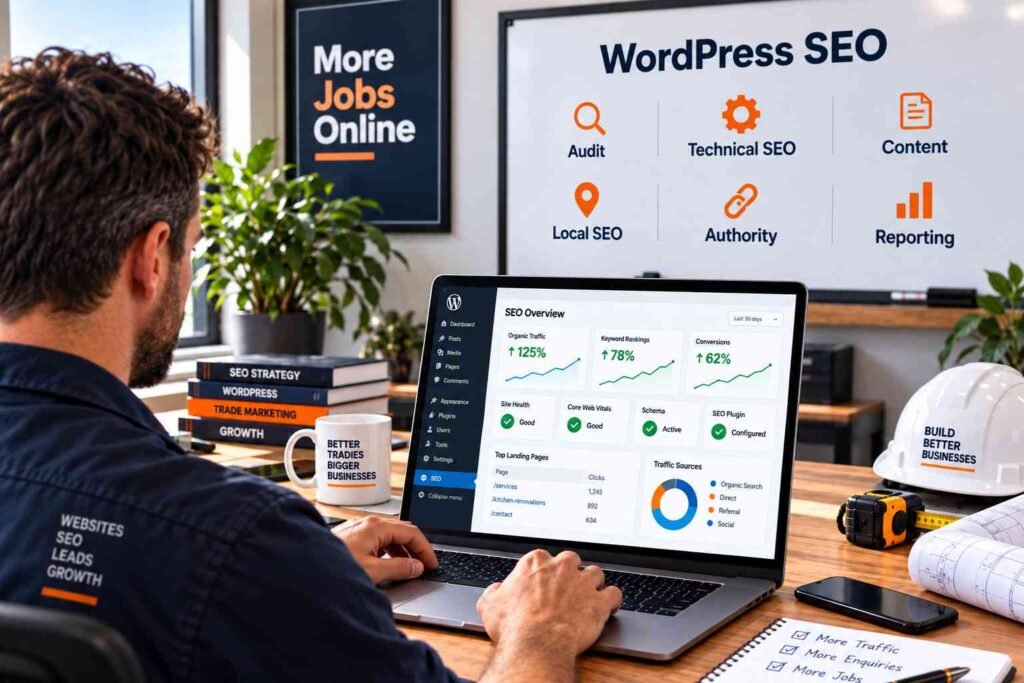
Technical WordPress SEO makes important pages accessible, indexable and structurally clear without allowing unnecessary URLs to create noise.
We review crawlability, indexability, XML sitemaps, robots.txt, meta robots directives, canonicalisation, HTTP status codes, 301 redirects, redirect chains, broken URLs, JavaScript rendering, HTTPS, internal crawl paths and permalink structures.
WordPress-specific checks extend into taxonomy behaviour, media attachment pages, author archives, category and tag templates, custom post types and plugin-generated URLs.
The objective is controlled discovery.
Pages that contribute to search demand should be discoverable. URLs with no useful search purpose should not compete unnecessarily with the pages intended to produce enquiries.
On-page optimisation aligns each important URL with a defined search need and a clear commercial purpose.
That includes titles, headings, URLs, page copy, supporting entities, image context, internal anchors and metadata.
Keyword research is used to understand demand rather than dictate awkward wording.
A customer may search “emergency plumber Melbourne”, “burst pipe plumber” or “24 hour plumbing service”. The page does not need to repeat every lexical variation mechanically. It needs to demonstrate clearly that the business provides the relevant service, in the relevant area, under the relevant conditions.
Google states that its language systems can understand how pages relate to many query variations even when every exact phrase is not explicitly inserted.
Our focus is therefore stronger intent coverage, clearer entities and better information—not keyword density.
Performance work targets the causes of slow loading and interaction rather than chasing a perfect laboratory score.
We investigate image formats and dimensions, lazy loading, caching, content delivery networks, JavaScript execution, unused CSS, fonts, database overhead, hosting response times, third-party scripts and theme behaviour.
Where appropriate, images can be compressed and served in efficient formats such as WebP or AVIF. Scripts can be deferred or removed where they serve no useful function. Caching can be configured around the site’s actual technology rather than layered through several plugins that perform the same job.
We validate changes against functional elements such as forms, phone buttons, menus, tracking and page-builder components.
The goal is a site that is technically leaner without becoming harder to manage or convert through.
More plugins do not create more SEO. They can create overlapping controls.
A WordPress installation running several SEO plugins may output conflicting canonicals, duplicate schema, competing sitemaps or inconsistent metadata.
We review the role of plugins rather than judging them by quantity alone.
The same applies to themes and builders.
Elementor, Divi, Gutenberg and similar systems can all support search-friendly websites when their templates, scripts and page structures are controlled correctly. The optimisation task is to identify unnecessary overhead, duplicated components and template-level issues without breaking the editing workflow the business relies on.
Structured data helps describe eligible page information in a machine-readable format, but it does not guarantee higher rankings or a rich result.
We implement schema that matches the visible content and entity represented on the page.
Depending on the website, that can include Organization, LocalBusiness, Service, BreadcrumbList, Article, Product or Offer information where those types genuinely apply.
We also check for duplicate or contradictory markup generated by themes and plugins.
Google states that structured data can make a page eligible for supported search features but does not guarantee that those features will appear.
That is why we treat schema as one part of information clarity—not as a ranking shortcut.
Authority work focuses on earning relevant third-party signals, not filling a spreadsheet with backlink counts.
We assess the existing backlink profile before deciding whether link acquisition is actually the next constraint.
That can involve relevant industry references, local citations, supplier or association opportunities, digital PR, publisher outreach, link reclamation and legitimate editorial coverage.
A link has more context when the source, destination and surrounding topic are genuinely related.
We therefore do not evaluate a campaign by statements such as “50 links delivered this month.”
The useful question is:
Did the campaign strengthen the site’s ability to compete for commercially valuable searches without creating unnecessary link risk?
SEO reporting should explain what changed and what happened commercially after the change.
We use Google Search Console to examine queries, pages, impressions, clicks and search visibility. GA4 and conversion tracking provide the next layer: what organic users did after arriving.
For a tradie campaign, reporting should move toward business events such as phone calls, quote submissions, bookings and qualified enquiries.
The measurement chain becomes:
search visibility → organic visit → conversion action → qualified lead → booked work
where the available CRM or business data allows that connection.
Rankings still matter. They are diagnostic signals.
They are not the final invoice-paying outcome.
WooCommerce requires a different search architecture from a standard tradie lead-generation website.
Where a WordPress business also sells products, the scope can extend into product URLs, category architecture, faceted navigation, duplicate descriptions, product structured data, internal linking and crawl management.
We separate this work from ordinary service-business SEO because the search journey is different.
A plumbing service page exists to generate an enquiry. A WooCommerce product page may need to produce a transaction.
The optimisation model should reflect that difference.
Who Do We Help With WordPress SEO?
Our strongest fit is an established Australian trade or service business that needs stronger SEO for tradies and is not generating enough qualified enquiries from organic search. Whether you already rely on referrals, Google Ads or existing search traffic, the objective is to make SEO contribute more reliably to leads, booked work and business growth.
Owner-Operator Tradies
Plumbers, electricians, roofers, builders, painters, landscapers and other tradies need visibility for high-value services in the areas they can profitably serve, so we strengthen service pages, local search relevance, internal linking, technical accessibility and conversion paths to turn commercial search demand into more calls, quote requests and booked jobs.
Growing Trade Businesses
Businesses with multiple crews, services or locations often accumulate overlapping pages, outdated URLs, weak internal linking and inconsistent location content, so we restructure WordPress around priority services, markets and locations to consolidate competing intent, strengthen site architecture and support expansion without creating additional technical debt.
Marketing Managers and In-House Teams
Marketing teams often know what needs improvement but need stronger technical execution, so we work across indexation, canonicals, redirects, Core Web Vitals, schema, Elementor, site architecture, Yoast, Rank Math, Search Console and GA4 to move SEO recommendations from audit findings into implemented, measurable improvements.
Businesses Replacing an SEO Provider
If SEO has been running for months but nobody can clearly show what changed, what improved or which work contributed to enquiries, we establish a new technical and performance baseline, retain useful assets, identify ineffective or risky work and prioritise the changes most likely to improve search visibility, lead quality and commercial performance.
Where Do We Provide WordPress SEO Services?
We provide WordPress SEO services for tradies and service businesses across Australia.
Campaigns can target national markets, individual states, metropolitan areas or defined service territories depending on where the business can actually accept work.
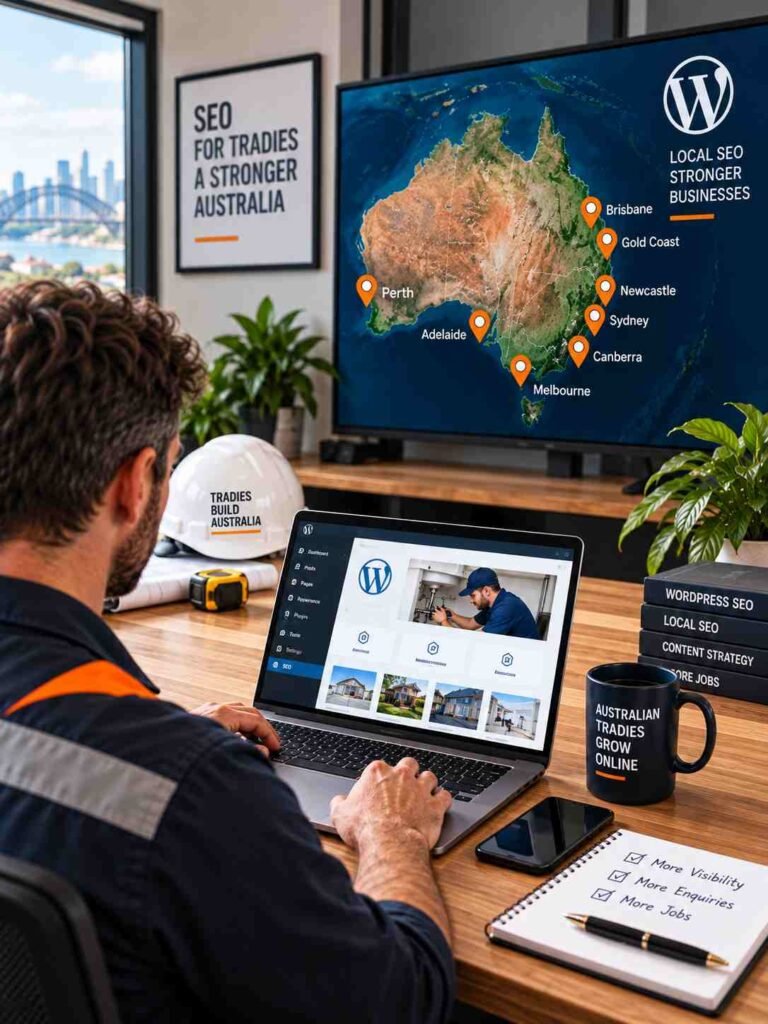
That includes trade businesses operating in Sydney, Melbourne, Brisbane, Perth, Adelaide, Canberra, Newcastle, the Gold Coast and surrounding service areas, alongside businesses covering multiple Australian markets.
Location targeting is based on genuine operating areas and search demand.
We do not create a page for every suburb simply because WordPress makes it easy to publish one.
The location architecture should correspond with real coverage, distinct user value and a commercially meaningful search relationship.
How Does Our WordPress SEO Process Work?
Our process moves from diagnosis to implementation before expansion, because scaling content, links or location pages on top of unresolved technical problems can simply scale the weakness already built into the site.
1. Establish the Search & Lead Baseline
We first establish how the website currently performs across search visibility, traffic and conversions using Search Console, analytics, conversion tracking and site crawls, so we can connect queries and landing pages with calls, forms, qualified enquiries and booked work.
2. Diagnose the WordPress Environment
We inspect indexation, XML sitemaps, robots directives, canonicals, redirects, taxonomies, templates, plugins, performance, internal linking and content overlap to identify the technical or structural constraints actually limiting visibility, usability or conversions.
3. Prioritise by Commercial Impact
Not every SEO issue deserves the same urgency, so we prioritise work according to commercial value, expected impact, implementation effort and dependency, with blocked revenue pages, broken enquiry paths and high-value service URLs taking priority over low-impact technical warnings.
4. Implement Technical & Structural Fixes
Where the scope allows, we make the required WordPress changes directly, including redirect corrections, indexation controls, canonical fixes, sitemap configuration, internal linking, URL cleanup, plugin settings, template improvements and performance work, so identified issues are actually resolved rather than left as recommendations in a report.
5. Expand Commercial Search Coverage
Once the technical foundation is controlled, we strengthen service and location pages where demand already exists and create new pages only where genuine commercial gaps remain, with the goal of expanding visibility around profitable services and locations rather than increasing page count for its own sake.
6. Strengthen Local & External Signals
For tradies and service-area businesses, our local SEO for tradies approach aligns the website with Google Business Profile, reviews, citations, local references and relevant authority signals, following Google’s local ranking guidance, so service and location pages are supported by consistent, legitimate evidence of the real business behind them.
7. Measure Results & Expand Proven Opportunities
As new queries, stronger pages and better lead opportunities emerge, we use search and conversion data to decide where further optimisation or expansion is justified, creating an evidence-led cycle of audit → prioritisation → implementation → measurement → expansion rather than repeating the same monthly activity regardless of results.
WordPress SEO Case Study: Sydney Plumbing Business
See how our WordPress SEO process helped improve organic visibility and commercially relevant search traffic for a Sydney plumbing business.
Client: Residential plumbing company
Location: Sydney, NSW
Website: WordPress
Campaign period: 6 months
The Problem
The website offered valuable plumbing services but had weak organic visibility for important Sydney searches.
Our audit identified buried service pages, overlapping suburb and service content, unnecessary indexable WordPress URLs, weak internal linking and under-optimised commercial pages.
What We Changed
We focused on the issues most likely to affect commercially important pages:
- reduced low-value indexable URLs;
- improved internal linking to priority services;
- consolidated overlapping content;
- strengthened key service pages;
- improved service-location relevance; and
- corrected selected title, heading and canonical issues.
Results After Six Months
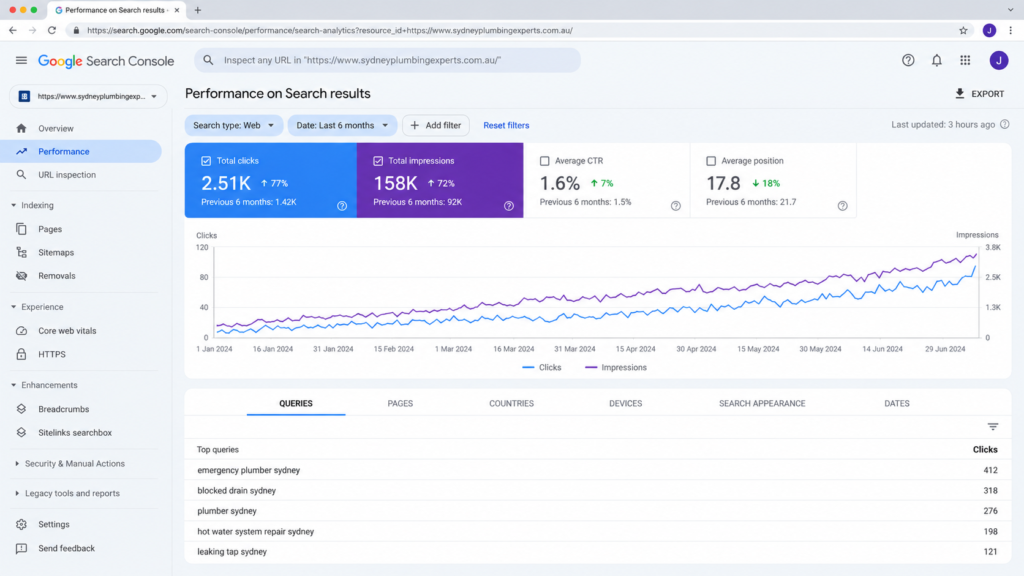
Google Search Console showed:
- Organic clicks: 1.42K → 2.51K (+77%)
- Organic impressions: 92K → 158K (+72%)
- Average CTR: 1.5% → 1.6%
Commercially relevant queries generating clicks included:
- emergency plumber sydney — 412 clicks
- blocked drain sydney — 318 clicks
- plumber sydney — 276 clicks
- hot water system repair sydney — 198 clicks
- leaking tap sydney — 121 clicks
What Improved
The gains followed improvements to WordPress architecture, commercial service pages, internal linking, technical cleanup and local relevance.
These figures demonstrate stronger organic search visibility and acquisition. They should not be treated as proof of increased revenue unless reliable call, lead or booked-job attribution is also available
What Is Included in Our WordPress SEO Service?
The agreed scope includes the work required to diagnose, prioritise, implement and measure the WordPress SEO campaign. Work outside that scope is identified before additional cost is incurred.
Included in the agreed SEO scope | Scope-dependent work | We do not sell |
SEO diagnosis and prioritisation | Major custom development | Guaranteed #1 rankings |
WordPress technical optimisation | Full website redesigns | Bulk spam backlinks |
On-page optimisation | Large-scale copy production | Fake reviews |
Internal-link improvements | Complex migrations | Multiple competing SEO plugins |
Search Console monitoring | Advanced custom integrations | Traffic-only reporting presented as ROI |
Conversion measurement | Digital PR campaigns | Mass AI pages created only to target keywords |
Agreed implementation | WooCommerce work outside the agreed package | Unexplained account lock-in |
Performance reporting | Multilingual implementations | Plugin scores presented as proof of SEO success |
Which WordPress SEO Mistakes Cost Tradies Leads?
The most expensive WordPress SEO mistakes are rarely missing keywords. They are decisions that send search engines or customers toward the wrong page, weaken commercial visibility, slow the buying journey or make lead performance difficult to measure.
Treating an SEO Plugin Score as the Strategy
A green Yoast or Rank Math score only confirms that certain plugin rules have been satisfied; it cannot determine which service, location or URL deserves priority, which jobs are most profitable or which markets the business should target. SEO strategy requires commercial context, not plugin scoring alone.
Running Overlapping WordPress Plugins
Multiple SEO, schema, redirect or caching plugins can generate conflicting canonicals, duplicate schema, competing sitemaps or unnecessary performance overhead. We identify which component should control each function and remove duplication where overlapping tools create technical risk rather than useful functionality.
Indexing Every WordPress Archive
Categories, tags, author archives and other generated URLs can support navigation, but they can also create thin or competing pages with little independent search value. Indexation should be intentional, with search visibility reserved for URLs that satisfy a meaningful user or commercial search need.
Blogging Before Fixing Service Pages
Publishing more informational content does little if the service pages closest to an enquiry remain underdeveloped. A weak “Roof Restoration Sydney” page may deserve priority over another generic roofing article. We improve high-value commercial pages first, then add supporting content where it strengthens demand coverage.
Creating Near-Duplicate Location Pages
Changing only the suburb name across multiple location pages creates little additional value and can weaken the site’s location architecture. Each location page should have a genuine search purpose, distinct service relevance and useful local context rather than functioning as a duplicated template with swapped place names.
Changing URLs Without Redirect Planning
Redesigns and restructures can remove URLs that already hold rankings, backlinks and internal authority. We map URL changes before launch, implement deliberate permanent redirects and verify the new structure afterward so valuable search signals are preserved instead of accidentally discarded.
Buying Cheap Links to Increase a Metric
A larger backlink count does not automatically create stronger authority. Links from irrelevant or low-quality sites built mainly for placement can add risk without improving commercial rankings. We prioritise topical relevance, editorial legitimacy and the quality of the referring source over raw backlink volume.
Measuring Rankings Without Measuring Enquiries
Rankings can improve while leads and revenue remain unchanged, which makes position tracking alone an incomplete measure of SEO performance. We connect organic visibility with calls, quote requests, bookings and qualified enquiries so the campaign can be judged by commercial outcomes as well as rankings.
What Happens in the First 30, 60 and 90 Days?
The first 90 days establish control, implement the highest-priority changes and create enough measurement to decide what should be expanded next. They are not a promise of a specific ranking position.
| Phase | Focus | What We Do | Expected Outcome |
|---|---|---|---|
| Days 1–30 | Diagnose & Stabilise | Audit tracking, indexation, site structure and technical blockers. Fix critical issues and prioritise opportunities. | A reliable baseline and clear SEO roadmap focused on the highest-impact work. |
| Days 31–60 | Strengthen Commercial Relevance | Improve priority service and location pages, internal linking, technical SEO and conversion paths. | Stronger relevance for valuable searches and clearer paths from traffic to enquiries. |
| Days 61–90 | Expand What the Data Supports | Review performance, emerging queries, lead quality and competitor gaps, then expand proven opportunities. | Clear evidence of what is working and where further investment should go. |
SEO changes do not all produce results on the same timeline. We report what has actually changed and what the data supports rather than inventing a ranking deadline.
Why Choose SEO Agency for Tradies for WordPress SEO?
Our approach combines WordPress-specific diagnosis, commercial search strategy, implementation and measurement rather than treating SEO as a monthly list of disconnected activities.
The difference should be visible in both the recommendations we make and the evidence used to support them.
The first question is not:
“What keywords can we rank?”
It is:
“Which services and locations produce valuable work, and what currently prevents those customers from finding or choosing the business?”
Search demand is then evaluated around that commercial context.
That means a high-volume keyword is not automatically a high-priority opportunity. A lower-volume service search can be more valuable when it represents work the business actually wants, in an area the team can profitably service.
This gives technical fixes, service-page improvements, location strategy and content work a commercial priority rather than treating every URL equally.
A visible SEO issue is often only the symptom.
A canonical problem may originate from an SEO plugin, theme template or custom function. Duplicate structured data may be produced by both a theme and a plugin. Unnecessary URLs may come from taxonomies, archives, attachment settings or custom post types. Redirect behaviour may be controlled inside WordPress, through a plugin, at the hosting layer or within server configuration.
We investigate which component is producing the problem before recommending the fix.
That matters because correcting the visible output without understanding its source can create conflicting signals or allow the same issue to return.
Finding a problem and correcting it are different deliverables.
Where implementation is included in the agreed scope, we can make the relevant WordPress changes rather than leaving every recommendation in an audit document for somebody else to interpret.
That can include work such as:
- correcting indexation settings;
- improving internal links;
- adjusting plugin configuration;
- fixing redirect or canonical issues;
- improving page templates;
- strengthening service pages;
- cleaning up unnecessary URLs; and
- implementing agreed performance improvements.
Where specialist development is required, that dependency is identified rather than hidden inside an SEO recommendation.
An increase in impressions is not revenue.
An increase in clicks is not automatically a qualified lead.
A ranking improvement is not automatically a booked job.
We report those stages separately.
Where conversion and CRM data are available, measurement can move through:
search visibility → organic visit → enquiry → qualified lead → booked work → revenue
Where reliable commercial attribution is not available, we do not present traffic growth as proof of ROI.
That distinction makes it easier to understand both what the SEO campaign changed and what the available evidence can genuinely prove.
SEO recommendations should be defensible.
Depending on the issue, that evidence can come from:
- Google Search Console query and page data;
- analytics and conversion events;
- website crawls;
- indexation and sitemap checks;
- internal-link and crawl-depth analysis;
- Core Web Vitals and page-performance data;
- backlink information;
- rankings and search-result observations; and
- direct inspection of the WordPress environment.
For example, if two service pages appear to compete for the same search demand, we should be able to show the overlapping queries, URLs or internal relationships behind that conclusion.
If a service page is considered difficult for search engines to discover, we should be able to identify the crawl path, internal-link depth or indexation problem.
The recommendation should explain:
what we found → why it matters → which pages are affected → what should be changed → what should happen first
Not every SEO issue deserves the same amount of time.
A blocked service page, broken enquiry path or important URL with strong existing search demand normally deserves more attention than a minor technical warning with little commercial impact.
We prioritise recommendations using four practical considerations:
commercial value · expected impact · implementation effort · dependency
This reduces the risk of spending campaign time on tasks that are easy to report but unlikely to materially improve search visibility or lead generation.
Your WordPress website, Google Search Console, analytics, Google Business Profile and other important business accounts should remain under the business’s control.
Agency access should support implementation and reporting.
It should not create a situation where the business loses access to important digital assets when the commercial relationship ends.
Your WordPress website, Google Search Console, analytics, Google Business Profile and other important business accounts should remain under the business’s control.
Agency access should support implementation and reporting.
It should not create a situation where the business loses access to important digital assets when the commercial relationship ends.
SEO reporting should help make the next decision.
Our reporting framework is built around three questions:
What did we change?
What happened after the change?
What should we prioritise next?
Search behaviour, competing pages, lead quality and commercial priorities can change as a campaign develops.
The objective is therefore not to repeat the same monthly activity indefinitely. It is to use the evidence produced by each stage of the campaign to determine where the next investment is most likely to matter. what you improve in this section
How Much Do WordPress SEO Services Cost in Australia?
WordPress SEO pricing depends on the amount of implementation required, the size and condition of the website, competition and the commercial markets being targeted.
We do not publish an invented “one-size-fits-all” figure because two WordPress websites can require fundamentally different work.
A small electrician website with 30 indexable URLs, one city and a clean theme may require limited technical correction and focused service-page work.
A multi-location trade business with several hundred URLs, old suburb pages, migration history, plugin conflicts and weak tracking is a different project.
The price is therefore influenced by the number and complexity of URLs, technical condition, target services and locations, competitive difficulty, content requirements, development dependencies and the level of ongoing implementation required.
WordPress SEO Audit
Best suited to businesses that need an independent SEO audit for tradies before committing to ongoing work.
The scope establishes technical problems, search gaps, priority pages, measurement weaknesses and recommended actions.
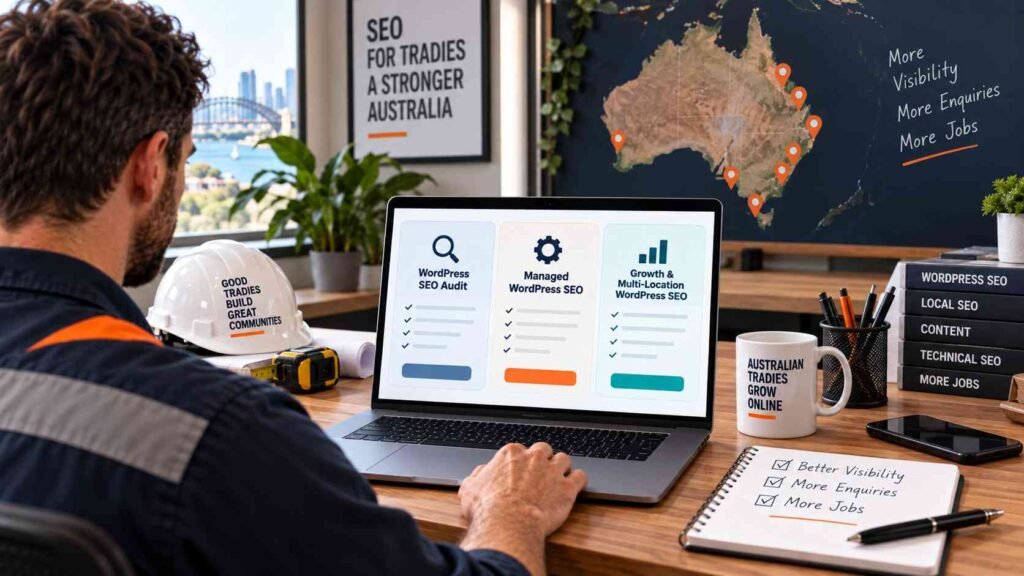
Managed WordPress SEO
Best suited to businesses that want the strategy implemented rather than receiving recommendations alone.
The ongoing scope can combine technical improvements, commercial-page optimisation, content, local search, authority development and reporting.
Growth and Multi-Location WordPress SEO
Best suited to established trade businesses expanding across several services, suburbs, cities or business locations.
These campaigns normally require more extensive architecture, location strategy, content production, tracking and competitive analysis.
You receive an itemised scope after we review the website and commercial objectives.
WordPress SEO Services FAQs
WordPress SEO services improve a WordPress website’s technical accessibility, search relevance, authority, local visibility and conversion measurement so relevant search users can find important pages and take a commercial action.
The work can include technical audits, on-page optimisation, site architecture, content, Core Web Vitals, structured data, internal linking, local SEO, authority development and analytics.
Yes. WordPress can support strong organic search performance when its technical settings, site architecture, content and templates are configured appropriately.
Using WordPress does not automatically create rankings. The CMS provides the publishing environment; the quality of the implementation determines how effectively the website communicates with users and search systems.
The best approach combines technical WordPress optimisation, commercial on-page SEO, useful content, internal architecture, relevant authority and measurement rather than relying on one plugin.
The exact emphasis depends on whether the website is a local service business, multi-location company, publisher or WooCommerce store.
No. Yoast can manage important SEO settings, but it cannot replace research, site architecture, content strategy, competitive analysis, local SEO, authority development or conversion measurement.
Use the plugin as an implementation layer within a wider strategy.
No. Rank Math provides useful controls for metadata, sitemaps, schema, robots directives and related settings, but achieving a high plugin score does not prove that a page targets the right search intent or generates leads.
The commercial strategy still has to be developed separately.
Yes. Elementor websites can be optimised for organic search, including template structure, internal links, metadata, images, scripts, Core Web Vitals and conversion elements.
We avoid removing necessary design or lead-generation functionality simply to improve a laboratory performance score.
Yes, agreed WordPress SEO implementation can be completed directly where access and the campaign scope allow it.
More complex server, theme or custom-code changes may require development work, which is identified before implementation.
Yes. We investigate the causes affecting LCP, INP and CLS and prioritise improvements around images, scripts, CSS, fonts, caching, themes, plugins, hosting and page templates.
Performance changes are also checked against forms, menus, tracking and other required functionality.
Yes. Local SEO is particularly important for tradies that depend on customers within defined cities, suburbs or service areas.
The work can connect the WordPress website with Google Business Profile, location architecture, service-area pages, reviews, citations and other local signals.
Yes. Migration SEO can identify lost URLs, redirect problems, indexation changes, broken internal links, missing metadata and other issues that can appear after a redesign or platform change.
For planned migrations, SEO involvement should begin before launch where possible.
There is no fixed ranking timeline because results depend on the site’s starting condition, competition, implementation speed, existing authority and the queries being targeted.
Some technical changes may be processed relatively quickly. Competitive commercial growth usually requires continued implementation and measurement over a longer period.
The cost depends on website size, technical condition, competition, services and locations targeted, content requirements and how much implementation is included.
We review these variables before providing an itemised WordPress SEO scope rather than assigning the same package to every website.
No credible provider controls Google’s ranking systems, so we do not guarantee a specific organic position.
Google’s own SEO guidance states that no technique automatically ranks a site first. The campaign instead focuses on improving the factors we can influence and measuring the resulting search and business performance.
We measure search visibility alongside commercial actions such as organic calls, quote forms, bookings and qualified enquiries.
Search Console provides query and page-level search information, while analytics and conversion tracking help determine what users do after entering the website.
Yes. Critical business assets should remain under the business’s control, including the WordPress website and core measurement or search accounts.
Agency access should support implementation and reporting rather than replace client ownership.
It can improve eligibility and information clarity, but no agency can guarantee a citation or mention from an AI system.
Google states that its AI search features rely on the same foundational SEO principles and require pages to be eligible for conventional Google Search.
We therefore treat AI-search visibility as an extension of good technical SEO, useful content, entity clarity and authority.
Find Out What Is Holding Your WordPress Website Back
Start with the problems that are actually restricting enquiries instead of buying another generic SEO package.
We will review how your WordPress website is discovered, indexed, structured and measured; identify the commercial pages that should be generating search demand; and show where technical, content, local or conversion gaps are limiting performance.
You will know what needs attention, why it matters and which improvements should be prioritised first.
No invented ranking promises. No green plugin scores presented as strategy. No traffic report that ignores whether customers actually contacted the business.


