AI Search Optimisation for Tradies That Builds Visibility and Drives More Local Leads
AI Search Optimisation helps Australian tradies get found, understood and represented accurately in AI-powered search. We analyse why competitors appear in generated answers, then strengthen your website, service, location and reputation signals across ChatGPT, Google AI experiences, Gemini, Perplexity and Microsoft Copilot. We also track whether that visibility contributes to calls and quote requests.
Find out what's holding you back
Enter your number — we’ll call you with a free ranking report for your suburb.
We call within 2 business hours. No scripts. No pressure.
Businesses We Support Across Australia
We support trade and commercial service businesses with stronger local visibility, clearer lead generation and marketing systems connected to measurable commercial outcomes.





Why Is Your Trade Business Missing From AI-Generated Answers?
AI systems may overlook your trade business when its information is difficult to retrieve, inconsistent across sources or unsupported by credible evidence. A strong Google ranking can improve discovery, but it does not guarantee inclusion in AI-generated answers.
Competitors Get Recommended Instead
Your website may rank in Google while ChatGPT, Gemini or Perplexity recommends competing tradies. AI systems compare websites, business profiles, directories, reviews and other sources. Competitors with clearer and more consistent evidence may be selected instead.
Problem: Visible in Google, missing from AI answers.
Your Business Details Are Inconsistent
Different business names, services, opening hours, licence details or service areas can confuse AI systems. Outdated directories and conflicting profiles may cause your business to be described incorrectly or excluded from relevant answers.
Problem: AI systems cannot confidently verify your business.
AI Visibility Is Not Producing Leads
A mention or citation has limited commercial value if it does not contribute to qualified visits, calls, quote requests or booked jobs. Without proper attribution, you cannot determine whether AI visibility supports business growth.
Problem: Brand visibility without measurable enquiries.
You Cannot Connect AI Visibility With Enquiries
Without connected analytics and conversion tracking, a citation or brand mention cannot be linked reliably with calls, quote requests or booked jobs.
Problem: Visibility without clear evidence of commercial value.
We address these four problems by tracking observable mentions, citations and answer accuracy alongside referral traffic and conversions. Where direct retrieval data is unavailable, we separate observed results from inferred causes.
What Do Our AI Search Optimisation Services Include?
Our service covers the observable AI visibility pipeline: technical access, information retrieval signals, entity recognition, answer inclusion, source citation and performance measurement. The campaign begins with evidence rather than assumptions about secret ranking factors.
Your website is only one of the sources AI systems may use to understand your brand.
AI-powered search systems may retrieve industry publications, directories, professional associations, reviews, local media and independent comparisons. Our citation-gap analysis finds sources that mention competitors but omit your business, outdated references and missing expert evidence. We focus on sources that customers and AI search systems can reasonably trust, not fake reviews, irrelevant directories or paid mentions without editorial value.
Your website is only one of the sources AI systems may use to understand your brand.
AI visibility should be measured through several indicators, not compressed into one invented ranking.
We track prompt families across agreed platforms and compare results over time. The reporting may include brand mention rate, citation rate, citation prominence, description accuracy, competitor share of answer and cited-source changes. Citation prominence records how visibly a source supports a key recommendation or statement in the answer.
Website analytics add the commercial layer. Identifiable AI referral sessions can be analysed through GA4, landing-page reports and conversion events. CRM data can then show whether those sessions contributed to enquiries, qualified leads or revenue.
Microsoft has introduced AI Performance reporting in Bing Webmaster Tools for citations across supported Microsoft AI experiences. Platform-native reporting is useful because it provides evidence that cannot be recreated through manual prompt checking alone. Bing Webmaster Tools
Generic content explains that a service is “important,” “effective” or “tailored.” Source-worthy content gives the system and the reader something specific to retrieve.
Depending on the business, that may include:
- Verified prices and pricing factors
- Service inclusions, exclusions and job requirements
- Named expert commentary or first-party performance data
- Defined procedures, limitations and calculation methods
- Dated service, licence or availability updates
The original GEO research found that content presentation strategies could change visibility within its experimental generative-engine environment. The reported improvement reached up to 40%, but the effect varied by domain and testing condition. The finding supports evidence-rich content; it does not prove that one formatting tactic will produce permanent citations across live platforms. GEO research published by ACM
For a plumber, source-worthy content could explain emergency call-out areas, licence details, the work covered by a call-out fee and the factors that change the final quote. This gives customers useful information and gives AI systems specific facts to understand.
We therefore improve the substance before adjusting presentation. More words are not automatically more useful. A precise table, definition or documented process can carry more information than several pages of generic commentary.
Entity optimisation makes the relationships between your trade business, services, people and service areas explicit.
A keyword is a word or phrase. An entity is an identifiable person, place, organisation, service or concept. AI systems need enough context to distinguish one trade business from another and connect it with the correct attributes.
We review the trade business’s:
- Legal and trading names
- Business category
- Trade services and job types
- Owners, licence holders and trade specialists
- Business locations and verified service areas
- Licences, accreditations and professional associations
- Opening hours, emergency availability and pricing factors
- Reviews, profiles and third-party references
We then correct conflicting details across your website, business profiles, directories and other relevant sources.
Structured data may support this work by expressing defined relationships in a machine-readable format. Where appropriate, schema markup can describe a local business, its trade services, service areas, people, reviews and page content. The markup must match accurate information visible on the page, and it does not force an AI engine to retrieve or cite that page.
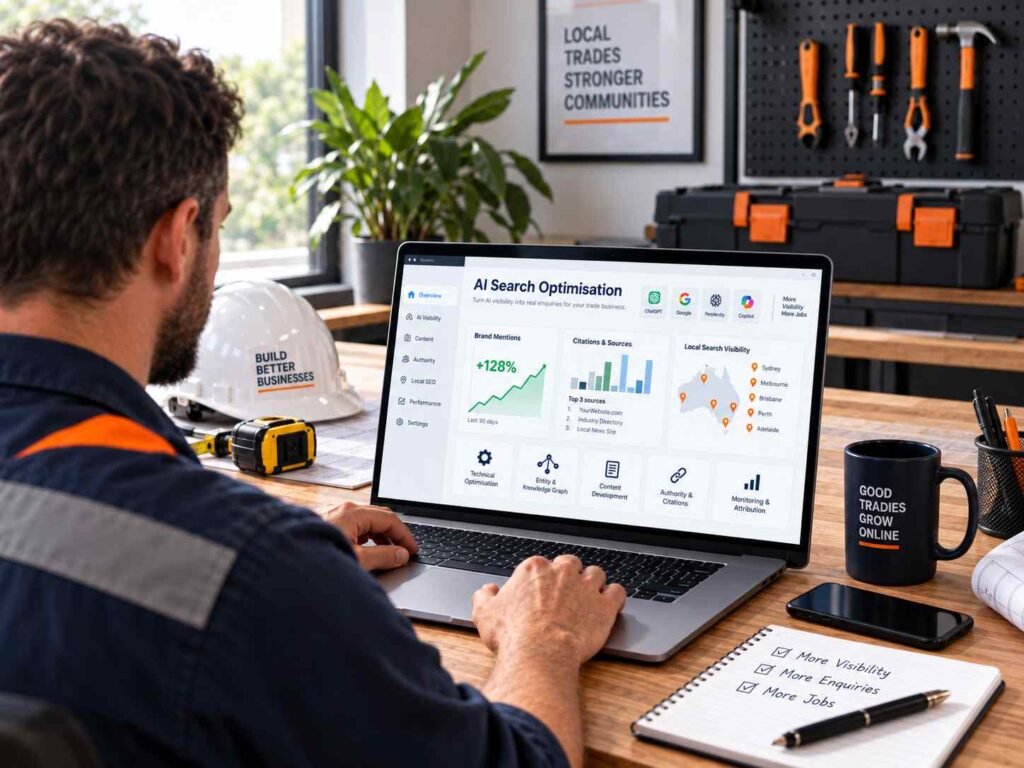
We establish how your brand currently appears across selected AI search engines and answer platforms.
The audit does not rely on a single “best tradie” prompt. We develop prompt families around the way local customers search for help, compare providers and request quotes. These include service, problem, urgency, location, price and trust-based prompts. Each family contains semantically related variations.
For example, a plumbing business may be tested for:
- A category prompt such as “licensed plumber near me”
- A problem prompt such as “who can fix a burst pipe today?”
- A comparison prompt involving local plumbing companies
- A transactional prompt such as “best emergency plumber in Sydney”
We record the platform, date, model or search mode, prompt wording, language and geographic context. We then compare your brand with relevant competitors.
The baseline measures mention frequency, citation frequency, answer accuracy, competitor inclusion and citation prominence, meaning how visibly a source supports a key part of the answer. It also identifies which sources repeatedly appear in the answers.
Prompt research identifies the questions customers ask before selecting a tradie or booking a service. These questions are often longer and more conversational than conventional keywords.
Keyword data still matters because it reveals established search demand. Prompt research extends that view by mapping how buyers describe constraints, alternatives and desired outcomes.
We organise prompts across six intent stages:
- Problem recognition
- Solution discovery
- Category education
- Provider comparison
- Quote and provider evaluation
- Post-service validation
We turn these customer questions into a fixed testing set. This lets us compare visibility over time without changing the test each month. It is not a list of phrases to repeat across every page.
Local prominence is supported by independent evidence showing that a painting business is established, active and recognised within its market.
Customer Reviews
Recent, genuine feedback helps prospects evaluate reliability, communication, workmanship and overall service quality. A consistent review-request process can strengthen customer confidence without offering incentives or manipulating ratings.
Completed Local Projects
Before-and-after photographs and project summaries connect your business with real painting work in specific markets. Each example can document the property type, preparation, finish, location and result, giving prospective clients stronger reasons to request an estimate.
Australian Business Citations
Consistent mentions across relevant directories, trade platforms and local websites reinforce the business entity. We correct conflicting names, eligible addresses, phone numbers, websites and hours instead of creating bulk listings with no customer value.
AI search visibility begins with accessible, indexable and machine-readable information. Content cannot be selected when the relevant platform cannot access or retrieve it.
The technical audit examines robots.txt directives, indexability, canonical tags, XML sitemaps, JavaScript rendering, internal links, page speed and content availability. We also inspect whether important facts exist only inside images, scripts or interfaces that crawlers may not process reliably.
Crawler access requires platform-specific evaluation. OpenAI, for example, distinguishes OAI-SearchBot from GPTBot. One supports search discovery, while the other relates to potential model training. Their controls are independent. OpenAI crawler documentation
Allowing a crawler does not guarantee a citation. Blocking a relevant search crawler, however, can remove a possible discovery path. We document the trade-off before recommending any change.
Which Tradies Benefit From AI Search Optimisation?
AI Search Optimisation is best suited to Australian trade businesses whose customers use AI tools to describe a problem, compare local providers or decide whom to contact for a quote.
Emergency and Repair Trades
Plumbers, electricians, locksmiths, HVAC technicians, pest controllers and water-damage specialists are often selected under time pressure. Customers may ask an AI platform who can solve a specific problem nearby, who is available now and which provider appears trustworthy.
These businesses need clear emergency availability, licence details, service areas, contact options and evidence for the exact jobs they handle.
Building and Project-Based Trades
Builders, carpenters, concreters, painters, roofers and shopfitters face longer comparison journeys. Customers evaluate project experience, service scope, licences, portfolios, reviews and quote processes before making contact.
AI-ready content should explain the types of projects accepted, geographic coverage, qualifications, process and evidence of completed work.
Property and Outdoor-Service Trades
Landscapers, gardeners, cleaners, solar installers and maintenance businesses compete across recurring and one-off services. Their visibility depends on clear service categories, genuine coverage areas, scheduling information and consistent customer feedback.
Multi-Location and Service-Area Tradies
Local AI answers may draw from websites, Google Business Profiles, directories, reviews and local publications.. Conflicting business names, telephone numbers, opening hours or service areas can weaken entity clarity.
Local optimisation therefore covers verified locations, genuine service coverage, review evidence and geographically relevant content. It does not mean publishing hundreds of pages with only the suburb name changed.
Where Do We Provide AI Search Optimisation for Tradies?
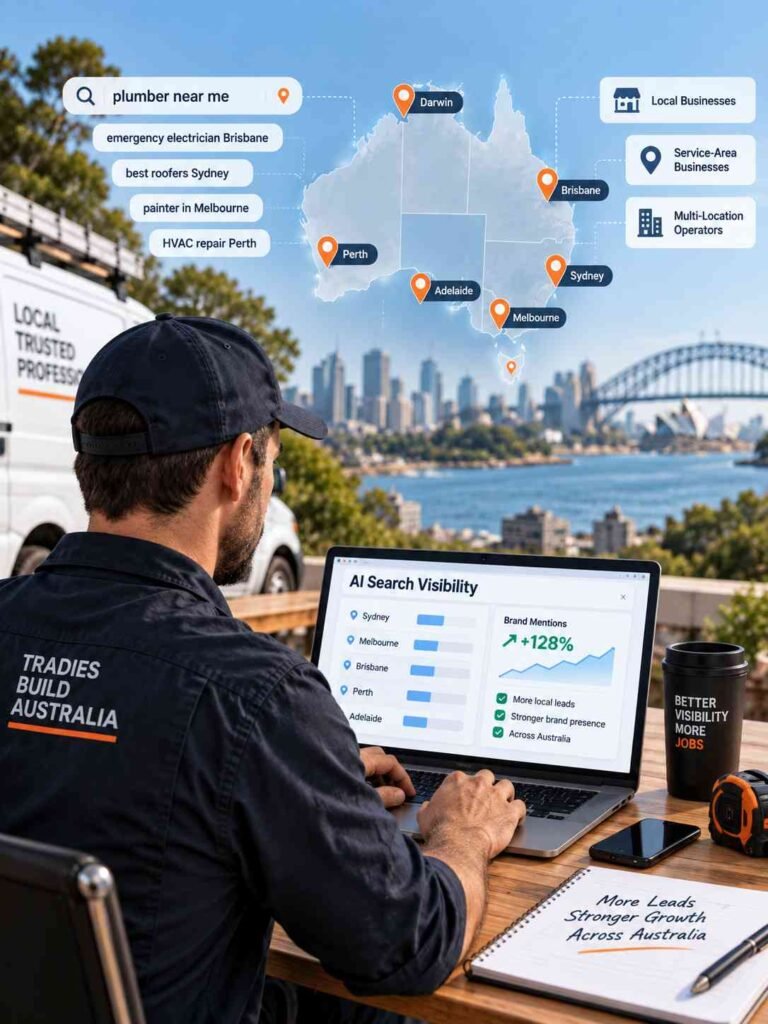
We provide AI Search Optimisation for trade businesses across Australia, including local, service-area and multi-location operators.
An Australian campaign can examine service, problem, suburb, city and “near me” prompts alongside local competitors, trade directories, reviews and location-sensitive answers. It can also test whether the same business appears differently across the areas it genuinely serves.
Geographic testing matters because generated answers may change with the user’s location, prompt wording and available local sources. A tradie may appear for a city-wide service prompt but disappear when a customer searches by suburb, urgency or job type.
Campaigns can be structured around genuine coverage in Sydney, Melbourne, Brisbane, Perth, Adelaide and other Australian service areas. Locations are included only when the business actually serves them.
Australian campaigns also check whether state or territory licence details, trade categories, emergency availability and suburb-level service boundaries are described consistently. Licence requirements vary by trade and jurisdiction, so only current, verifiable details should be published.
How Does Our AI Search Optimisation Process Work?
The process identifies where visibility is lost before deciding what to change. This prevents a technical problem from being treated as a content problem or a reputation problem from being treated as a schema problem.
Step 1: Establish the Baseline
We select relevant AI platforms, competitors, markets and prompt families. Each test records the conditions under which the answer was generated.
The baseline documents brand mentions, citations, source domains, factual accuracy and competitor inclusion. It also separates observed results from inferred causes.
Step 2: Correct Technical and Factual Signals
We address blocked resources, weak internal links, canonical conflicts, unclear page relationships and inaccessible content. We also correct conflicting business names, trade categories, service areas, opening hours and service information.
The priority is factual consistency. Publishing more pages before correcting the core entity can spread the same confusion across a larger site.
Step 3: Improve Source Quality
We upgrade the pages most likely to influence discovery and evaluation. The changes may include direct answers, clearer definitions, pricing criteria, specifications, original evidence, named authors, citations and dated updates.
Each page retains one main search intent. A service page converts. A methodology page explains the process. A comparison page supports evaluation. An original study provides evidence.
Step 4: Strengthen Trusted Third-Party Support
We identify relevant third-party sources and citation gaps. The work may involve correcting profiles, developing publishable evidence, obtaining expert coverage or improving review consistency.
Trusted authority cannot be produced by repeating the same claim across low-quality directories. The supporting source must have a credible relationship with the topic or market.
Step 5: Retest and Compare
We repeat agreed prompt families using controlled variations. Results are compared with the original baseline and competitor set.
Because generated answers can vary between tests, we do not present one favourable output as a trend. A change becomes meaningful when it appears consistently across repeated observations or is supported by platform-native data.
What Is Included in the Campaign?
The campaign includes diagnostic, implementation and measurement work within the agreed platforms, markets, languages and website scope.
Included | Not included |
AI visibility and citation baseline | Guaranteed placement in generated answers |
Prompt-family research | Access to private model training data |
Technical crawler review | Manipulation of AI systems |
Entity consistency audit | Fake reviews or artificial mentions |
Content and citation-gap analysis | Mass production of thin pages |
Structured data review | Claims that schema guarantees inclusion |
Competitor source analysis | A permanent AI “ranking position” |
Repeated testing and reporting | Conclusions based on one test |
Prioritised implementation plan | Guaranteed traffic, leads or revenue |
Which AI Search Optimisation Mistakes Waste Budget?
Treating AI visibility as one stable ranking is the most damaging measurement mistake. Generated answers are personalised, variable and influenced by prompt context.
Tracking One Exact Prompt
One prompt produces one observation. It does not represent the wider customer journey.
A stronger test uses a prompt family, several meaningful paraphrases and repeated runs. The methodology should preserve intent while changing the wording naturally.
Publishing Generic AI Content at Scale
More pages can increase coverage, but only when each page answers a distinct need. Repetitive pages create little information gain and may weaken the site’s overall usefulness.
If a competitor can replace your brand name and publish the same paragraph, the content does not demonstrate your evidence, process or market knowledge.
Treating Schema or llms.txt as a Shortcut
Schema can express structured attributes. An llms.txt file may provide information to systems that choose to use it. Neither mechanism guarantees discovery, recommendation or citation across AI platforms.
The website still needs accessible pages, accurate facts, clear relationships and credible evidence.
Replacing SEO With GEO
AI Search Optimisation does not remove the need for technical SEO, content quality, internal links, digital PR or reputation management. AI Search Optimisation works alongside SEO for tradies rather than replacing it. It changes the output being measured.
What Happens During the First 90 Days?
The first 90 days establish a measurable baseline, correct priority issues and begin repeated platform testing. This period creates an operating system for AI visibility; it does not guarantee citations or revenue.
PeriodWork | completedMain | deliverablePrimary | measurement |
Days 1–30 | Platform selection, prompt research, competitor analysis, technical audit and entity review | AI visibility baseline and issue map | Prompt coverage and factual accuracy |
Days 31–60 | Technical corrections, business-detail fixes and priority content improvements | Improved access, clarity and source quality | Observable mention, citation and answer-accuracy changes |
Days 61–90 | External source work, repeated testing and attribution review | Comparative performance report and next-quarter plan | Mention rate, citation rate, referral activity and conversions |
Why Choose Our AI Search Optimisation Service?
Choose this service when you want evidence about access, mentions, citations and conversions—not a made-up “ChatGPT ranking” report.
Built for Australian Tradies
Our campaigns are structured for service-area businesses that depend on local calls and quote requests. We connect trade services, genuine coverage areas, availability, qualifications and customer evidence instead of applying a generic national-business template.
Experience Across Trade and Location Pages
Our search experience includes trade-service, industry and location pages. That helps us identify whether an AI visibility problem starts with weak service information, inaccurate location signals, poor page structure or conflicting external profiles.
Calls, Forms and Qualified Enquiries Stay Visible
We do not stop reporting at mentions and citations. Where tracking is available, we connect landing-page visits with calls, forms, qualified enquiries and CRM outcomes so you can judge commercial value rather than visibility alone.
Itemised Reporting Without Invented Rankings
Our reports separate technical issues, content work, external-source corrections and measurement findings. AI platforms still control their answers, so we report observed changes and limitations instead of presenting a made-up permanent ranking.
What Determines the Cost of AI Search Optimisation?
AI Search Optimisation pricing depends on the number of platforms, prompts, service areas, trade categories, competitors and pages included. A local sole trader requires a smaller research and monitoring set than a multi-location trade business offering several services across Australia.
A one-time audit is suitable when you need a verified baseline before committing to ongoing work.
The audit can include:
Platform and prompt selection
Competitor mention and citation analysis
Technical crawler review
Entity consistency assessment
Content and source-gap analysis
A prioritised 90-day roadmap
Monthly support is suitable when the website requires implementation, content development, external authority work and ongoing monitoring.
The scope may cover technical corrections, prompt testing, content upgrades, structured data, business-detail corrections, citation-gap work and performance reporting.

Expanded pricing applies when the campaign covers several locations, trade categories, business divisions or large service-page inventories.
The main cost drivers are:
Pricing factorFocused | scopeExpanded scope | scope |
Platforms | Two or three platforms | Four or more platforms |
Prompts | One trade service | Multiple services and job types |
Service areas | One city or region | Multiple Australian locations |
Trade categories | One trade | Several trade divisions |
Website size | Small local service site | Multi-location trade website |
Attribution | Website analytics | CRM and revenue integration |
Which Services Support AI Search Visibility?
AI Search Optimisation performs best when its supporting search, content, authority and measurement systems are already connected.
Technical SEO supports crawling and indexing. Semantic SEO clarifies services, locations and business relationships. Content marketing creates useful service pages, comparisons and expert resources. Digital PR and reputation management strengthen trusted third-party information. Local SEO connects the business with genuine service areas, while SEO reporting links visibility with calls, forms, qualified leads and revenue where the required data is available.
AI Search Optimisation FAQs
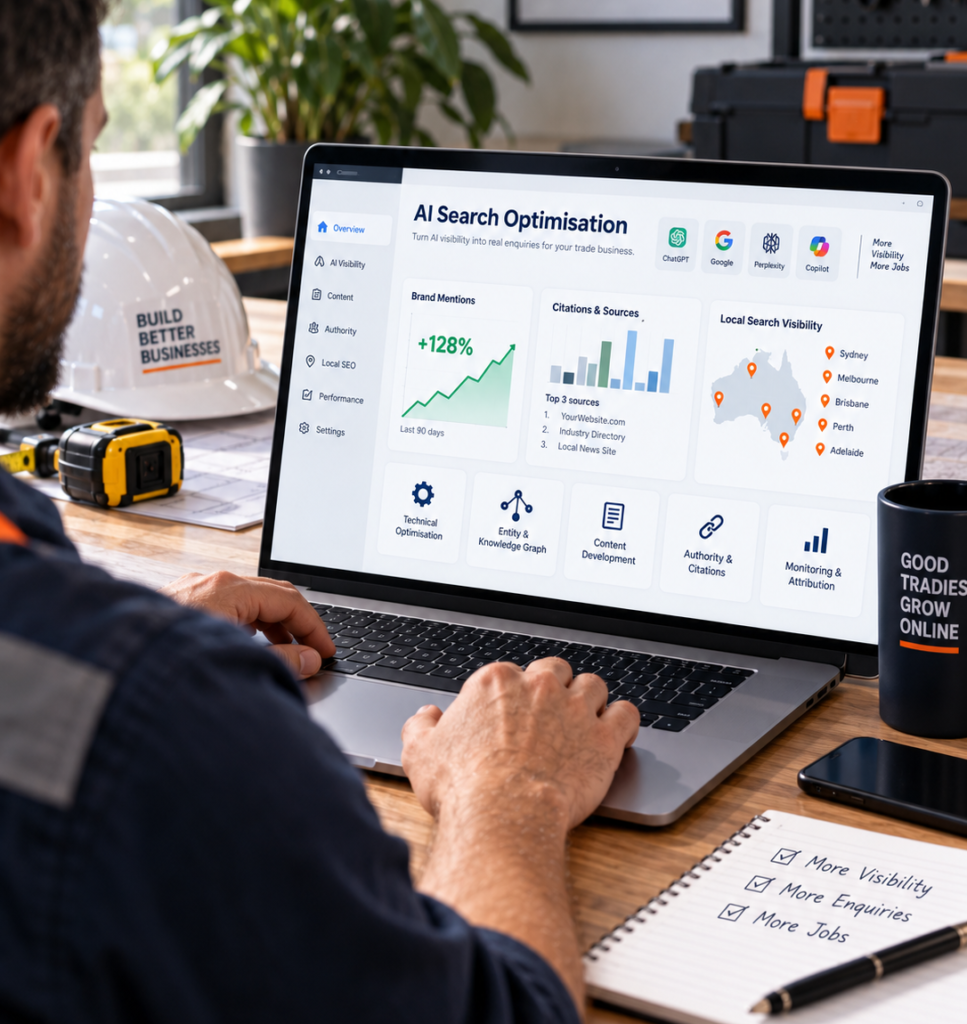
AI Search Optimisation is the process of improving how brand information is accessed, retrieved, understood, mentioned and cited by AI-powered search and answer systems.
The work can include technical SEO, entity optimisation, structured information, source-worthy content, third-party authority and performance measurement.
GEO is a commonly used name for improving content visibility in generative-engine responses.
AI Search Optimisation is a clearer commercial term because it can cover a broader process: discovery, retrieval, brand mentions, citations, factual accuracy, referral traffic and conversions.
No. GEO extends SEO toward generated-answer visibility but still depends on crawlability, indexability, relevance, useful content and authority.
If a search system cannot access or understand a page, presentation changes alone are unlikely to solve the problem.
No agency can guarantee that ChatGPT or another AI platform will cite a specific website.
Generated answers vary by prompt, context, model, location, source availability and system changes. A credible service improves eligibility and measures outcomes without promising control.
AI search visibility is measured through prompt coverage, mention rate, citation rate, citation prominence, description accuracy, competitor inclusion and referral performance.
Conversions should be measured separately through calls, quote forms, bookings, confirmed jobs and CRM records.
The first 30 days normally establish the baseline, while implementation and repeated measurement continue through the 60- and 90-day stages.
The actual timeline depends on technical access, content quality, publishing speed, external authority and the size of the monitored prompt set.
The cost depends on the platforms, prompts, services, locations, competitors and pages included in the campaign. A local sole trader usually needs a smaller scope than a multi-location trade business. We provide an itemised quote after defining the audit, implementation and reporting requirements.
Find Out How AI Platforms Represent Your Brand
Start with evidence instead of an invented AI ranking. We will test relevant prompt families, identify the brands and sources appearing in generated answers, assess factual accuracy and show where your website loses visibility.
Your audit will provide:
- A platform-by-platform visibility baseline
- Competitor mention and citation analysis
- Factual and entity-consistency findings
- Technical access and observable visibility issues
- A prioritised 90-day implementation plan


