SEO Services for Australian Restoration Companies
We provide restoration SEO services for Australian water-damage, flood, fire, smoke, mould, sewage, biohazard and disaster-recovery companies. The campaign connects each restoration service with the correct search intent, service area, landing page and conversion path.
This page concerns SEO for property-restoration contractors. It does not refer to restoring a website after a Google penalty or algorithm decline.
Our work is designed for restoration businesses with real operating capacity, defined Australian service areas and a process for answering and recording enquiries. We optimise organic visibility, Google Business Profiles, service pages, location architecture, technical performance, reviews, authority signals and lead attribution as one acquisition system.
The commercial objective is clear: more serviceable enquiries, less dependence on referrals and better evidence of which services and locations produce revenue.
Find out what's holding you back
Enter your number — we’ll call you with a free ranking report for your suburb.
We call within 2 business hours. No scripts. No pressure.
Businesses We Support Across Australia
We support trade and commercial service businesses with stronger local visibility, clearer lead generation and marketing systems connected to measurable commercial outcomes.
Why Are Restoration Companies Losing Emergency Leads on Google?
Most restoration companies lose search demand because their local visibility, service relevance, geographic coverage, mobile conversion and lead tracking do not work together.
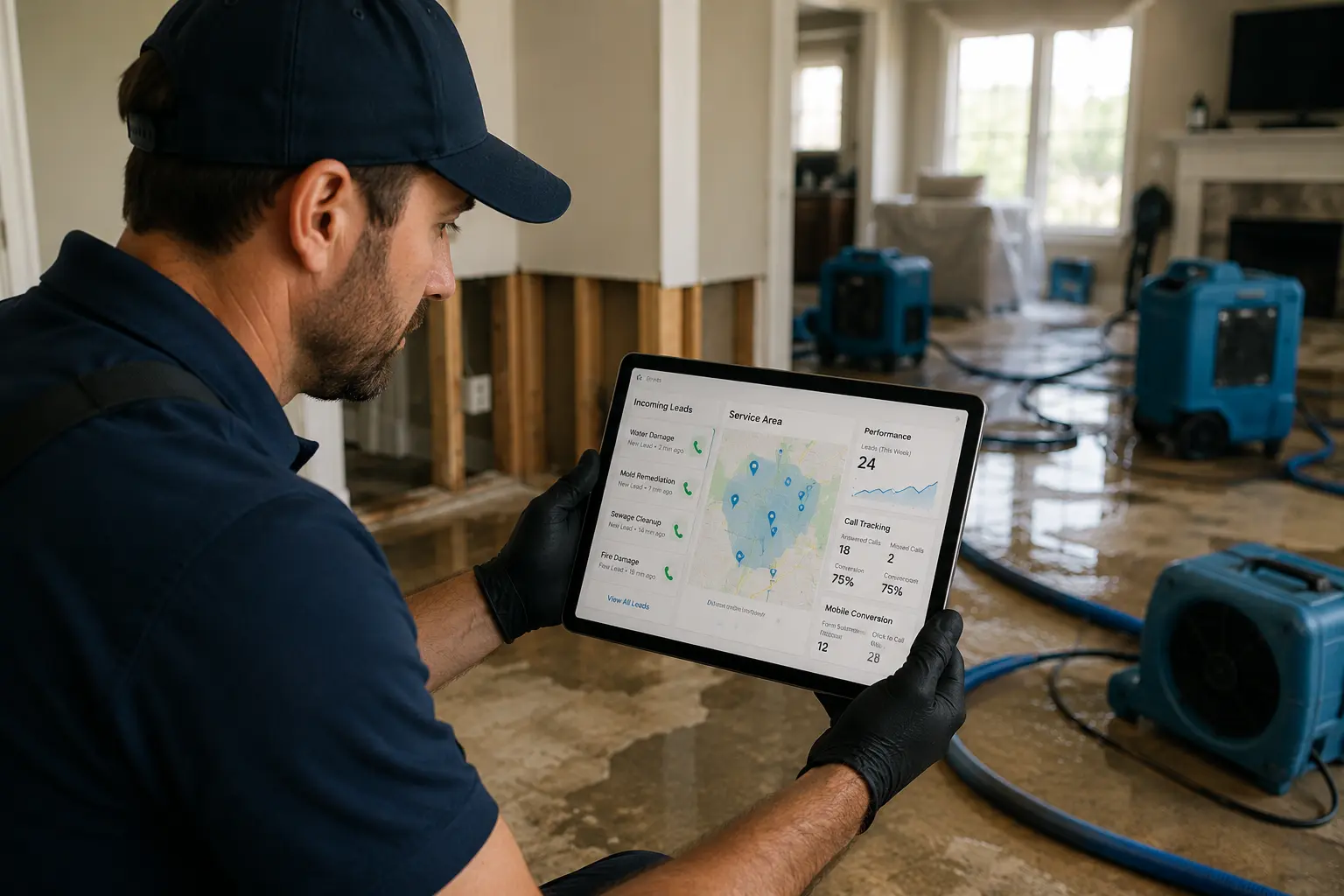
A website can gain impressions and still produce very little restoration work. This usually happens when the campaign is built around rankings rather than the customer journey.
A property owner may search for emergency water extraction. A strata manager may need commercial mould remediation. A facilities manager may compare large-loss response providers. These people do not have the same problem, terminology or next step. Sending every searcher to one generic “restoration services” page weakens relevance and conversion.
Local visibility creates another barrier. Google states that local results are mainly based on relevance, distance and prominence. Complete information, accurate hours, appropriate categories, reviews and broader web signals can support visibility, but a business cannot pay Google for a stronger local position.
That matters for service-area businesses. Adding a suburb to a Google Business Profile does not create a physical presence there. The profile, website and service-area content must represent the real operation accurately. Google’s business-representation guidelines require precise addresses or service areas and consistent real-world representation.
The final problem is measurement. A call is not automatically a qualified lead. A qualified lead is not a booked job. A booked job is not proven revenue until the outcome is recorded. When reports stop at traffic and rankings, the business cannot tell whether SEO generated profitable restoration incidents or irrelevant enquiries.
The correct acquisition model is:
- Search visibility →
- qualified call →
- inspection →
- quote or scope →
- booked job →
- attributable revenue
- Search visibility →
- qualified call →
- inspection →
- quote or scope →
- booked job →
- attributable revenue
How Does Restoration SEO Generate Booked Jobs?
Restoration SEO matches high-intent service-and-location searches with the right business profile, landing page, contact action and lead-tracking process.
The journey normally begins when property damage creates demand. The customer searches for a service such as water removal, structural drying, fire restoration or mould remediation. Google then presents local and organic results. The customer evaluates relevance, availability, location, credentials, reviews and evidence before calling or submitting an enquiry.
Our role is to improve the parts of that journey controlled by search and the website. We establish which page owns each search intent, strengthen the business entity, reduce technical barriers and make the next action obvious.

The business must complete the rest. Calls need to be answered. Losses need to be qualified. Crews need to be available. Job outcomes need to be recorded.
This is why we separate visibility metrics from commercial metrics. Rankings explain where the company appears. Calls and booked jobs explain whether the campaign creates value.
Which Restoration Services Can We Promote?
We optimise genuine property-restoration and disaster-recovery services that the company is qualified, equipped and available to perform.
Property restoration is the broader service category. Its narrower service groups include water and flood restoration, fire and smoke restoration, mould remediation, storm recovery, sewage cleanup, biohazard remediation, contents restoration and commercial reinstatement.
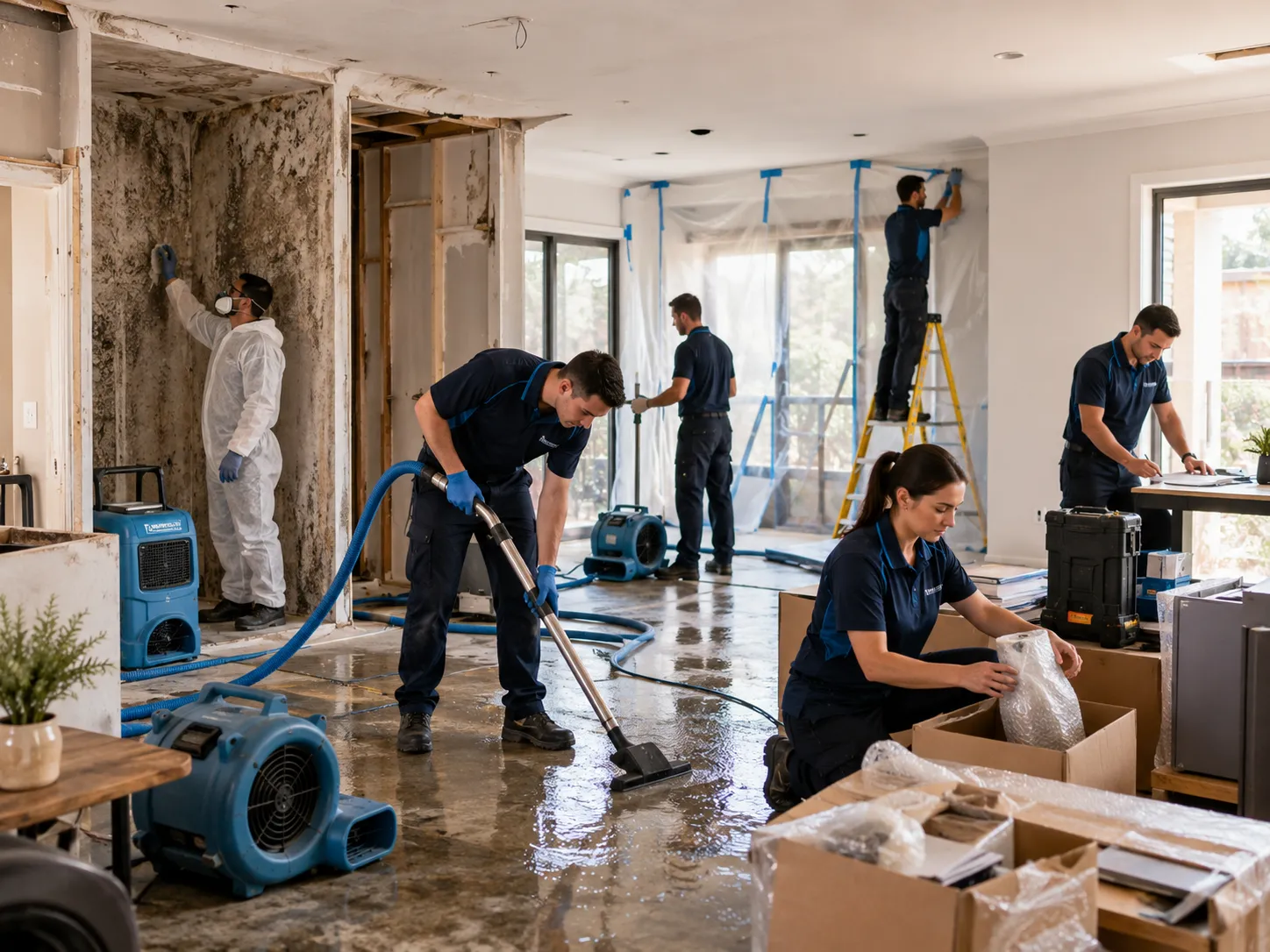
Water and Flood Restoration SEO
Water-damage restoration SEO can target emergency water extraction, flood cleanup, water pump-out, standing-water removal, carpet extraction, subfloor drying, cavity drying, moisture detection, dehumidification and structural drying.
The content must reflect the contractor’s actual process. Where relevant, this may include moisture mapping, psychrometric conditions, drying records, air movement and material monitoring. Australia adopted AS-IICRC S500:2025 as the current professional water-damage restoration standard in March 2025.
Fire, Smoke and Contents Restoration SEO
Fire-restoration SEO may cover fire damage, soot cleaning, smoke contamination, odour removal, structural cleaning, contents restoration and reinstatement. These terms belong within one fire-and-smoke context, but separate pages may be required when the service and search intent are materially different.
Mould Remediation SEO
Mould-remediation SEO can cover mould inspection, assessment, containment, source control, HEPA filtration, removal and post-remediation processes. Australian spelling should remain primary, while “mold remediation” may appear naturally where search data supports the variation.
Storm, Sewage and Specialist Restoration SEO
Storm and disaster-restoration SEO may include emergency make-safe work, temporary protection, water extraction, cyclone damage, hail damage and catastrophe response. Sewage and biohazard SEO may cover contaminated-water cleanup, disinfection, trauma cleaning and odour control where the business genuinely offers those services.
Commercial and Insurance Restoration SEO
Commercial restoration SEO targets facilities managers, strata managers, body corporates, insurers, loss adjusters, property managers and commercial owners. The content should address response capacity, business continuity, documentation, large-loss work and reinstatement rather than using only homeowner emergency messaging.
What Is Included in Our Restoration SEO Service?
The campaign combines restoration-market research, local SEO, content architecture, technical optimisation, reputation development, conversion improvement and commercial reporting.
Restoration Market and Competitor Research
We identify which services, locations and competitors shape the available demand. The research covers Google Maps, organic results, service pages, location coverage, reviews, authority signals and conversion paths.
The result is a prioritised opportunity map. It shows which services deserve dedicated pages, where geographic demand is commercially useful and which competitors capture calls the business could service.
02
Keyword, Entity and Search-Intent Mapping
Keyword research identifies the phrases people use. Entity mapping defines the relationships behind those phrases.
For example, water damage restoration is a service entity. Structural drying is a process. Sydney is a location. Emergency is an urgency attribute. A homeowner, strata manager or facilities manager is a customer entity. A phone call, inspection or proposal request is a conversion event.
We assign these entities to pages according to shared intent. This prevents one page from becoming too broad and stops several pages from competing for the same query.
03
Google Business Profile and Local SEO
We review profile eligibility, categories, address or service-area settings, operating hours, contact information, services, photographs, reviews and duplicate profiles.
The objective is accurate local representation, not artificial expansion. We do not recommend virtual offices, false addresses or branch profiles that do not meet Google’s eligibility rules. Complete and accurate information helps Google understand what the business does and where it operates. Reviews and useful responses can also help the business stand out.
04
Restoration Service and Location Architecture
Each commercially important search intent receives a clear page owner.
Water extraction, fire restoration, mould remediation and commercial restoration may require separate pages because their terminology, customer needs and conversion actions differ. Closely related minor services can remain grouped where they share the same search context.
Location pages follow the same rule. A city, regional or suburb page must reflect genuine coverage and provide distinct value through service availability, response information, local evidence, branch details or customer context.
Google classifies substantially similar regional pages that funnel users towards another destination as potential doorway abuse. It also treats large volumes of unoriginal pages created mainly to manipulate rankings as scaled content abuse, regardless of whether people, automation or AI created them.
05
Technical SEO and Mobile Performance
Technical SEO helps search engines access the correct pages and helps urgent visitors reach the business without friction.
The work may include crawling, indexation, canonical tags, redirects, XML sitemaps, internal architecture, broken links, mobile usability, Core Web Vitals, structured data and duplicate-content controls.
We prioritise by commercial impact. An indexation fault affecting a primary service page matters more than a minor issue on an old blog post. A broken click-to-call button matters more than an abstract audit score.
06
Restoration Content and Internal Linking
A semantic content network is built around the parent topic of restoration SEO and its narrower service, location, process and buyer-intent pages.
The main service page owns the transactional provider query. Supporting pages may cover water-damage SEO, fire-restoration SEO, mould-remediation SEO, local SEO, multi-location campaigns, pricing, case studies and Google Ads comparisons.
Internal links use descriptive anchor text that matches the destination. This helps users and search engines understand how the pages relate without repeating the entire subject on every URL.
Google’s current guidance prioritises helpful, reliable, people-first content that provides original value, clear sourcing and demonstrable expertise. It also states that Google has no preferred word count and identifies trust as the most important element within E-E-A-T.
07
Reviews, Citations and Authority Development
We improve the consistency and credibility of the business entity across relevant platforms.
This may involve citation correction, duplicate-listing review, review-request workflows, review-response guidance, supplier links, association mentions, local partnerships and legitimate editorial coverage.
We do not treat thousands of unrelated backlinks as authority. Relevant links and mentions should reinforce the company’s service, location or professional relationships.
08
Conversion, Call and Revenue Tracking
The website must make the next step clear. Emergency pages may use a visible telephone number, tap-to-call action, short enquiry form, operating hours and service-area confirmation. Commercial pages may use a capability enquiry or consultation request.
Tracking can cover organic calls, Google Maps calls, forms, inspections and booked jobs. Where the business records revenue outcomes, reporting can also show value by service, branch and location.
A lead should be counted as qualified only when the requested service is offered, the location is serviceable, the loss is suitable and the customer can proceed to the next commercial step.
We do not treat these as unrelated monthly tasks. Each activity supports the same context: helping an Australian restoration company appear for relevant searches and convert suitable demand into measurable work.
Each activity supports the same context: helping an Australian restoration company appear for relevant searches and convert suitable demand into measurable work.
Who and Where Do We Help?
We work with restoration businesses that have the capacity, credentials and service-area discipline required to convert additional search demand.
Independent local restoration companies usually need stronger Google Maps visibility, better service pages, more reviews and a controlled local footprint.
Regional and multi-location restorers need a scalable architecture. Their challenges include branch cannibalisation, inconsistent profiles, incorrect lead routing and reports that hide weak markets inside national totals.
Insurance-dependent restoration businesses may use SEO to build a direct acquisition channel and reduce reliance on assigned work. The content can explain mitigation, documentation and reinstatement without giving insurance advice or promising claim approval.
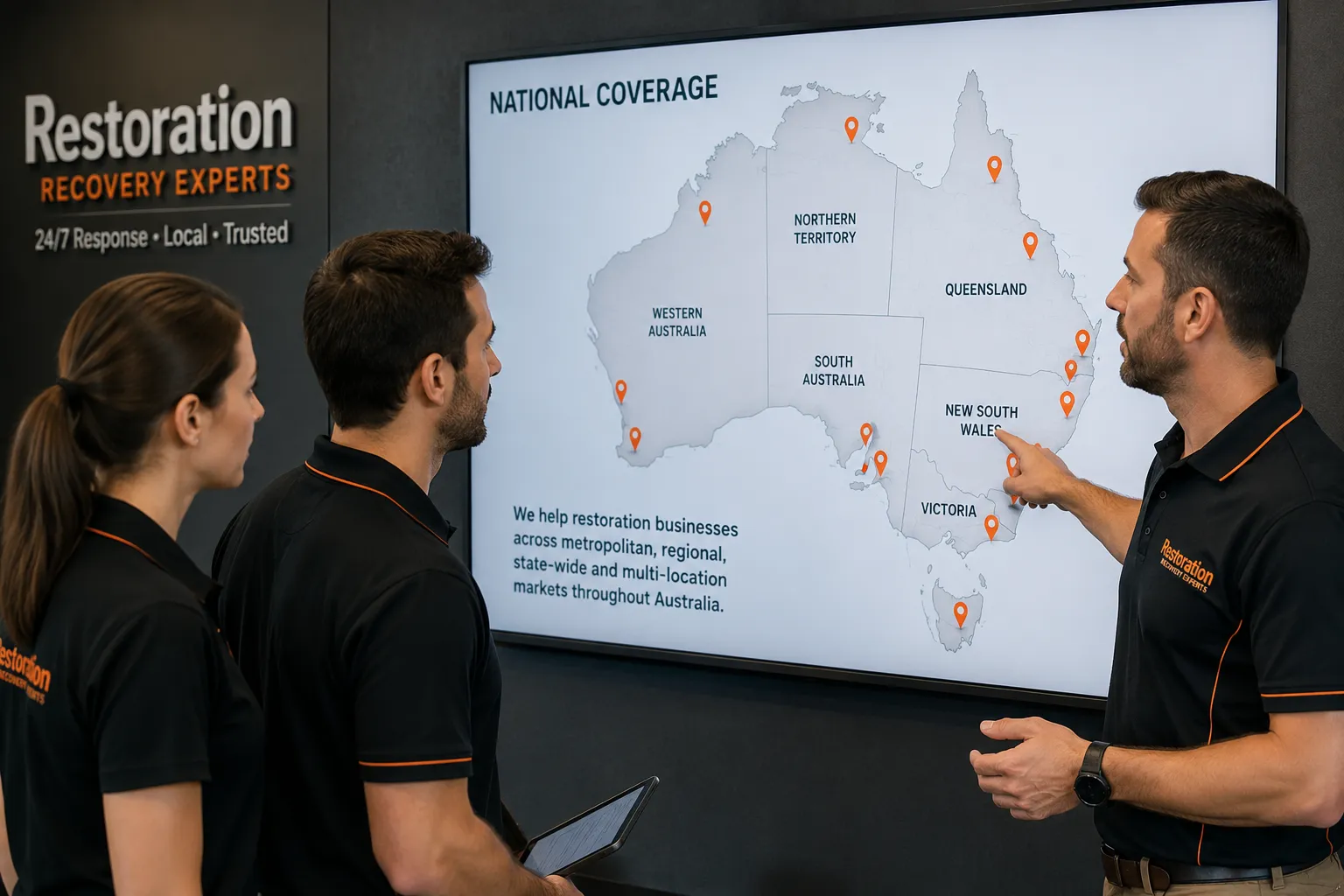
Commercial and large-loss specialists need pages for facilities, strata, industrial, retail, healthcare or institutional buyers. These campaigns focus on response capability, compliance evidence, documentation and business continuity rather than raw domestic lead volume.
Campaign management can support metropolitan, regional, state-wide and multi-location markets across Australia. Targeting remains limited to locations the business genuinely serves. We do not list every Australian city to create artificial national relevance.
What Is Included and What Is Excluded?
The proposal defines the agreed SEO work, deliverables, ownership and exclusions before implementation begins.
Included within the agreed scope
- SEO audit and campaign strategy
- Keyword, entity and intent mapping
- Google Business Profile optimisation
- Service and location architecture
- Technical SEO and internal linking
- Citation, review and authority strategy
- Conversion and call tracking
- Monthly performance reporting
- Genuine service-area targeting
Not automatically included
- Google Ads or social media management
- Call-centre staffing
- Restoration certification or licensing
- Unlimited content production
- Complete website rebuild unless quoted
- Fake reviews or bulk backlinks
- CRM replacement unless scoped
- Guaranteed ranking positions
- False addresses or ineligible profiles
The client should retain appropriate ownership or administrative access to the domain, website, Google Business Profiles, Search Console, analytics, approved content and core customer data. Any third-party tracking or software terms should be disclosed before implementation.
What Happens During the First 90 Days?
The first 90 days establish the commercial baseline, correct high-impact weaknesses and build the priority assets required for ongoing growth.
Days 1–30: Diagnose and Map
We confirm the service mix, priority job types, service areas, crew capacity, current lead sources and commercial objectives.
The campaign then establishes the search baseline. This may include Google Maps visibility, organic rankings, indexed pages, profile condition, website performance, calls, forms and any available job-outcome data.
The first phase produces the keyword and entity map, page-ownership plan, technical priorities, Google Business Profile actions, measurement framework and content roadmap.
By the end of this stage, the business should know what is limiting visibility, which opportunities matter and how performance will be judged.
Days 31–60: Correct and Build
The second stage addresses the highest-value problems first.
Work may include profile corrections, technical fixes, core service-page improvements, internal-link restructuring, mobile conversion changes, citation cleanup and priority content production.
A primary page capable of generating qualified restoration calls takes priority over a low-intent article with little commercial connection.
Days 61–90: Expand and Validate
The third stage extends the corrected foundation.
This may include additional service or location pages, review workflows, authority development, commercial content, lead-quality analysis and conversion testing.
We then compare early performance against the baseline and set the next-quarter priorities.
The roadmap defines implementation milestones. It does not guarantee ranking positions. Progress depends on competition, website condition, authority, reviews, market size, implementation speed and geographic scope.


