

Content marketing helps Australian tradies attract local customers, showcase their workmanship, build trust, and generate more relevant enquiries. Whether you’re a plumber, electrician, builder, roofer, or landscaping contractor, useful content can help potential customers understand your services and decide whether you’re the right person for the job.
Think about how homeowners choose a tradie.
Someone dealing with a blocked drain might search Google for a local emergency plumber. Another homeowner planning a bathroom renovation might spend weeks comparing contractors, reading cost guides, and looking at completed projects.
Both customers need information, but they need different kinds of information at different times.
That’s where content marketing becomes valuable.
Instead of relying entirely on advertisements or word-of-mouth recommendations, tradies can use service pages, helpful guides, project photos, videos, and customer FAQs to answer questions and demonstrate their experience.
You don’t need to publish a blog every day or become a social media influencer. A detailed explanation of your services or a genuine completed-project case study can be more useful than dozens of generic posts.
In this guide, we’ll explain the seven main benefits of content marketing for tradies, which content types work best, how to get started, and how to measure whether your efforts are generating real business value.
What Is Content Marketing for Tradies?
Content marketing for tradies means creating and sharing useful information that helps potential customers understand your services, evaluate your workmanship, and make confident hiring decisions.
Unlike traditional advertising, which primarily promotes a service or offer, content marketing focuses on answering customer questions and demonstrating relevant experience.
For example:
- A plumber might publish a guide explaining common causes of blocked drains and when professional assistance is necessary.
- An electrician could share photos of a completed switchboard upgrade and explain what the project involved.
- A builder might publish a home extension case study showing the construction stages and finished results.
- A roofer could explain the signs of roof deterioration and when an inspection may be appropriate.
- A landscaper might showcase completed outdoor projects and explain how different materials affect maintenance requirements.
These examples help customers understand what a business offers before making contact.
Content marketing can include service pages, blogs, before-and-after photos, project portfolios, educational videos, FAQs, and customer maintenance emails.
Search engine optimisation (SEO) helps make relevant website content discoverable through search engines. Social media and email can provide additional ways to reach customers.
However, publishing content is only part of the process. Your website also needs clear service information, genuine trust signals, and straightforward ways for customers to contact you.
The goal isn’t simply to attract more visitors. It’s to help suitable customers find your business and take the next step.
Why Is Content Marketing Important for Tradies?
Content marketing matters because customers often want evidence that a tradesperson is experienced, reliable, and capable of completing their particular job.
Before contacting a contractor, homeowners may want answers to questions such as:
- Does this business provide the service I need?
- Does it operate in my area?
- Has it completed similar projects?
- What factors affect the cost?
- What should I expect during the job?
- How can I request a quote?
When your website answers these questions clearly, potential customers can evaluate your business without needing to make an initial phone call.
Content can also help your business appear for relevant Google searches, support customer confidence, and reduce unsuitable enquiries.
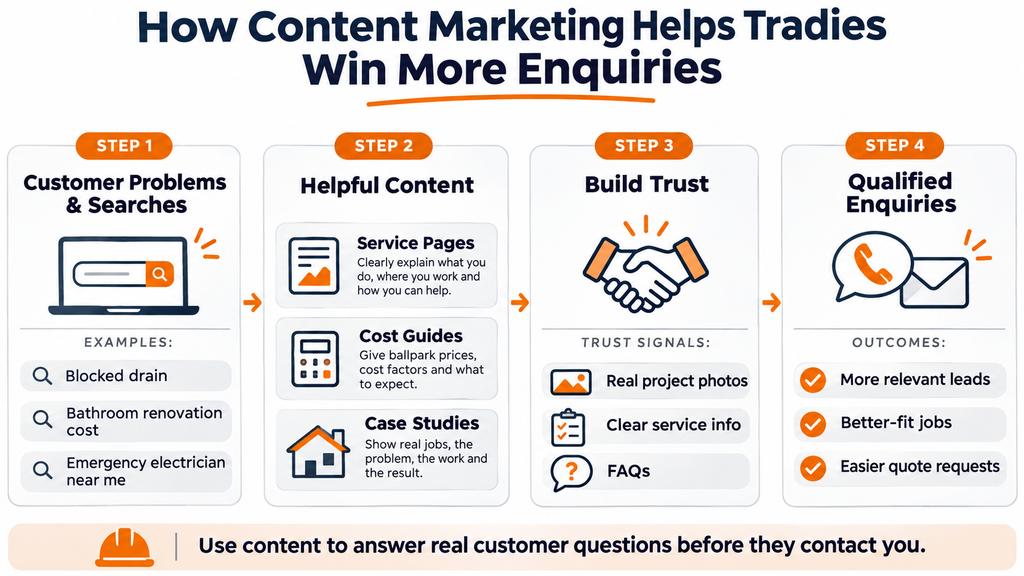
Here are seven ways it can benefit Australian trade businesses.
7 Key Benefits of Content Marketing for Tradies
1. Improve Local Search Visibility
One of the biggest benefits of content marketing for tradies is the opportunity to reach customers searching online for specific services and problems.
Imagine you run a plumbing business in Sydney.
Your website might have a general plumbing services page, but customers don’t always search for broad terms such as “plumbing company”.
They may search for:
- Blocked drain plumber Parramatta
- Emergency plumber Sydney
- Why does my shower drain smell?
- Signs of a blocked sewer pipe
- Hot water system repair Sydney
These searches represent different customer needs.
Someone searching for an emergency plumber may be ready to book immediately. Someone researching shower drain smells may still be investigating the problem.
A clear blocked drain service page can help customers looking for professional assistance, while an educational guide can explain common symptoms and when a plumber should inspect the issue.
Both types of content can contribute to a stronger website.
According to Google’s SEO Starter Guide, helpful content and descriptive language can make it easier for search engines and people to understand a website.
However, creating more content doesn’t automatically mean better rankings. Search performance also depends on competition, website accessibility, relevance, and overall quality.
Does content marketing help with Google Maps rankings?
Website content and Google Maps visibility are related but different.
Google identifies relevance, distance, and prominence as major local ranking considerations.
An accurate Google Business Profile, genuine reviews, and consistent business information are important for local visibility.
Useful location-specific website content can support customers researching your services, but publishing dozens of nearly identical suburb pages is not a reliable way to rank across an entire region.
Focus on the suburbs you genuinely serve and provide information that is useful to customers in those areas.
The key benefit: More opportunities to be discovered by people searching for services your business actually provides.
2. Build Customer Trust and Credibility
When homeowners hire a tradie, they’re trusting someone with their property, money, and sometimes their safety.
They may not have the technical knowledge to judge electrical installations, roof repairs, waterproofing, or structural work.
That makes evidence of professional experience particularly important.
Content marketing gives you a way to show customers what you do and how you approach your work.
For example, consider a Melbourne roofing contractor.
A photo of a completed roof restoration may look impressive, but a detailed project explanation provides much more value.
The contractor could explain:
- The condition of the roof before work began
- The problems identified during inspection
- The agreed repair or restoration scope
- The materials and methods used
- The completed outcome
- Any relevant follow-up recommendations
With authentic photographs, this information helps potential customers evaluate the contractor’s experience.
The same approach works for electricians, builders, plumbers, carpenters, and other trade professionals.
A builder could document the stages of a home extension. An electrician might explain a completed switchboard upgrade. A landscaping contractor could show how site preparation influenced a finished outdoor project.
Where relevant, include accurate licensing details, genuine customer feedback, and information about applicable qualifications.
Avoid presenting stock photography as your own completed work or making claims that cannot be verified.
The key benefit: Customers can see evidence of your capability rather than relying entirely on marketing promises.
3. Generate More Qualified Leads
Getting more enquiries sounds good, but not every enquiry becomes a profitable job.
A builder specialising in major home renovations might receive requests for minor repairs. A commercial electrician may receive residential enquiries outside their service scope. A plumber might get calls from locations they don’t cover.
These enquiries can consume time without creating suitable business opportunities.
Content marketing can help customers understand whether your services match their needs before contacting you.
Suppose you operate a residential renovation business.
Your website could explain the types of renovations you undertake, your service area, how the process works, and which factors influence project costs.
You could also publish guides covering common questions about renovation timelines, approvals, budgets, and construction stages.
This information allows customers to assess whether your business is a suitable match.
What is a qualified lead?
A qualified lead is a potential customer whose requirements align with your services, location, availability, and commercial criteria.
Consider this hypothetical comparison:
| Lead quality measure | Scenario A | Scenario B |
|---|---|---|
| Total enquiries | 30 | 30 |
| Suitable enquiries | 9 | 21 |
| Qualified lead rate | 30% | 70% |
These are illustrative figures, not actual industry results.
Both scenarios produce the same number of enquiries, but Scenario B provides significantly more opportunities to quote relevant work.
You can improve lead qualification by clearly explaining your service types, geographic coverage, project requirements, and pricing considerations where appropriate.
A straightforward contact form can also ask customers to describe their job, location, and preferred timeframe.
The key benefit: Content can help attract customers who are more likely to need the work you actually want to undertake.
4. Support Cost-Effective Long-Term Marketing
Paid advertising can generate exposure while a campaign is running, but useful website content may continue helping customers long after publication.
For example, an air conditioning contractor might create a guide explaining when a split-system air conditioner should be repaired or replaced.
That guide could answer common questions about poor cooling performance, unusual noises, running costs, and replacement considerations.
If the information remains accurate and relevant, customers may continue finding it over time.
This is often called evergreen content.
Unlike a paid advertisement that incurs charges for eligible clicks, organic search visits do not carry a direct per-click advertising fee.
However, content marketing is not free.
Creating and maintaining useful content requires time, professional knowledge, research, writing, photography, website work, and performance monitoring.
Is content marketing cheaper than Google Ads?
Not necessarily.
Google Ads may be useful for reaching customers with immediate service needs, particularly in competitive emergency categories.
Content marketing may be valuable for explaining services, supporting research-led decisions, and building a library of useful information over time.
The better comparison is the cost of acquiring an actual customer.
Customer acquisition cost = Total attributable acquisition cost ÷ Number of new customers acquired
For example, suppose a contractor invests A$1,200 in content-related marketing during a reporting period and acquires six new customers attributed to that activity.
The acquisition cost would be:
A1,200÷6=A200 per customer
This is a hypothetical calculation, not an industry benchmark.
To know whether that result is worthwhile, the contractor must compare acquisition costs with the contribution generated by the resulting jobs.
Content marketing and paid advertising can also complement each other. An urgent repair service may require immediate paid search visibility, while educational content supports customers planning larger projects.
The key benefit: Useful content can become a reusable marketing asset, although ongoing traffic and profitable returns are never guaranteed.
5. Stand Out From Competing Tradies
Many trade websites use similar statements:
“Quality workmanship.”
“Affordable prices.”
“Reliable local service.”
These claims are common, and they don’t necessarily help customers understand why one business is more suitable than another.
Content marketing gives you an opportunity to demonstrate what makes your services different.
Consider a concreter specialising in exposed aggregate driveways.
Instead of simply claiming to provide high-quality concrete work, the business could show completed projects and explain the role of site preparation, drainage, surface selection, and access requirements.
A carpenter specialising in outdoor decking could document timber choices, subframe preparation, installation stages, and finished designs.
These details make the contractor’s actual capabilities easier to understand.
What makes trade-business content different from generic marketing?
Specificity and evidence.
A useful project description explains what was involved, what the contractor did, and what customers should understand about similar work.
A generic article might say that roof maintenance is important.
A more distinctive article from an experienced roofer could explain common issues found during inspections of particular roof types, supported by genuine project photographs and appropriately qualified professional explanations.
You don’t have to specialise in one narrow service to stand out.
A general maintenance contractor can differentiate their business by explaining accepted job types, service coverage, working processes, and examples of completed repairs.
The key benefit: Customers can compare your actual services and experience rather than relying on interchangeable advertising claims.
6. Educate Customers Before They Contact You
Customers often need to understand a problem before they’re ready to speak with a tradesperson.
They may be unsure what caused the issue, what options exist, how much work might be involved, or which questions they should ask.
Educational content can help.
For example, a homeowner considering a retaining wall may have questions about materials, drainage, site conditions, and council requirements.
A landscaping contractor can explain these general considerations and clarify which details require professional assessment.
An electrician could provide information about warning signs that a switchboard requires inspection.
A builder might explain why project variations can affect a renovation budget.
A roofing contractor could describe what usually happens during a professional roof inspection.
Providing this information helps customers prepare for conversations and make more informed decisions.
Can content reduce repetitive questions?
It can make answers to common questions available before someone contacts your business.
Imagine a bathroom renovation company receiving frequent questions about how long renovations take.
A helpful guide could describe the main stages, including demolition, plumbing, electrical work, waterproofing, tiling, and finishing.
It could also explain why project duration varies depending on design requirements, materials, site conditions, and approvals.
Customers can read the guide before requesting a quote, giving them a more realistic understanding of the process.
Educational articles should never replace site-specific professional advice.
Electrical, gas, structural, and other regulated work must be handled in accordance with applicable safety and licensing requirements. Content should help readers recognise when they need a qualified professional, not encourage unsafe DIY work.
The key benefit: Better-informed customers can explain their needs more clearly and understand what to expect from your service.
7. Encourage Repeat Business and Long-Term Growth
Content marketing doesn’t have to stop after a customer books a job.
It can also help you maintain relationships with existing customers.
For example, after installing an air conditioning system, an HVAC contractor might send relevant maintenance guidance.
A plumber could provide information about warning signs of developing drainage problems.
A roofer might explain when a professional inspection could be useful following severe weather.
These communications can help customers remember your business when another genuine service need arises.
Content can also support referrals.
Imagine a homeowner recommends a local painter to a neighbour.
Before getting in touch, the neighbour may look at the painter’s website or social media profile.
If they find authentic project photos, clear service information, and examples of similar residential work, they have more information to support their hiring decision.
Does content marketing guarantee repeat customers?
No.
Repeat business depends on service quality, customer satisfaction, future needs, availability, and pricing.
Good content cannot compensate for poor workmanship or unreliable communication.
However, it can help customers stay informed about relevant services and make your business easier to recommend.
The key benefit: Content can support customer relationships, referrals, and sustainable growth alongside good service delivery.
What Types of Content Work Best for Australian Tradies?
The best content depends on what your customers need to know and how close they are to hiring someone.
An emergency plumber needs clear service information, coverage details, and easy contact options.
A home renovation builder may need detailed case studies because customers are comparing experience and planning substantial investments.
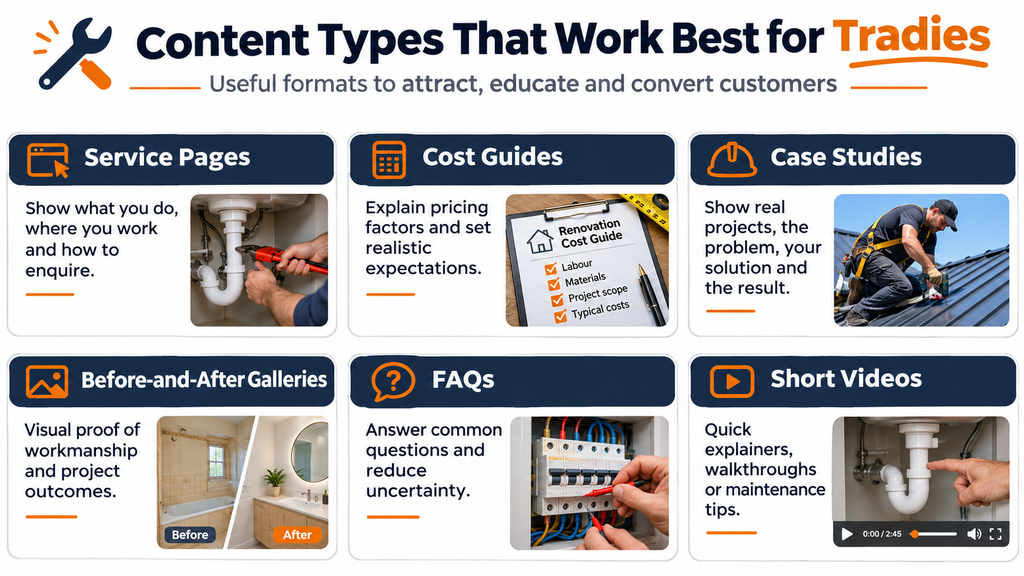
Here are useful formats for different customer needs.
| Content type | Trade example | Main purpose |
|---|---|---|
| Service pages | Emergency plumbing in Brisbane | Attract service enquiries |
| Cost guides | Factors affecting switchboard upgrade costs | Help customers assess budgets |
| Case studies | Completed home extension project | Demonstrate experience |
| Before-and-after galleries | Driveway resurfacing project | Showcase workmanship |
| Educational blogs | Why an air conditioner isn’t cooling properly | Answer customer questions |
| FAQs | What happens during a roof inspection? | Reduce uncertainty |
| Short videos | Overview of a completed decking project | Communicate visually |
| Maintenance emails | Seasonal HVAC maintenance information | Support existing customers |
Should Tradies Focus on Blogs, Videos, or Project Photos?
Start with the information you already have.
Every completed job may provide useful material, provided you have the necessary customer permission and the content does not reveal private or unsafe information.
For example, an electrician completing a switchboard upgrade may be able to document the reason for the work, the professional assessment, the approved scope, and the final outcome.
That information could support a project case study, an educational FAQ, or a short video explaining the service.
The important consideration is whether each piece adds something useful rather than repeating the same description.
Example of a Completed-Job Case Study
A practical case study could follow this structure:
Project title: Residential Blocked Drain Inspection and Repair
Customer problem: Explain the symptoms the customer reported.
Professional inspection: Describe the assessment performed and the issue identified.
Work completed: Outline the approved repair scope and relevant methods or materials.
Project outcome: Explain the verified result without exaggeration.
Supporting evidence: Include approved photographs and an appropriate general location.
Next step: Link to the relevant plumbing service page or enquiry form.
This is a content template, not a description of an actual completed project.
When filled with genuine project information, it can help prospective customers understand the business’s experience and approach.
Is Content Marketing Worth It for Small Trade Businesses?
Yes, content marketing can be worthwhile for small trade businesses when it supports genuine customer demand and fits the business’s available resources.
However, not every business needs an extensive content strategy from day one.
If you’re a sole trader with limited time, improving your main service pages may be more valuable than publishing numerous general-interest articles.
For example, a plumber with poorly explained blocked drain and hot-water services should consider clarifying those pages before creating unrelated blog content.
A builder who already receives enquiries may benefit more from project case studies and renovation cost guides that help prospective customers assess whether their projects are suitable.
The right approach depends on your services, existing visibility, lead quality, and workload.
If you need urgent enquiries, content marketing alone may not be the fastest solution.
A balanced marketing strategy should consider immediate demand as well as longer-term customer acquisition.
How Much Does Content Marketing Cost for Tradies?
Content marketing costs vary depending on the work required, who creates the material, and how much existing information the business can provide.
Common expenses include:
- Content research and planning
- Professional writing and editing
- Project photography or video production
- Technical review by a qualified tradesperson
- Website publishing and optimisation
- Internal linking and service-page improvements
- Analytics and conversion tracking
- Ongoing content updates
A self-managed approach may reduce direct agency expenditure but still requires business-owner or staff time.
Outsourcing can provide additional marketing support, although the contractor should understand what work is included and how performance will be evaluated.
Before purchasing a content package, ask for a clear description of the deliverables.
For example, find out whether the package includes content research, service-page updates, project documentation, technical review, publishing, and measurement.
A promise to publish a certain number of blog posts every month does not, by itself, demonstrate value.
How Can Tradies Start Content Marketing?
You don’t need a large marketing department to begin.
A practical approach is to focus on your highest-priority services, answer genuine customer questions, and document work you’ve already completed.
Step 1: Identify Your Most Important Services
List the services that matter most to your business.
An electrician might prioritise switchboard upgrades, fault finding, and EV charger installations.
A plumber could focus on blocked drains, hot-water systems, and emergency repairs.
Choose services based on genuine demand, profitability, business capacity, and geographic coverage.
Step 2: Improve Your Existing Service Pages
Check whether a customer can quickly understand:
- What the service includes
- Which problems you handle
- Where you operate
- What the work generally involves
- How to request an inspection or quote
Make sure contact details are easy to find, especially on mobile devices.
Step 3: Collect Real Customer Questions
Think about the questions customers ask on the phone or during site visits.
These can become useful content topics.
For example:
- What affects the cost of a switchboard upgrade?
- When should a hot-water system be replaced?
- How long does a bathroom renovation take?
- What happens during a professional roof inspection?
- Which factors affect driveway installation costs?
The best questions are those that relate directly to services your business provides.
Step 4: Document Completed Projects
With appropriate permission, collect photographs, project notes, scope details, and verified outcomes.
Use that information to create meaningful case studies.
Authentic project documentation can be more persuasive than generic claims about your experience.
Step 5: Publish and Connect Related Content
Link relevant articles to your service pages.
For example, a guide discussing common blocked drain problems should make it easy for someone who needs professional assistance to find your blocked drain service.
Use clear headings, descriptive page titles, helpful images, and straightforward contact options.
Step 6: Review Performance
Monitor whether your content attracts relevant visitors and contributes to suitable enquiries.
Don’t judge success solely by the number of articles published or page views received.
Example Four-Week Content Marketing Plan
| Week | Activity | Outcome |
|---|---|---|
| Week 1 | Review important services and customer questions | Priority content list |
| Week 2 | Gather details from a completed job | Project case study material |
| Week 3 | Improve one service page and publish the case study | Two connected content assets |
| Week 4 | Check internal links, contact options, and analytics | Measurement baseline |
This is an illustrative schedule, not a guarantee of rankings or bookings within four weeks.
The objective is to build a manageable process that supports your business without interfering with your primary work.
How Can Tradies Measure Content Marketing Results?
The best way to measure content marketing is to look at the business outcomes it helps generate.
Website visits and Google rankings provide useful information, but they don’t tell the whole story.
A tradie should also assess enquiries, qualified leads, accepted quotes, and confirmed jobs.
Useful performance indicators include:
- Organic search clicks: How often people visit your website through unpaid search results.
- Enquiries: Phone calls or forms submitted by prospective customers.
- Qualified leads: Enquiries that match your actual services and business requirements.
- Quotes issued: Suitable jobs that progress to a formal quotation.
- Confirmed jobs: Enquiries that become booked work.
- Customer acquisition cost: The amount spent acquiring new customers.
- Marketing ROI: The financial return associated with marketing expenditure.
Google Search Console can help identify organic search queries and pages.
Google Analytics 4 can measure relevant website actions when tracking is configured properly.
Call tracking and customer management records can help connect enquiries to completed jobs.
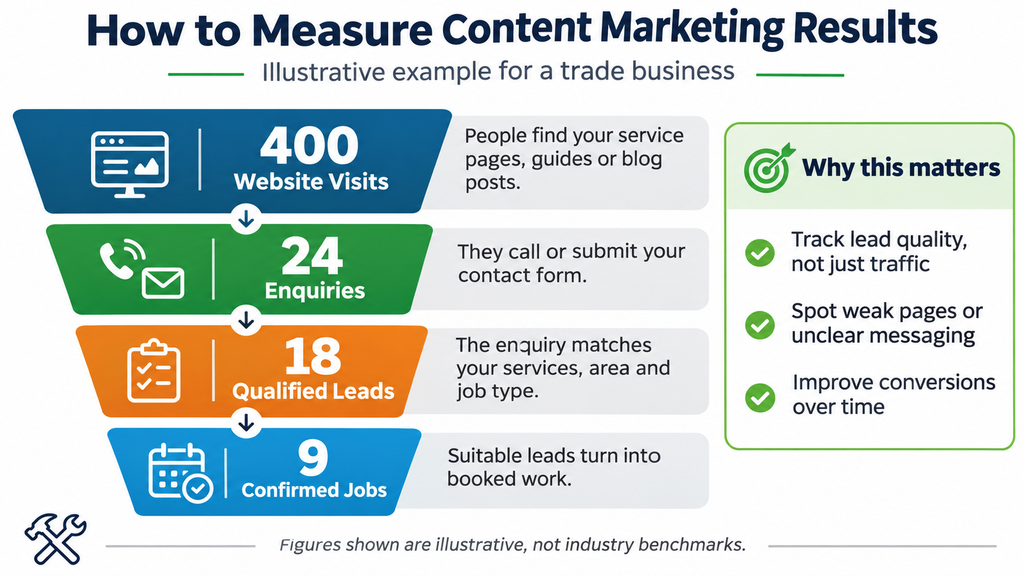
Example of Content Marketing Performance
Consider a hypothetical Australian trade business reviewing its monthly results.
| Metric | Example result |
|---|---|
| Relevant website visits | 400 |
| Enquiries | 24 |
| Qualified enquiries | 18 |
| Quotes issued | 12 |
| Quotes accepted | 9 |
| Confirmed jobs | 9 |
In this example:
Enquiry conversion rate:
24 ÷ 400 × 100 = 6%
Qualified lead rate:
18 ÷ 24 × 100 = 75%
Enquiry-to-booking rate:
9 ÷ 24 × 100 = 37.5%
These figures are illustrative, not industry benchmarks.
The example assumes that all nine accepted quotes became confirmed bookings. Real businesses should track those stages separately.
This kind of measurement helps identify where improvements are needed.
For example, if a service page attracts relevant visitors but produces few enquiries, the business may need clearer contact information, stronger trust evidence, or better explanations of its services.
If the website produces many enquiries that don’t match the contractor’s services, the content may need to communicate service scope and geographic coverage more clearly.
How Do You Calculate Content Marketing ROI?
Content marketing ROI compares attributable financial contribution with marketing investment.
It’s important not to confuse revenue with profit.
A contractor might generate A$20,000 in job revenue, but materials, labour, subcontractors, and other direct costs must be considered.
A useful calculation is:
Marketing ROI = (Attributable contribution − Marketing investment) ÷ Marketing investment × 100
Suppose completed jobs attributed to content marketing produce A$6,000 in contribution after relevant direct job costs but before marketing expenses.
If content marketing costs A$2,000:
(A6,000-A2,000) ÷ A$2,000 × 100 = 200%
The illustrative marketing ROI is 200%.
This doesn’t necessarily represent the business’s final net profit, because other overheads may still apply.
Marketing attribution can also be imperfect. A customer might read a blog post, later see a paid advertisement, and eventually book after receiving a personal recommendation.
Use measurement to make better business decisions rather than assuming every booking can be attributed perfectly to one channel.
When Should Tradies Hire a Content Marketing Agency?
Professional support can be useful when your business needs better website content, more relevant search visibility, or clearer enquiry tracking, but you don’t have the resources to manage everything internally.
Some businesses already have good project photos, customer reviews, and specialist trade knowledge. What they lack is a structured way to turn that information into useful website content.
Others have published many articles but don’t know whether those pages are attracting potential customers or contributing to enquiries.
Before hiring an agency, identify the problem you want to solve.
It might involve:
- Poorly explained service pages
- Limited organic search visibility
- A lack of completed-project examples
- Content that attracts irrelevant visitors
- Weak internal linking
- Unclear enquiry pathways
- Incomplete conversion tracking
A good content strategy should address actual business needs rather than simply increasing publishing volume.
How Can SEO Agency for Tradies Help?
At SEO Agency for Tradies, we focus on helping Australian trade businesses improve the information customers use to discover, understand, and evaluate their services.
Our approach considers the services you want to promote, the areas you genuinely serve, and the questions customers ask before requesting work.
A content strategy review can examine existing service pages, search intent, related content, internal links, evidence of completed work, and website enquiry pathways.
The purpose is to identify practical improvements that could make your website more useful to prospective customers.
If your website receives visitors but few suitable enquiries, or your completed projects aren’t clearly represented online, reviewing your existing content is a sensible starting point.
Before proceeding, confirm the scope of the assessment, expected deliverables, and any applicable fees.
Request a Tradie SEO and Content Strategy Review
Frequently Asked Questions About Content Marketing for Tradies
Does Content Marketing Really Help Tradies Get More Jobs?
Content marketing can help generate job opportunities by making services easier to discover, showing evidence of completed work, and guiding suitable visitors towards an enquiry. Results depend on search demand, competition, content quality, and conversion performance.
Do Tradies Need a Blog?
No. Service pages, project portfolios, completed-job photos, FAQs, and videos can all support content marketing. A blog is useful when it answers relevant customer questions, but frequent publishing is not mandatory.
Is Content Marketing Better Than Google Ads?
Neither channel is automatically better. Google Ads can provide paid exposure for relevant searches, while content marketing may support ongoing organic discovery and customer education. The best approach depends on your services, budget, urgency, and acquisition costs.
How Long Does Content Marketing Take to Work?
There is no guaranteed timeframe. Results depend on your website’s existing visibility, competition, content quality, search demand, and promotion. A newly published article may not generate immediate enquiries.
What Content Should a Tradie Publish First?
Start with clear pages explaining your main services and service locations. Then add genuine project examples and answers to frequently asked customer questions.
Can Content Marketing Work Without Social Media?
Yes. Useful website content can attract customers through organic search without requiring an active social media presence. Social platforms may provide additional opportunities to share content, but they aren’t essential for every trade business.
Can Tradies Do Content Marketing Themselves?
Yes. Tradies can collect project photos, answer common questions, and maintain accurate service information. Professional assistance may be useful for SEO research, technical website improvements, writing, and measurement.
How Do You Know If Content Marketing Is Worth the Investment?
Look at whether your content contributes to qualified enquiries, accepted quotes, confirmed jobs, or repeat business at an acceptable cost. Rankings and website traffic are useful supporting indicators, but commercial outcomes matter most.
Final Thoughts: Why Content Marketing Matters for Australian Tradies
Content marketing gives Australian tradies an opportunity to turn their everyday knowledge and completed work into information customers can use.
It can improve local search discoverability, build trust, generate more suitable enquiries, differentiate your business, educate homeowners, and support ongoing customer relationships.
But successful content marketing isn’t about producing the most blog posts or repeating keywords throughout a website.
It’s about answering real questions, demonstrating genuine experience, and helping customers decide whether your services meet their needs.
A plumber can document a completed blocked drain repair. An electrician can explain a switchboard upgrade. A builder can show how a home renovation progressed from planning to completion.
These are practical examples of the knowledge trade businesses already possess.
The opportunity is to make that knowledge accessible to people looking for professional help.
If your website doesn’t clearly explain what you do, where you work, and why customers should consider your services, improving that information is a useful first step.


