

No. A tradie should not create a page for every suburb listed in their service area.
A suburb page is justified when the business genuinely serves that location, the page answers a distinct local need, and the company can support its claims with operational or project evidence.
If the only unique element is the suburb name, the page should probably not be published.
This matters because Google identifies substantially similar regional pages that funnel visitors towards the same destination as a form of doorway abuse. Google also lists blocks of city and regional names without substantial value as an example of keyword stuffing.
The question is therefore not:
How many suburb pages can we publish?
The better question is:
Which locations deserve their own page because customers need different information before requesting a quote?
Research basis for this article
We reviewed Google’s current search spam policies, people-first content guidance and service-area business documentation in September 2026.
We also examined Australian local SEO and tradie marketing pages appearing for searches related to suburb SEO, local landing pages and tradie location targeting.
The recurring competitor recommendation was to create detailed pages for important locations. The missing part was a reliable decision process for determining which suburbs deserve a page.
This article fills that gap with a seven-point location evidence model. The model is our editorial framework. It is not an official Google scoring system or a guarantee of rankings.
A Google Business Profile service area is not a website-page plan
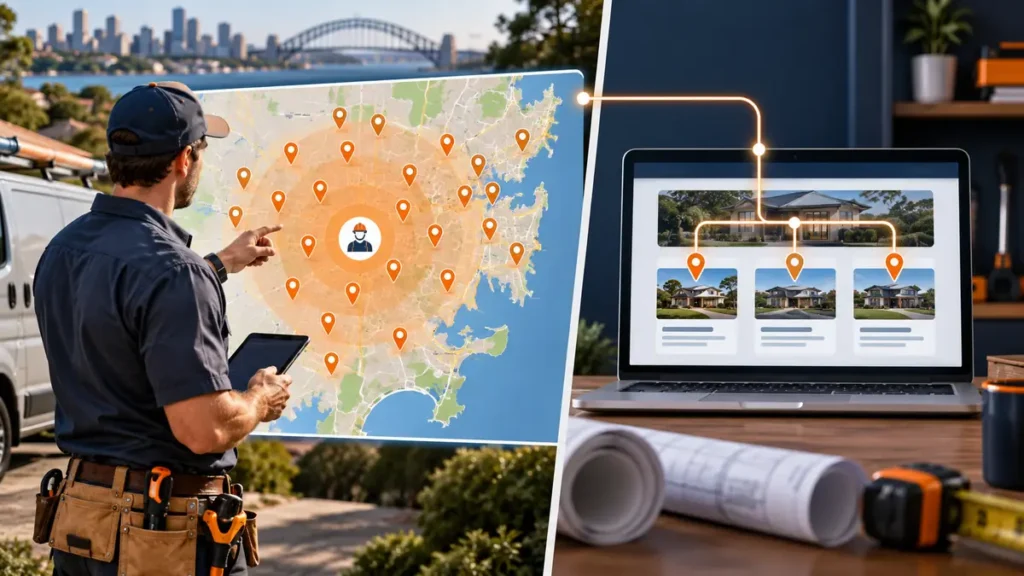
Your Google Business Profile and website serve different purposes.
The service-area field tells customers where your business can provide services. Google currently allows eligible service-area and hybrid businesses to select up to 20 areas based on cities, postcodes or other supported regions.
Google also recommends that the overall area remain within approximately two hours’ driving time from the business base. See Google’s service-area business guidelines.
These rules do not mean you need 20 website pages.
A plumber might list 20 operating areas in the profile but only have enough evidence to create five useful suburb pages. The remaining areas can be covered through city hubs, regional pages, service pages and clear service-area information.
Selecting an area in your Business Profile also does not create a new physical location. A service-area business normally operates from one real base and travels to customers.
What is a suburb SEO page?
A suburb SEO page is a location-specific website page designed to help people understand whether a business provides relevant services in their area.
For example:
- Electrician in Parramatta
- Plumber in Penrith
- Roofer in Chermside
- Air conditioning repairs in Dandenong
- Pest control in Fremantle
A legitimate suburb page connects three entities:
- A real business
- A genuine service
- A location the business actually serves
Removing any one of these relationships weakens the page.
A business cannot establish local relevance simply by placing a suburb name in the title, H1 and footer. The content must explain what the company provides in that location and why the page is useful to customers there.
The seven-point suburb-page evidence model

Score each proposed suburb page from zero to seven.
This model is designed to prevent mass publishing based only on keyword lists.
| Test | Question | Evidence |
|---|---|---|
| Genuine coverage | Does the team regularly serve this suburb? | Booking records, service boundaries or completed jobs |
| Operational capacity | Can the company accept more work there? | Travel time, technicians, vehicles and scheduling capacity |
| Commercial fit | Are the available services profitable and suitable? | Job value, margin, equipment and licence requirements |
| Distinct customer need | Do customers in this area need specific information? | Property types, access, faults, climate or regulations |
| Local proof | Can the business demonstrate relevant experience? | Projects, photographs, reviews or job records |
| Unique page purpose | Will the page contain information not found elsewhere? | Different services, conditions, examples or customer decisions |
| Measurement plan | Can performance and lead quality be tracked? | Search Console, call tracking, forms and CRM data |
How to use the score
A page scoring five or more may be worth developing.
However, two conditions should be treated as mandatory:
- The business genuinely serves the suburb.
- The company has, or can collect, credible local evidence.
A location should not receive a page merely because it reaches five points through weaker criteria.
The score is a publishing filter. It is not a prediction that Google will rank the page.
Three situations where a suburb page is justified
1. The business has completed relevant work in the area
Completed work provides information that cannot be produced by replacing location names in a template.
A useful project record may include:
- The service completed
- The general location
- The original fault
- Property or access conditions
- Diagnostic findings
- Repair options considered
- Work performed
- Photographs with permission
- Relevant customer feedback
A roofer who has completed storm-damage repairs in a Brisbane suburb can discuss actual roof types, access conditions and repair decisions.
That is stronger than writing that the suburb has “a vibrant community and diverse homes”.
2. Customers in the area face a distinct service condition
Location can change the way a service is assessed or delivered.
Examples include:
- Apartment access and strata approval
- Older homes with outdated electrical systems
- Coastal exposure affecting roofing materials
- Limited parking for service vehicles
- Rural travel and equipment requirements
- Bushfire-zone construction constraints
- Local council access or waste requirements
Only include a condition when it is accurate and relevant to the trade.
Do not invent local problems because they make the content sound specialised.
3. The location represents a separate commercial market
Some locations deserve their own page because they involve a different service mix, booking process or customer type.
An electrician may provide residential repairs in one area and commercial maintenance in another. A plumber may handle emergency domestic jobs across nearby suburbs but restrict large sewer projects to a smaller operating zone.
The page should explain these real differences.
If the offer, service process and customer questions remain identical, a separate page may add little value.
When a suburb page should not be created
You have never worked in the suburb
Claiming service coverage without evidence creates a trust problem.
The business may genuinely be willing to travel there, but willingness alone rarely produces meaningful location content. Start by mentioning the area on a broader service-area page. Build a dedicated page after the business has completed relevant jobs and collected useful evidence.
The team cannot serve the area profitably
Ranking in a distant suburb is not helpful if travel time destroys the margin or prevents the team from responding quickly.
Before creating the page, calculate:
A location can produce leads and still be a poor market.
If technicians regularly reject or reschedule enquiries from the suburb, publishing a page may increase operational waste rather than revenue.
The page would duplicate an existing location
Two pages should not compete to answer the same customer requirement.
For example:
/plumber-western-sydney//plumber-parramatta//emergency-plumber-parramatta//plumbing-services-parramatta/
All four URLs could overlap if they offer substantially the same information.
The correct structure depends on search intent and service depth. More URLs do not automatically create more visibility.
Only the suburb name would change
A page is weak when the location could be replaced without affecting the meaning.
Common warning signs include:
- The same introduction across every page
- Identical service lists
- Reused testimonials
- The same FAQs
- Repeated stock images
- Generic descriptions of the suburb
- Identical calls to action
- City names inserted into every heading
Google defines doorway abuse as creating pages for specific, similar queries that lead users through less-useful intermediate pages. Its examples include substantially similar pages and regional pages that funnel visitors towards one destination. See Google’s current spam policies.
Not every location page is a doorway page. The risk appears when the pages exist mainly to capture similar searches without providing distinct value.
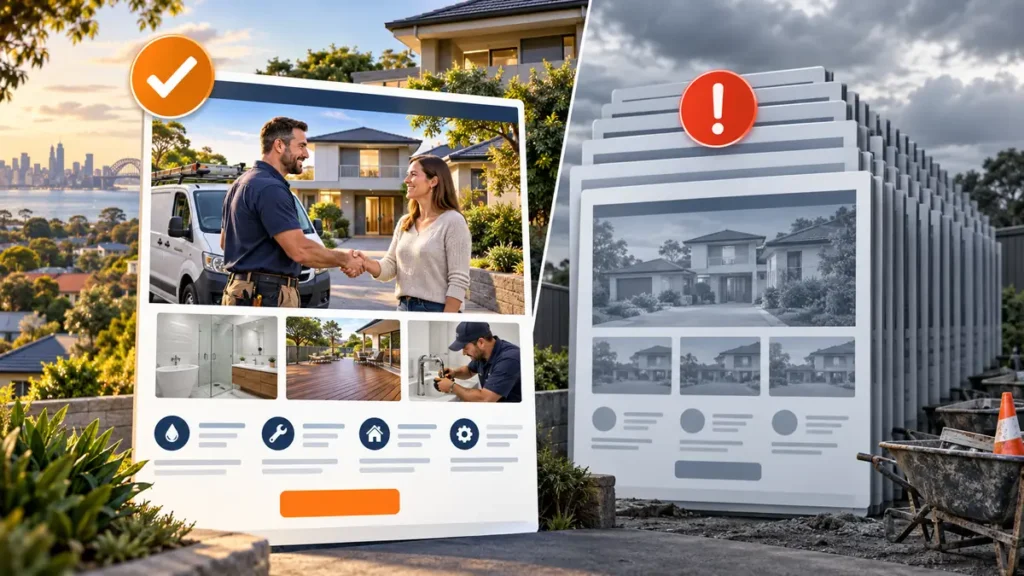
The difference between a useful page and a doorway page
| Page element | Useful suburb page | Weak or doorway-style page |
|---|---|---|
| Service coverage | Based on real operating boundaries | Claims every surrounding suburb |
| Local evidence | Projects, photographs and reviews | No evidence of work in the area |
| Service information | Reflects work available locally | Copies the same list everywhere |
| Local conditions | Explains relevant operating factors | Adds generic suburb history |
| Customer decision | Helps the visitor assess suitability | Sends everyone to the same generic page |
| Internal links | Fits a clear website hierarchy | Exists mainly as an isolated search entry |
| Measurement | Tracks calls, forms and job quality | Reports rankings without business outcomes |
The distinction is usefulness, not the presence of a suburb name.
What should a strong tradie suburb page contain?
A direct statement of service coverage
The opening should tell the visitor:
- Who provides the service
- What work is available
- Where it is provided
- Who the service is for
- How to request help
Avoid a long history of the suburb. A person with a blocked drain or electrical fault needs service information first.
Services genuinely available in that location
List only work the company can deliver there.
A plumbing page might cover:
- Blocked-drain clearing
- Leak detection
- Burst-pipe repairs
- Hot-water servicing
- Gas fitting
- Sewer inspections
If gas fitting is unavailable in that operating area, it should not appear simply because it is offered elsewhere.
Connect important services to their dedicated service pages. This creates a clear relationship between the location and the work performed.
Local project evidence
Use a short example rather than an unsupported claim.
A project example should state:
- The customer’s problem
- The general area
- What the inspection found
- What work was completed
- Any relevant limitation
- The practical result
Do not publish an exact residential address. Obtain permission before using customer photographs or identifiable information.
Relevant reviews
A review from a customer in or near the location can support trust.
Use the customer’s original words. Do not rewrite a review to add keywords or services that the customer did not mention.
If no local review exists, use a relevant service review and describe it accurately. Do not label it as a suburb-specific review.
Real operating information
Tell customers what may affect the booking.
Useful details can include:
- Normal operating hours
- Emergency availability
- Types of properties served
- Commercial or residential limitations
- Inspection requirements
- Parking or access needs
- Quote process
- Nearby areas covered by the same team
Do not promise response times unless the business can consistently meet them.
A location-specific call to action
The CTA should match the service and customer stage.
Examples include:
- Request an inspection
- Check service availability
- Call for emergency assistance
- Ask for a written quote
- Send photographs of the problem
“Contact us today” is acceptable, but it gives the customer less information about what happens next.
Do not write suburb history unless it changes the service

Population figures, landmarks and local history do not automatically make a page useful.
Mentioning a railway station, shopping centre or famous park may prove that the writer found the suburb on a map. It does not prove that the company has worked there.
Local information belongs on the page when it affects:
- The problem
- The property
- The inspection
- The service method
- The booking
- The cost
- The customer’s decision
A heritage housing area may affect electrical or plumbing work. A local café recommendation does not.
City pages and suburb pages have different jobs
A city page should explain broad service coverage across a metropolitan market.
A suburb page should answer a narrower local requirement.
A sensible hierarchy may look like this:
Trade service
└── City or regional service hub
    ├── Priority suburb page
    ├── Priority suburb page
    └── Priority suburb page
The city hub should link to the most important locations. Suburb pages should link back to the relevant city, service and supporting project pages.
Do not place every suburb in a long footer block. Google specifically identifies blocks of cities and regions without substantial value as a possible form of keyword stuffing.
A clear hierarchy helps users navigate the website and helps search systems understand the relationship between services and locations.
One combined page can be stronger than ten thin pages
A regional service-area page may be the better option when several nearby suburbs share the same:
- Service team
- Travel route
- Property conditions
- Service availability
- Customer questions
- Project evidence
For example, one well-developed “Plumber in Western Sydney” hub may initially be more useful than ten pages containing almost identical plumbing information.
Dedicated suburb pages can be added later when enough evidence and demand exist.
This approach protects crawl resources, reduces content maintenance and lowers the chance of pages competing against one another.
How to collect first-party evidence for future location pages
Create a simple job-evidence form for technicians or office staff.
After a suitable project, record:
| Field | Example |
|---|---|
| Date | Month and year |
| General location | Suburb, not full address |
| Service | Switchboard replacement |
| Customer problem | Repeated tripping and ceramic fuses |
| Finding | Outdated board requiring replacement |
| Work completed | New board and safety switches |
| Property type | Detached residential home |
| Constraints | Limited meter access |
| Photographs permitted | Yes or no |
| Review requested | Yes or no |
This information can support:
- Location pages
- Service pages
- Project case studies
- Google Business Profile updates
- FAQs
- Social content
- Sales conversations
The evidence begins with operations, not keyword research.
Google’s people-first content guidance asks whether content provides original information, reporting, research or analysis and whether it demonstrates first-hand expertise. A structured job-evidence process directly supports those qualities. Read Google’s people-first content guidance.
Measure whether a suburb page produces worthwhile work

Do not judge a location page by rankings alone.
Track:
- Search impressions
- Organic clicks
- Calls
- Quote forms
- Service requested
- Customer postcode
- Qualified leads
- Quotes issued
- Jobs won
- Revenue
- Travel time
- Gross margin
A page with 30 monthly visits and five profitable jobs may be more valuable than a page with 500 visits and poor-fit enquiries.
After enough data has accumulated, classify each location:
| Classification | Evidence | Action |
|---|---|---|
| Profitable | Qualified leads and suitable jobs | Maintain and strengthen |
| Promising | Relevant impressions but weak conversion | Improve offer, proof or CTA |
| Misaligned | Leads request unavailable services | Correct targeting and content |
| Operationally weak | Jobs are too distant or unprofitable | Reduce promotion or consolidate |
| Unsupported | No visibility, evidence or demand | Rework, merge or remove |
There is no universal review period. A high-demand emergency service may collect useful data faster than a specialist trade with longer sales cycles.
A practical suburb-page publishing process

Step 1: Define the profitable service area
Use booking records, travel time, technician availability and job margins.
Do not begin with a list of every suburb within driving distance.
Step 2: Group locations by operating conditions
Identify suburbs that share the same team, service mix and customer requirements.
This reveals where a regional hub may be enough.
Step 3: Score each proposed page
Apply the seven-point evidence model.
Reject locations without genuine coverage or local proof.
Step 4: Check existing pages
Look for overlapping city, region, service and suburb URLs.
Decide which page should own each search intent before publishing another URL.
Step 5: Build the strongest location first
Use project evidence, relevant services, reviews, operating details and clear internal links.
Do not launch 30 incomplete pages simultaneously.
Step 6: Track lead quality
Connect Search Console and website analytics with call, form and customer-location data.
Rankings show visibility. Lead records show whether the market is commercially useful.
Step 7: Expand only when the evidence supports it
A successful location page can reveal which nearby areas or service combinations deserve deeper coverage.
Expansion should follow evidence, not page-count targets.
Frequently asked questions
How many suburb pages should a tradie website have?
There is no correct number. The website should have as many location pages as the business can support with genuine service coverage, distinct customer value and credible evidence.
Can suburb pages help a tradie rank in Google Maps?
A relevant website can support Google’s understanding of the business, but a suburb page does not create a physical location. Google Maps results also depend on factors including relevance, distance and prominence.
Can I use the same services on several suburb pages?
Yes, when the services are genuinely offered in each location. However, each page still needs a distinct local purpose and supporting evidence. Repeating the same service list does not make the entire page unique.
Should I create a page before completing work in a suburb?
Usually, start with a regional or city page if local evidence is unavailable. A dedicated page becomes more defensible after the company has served the area and can answer location-specific questions.
Should every service have a page for every suburb?
No. Creating every possible service-and-suburb combination can produce hundreds of overlapping pages. Build combinations only when the search intent, service availability and supporting evidence are genuinely distinct.
Should low-performing suburb pages be deleted?
Not automatically. First determine whether the page should be improved, combined with a stronger page, redirected or removed. Check impressions, links, leads and existing rankings before changing the URL.
Build location coverage around evidence, not templates
Suburb pages can generate qualified local enquiries when they connect real services, operating areas and completed work.
They become a liability when they exist only to place another location name in Google’s index.
Before publishing your next page, apply three tests:
- Do we genuinely serve this location?
- Can we prove relevant experience?
- Will the page help a customer make a better decision?
If any answer is no, collect more evidence or use a broader service-area page.
Our local SEO for tradies service reviews your current service, city and suburb coverage to identify missing opportunities, overlapping pages and locations that are attracting the wrong enquiries.
Request a tradie SEO audit before expanding your location-page network.


