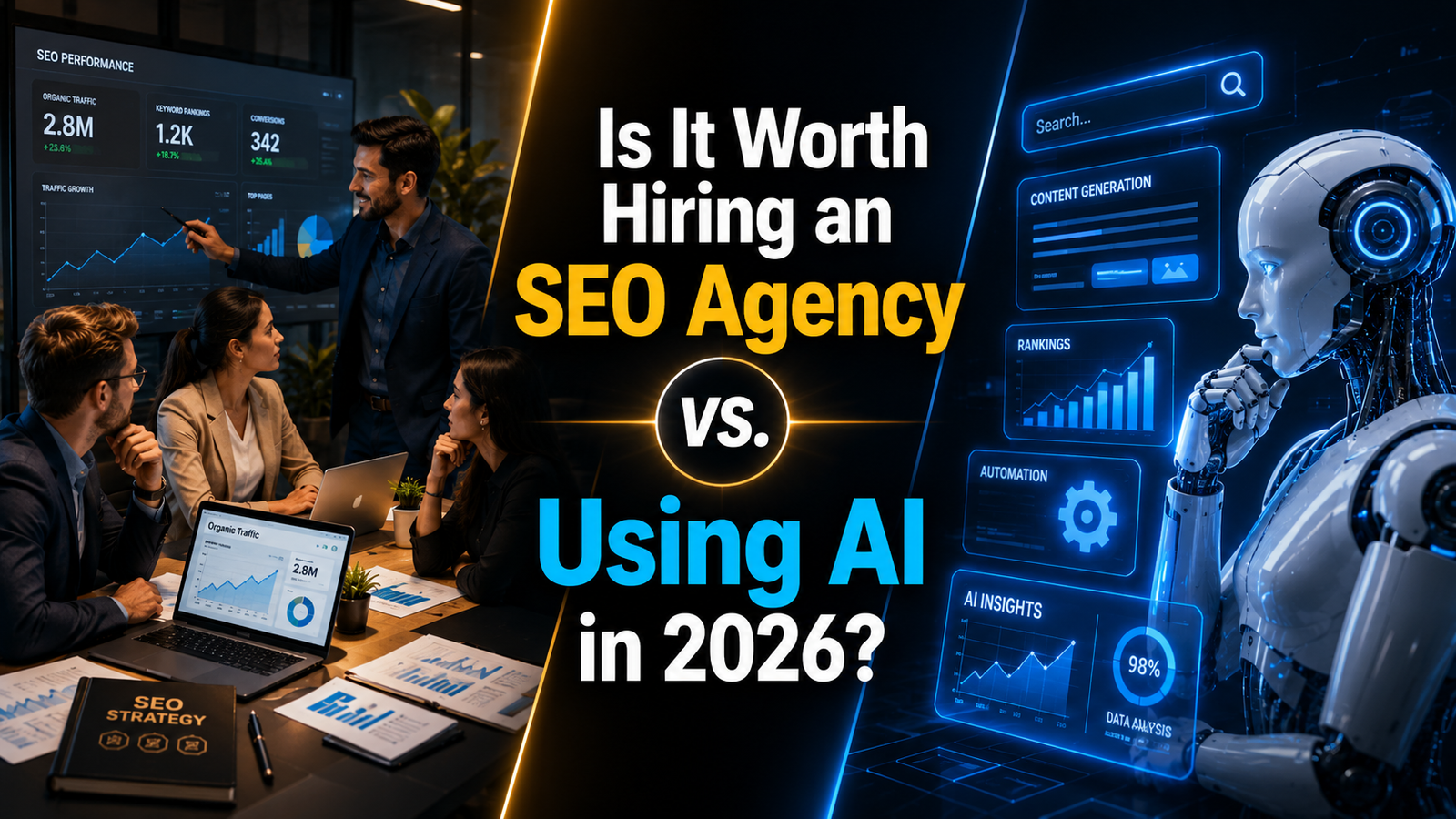
Yes. Hiring an SEO agency remains worth the investment when the agency provides strategy, technical expertise, implementation, original research, authority development and commercial accountability. AI has reduced the cost of repetitive SEO work, but it has not removed the need for expert decision-making.
The comparison has changed in 2026. Businesses are no longer choosing only between doing SEO internally and paying a search engine optimisation agency. They now have a third operating model: AI-assisted SEO, where generative AI, large language models (LLMs), automation systems and human specialists work together.
This matters because AI is already effective at many knowledge-work tasks. A Harvard Business School and Boston Consulting Group field experiment involving 758 consultants found that, for tasks inside AI’s capability frontier, GPT-4 increased task-completion speed by more than 25%, human-rated performance by more than 40%, and task completion by more than 12%. Performance became less reliable when tasks moved outside that technological frontier.
A separate NBER study of 5,179 customer-support agents found a 14% average productivity increase from generative-AI assistance, rising to approximately 34% among novice and lower-skilled workers. The research supports an important distinction: AI frequently increases execution efficiency, while expertise still determines how effectively that output is interpreted and applied.
SEO now follows the same pattern.
The relevant question is therefore not whether AI performs SEO work. It does. The more useful question is which SEO functions deserve automation, which require specialist control, and what combination produces measurable organic-search results.
That starts with the question many businesses now ask before renewing an agency retainer.
Should we just use AI instead of an SEO Agency?
Yes, AI can replace a meaningful portion of SEO production. An SEO agency remains valuable where the business needs strategy, prioritisation, technical implementation, external authority development, risk control and measurable accountability.
AI assistants such as ChatGPT, Claude, Gemini and specialised SEO agents already perform tasks including:
- Keyword classification.
- Search-intent analysis.
- Topic ideation.
- Content-brief creation.
- First-draft production.
- Metadata generation.
- Schema drafting.
- Internal-link suggestions.
- Search Console data summarisation.
- Competitor-page analysis.
These are real efficiency gains. They reduce labour spent processing information.
The distinction appears when the task changes from production to decision-making.
An AI system might identify 300 keywords, 70 weak pages and 45 technical issues. The commercially important work is deciding whether the business earns more value by fixing crawl/indexation problems, rebuilding one service page, creating five new pages, strengthening local entities or reallocating resources elsewhere.
That requires understanding attributes that a generic prompt does not automatically contain: gross margin, lead quality, customer lifetime value, service capacity, geographic reach, conversion rate, competitive strength, implementation resources and business risk.
A practical comparison looks like this:
| SEO function | AI alone | SEO agency | AI + SEO specialist |
|---|---|---|---|
| Keyword processing | Strong | Strong | Strong |
| Content drafting | Strong | Strong | Strong |
| Repetitive analysis | Strong | Strong | Strong |
| Commercial prioritisation | Depends on supplied context | Strong when competent | Strong |
| Complex technical implementation | Limited without expert control | Strong when technically capable | Strong |
| Original first-party evidence | Requires human input | Strong when researched | Strong |
| Digital PR and relationships | Limited | Strong when included | Strong |
| Business accountability | Tool has none | Contractual/service responsibility | Strong |
| Scale | High | Labour-dependent | High |
| Quality assurance | Operator-dependent | Agency-dependent | Human-controlled |
Google itself recognises the distinction. Its current guidance says small local businesses often perform much of their SEO internally, while professional SEOs provide services such as technical advice, content development, keyword research, market expertise and optimisation for generative AI.
AI therefore changes which agency work is valuable, rather than making all professional SEO unnecessary.
That leads directly to the wider question of whether the agency model itself still has a place in an AI-driven search environment.
Are SEO Agencies Still Relevant in the Age of AI?
Yes. SEO agencies remain relevant when they provide capabilities beyond producing keywords, articles and reports. Their value increasingly comes from specialist judgement, implementation, business context and coordination across search systems.
SEO itself is also expanding.
Google reported at I/O 2026 that AI Overviews had more than 2.5 billion monthly active users, while AI Mode had surpassed 1 billion monthly users. Google also states that generative Search remains rooted in its core Search ranking and quality systems.
That means today’s organic-search environment includes:
- Google Search results.
- Google Maps and local results.
- AI Overviews.
- AI Mode.
- ChatGPT Search.
- Gemini.
- Perplexity.
- Other retrieval-augmented generative systems.
The search provider’s role therefore moves beyond producing ten blue-link rankings.
A capable organic search agency, SEO consultancy or search marketing partner now coordinates several connected systems:
- Technical discovery — crawling, rendering, indexing and architecture.
- Relevance — entities, topics, search intent and page purpose.
- Information quality — accuracy, depth, first-party experience and evidence.
- Authority — links, mentions, citations, reviews and reputation.
- Local visibility — Business Profiles, location information and local evidence.
- Generative visibility — accessibility and relevance for AI-driven search interfaces.
- Measurement — impressions, clicks, leads, revenue and AI referrals.
Google’s 2026 generative-search guidance reinforces the continuity between traditional SEO and AI discovery. It states that foundational SEO remains relevant because generative features use Google’s existing Search index and ranking systems through techniques such as retrieval-augmented generation (RAG) and query fan-out.
The relevant question is therefore not whether agencies remain relevant. It is which parts of the agency’s work still require human judgement.
Which parts of SEO do you think AI still can’t do well without human judgment?
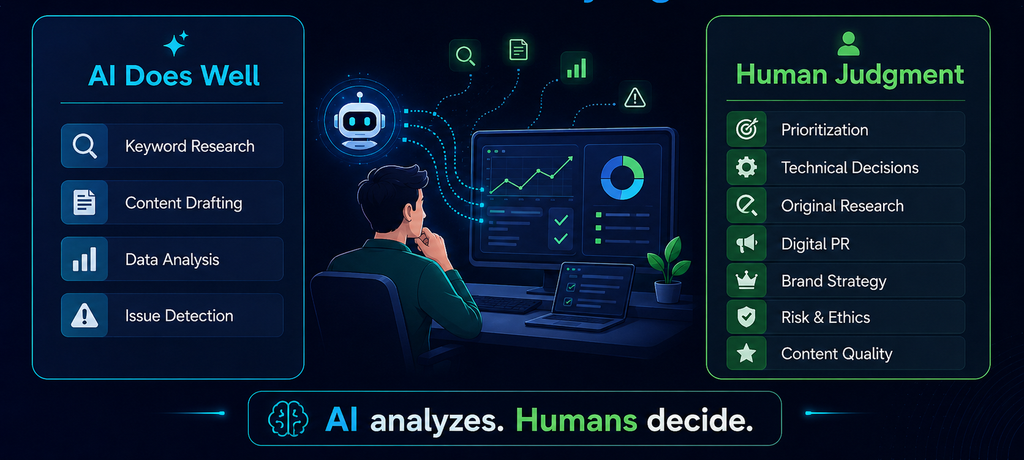
Human judgement remains most valuable in SEO tasks where the correct action depends on incomplete information, business trade-offs, technical risk, original experience or external relationships.
This matches the concept researchers at Harvard call the “jagged technological frontier.” AI performs extremely well on some knowledge tasks while closely related tasks remain outside its reliable performance boundary.
Seven SEO areas sit closer to that human-controlled boundary.
1. Commercial prioritisation
A ranking opportunity is not automatically a business opportunity.
A keyword with 10,000 searches could produce less economic value than a term with 200 searches if the second query attracts higher-value buyers.
The decision requires values such as:
- Search demand.
- Conversion probability.
- Average transaction value.
- Profit margin.
- Geographic feasibility.
- Sales capacity.
- Ranking difficulty.
- Implementation cost.
2. Complex technical SEO
Examples include:
- Site migrations.
- JavaScript rendering problems.
- Faceted navigation.
- International SEO.
- Canonicalisation at scale.
- Ecommerce indexation.
- Large redirect maps.
- Crawl-budget management.
AI produces possible solutions. A technical specialist evaluates side effects before deployment.
3. Causal diagnosis
Traffic declining after a website change does not prove that the change caused the decline.
Diagnosis requires separating variables such as:
- Seasonality.
- Algorithm changes.
- competitor movement.
- tracking errors.
- lost links.
- indexing changes.
- SERP-layout changes.
4. Original knowledge acquisition
AI summarises information already supplied or retrievable. Businesses create defensible information through:
- Customer data.
- Sales-call analysis.
- Internal experiments.
- Case studies.
- Subject-matter expert interviews.
- Original surveys.
- Proprietary datasets.
Google’s 2026 guidance explicitly emphasises non-commodity content containing unique experience and information that a generative model cannot simply reproduce from existing web material.
5. Reputation and authority
Relationships with journalists, trade publications, industry organisations, customers and partners involve human trust and verification.
6. High-risk implementation
Deleting, redirecting or canonicalising hundreds of URLs produces consequences beyond text generation. Human technical governance reduces operational risk.
7. Accountability
An AI assistant has no commercial responsibility for a failed migration, falling lead volume or an incorrect strategy.
These limitations do not make AI ineffective. They identify where automation delivers the highest value when a qualified operator remains in the control loop.
That distinction raises a practical alternative: replacing the agency with a collection of AI and SEO tools.
Any recommendations for something that could replace an agency, maybe an AI tool?
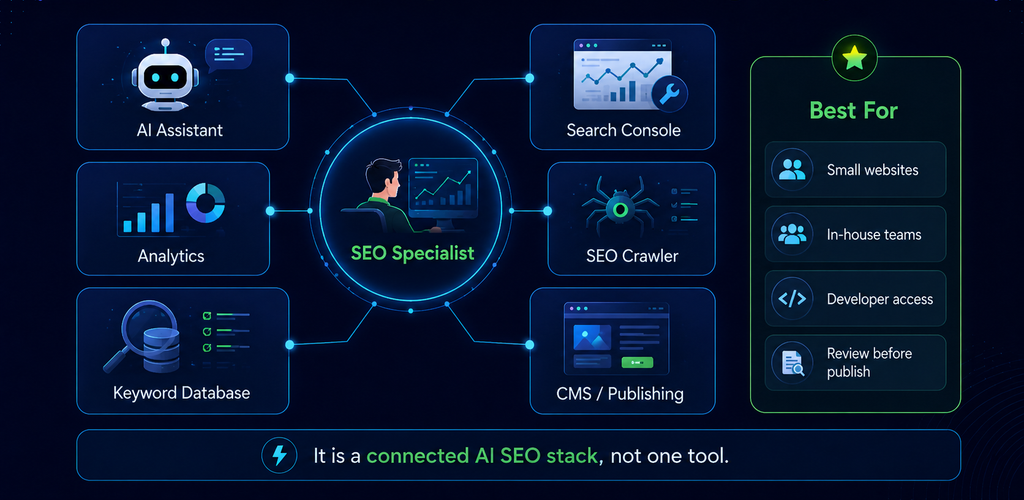
Yes. An AI-assisted internal SEO stack can replace many agency functions when one competent person owns strategy, verification and implementation. No single AI tool reproduces every capability of a full multidisciplinary SEO team.
Think in terms of a system, not one subscription.
A functional internal stack requires at least six capabilities:
| Capability | Function |
|---|---|
| LLM / AI assistant | Research, classification, drafting, analysis |
| Search Console | First-party Google search-performance data |
| Analytics platform | Sessions, engagement, conversions and revenue |
| SEO crawler | Technical crawling and page-level diagnostics |
| Keyword/competitor database | Demand, rankings and competitive research |
| Human operator | Strategy, QA, implementation and accountability |
Google specifically recommends Search Console as a first-party source because third-party SEO tools do not have access to Google’s internal ranking systems.
A tool stack therefore works particularly well for:
- Small websites.
- Businesses with experienced in-house marketers.
- Content sites with established editorial processes.
- Teams with developer access.
- Companies with stable site architecture.
- Businesses able to review every material AI recommendation.
The replacement becomes less complete where SEO depends heavily on:
- digital PR,
- complex development,
- multi-location operations,
- international architecture,
- large ecommerce catalogues,
- reputation management,
- specialist content,
- regulated information.
The cost model is also wider than the software bill.
Internal AI SEO cost = software + operator time + implementation + editorial review + technical QA + monitoring.
That formula explains why some businesses successfully automate most SEO while others create more work than they remove.
The next question is what happens when that system becomes almost completely automated.
Has anyone else here moved away from agencies to a fully automated or AI-focused SEO setup?
Yes. A largely automated SEO workflow is technically feasible in 2026, especially for research, drafting, monitoring and repetitive optimisation. The strongest operating model still retains human governance for material publishing and technical decisions.
A modern automated workflow can follow this sequence:
- Pull Search Console query and page data.
- Detect declining or underperforming URLs.
- Cluster related queries.
- Compare content coverage.
- Generate optimisation recommendations.
- Draft page updates.
- Recommend internal links.
- Validate structured data.
- Send changes for human review.
- Publish approved changes.
- Monitor impressions, clicks and conversions.
- Re-evaluate results after sufficient data accumulates.
The efficiency is real.
The operational risk comes from error propagation. One incorrect assumption repeated across 500 generated pages becomes 500 implementation errors.
Examples include:
- fabricated facts,
- incorrect canonicals,
- invented schema properties,
- duplicated service pages,
- over-optimised anchor text,
- unsupported medical or legal claims,
- irrelevant internal links,
- incorrect redirects.
This is why automation benefits from a human-in-the-loop system rather than unrestricted publishing.
Google’s guidance supports this distinction. Generative AI is useful for research and structuring original material, while automatically generating large numbers of pages without added user value can fall under its scaled content abuse policy.
Automation therefore works best as a production multiplier rather than an evidence substitute.
Content production is the most visible example, which leads to the next question.
Can AI-Generated Content Rank on Google?
Yes. AI-generated and AI-assisted content is eligible to rank on Google when the finished page is accurate, useful, relevant, original enough to add value, and compliant with Google’s Search Essentials and spam policies.
Google’s published guidance focuses on the quality and purpose of the finished content, not simply the software used to produce it. Google specifically identifies generative AI as useful for research and structuring original information.
Four attributes matter more than the AI-versus-human label:
- Accuracy — factual claims are verifiable.
- Quality — the page adequately satisfies the user’s need.
- Relevance — information remains aligned with the query and page purpose.
- Added value — the page contributes more than a rewritten summary of existing results.
This creates an important distinction.
Commodity AI content
A commodity page generally repeats information already present across dozens of sources:
- generic definitions,
- obvious tips,
- unsupported claims,
- surface-level summaries,
- repeated examples.
Non-commodity AI-assisted content
A stronger page integrates AI efficiency with information unavailable from generic prompts:
- original data,
- expert commentary,
- documented experiments,
- customer evidence,
- case-study results,
- first-hand photographs,
- proprietary processes,
- unique datasets.
Google now uses the term “non-commodity content” in its official guidance for generative AI Search and explicitly encourages content that goes beyond information a generative model could easily reproduce.
The Princeton-led GEO research adds another useful scientific perspective. Its benchmark found that content interventions involving citations, statistics and authoritative material improved visibility in generative-engine responses by as much as 40% in the tested conditions. The effect varied by domain, so the 40% figure is not a universal guarantee.
Ranking eligibility therefore brings up a related but different question: Google’s spam enforcement.
Does Google penalize AI-generated content if it is useful and optimized for users?
Useful AI-assisted content remains eligible for Google Search. Google’s enforcement focuses on spam, manipulation and low-value scaled production rather than treating AI authorship itself as a ranking violation.
The distinction is important.
Google states that using generative AI to create numerous pages without adding value can violate its policy against scaled content abuse. It also instructs publishers using automated content to focus on accuracy, quality and relevance.
The risk model therefore looks like this:
| Production method | User value | Policy risk |
|---|---|---|
| Human-written, copied/low-value | Low | High |
| AI-generated, copied/low-value | Low | High |
| Human-written, original/useful | High | Lower |
| AI-assisted, original/useful | High | Lower |
| Mass automated pages built to manipulate Search | Low | High |
The relevant attribute is purpose and output quality, not whether a human physically typed every sentence.
A responsible AI-assisted editorial process contains five controls:
- Verify material factual claims.
- Remove invented citations and statistics.
- Add first-party expertise.
- Check that every section satisfies a distinct user need.
- Review the final page against Google’s spam policies.
This also explains why publishing 1,000 AI articles is not automatically a stronger strategy than publishing 20 evidence-rich pages.
Google’s July 2026 generative Search documentation additionally states that website owners do not need to rewrite content specifically for AI, create special AI markup, create llms.txt for Google Search, or artificially break pages into tiny “AI-readable” chunks.
That policy context becomes especially important when an agency sells a separate “AI search” service.
My SEO agency is trying to charge me extra for ai search they say it will get me seen in chat gpt. Is it worth it?
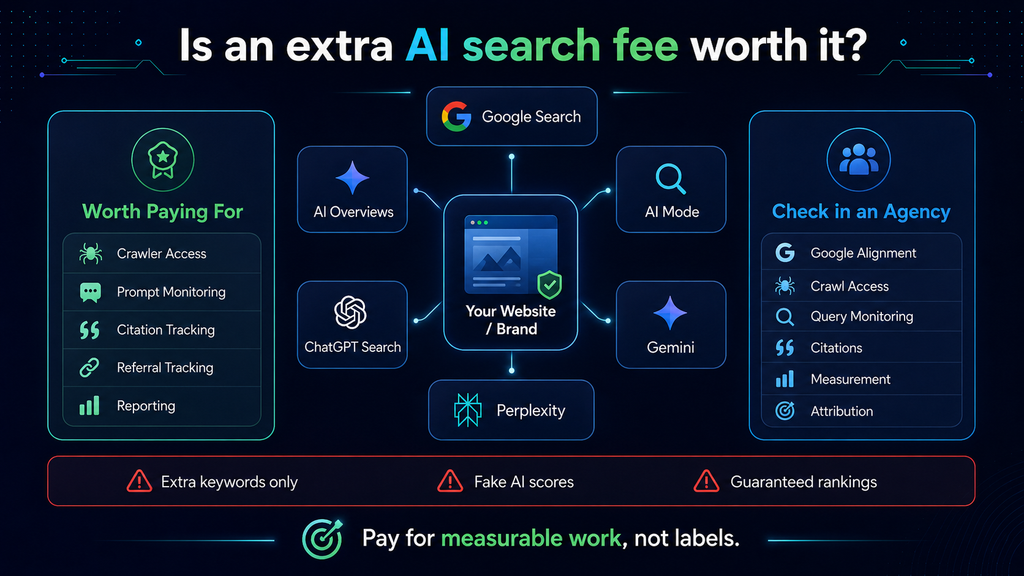
Yes, an additional AI-search fee is defensible when it pays for identifiable work, additional measurement and platform-specific technical requirements. A label such as “GEO” or “ChatGPT SEO” alone does not establish additional value.
Start with the platforms.
For Google, its official position is unusually clear: optimisation for AI Overviews and AI Mode remains fundamentally SEO. Google says businesses do not need special AI markup or superficial AEO/GEO tactics.
For ChatGPT Search, OpenAI states that public websites can appear in search and that publishers interested in being discovered and cited need to allow OAI-SearchBot access. ChatGPT referral traffic can also be tracked in analytics.
An extra fee therefore has stronger justification when the service contains additional deliverables such as:
- AI-search crawler accessibility review.
- OAI-SearchBot configuration.
- AI referral tracking.
- Query-set monitoring across ChatGPT, Gemini and Perplexity.
- Citation and brand-mention analysis.
- Entity and knowledge-gap analysis.
- Original data or expert-source development.
- Content improvements based on generative-search visibility.
- Dedicated reporting.
- Testing and measurement over time.
It has weaker justification when the new package contains only:
- rewritten headings,
- extra keywords,
- generic FAQ generation,
llms.txtsold as a Google ranking tactic,- unverified “AI authority scores,”
- guaranteed ChatGPT rankings.
The market is already economically significant enough to measure, but it remains smaller than conventional search traffic. Ahrefs reported that AI chatbots represented approximately 0.28% of total traffic across a dataset of 74,752 websites in March 2026, while Google represented 28.12%.
Another 2026 analysis of 6.77 million LLM-driven sessions reported that ChatGPT accounted for 92.4% of the analysed AI referral traffic.
Those numbers support investment in measurement without treating conventional organic search as obsolete.
The next question is therefore how to evaluate an agency claiming expertise in this new search layer.
What do you usually check for SEO agencies for AI visibility?
Evaluate an AI-search agency on verifiable methodology, platform-specific knowledge, first-party measurement and business outcomes rather than terminology such as GEO, AEO or LLM optimisation.
Eight checks provide a useful evaluation framework.
1. Google alignment
Compare the agency’s recommendations with Google’s current generative-search guidance.
Google explicitly warns businesses to evaluate third-party AEO/GEO advice against official documentation.
2. Crawl accessibility
Verify that major search and AI crawlers have appropriate access.
For ChatGPT Search, this includes OAI-SearchBot.
3. Query-level monitoring
Ask which prompts or query classes the agency monitors.
Examples include:
- category discovery,
- brand comparisons,
- local recommendations,
- problem-solving queries,
- product/service recommendations.
4. Citation tracking
Visibility and citation are different metrics.
A brand can be mentioned without receiving a clickable citation.
5. Referral measurement
Measure traffic from identifiable AI referral sources where available.
6. Search Console measurement
Google introduced dedicated generative AI performance reporting in Search Console in June 2026 for a subset of websites during rollout. The reports include visibility from features such as AI Overviews and AI Mode.
7. Original-information strategy
Look for plans involving:
- proprietary data,
- first-party research,
- expert commentary,
- reviews,
- case studies,
- local evidence.
8. Commercial attribution
The agency needs a method for connecting visibility with:
- qualified visits,
- enquiries,
- registrations,
- calls,
- opportunities,
- revenue.
These checks move the evaluation from “Do you offer GEO?” to “What exactly changes, how is it measured, and what business value does it produce?”
That measurement standard leads naturally to the type of results that distinguish one agency from another.
What made them stand out, and did you see real results beyond just higher rankings?
Real business outcomes provide stronger evidence of SEO value than ranking counts alone. Rankings remain useful diagnostic metrics, but leads, revenue, qualified demand and discoverability reveal whether the visibility is commercially meaningful.
A complete SEO measurement model uses several layers.
| Measurement layer | Examples | What it explains |
|---|---|---|
| Visibility | impressions, rankings, AI mentions | Whether users can discover the brand |
| Engagement | clicks, sessions, engaged visits | Whether visibility produces visits |
| Conversion | calls, forms, trials, bookings | Whether visitors act |
| Qualification | qualified leads, opportunities | Whether demand fits the business |
| Commercial | sales, pipeline, revenue | Whether SEO creates economic value |
An agency stands out when it connects those layers rather than reporting the first one alone.
For example:
Ranking from position 18 to position 4 is an SEO result.
But:
Ranking from position 18 to 4 generated 90 additional organic visits, 11 enquiries, 6 qualified opportunities and 2 sales worth $18,000.
is a commercial search result.
Generative search introduces additional measurements:
- AI Overview visibility.
- AI Mode impressions.
- ChatGPT referral sessions.
- cited URLs.
- brand mentions.
- source frequency.
- AI-assisted conversions.
OpenAI confirms that publishers allowing OAI-SearchBot can identify ChatGPT referral traffic through analytics platforms such as Google Analytics.
The next evaluation step is the opposite side of proof: identifying providers producing high volumes of AI-generated work without equivalent quality control.
What are the red flags that an agency is just using GPT to churn and burn?
The clearest red flag is high-volume production without evidence, verification, differentiation or a documented reason for publishing each asset.
AI use itself is not the red flag. Uncontrolled AI use is.
Look for these 10 warning signs:
- Hundreds of pages proposed before demand is mapped.
- No explanation of which query or customer problem each URL serves.
- Generic content that repeats the current SERP.
- Statistics without primary sources.
- Invented quotations, citations or case studies.
- Pages published without specialist review.
- Identical templates across unrelated services or locations.
- No Search Console or analytics validation.
- Reporting based mainly on article counts or “AI scores.”
- Guaranteed Google or ChatGPT rankings.
Google explicitly states that automatically generating many pages without added value risks violating its scaled content abuse policy.
Google also warns that no SEO company can guarantee a number-one Google ranking and advises businesses to be cautious when providers refuse to explain their methods.
There is also a semantic-quality problem.
If every competitor asks an LLM the same prompt and publishes essentially the same answer, information gain approaches zero. The business adds another commodity document rather than creating new evidence.
A stronger agency uses GPT, Claude, Gemini or another LLM for tasks where automation creates efficiency, then adds sources unavailable to the generic model:
- internal business data,
- customer interviews,
- SME commentary,
- photos,
- experiments,
- case-study numbers,
- unique examples,
- proprietary processes.
That is much closer to Google’s current definition of non-commodity content.
Avoiding poor providers is only half of the selection problem. The other half is identifying evidence that creates confidence before signing.
If you’ve hired an SEO agency recently, what made you confident enough to move forward?
Confidence comes from verifiable evidence, transparent methodology, relevant expertise and clear measurement rather than promises about rankings.
Google’s own hiring guidance provides an unusually useful vendor-evaluation framework.
It recommends asking potential SEO providers about:
- previous work,
- success stories,
- Search Essentials compliance,
- expected results,
- measurement,
- industry experience,
- geographic experience,
- communication,
- recommended changes and reasoning.
For 2026, expand that due diligence to 10 points:
- Relevant case studies
Results relate to a comparable business model, geography or search problem. - Named deliverables
The proposal identifies technical work, content, authority, local SEO, analytics and AI-search work separately. - Clear prioritisation
The agency explains why one action happens before another. - Evidence-backed recommendations
Major recommendations reference Search Console data, crawling evidence, SERP analysis or official documentation. - Senior expertise
The people responsible for strategy are identifiable. - Implementation ability
Recommendations translate into actual website changes. - AI transparency
The provider explains where generative AI enters research, writing, analysis and QA. - No guaranteed rankings
Search outcomes remain probabilistic. - Conversion measurement
Leads and sales sit beside ranking metrics. - Business understanding
The agency asks about margins, priority services, locations, customers and commercial goals.
Google specifically states that an SEO interested in the business needs to understand what makes it unique, its competitors, how customers find it and how Search contributes to the organisation.
These evaluation criteria lead to the commercial question behind the entire debate: whether the agency fee produces enough value to justify the investment.
Are agencies still worth the investment in 2026?
Yes. An SEO agency remains worth the investment when the expected value of better strategy, implementation, risk reduction and organic acquisition exceeds the cost of the engagement.
Agency pricing is significant enough that this calculation matters.
Ahrefs’ survey of 439 SEO providers reported:
- $2,917 per month average SEO cost overall.
- $3,209 per month average agency retainer.
- $1,348.63 per month average freelancer retainer.
- $1,557 per month average local SEO cost.
- $111 per hour average hourly SEO rate.
- 78.2% of respondents using monthly retainers.
Those figures describe the surveyed market, not a universal price requirement.
The relevant ROI calculation is:
SEO ROI = (organic-search profit attributable to SEO − SEO cost) ÷ SEO cost × 100
For example:
- Monthly SEO investment: $3,000
- Additional qualified leads: 20
- Lead-to-sale conversion rate: 20%
- Additional sales: 4
- Gross profit per sale: $2,000
- Additional gross profit: $8,000
- SEO investment: $3,000
- Net incremental return before other costs: $5,000
The investment becomes less attractive when a business pays $3,000 per month for activity that an internal marketer plus AI already performs effectively.
It becomes more attractive where the agency contributes:
- specialist technical expertise,
- faster execution,
- high-value content,
- authority acquisition,
- local-market knowledge,
- analytics,
- conversion improvement,
- strategic prioritisation.
This is the economic change AI creates.
AI compresses the market value of repetitive output. Expertise, evidence and accountability retain more value.
The final decision therefore does not need to be framed as technology versus humans. The more accurate comparison is between three operating models.
What actually delivers results now — AI, agencies, or a mix of both?
For most growth-focused businesses, the strongest model is a combination of AI efficiency and expert human governance. AI handles high-volume information processing; experienced professionals control strategy, verification, implementation, original evidence and commercial decisions.
Research outside SEO supports this hybrid model.
Harvard’s BCG experiment identified two successful patterns of human-AI work. Researchers called them “Centaurs,” who divided tasks between human and machine, and “Cyborgs,” who integrated AI continuously throughout their workflow.
SEO has the same operational choices.
| Model | Best use | Main strength | Main constraint |
|---|---|---|---|
| AI-only SEO | Simple sites with skilled internal operators | Low production cost and speed | Requires internal judgement |
| Agency-led SEO | Complex organisations with limited internal SEO resources | Expertise and execution capacity | Higher financial cost |
| AI + specialist | Businesses seeking efficiency plus expertise | Scale with human control | Requires disciplined processes |
A high-performing hybrid workflow separates responsibilities clearly.
AI is effective for
- Processing large datasets.
- Categorising search queries.
- Summarising SERPs.
- Creating initial briefs.
- Drafting routine content.
- Generating code or schema candidates.
- Identifying patterns.
- Reformatting information.
- Producing reporting summaries.
- Monitoring repeatable signals.
Human specialists remain responsible for
- Defining search strategy.
- Prioritising commercial opportunities.
- Verifying evidence.
- Interviewing subject-matter experts.
- Managing complex technical changes.
- Building external relationships.
- Developing original evidence.
- Reviewing brand and factual accuracy.
- Measuring business outcomes.
- Accepting responsibility for implementation.
Google’s own 2026 guidance effectively points toward the same conclusion. Traditional SEO fundamentals continue to matter for generative Search. Valuable non-commodity information matters. Technical accessibility matters. Search Console measurement matters. Superficial GEO tricks do not replace those foundations.
OpenAI similarly states that public websites are eligible to appear in ChatGPT Search, with OAI-SearchBot accessibility helping content become discoverable, surfaced and cited.
AI therefore changes how SEO work is performed, not the commercial objective of SEO.
The final distinction is straightforward:
Do not pay an SEO agency merely for labour that generative AI has made inexpensive. Pay for validated strategy, specialist execution, original information, technical governance, authority development and measurable business outcomes.
AI supplies speed.
SEO expertise determines direction.
The combination becomes most valuable when both are connected to the same measurable objective: making a business easier to discover across Google and generative search, then turning that visibility into qualified commercial demand.
Frequently Asked Questions
Yes. ChatGPT can support keyword research, content planning, page optimisation, schema drafting, internal linking and reporting for a small business. Human review remains important for technical changes, factual verification, local-market decisions and commercial prioritisation.
Yes. AI software usually has a lower direct cost than an SEO agency, but software price is only one part of the total cost. Businesses also need to account for operator time, implementation, quality control, content review, technical expertise and monitoring.
SEO agency pricing commonly ranges from hundreds to several thousand dollars per month, depending on website size, competition, market coverage and required services. Ahrefs’ survey of 439 SEO providers reported an average agency retainer of approximately $3,209 per month.
AI can shorten research, analysis and content-production time, but it does not eliminate the time required for Google to crawl, index, evaluate and rank pages. Ranking growth can still take several months because search performance depends on competition, website authority, technical condition and content quality.
Yes. AI can analyse technical SEO data and generate recommendations for issues such as redirects, canonical tags, schema, indexation and internal linking. Complex changes involving migrations, JavaScript rendering, faceted navigation or large-scale URL changes require stronger specialist validation.
AI can identify prospects, analyse websites, draft outreach and organise link-building campaigns, but it cannot fully replace relationship-based authority building. High-quality backlinks often depend on original research, digital PR, partnerships, expert contributions and editorial relationships.
No. Using AI for SEO does not violate Google’s guidelines by itself. Google focuses on whether content provides value and complies with its spam policies; large-scale automated content created primarily to manipulate rankings can violate its scaled content abuse policy.
Businesses need visibility across generative search, but Google states that established SEO fundamentals continue to apply to AI Overviews and AI Mode. GEO and AEO activities add value when they improve entity clarity, source authority, original information, technical accessibility and measurable AI-search visibility rather than simply relabelling existing SEO work.
AI referral traffic can be measured through analytics platforms when the referring source is identifiable. Businesses can monitor referral sessions from ChatGPT and other AI platforms, while Google Search Console provides data for Google Search visibility and is expanding reporting for generative-search experiences.
An in-house AI SEO model works well when the business already has SEO expertise, implementation capacity and enough time to manage quality control. An agency is more suitable when the business needs multidisciplinary expertise across technical SEO, content, authority, local search, analytics and strategy.
A hybrid model combining AI automation with human SEO expertise provides the strongest balance of speed, scale, quality control and commercial judgement for many businesses. AI handles repetitive processing while specialists control strategy, verification, implementation and accountability.


