
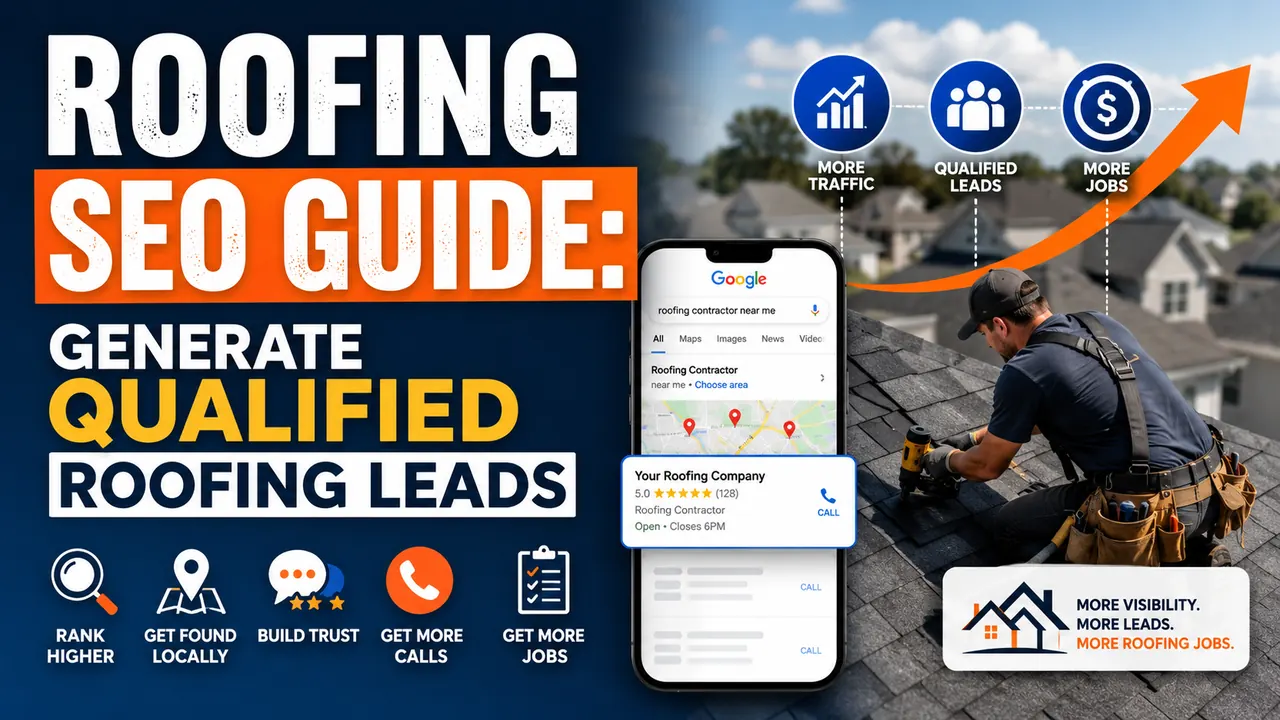
Roofing SEO connects people searching for roof repair, replacement, inspections, and commercial roofing with a qualified local contractor. The system combines search-demand analysis, service pages, local visibility, business evidence, technical accessibility, and lead tracking.
The objective is not to attract every person searching for roofing information. It is to attract property owners and commercial decision-makers who need a service the company provides within a market it can profitably serve.
Google’s current content guidance prioritizes original, useful, people-first information. It warns against publishing content primarily to attract search traffic without adding first-hand expertise, analysis, or practical value.
The commercial sequence is:
Roofing problem → search query → suitable page → trusted contractor → call or form → inspection → estimate → booked job
Every roofing SEO activity must strengthen one stage in this sequence.
1. Which Roofing SEO Opportunities Should You Target First?
Target roofing searches that combine strong service relevance, profitable job value, genuine geographic coverage, available capacity, and enough business evidence to support the page. Search volume alone does not establish commercial value.
A roofing company can rank for a query and still lose money from it. The problem occurs when the query attracts the wrong service, location, customer, or project value.
Use the following Roofing Opportunity Score before approving a keyword cluster or landing page. This is a planning model, not a Google ranking factor.
| Evaluation factor | Weight | Decision question |
|---|---|---|
| Service relevance | 25% | Does the company perform this service regularly? |
| Profit potential | 25% | Can the service produce an acceptable gross margin? |
| Geographic fit | 20% | Can the company serve the location efficiently? |
| Operational capacity | 15% | Can the company respond, inspect, quote, and deliver? |
| Evidence availability | 15% | Are projects, reviews, photographs, and expertise available? |
Score each factor from 0 to 100. Multiply the score by its weight.
Illustrative example
A roofing company is considering a page for commercial roof maintenance in Dallas.
| Factor | Score |
|---|---|
| Service relevance | 90 |
| Profit potential | 85 |
| Geographic fit | 90 |
| Operational capacity | 70 |
| Evidence availability | 80 |
| Weighted opportunity score | 84.25 |
A score above 75 indicates a strong internal priority. A score below 50 indicates that the company may lack service fit, market access, operational capacity, or evidence.
Do not create pages merely because a competitor has them.
2. How Should Roofing Keywords Be Mapped to Pages?
Map each keyword cluster to the page that best satisfies its search intent. One strong page can target several close query variations when those queries require the same information and commercial action.
Roofing keywords are created by combining several entities:
Service + problem + roof system + customer + location + urgency + action
Examples include:
- Emergency roof leak repair near me
- Metal roof replacement in Dallas
- Commercial TPO roof inspection
- Hail-damage roofing contractor
- Residential roof replacement estimate
- Warehouse roof-maintenance company
The following map prevents keyword cannibalization and irrelevant page creation.
| Search query | Intent | Correct page | Primary action |
|---|---|---|---|
| Emergency roofer near me | Urgent transactional | Emergency Roof Repair | Call now |
| Roof leak repair Dallas | Local transactional | Roof Leak Repair in Dallas | Request inspection |
| Roof replacement cost | Commercial investigation | Roof Replacement Cost Guide | Request estimate |
| Metal versus asphalt roof | Comparison | Roofing Material Comparison | Review options |
| Commercial roof maintenance | B2B transactional | Commercial Roof Maintenance | Book consultation |
| Signs of hail damage | Problem-aware | Hail Damage Guide | Request inspection |
Do not create separate pages for “roof leak repair,” “leaking roof repair,” and “repair a roof leak” when the user needs the same service and answer.
Create another page only when the customer, service scope, evidence, and conversion action change materially.
3. What Pages Does a Roofing Website Actually Need?
A roofing website needs pages for commercially important services, legitimate service areas, roof systems, customer problems, completed projects, business evidence, and high-value decision questions.
“Roofing service” is the hypernym. Its hyponyms include roof repair, roof replacement, roof inspection, emergency roofing, storm-damage repair, maintenance, restoration, and commercial roofing.
A practical structure is:
Homepage
├── Residential Roofing
│   ├── Roof Repair
│   ├── Roof Replacement
│   ├── Emergency Roof Repair
│   └── Roof Inspection
├── Commercial Roofing
│   ├── Commercial Roof Repair
│   ├── Roof Maintenance
│   ├── TPO Roofing
│   └── Roof Coatings
├── Roofing Systems
│   ├── Asphalt Shingles
│   ├── Metal Roofing
│   ├── Tile Roofing
│   └── Flat Roofing
├── Service Areas
├── Projects
├── Reviews
├── Resources
├── About
└── Contact
Residential and commercial roofing require separate pathways when the company serves both markets.
A homeowner may need a replacement estimate and financing information. A facility manager may require condition reporting, preventive maintenance, safety documentation, budget planning, and a commercial consultation. Combining both audiences on one general page weakens relevance.
Page-creation rule
Approve a new page only when all four conditions are present:
- The query represents distinct intent.
- The company provides the service.
- The company can supply unique evidence.
- The page has a defined conversion action.
A page without these conditions increases maintenance cost without creating meaningful coverage.
4. What Makes a Roofing Service Page Non-Commodity?
A non-commodity roofing service page explains how the company diagnoses, scopes, performs, verifies, and documents the specific service. It uses real project evidence instead of generic statements about quality and experience.
A roof-repair page must answer more than “we repair roofs.”
It must explain:
- Which roofing problems the service addresses
- Which roof systems the company repairs
- How the inspection identifies the failure mechanism
- Which conditions affect repairability
- When replacement may be required
- Which pricing variables affect the estimate
- Which evidence supports the company’s capability
- What happens after the customer makes contact
Minimum evidence standard
A commercial service page should contain at least four forms of first-party evidence:
| Evidence type | Roofing example |
|---|---|
| Operational evidence | The documented inspection and repair process |
| Visual evidence | Original damage and completed-project photographs |
| Technical evidence | Materials, roof systems, failure points, and scope criteria |
| Reputation evidence | Relevant customer reviews or project references |
| Qualification evidence | Licences, insurance, training, or manufacturer credentials |
| Local evidence | Projects or customer experience within the service market |
Do not claim that every roof leak requires the same repair. A ceiling stain is a symptom. The failure may involve flashing, penetrations, damaged coverings, drainage, membrane seams, or adjoining building components.
That distinction demonstrates roofing knowledge and prevents misleading content.
5. When Does a City Need Its Own Roofing Location Page?
Create a roofing location page only when the company genuinely serves the area and can provide unique local evidence. Replacing one city name with another does not create a useful local page.
Google defines doorway abuse as creating similar regional or city pages that funnel users toward the same destination without providing adequate independent value. Google also classifies large quantities of unoriginal pages created primarily to manipulate rankings as scaled content abuse.
Use this Location Page Qualification Score before publication.
| Qualification factor | Weight |
|---|---|
| Genuine operational coverage | 25% |
| Commercial search demand | 20% |
| Completed local projects | 20% |
| Local reviews or references | 15% |
| Service profitability | 10% |
| Distinct local information | 10% |
A location scoring below 65 should normally remain part of a broader service-area page until stronger evidence exists. This threshold is an internal editorial rule, not a Google requirement.
What creates genuine local value?
A useful roofing location page can contain:
- Services available in the area
- Roof systems common to the market
- Relevant weather exposure
- Completed local projects
- Customer reviews from the area
- Property types served
- Response and inspection procedures
- Applicable permit or compliance context
- Original local photographs
Do not insert landmarks, neighbourhood names, or weather statements unless they affect the roofing service or help the customer make a decision.
6. How Do Google Business Profile, Reviews, and the Website Work Together?
Google Business Profile confirms the local business entity, the website explains its services, and reviews document customer experience. Conflicting information weakens user confidence and creates entity ambiguity.
Google states that local results are mainly influenced by relevance, distance, and prominence. Complete business information can improve relevance. Links, reviews, and review ratings contribute to prominence. Distance remains dependent on the searcher’s location.
The company cannot remove the distance variable by creating more city pages.
Local entity consistency model
| Business attribute | Google Business Profile | Website | Other platforms |
|---|---|---|---|
| Business name | Real-world name | Same brand name | Same identity |
| Primary service | Correct category | Service pages | Relevant listings |
| Address or service area | Accurate | Clearly explained | Consistent |
| Telephone number | Current | Click-to-call | Current |
| Operating hours | Current | Contact information | Current |
| Reviews | Customer feedback | Selected proof | Platform-specific |
| Project evidence | Photos and updates | Detailed case studies | Relevant mentions |
Google requires businesses to use the name recognized in the real world and maintain an accurate address or service area. Adding unnecessary services or locations to the business name can create policy problems.
Review system
Request an honest review after the customer can evaluate the completed service. Suitable moments include repair completion, replacement handover, final inspection, or a commercial maintenance milestone.
Do not request only positive reviews. Do not provide review wording. Do not offer compensation for a specific rating.
A useful review describes an actual experience, such as inspection clarity, communication, punctuality, cleanup, workmanship, documentation, or issue resolution.
7. Which Roofing Content Produces Commercial Value?
Roofing content produces commercial value when it resolves a customer decision and leads naturally to an inspection, estimate, consultation, or service page. Traffic without a service pathway has limited acquisition value.
Use four connected content clusters.
Roofing-problem content
Address roof leaks, missing shingles, cracked tiles, damaged flashing, ponding water, membrane failure, hail damage, and wind damage.
The next step is normally an inspection or repair page.
Roofing-decision content
Address repair versus replacement, replacement cost, material selection, warranties, financing, contractor selection, and insurance documentation.
The next step is normally an estimate or consultation.
Roofing-system content
Address asphalt shingles, metal roofing, tile, slate, TPO, EPDM, PVC, coatings, and low-slope roofing.
The next step is normally a material-specific service page.
Commercial roofing content
Address preventive maintenance, condition reports, roof-access planning, drainage, coatings, capital budgeting, facility management, and long-term system performance.
The next step is normally a commercial consultation.
Content approval test
Do not publish an article until it answers:
- Which customer problem does this resolve?
- Which service does it support?
- Which entity relationship does it explain?
- Which first-party evidence will it contain?
- Which page should the reader visit next?
Google’s people-first guidance specifically asks whether content supplies original information, demonstrates first-hand expertise, maintains a clear site purpose, and leaves the reader able to achieve a goal.
8. Which SEO Problems Should Roofers Fix First?
Fix problems according to revenue risk, not the length of the audit report. A blocked service page, broken call button, or incorrect business profile normally deserves attention before a minor metadata improvement.
Use this implementation priority matrix.
| Priority | Condition | Roofing example |
|---|---|---|
| Critical | Prevents discovery or contact | Important service page is noindexed |
| High | Weakens commercial relevance | Roof replacement service has no dedicated page |
| High | Creates policy or entity risk | Keyword-stuffed Google Business Profile name |
| High | Prevents attribution | Calls are not tracked |
| Medium | Weakens trust or usability | No project evidence on a service page |
| Medium | Reduces page performance | Oversized project gallery |
| Low | Limited commercial effect | Minor wording inconsistency in old blog metadata |
Technical SEO remains necessary, but it is a supporting system.
Verify that profitable pages:
- Return a successful status code
- Can be crawled and indexed
- Appear in the XML sitemap
- Have appropriate canonical tags
- Receive internal links
- Work on mobile devices
- Load without major visual instability
- Contain working call and form actions
Structured data can describe the business, services, breadcrumbs, images, and videos. It cannot replace missing content, weak evidence, or inaccurate business information.
9. How Should Roofing Leads Be Qualified?
A roofing conversion should be classified by service fit, location, property type, urgency, project value, and sales outcome. A form submission is not automatically a qualified lead.
Use the following classification model.
| Lead type | Example | Acquisition value |
|---|---|---|
| Qualified emergency | Active leak inside the service area | High |
| Qualified replacement | Aging roof requesting an estimate | High |
| Qualified commercial | Facility manager requesting an inspection | High |
| Outside service area | Valid project beyond operational coverage | Low |
| Wrong service | Service the company does not provide | None |
| Existing customer | Warranty or support request | Not new acquisition |
| Supplier | Product or partnership enquiry | None |
| Recruitment | Employment request | None |
| Spam | Automated or deceptive submission | None |
Match the CTA to the searcher
Emergency pages need a visible click-to-call action.
Replacement pages need an estimate or inspection request.
Commercial pages need a consultation or project-discussion action.
Informational guides need contextual links to the relevant service rather than an aggressive repeated CTA.
The sales process must record whether the enquiry was:
Connected → qualified → inspected → estimated → won or lost
Without these stages, SEO reporting cannot distinguish lead volume from business value.
10. How Is Roofing SEO ROI Calculated?
Roofing SEO ROI Calculator
Change any input below. The connected conversations, qualified leads, inspections, estimates, booked jobs, profit and ROI will all recalculate immediately.
Enter Your Funnel Assumptions
Use your real CRM and call-tracking conversion rates where available.
11. What Should a Roofing Company Complete in 90 Days?
The first 90 days should establish control, repair critical barriers, build commercially important pages, strengthen local evidence, and connect SEO activity with lead and sales data.
Days 1–30: Establish control
Secure the domain, website, Google Business Profile, Search Console, GA4, call tracking, and CRM.
Record current rankings, pages, calls, qualified leads, inspections, estimates, and booked jobs.
Complete the Roofing Opportunity Score for major services and markets.
Output: baseline report, keyword-to-page map, account register, and prioritized issue list.
Days 31–60: Build commercial relevance
Improve the core service pages. Consolidate overlapping URLs. Create only qualified location pages. Correct business information. Add internal links, project evidence, review workflows, and working conversion tracking.
Output: complete service structure, validated local information, and measurable calls and forms.
Days 61–90: Strengthen evidence and performance
Publish decision-focused supporting content. Build project case studies. Acquire relevant local or industry mentions. Review geographic visibility, call quality, inspection rates, estimate rates, and won jobs.
Output: commercial performance review and the next 90-day implementation plan.
A 90-day plan is an execution period. It is not a ranking guarantee.
12. How Do You Choose a Roofing SEO Provider?
Select a provider that can explain how search demand becomes qualified roofing revenue. Reject providers that report activities without connecting them to services, locations, calls, inspections, estimates, and booked jobs.
Require clear answers to these questions:
- How will profitable services be prioritized?
- How will keywords be assigned to pages?
- How will location pages avoid doorway-page patterns?
- Who owns every account?
- Who verifies roofing accuracy?
- How will calls be classified?
- How will leads be connected with estimates and jobs?
- How will links and mentions be acquired?
- Which tasks require the roofing company?
- What happens when the data contradicts the strategy?
Warning signs include guaranteed rankings, fixed backlink quantities, mass city pages, fake review systems, keyword-density targets, no call tracking, traffic-only reporting, and agency ownership of core accounts.
Roofing SEO FAQs
Does every roofing service need a separate page?
No. A separate page is required only when the service has distinct search intent, scope, evidence, commercial value, and a defined customer action.
How many city pages should a roofer create?
Create pages only for genuine markets supported by operational coverage, demand, projects, local evidence, and unique information.
Can one roofing office rank across an entire city?
Visibility can vary across the city because Google considers distance in local results. Content and profile optimization cannot eliminate physical proximity.
Do roofers need blog content?
Roofers need supporting content when customers research problems, materials, costs, maintenance, insurance, or contractor selection before requesting a service.
Do more website pages produce more leads?
No. Additional pages create value only when they satisfy distinct demand and contain useful evidence; unoriginal pages created at scale can violate Google’s spam policies.
How long does roofing SEO take?
Technical corrections can produce early changes, but sustained local visibility and qualified lead growth depend on competition, location, evidence, implementation speed, reviews, authority, and website condition.
Build a Roofing Lead System, Not a Larger Website
A roofing company does not need the highest possible page count. It needs the correct pages for profitable services and genuine markets.
The complete system is:
Commercial demand → suitable page → local business evidence → trusted contractor → qualified contact → inspection → estimate → booked job → measured gross profit
Audit the system in that order.
Request a Roofing SEO Audit to identify missing service pages, weak location targeting, Google Business Profile inconsistencies, technical barriers, unqualified traffic, and organic leads that are not connected with booked revenue.


