Pest-control SEO connects a pest-management company’s services, service areas, website, Google Business Profile, reviews, and local authority with searches that can produce calls, inspections, treatments, and recurring contracts.
The final outcome is not a higher keyword position. It is a qualified customer who contacts the business, lives inside the service area, needs a service the company provides, and books profitable work.
That distinction matters in pest control. A company can reach the first page for a term such as “pest control in Sydney” and still receive too few calls. Paid advertisements, local listings, review-heavy competitors, slow mobile pages, and unanswered phones can block the path between visibility and revenue.
One pest-control operator described the problem directly: the rankings improved, but the clicks and calls still looked awful. Another had paid several SEO companies for years without being able to connect the reports with positive business results. These are not objections to SEO itself. They are objections to measuring the wrong outcome.
This guide explains how to build an owned customer-acquisition system around:
- Google Search
- Google Maps
- Pest-specific service pages
- Genuine location coverage
- Reviews and local evidence
- Mobile calls and booking forms
- Call, job, and revenue attribution
The page is written for local pest-control owners, managers, and marketing teams. The primary business objective is more qualified local enquiries, including phone calls, quote requests, inspection bookings, and recurring pest-management agreements.
What Is Pest-Control SEO?
Pest-control SEO is the process of improving a pest-management company’s visibility in Google Maps and organic search for queries that can produce qualified calls, inspections, treatments, and recurring service contracts.
Search engine optimization is the broader marketing discipline. Local SEO is its geographic branch. Pest-control SEO is a narrower application that accounts for pest species, treatment methods, service urgency, property types, seasonal activity, customer safety, and technician availability.
The phrase contains three connected concepts. Pest control defines the service domain. SEO defines the discovery process. Guide defines the instructional purpose.
A complete pest-control SEO system includes five operating layers:
| Operating layer | Primary function | Pest-control examples |
| Search demand | Identify what customers need | Termite inspection, rat removal, bed bug treatment |
| Search visibility | Appear in relevant results | Google Maps, local results, organic listings |
| Website relevance | Match the query with a useful page | Pest page, location page, commercial service page |
| Conversion | Make contact simple and credible | Click-to-call button, inspection form, quote request |
| Attribution | Connect the enquiry with business value | Qualified call, booked treatment, recurring contract |
The system moves through one context vector:
Pest-control SEO → local visibility → relevant pest-and-location search → appropriate landing page → trust formation → contact → booked job → revenue.
That sequence must guide the website from its homepage to its final conversion action. Traffic that never enters this sequence has limited commercial value.
What does pest-control SEO include?
Pest-control SEO includes local search optimization, website architecture, pest-specific content, location relevance, technical accessibility, reputation management, authority building, conversion optimization, and performance measurement.
These activities are related, but they are not synonyms.
A Google Business Profile represents the company in local search. A pest service page explains a treatment. A location page establishes geographic relevance. A review provides customer evidence. A backlink transfers external authority. A call-tracking system measures a conversion.
Treating these elements as separate monthly tasks produces fragmented results. Connecting them creates a search-to-booking system.
What should pest-control SEO produce?
The primary performance measures are qualified calls, inspection requests, booked treatments, recurring agreements, cost per booked job, and organic revenue.
Keyword rankings remain useful diagnostic measurements. They show whether a page has gained or lost visibility. They do not show whether the company can serve the caller, whether the enquiry became an appointment, or whether the treatment was profitable.
A useful report must therefore distinguish:
- A website visit from a lead
- A lead from a qualified lead
- A qualified lead from a booking
- A booking from completed revenue
- One-time revenue from recurring contract value
This outcome-based position reflects the concerns of pest-control owners who have received traffic and ranking reports without evidence of booked work.
Why Is Pest-Control SEO So Competitive?
Pest-control SEO is competitive because local operators compete with national chains, paid advertisements, Google Maps listings, high-review businesses, seasonal demand, and urgent customer behavior within the same search results.
A customer with an active infestation does not always conduct a long evaluation. The person may call the first credible company that confirms availability. This gives visibility, trust, response speed, and mobile usability a shared role in customer acquisition.
The search results can also contain several commercial layers before a standard organic listing appears. Depending on the market and query, the searcher may encounter paid search ads, Local Services Ads, map results, business profiles, and organic pages.
The supplied search-results analysis shows that current ranking content consistently emphasizes local SEO, Google Business Profile optimization, pest-and-location keywords, service pages, reviews, mobile performance, and lead conversion.
How do national chains create competitive pressure?
National and regional pest-control companies can hold several structural advantages. These include larger advertising budgets, broader brand recognition, stronger domains, more reviews, and dedicated marketing staff.
A local operator has different advantages. These include narrower service knowledge, faster operational decisions, original local evidence, community relationships, and direct access to technicians.
The correct strategy is not to copy the national brand page for page. A local company can compete through stronger specificity:
- A termite page that explains local property risks
- A commercial page written for regional restaurants
- A city page with real jobs and technician coverage
- Recent reviews that mention actual services
- Faster response for same-day enquiries
- Original photographs from local inspections
These attributes improve relevance and trust without requiring the company to match a national advertising budget.
Why can a top organic position still produce poor results?
A high organic position can produce weak results when the listing receives limited visual exposure or the landing page fails to convert the visit.
The problem may occur before or after the click.
Before the click, advertisements, map listings, ratings, business names, and search features compete for attention. After the click, slow loading, unclear service coverage, weak proof, hidden phone numbers, and long forms can reduce enquiries.
The correct diagnosis therefore asks two separate questions:
- Is the business visible for commercially relevant searches?
- Does that visibility generate qualified and booked work?
A ranking report answers only part of the first question.
How does seasonality change the market?
Pest demand changes according to species, climate, property conditions, and season.
Mosquito activity often increases during warmer conditions. Rodent entry can increase when outside temperatures fall. Termite activity varies by species and region. Rainfall, moisture, food access, structural gaps, and local vegetation can also affect pest pressure.
Seasonal SEO therefore connects five entities:
Season → pest activity → search demand → service capacity → content priority
A company that publishes a mosquito page after local demand has peaked has missed part of the opportunity. A more useful process updates seasonal content before search interest and customer need increase.
How Do Customers Search for Pest-Control Services?
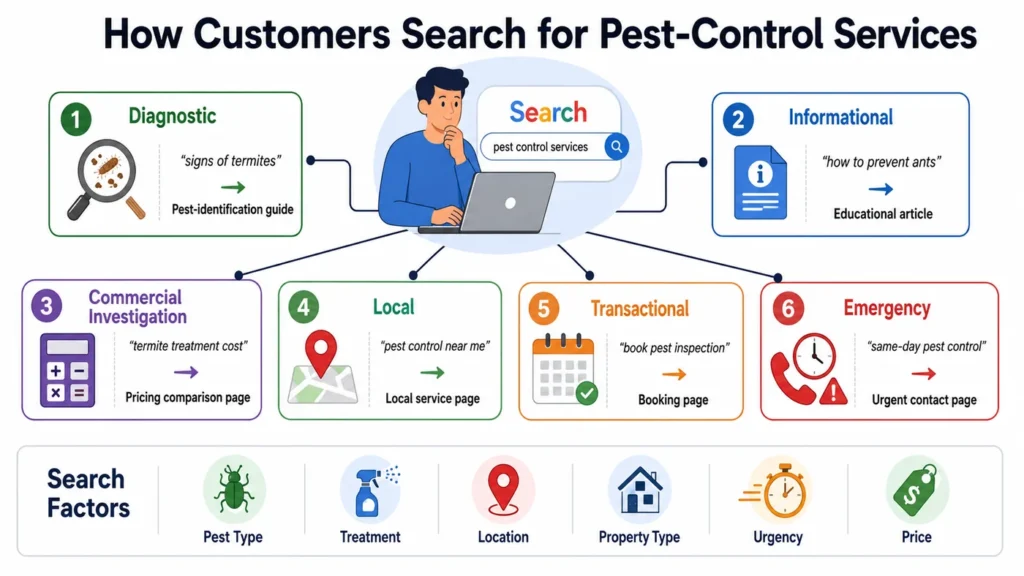
Pest-control customers use diagnostic, informational, local, commercial, transactional, and emergency queries based on the pest, treatment, location, property type, urgency, and price concern.
Search intent describes the action the user wants to complete. It should determine the page type, content sequence, evidence, and call to action.
A person searching “signs of termites” is trying to identify a possible problem. A person searching “termite inspection near me” is looking for a provider. A person searching “same-day termite inspection” is expressing provider, location, and urgency requirements in one query.
These searches belong to the same pest-control topic, but they require different answers.
What are diagnostic pest searches?
Diagnostic searches occur when the person has found evidence but has not confirmed the pest.
Examples include:
- Small droppings under a sink
- Scratching sounds in a wall
- Mud tubes near a foundation
- Bites appearing after sleep
- Shed insect skins near furniture
The correct content type is a pest-identification guide. Its purpose is to explain evidence, reduce misidentification, clarify risk, and state when a professional inspection is appropriate.
The article should not diagnose an infestation from one symptom. It should explain variations and limitations.
For example, rodent droppings, urine marks, gnawing, nesting materials, and entry gaps are separate evidence types. The CDC advises checking for entry points and continuing control until rodent signs stop, rather than treating one captured animal as proof that the infestation has ended.
What are informational searches?
Informational searches focus on treatment, safety, duration, prevention, or pest behavior.
Examples include “how does termite treatment work,” “is pest control safe for pets,” and “how long does bed bug treatment take.”
The correct page must answer the question before introducing the company’s service. The service link becomes useful after the reader understands the condition, method, and next step.
This is where scientific and regulatory evidence creates information gain. EPA describes integrated pest management as a prevention-focused system that combines site information, monitoring, nonchemical measures, and judicious pesticide use rather than routine treatment alone.
What are commercial-investigation searches?
Commercial-investigation searches occur before provider selection.
Examples include:
- Pest-control cost
- Termite inspection fee
- Bed bug heat treatment versus chemical treatment
- One-time versus recurring pest control
- Best pest-control company for restaurants
These pages must explain decision factors rather than force an immediate sales pitch.
A useful pricing page explains what changes the cost, including the pest, severity, property size, treatment method, number of visits, access conditions, and prevention work. A weak page hides every variable behind “contact us for a quote.”
The exact price may require an inspection. The factors should still be explained.
What are local and emergency searches?
Local searches combine service need with geography. Emergency searches add immediate timing.
Examples include:
- Pest control near me
- Exterminator in Sydney
- Rodent control [suburb]
- Same-day bed bug treatment
- Emergency wasp removal
- Pest control open now
These searches require a direct answer about availability, coverage, service type, and contact method.
The page should not make an urgent customer search through several paragraphs to find the phone number.
What are commercial pest-control searches?
Commercial searchers may include restaurant owners, hotel managers, warehouse operators, landlords, school administrators, and facility managers.
Their needs differ from those of residential customers. They may require monitoring, service records, scheduled inspections, corrective actions, multi-site coverage, and recurring contracts.
Commercial pest-control content is often underdeveloped in competing guides, despite its connection with higher-value and longer-term agreements.
What Prevents Pest-Control Websites From Generating Calls?
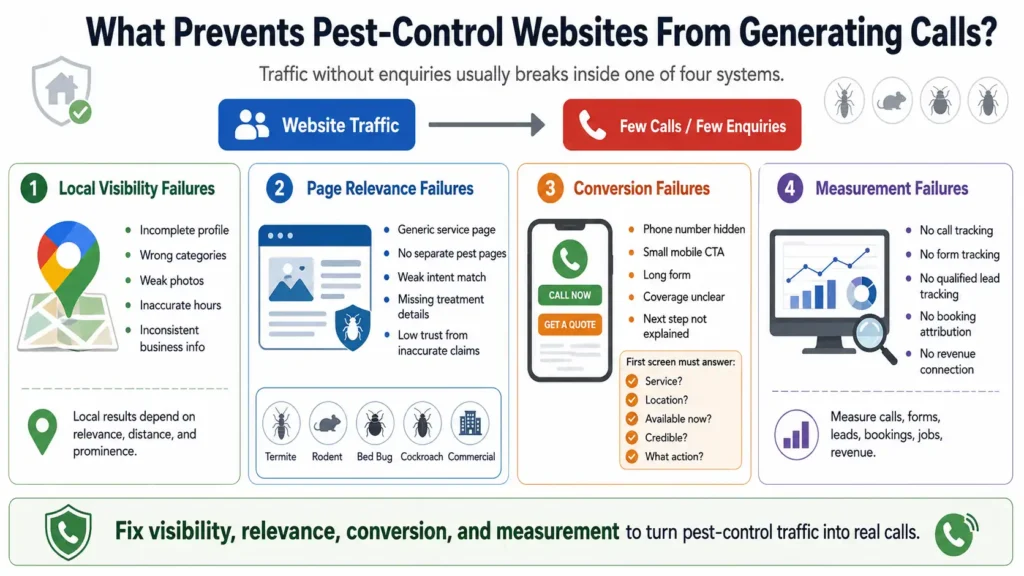
A pest-control website may receive traffic but few enquiries when it targets weak intent, lacks service coverage, loads slowly, hides contact options, provides little evidence, or fails to explain the next step.
The cause usually sits inside one of four systems: local visibility, page relevance, conversion usability, or measurement.
Local visibility failures
A weak or incomplete Google Business Profile can limit how well the company matches relevant local searches. Common problems include inaccurate hours, incomplete services, incorrect categories, weak photographs, and inconsistent identity information.
Google states that local results are mainly determined by relevance, distance, and prominence. Complete business information helps Google understand relevance. Links, reviews, ratings, and general recognition can contribute to prominence. Distance depends on the relationship between the searcher and the business.
This means a company cannot optimize its way out of every geographic limitation. It can, however, improve how clearly and credibly it represents the areas it genuinely serves.
Page relevance failures
A generic page labeled “Our Services” cannot provide the same depth as separate pages for termite control, rodent control, bed bug treatment, cockroach control, and commercial pest management.
Each pest involves different evidence, risks, treatment methods, recurrence conditions, and customer concerns.
A termite page must discuss inspection and structural risk. A rodent page must discuss entry points, trapping, sanitation, and exclusion. A bed bug page must address identification, inspection, spread, treatment options, and preparation.
Bed bugs, for example, are not known to spread disease, but they can cause itching, sleep loss, and occasional allergic reactions. A page that uses unsupported disease claims to create fear would be inaccurate and could weaken trust.
Conversion failures
Conversion problems usually appear as friction.
The phone number may be hidden inside a menu. The mobile button may be too small. The form may request ten fields before confirming coverage. The page may describe treatment without stating whether inspections are available.
For an urgent query, the first screen should answer:
- Does the company provide the service?
- Does it serve the location?
- Is service currently available?
- Is the company credible?
- What action should the customer take?
Measurement failures
A company cannot improve what it cannot connect.
Traffic data must connect with phone calls, forms, qualified leads, bookings, completed jobs, and revenue. Without that connection, the business cannot identify whether a termite page produces profitable inspections or merely attracts students researching termites.
Which SEO Goals Matter for a Pest-Control Company?
Pest-control SEO goals must measure qualified calls, inspection requests, booked treatments, recurring agreements, cost per booked job, and revenue by service and location.
Before keyword research begins, the company must decide which work it wants to generate.
A business may rank for mosquito control but lack technician capacity for additional seasonal jobs. Another may want more termite inspections because the average job value is higher. A commercial provider may prioritize quarterly restaurant contracts over one-time residential treatments.
SEO goals must reflect operations.
How should services be prioritized?
Evaluate each service across the same commercial dimensions.
| Dimension | Question |
| Demand | Do local customers search for the service? |
| Relevance | Does the company genuinely provide it? |
| Capacity | Can technicians accept more jobs? |
| Profitability | What is the expected gross profit? |
| Frequency | Is the service one-time or recurring? |
| Seasonality | When does demand increase or decline? |
| Geographic reach | How far can the company deliver the service profitably? |
| Conversion | What percentage of qualified enquiries become bookings? |
This prevents the content plan from being driven entirely by keyword volume.
Which baseline values must be recorded?
A useful baseline includes monthly organic calls, Google Business Profile actions, form submissions, booked inspections, booked treatments, review count, average rating, lead-to-booking rate, and attributed revenue.
Record the values by service when possible.
“SEO generated 60 calls” is incomplete. “SEO generated 60 calls, 38 qualified leads, 21 booked jobs, and $X in revenue” supports a business decision.
Who must own the marketing assets?
The pest-control company should retain ownership or administrative control of its domain, website, hosting, Google Business Profile, Search Console, analytics, call tracking, content, photographs, and CRM data.
This requirement addresses a recurring concern in pest-control and local-business discussions: owners do not want to lose their website, content, profile, or data when they leave an agency. The supplied research also identifies unclear deliverables, inaccessible accounts, weak links, and traffic-only reporting as central sources of distrust.
How Should Pest-Control Keyword Research Be Conducted?
Pest-control keyword research combines pest, service, location, urgency, property type, price, and frequency modifiers before assigning each query cluster to one primary page.
A keyword is not an isolated phrase. It is a linguistic expression of entities and their relationships.
“Emergency rat removal in Phoenix” identifies a pest, service, urgency state, and location. “Quarterly restaurant pest management” identifies frequency, property type, and commercial service intent.
What is the keyword construction model?
Use this model:
Pest or problem + service or treatment + location + urgency + property type + price or frequency
The components can be expanded through the following entity values:
| Entity | Values |
| Pest | Termite, rat, mouse, bed bug, cockroach, ant, mosquito |
| Service | Inspection, treatment, control, removal, exclusion, prevention |
| Geography | City, suburb, neighborhood, county, service area |
| Urgency | Emergency, same-day, open now, 24-hour |
| Property | House, apartment, restaurant, hotel, warehouse, school |
| Price | Cost, price, inspection fee, quote |
| Frequency | One-time, monthly, quarterly, annual |
| Preference | Pet-conscious, child-conscious, low-toxicity, preventive |
These values create meaningful combinations. They should not be mechanically forced into headings.
How should keywords be evaluated?
Search volume cannot determine priority alone.
A low-volume query such as “emergency restaurant cockroach control Sydney” may have more commercial value than a high-volume query such as “what do cockroaches eat.”
Evaluate each cluster using:
- Search intent
- Service relevance
- Expected job value
- Recurring potential
- Local competition
- Seasonal demand
- Technician capacity
- Conversion likelihood
How should keywords be assigned to pages?
Each cluster needs one dominant destination.
| Keyword cluster | Primary intent | Correct page type | Primary action |
| Signs of termites | Diagnostic | Pest guide | Book an inspection |
| Termite treatment | Transactional | Pest service page | Request treatment |
| Termite treatment Sydney | Local transactional | Service or qualified local page | Call or request a quote |
| Termite treatment cost | Commercial investigation | Pricing guide | Request an estimate |
| Restaurant termite control | Commercial | Industry service page | Request a site assessment |
This keyword-to-page map prevents two common errors: missing coverage and keyword cannibalization.
Contextual next step: After the search clusters are defined, the website needs a hierarchy that assigns a clear function to every page.
How Should a Pest-Control Website Be Structured?
A pest-control website requires separate but connected structures for residential services, commercial services, pest treatments, emergency response, geographic coverage, and supporting pest information.
Website architecture is the broader system. Service pages, pest pages, location pages, and articles are its narrower components.
A useful structure may look like this:
Homepage
├── Residential Pest Control
│ ├── Termite Control
│ ├── Rodent Control
│ ├── Bed Bug Treatment
│ ├── Cockroach Control
│ ├── Ant Control
│ └── Mosquito Control
│
├── Commercial Pest Control
│ ├── Restaurant Pest Control
│ ├── Hotel Pest Control
│ ├── Warehouse Pest Control
│ ├── School Pest Control
│ └── Property Management Pest Control
│
├── Emergency Pest Control
├── Pest Inspections
├── Exclusion Services
├── Preventive Pest-Control Plans
│
├── Service Areas
│ ├── City A
│ ├── City B
│ └── City C
│
└── Pest Resource Center
├── Pest Identification
├── Treatment and Safety
├── Pest Prevention
├── Pricing Guides
└── Seasonal Pest Information
This structure connects the business entity with services, pests, properties, locations, and customer needs. It also gives search engines a browseable hierarchy instead of a collection of disconnected landing pages.
Why should residential and commercial services be separated?
Residential and commercial customers have different risks, decision-makers, evidence requirements, and service frequencies.
| Dimension | Residential pest control | Commercial pest control |
| Customer | Homeowner, renter, landlord | Owner, manager, facility professional |
| Primary concern | Household protection and fast treatment | Compliance, continuity, contamination, records |
| Service frequency | One-time or recurring | Commonly scheduled or contracted |
| Evidence | Reviews, safety, home results | Reports, monitoring, sector experience |
| Conversion | Phone call or inspection | Site assessment or contract discussion |
Placing both audiences on one generic page weakens the information needed by each.
How does architecture prevent cannibalization?
Cannibalization occurs when several pages compete for substantially the same query and purpose.
A termite service page should explain treatment. A termite guide should explain evidence or prevention. A city page should explain local coverage. A commercial termite page should address a business property and decision-maker.
The pages can overlap semantically without sharing the same dominant intent.
What Information Belongs on a Pest Service Page?
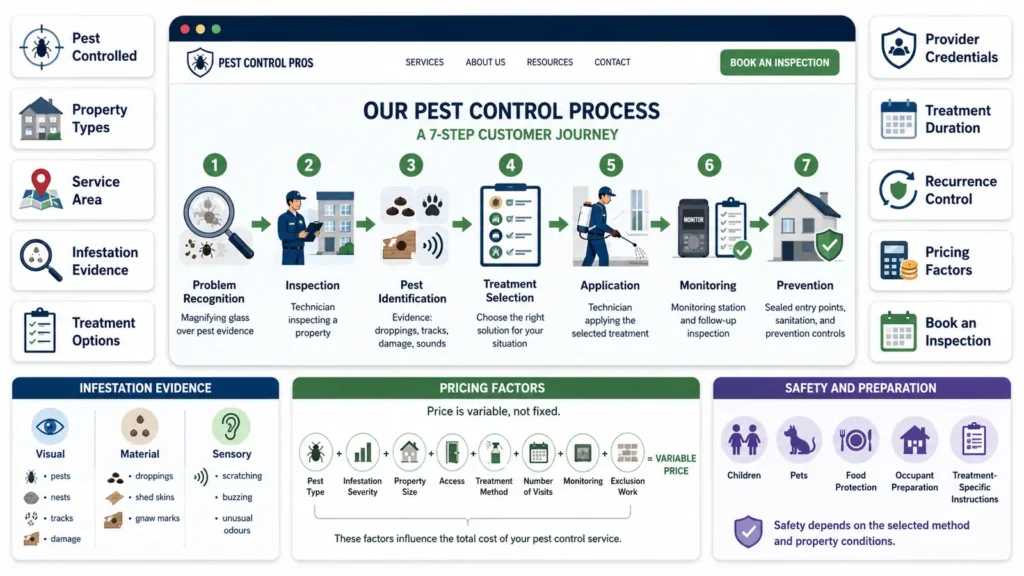
A pest service page must explain the pest, evidence, risks, inspection process, treatment options, safety conditions, duration, recurrence controls, pricing factors, service area, provider evidence, and booking action.
The broad service entity is pest management. Its narrower service types include inspection, control, removal, exclusion, treatment, monitoring, and prevention.
A strong page follows the operational sequence experienced by the customer:
Problem recognition → inspection → identification → treatment selection → application → monitoring → prevention
This sequence reflects the frame relationships identified in the semantic research.
What should the opening answer?
The opening must state:
- Which pest is controlled
- Which property types are covered
- Which area is served
- Whether inspection is required
- Which action the user can take
Example:
Rodent control identifies rat or mouse activity, removes active rodents, locates entry points, and reduces recurrence through trapping, sanitation guidance, and structural exclusion.
The answer is more useful than “We provide the best rodent solutions.”
How should infestation evidence be explained?
Evidence belongs to three broad categories.
Visual evidence includes live pests, tracks, nests, or damage. Material evidence includes droppings, shed skins, gnaw marks, or wood fragments. Sensory evidence includes scratching, buzzing, or persistent odors.
The page must explain variations. One sign may support an inspection, but it may not confirm species, severity, or treatment requirements.
How should treatment methods be presented?
Treatment is the hypernym. Heat, baiting, trapping, pesticide application, physical removal, sanitation, and exclusion are hyponyms.
The page should explain when each method may apply and what conditions affect selection.
EPA defines integrated pest management as a system that emphasizes prevention, site information, monitoring, nonchemical methods, and pesticide use only when needed. It is not one treatment product.
This distinction allows the company to explain its process without claiming that every infestation receives the same chemical application.
How should safety be discussed?
Safety content must be factual and treatment-specific.
EPA advises reading and following pesticide labels, removing children and pets from treated areas when required, covering food during indoor applications, and asking commercial applicators about risks and precautions.
A service page should therefore answer:
- What preparation is required?
- Must occupants leave?
- When can children and pets return?
- How are food areas protected?
- Which nonchemical methods are considered?
- What follow-up instructions apply?
Do not use a universal claim such as “100% safe.” Risk depends on the product, application, exposure, label, property conditions, and customer instructions.
How should pricing be explained?
A useful page explains cost variables even when it cannot provide a fixed price.
These variables can include pest type, infestation severity, property size, access, treatment method, number of visits, monitoring requirements, exclusion work, and service frequency.
The page can state that an inspection is required for an exact estimate. It should not hide all pricing context.
Why Do Residential, Commercial, Emergency, and Preventive Services Need Different Pages?
Residential, commercial, emergency, and preventive pest-control pages require different search intent, evidence, service conditions, response language, and conversion actions.
They belong to the same service taxonomy, but they do not solve the same customer problem.
Residential pest control
Residential pages should address houses, apartments, rental properties, families, pets, preparation, treatment duration, and return instructions.
The main conversion may be a phone call or home inspection.
Commercial pest control
Commercial pages should address operational continuity, food areas, inventory, documentation, monitoring, scheduled visits, corrective actions, and multi-site agreements.
The main conversion may be a site assessment rather than an immediate treatment booking.
A restaurant page must discuss kitchens, storage, waste, delivery areas, sanitation, contamination risk, and service records. A warehouse page may focus on loading areas, stored products, perimeter control, monitoring stations, and recurring inspection schedules.
Emergency pest control
Emergency pages must define what the company considers urgent.
Examples may include stinging insects in an occupied area, active rodent entry, severe bed bug spread, or pest activity affecting a commercial food area.
The page must state service hours, geographic limits, response process, and immediate contact method.
Do not use “24-hour pest control” unless the company provides that availability.
Preventive pest control
Preventive services reduce the conditions that allow recurrence.
These may include monitoring, sealing entry gaps, removing food and water access, sanitation guidance, scheduled inspections, and targeted treatment.
The antonym of preventive service is not necessarily emergency service. Preventive and reactive services represent different timing states:
- Preventive: risk exists before active infestation
- Reactive: evidence is present
- Emergency: evidence and immediate hazard or disruption are present
When Does a Service Area Need Its Own Page?
A location requires a dedicated page when the company genuinely serves it, meaningful customer demand exists, and the page can provide unique local evidence and a distinct user purpose.
A city name alone does not create local value.
The page must prove three relationships:
- The company serves the location.
- The company provides the relevant services.
- The page helps a person in that location make a service decision.
What makes a location page useful?
A useful local page can describe service coverage, neighborhoods, property types, seasonal pest activity, technician availability, response expectations, commercial sectors, local jobs, and customer evidence.
The content must remain accurate. A company should not claim local offices, local technicians, or rapid response without operational proof.
What creates a thin or doorway-style page?
A thin location page usually changes only the city name while repeating the same content, services, images, proof, and FAQs.
Google defines doorway abuse as creating substantially similar pages for specific cities or regions that funnel users toward the same destination instead of providing a useful, browseable hierarchy.
This does not mean every city page is prohibited. It means each page needs a justified role and substantive local value.
How should service and location pages coexist?
The service page owns the treatment intent. The location page owns the geographic coverage intent.
For example:
- /rodent-control/ explains rodent treatment.
- /locations/phoenix/ explains pest-control coverage in Phoenix.
- /rodent-control-phoenix/ is justified only when the combined query has sufficient demand and the page can provide unique service-location information.
Creating all possible combinations without evidence dilutes crawl resources, internal authority, and content quality.
How Should a Google Business Profile Be Optimized?
A pest-control Google Business Profile requires accurate identity information, relevant categories, complete services, current hours, original photographs, genuine reviews, and helpful customer responses.
Google Business Profile is a local business asset. It represents the company in Search and Maps and can display its phone number, website, hours, service area, photographs, reviews, and customer actions.
Which identity fields must be accurate?
The business name should match the real-world name used on signage, branding, and the website. The service area or address must represent actual operations. Business hours must match availability.
Google’s representation guidelines prohibit adding unnecessary service or location keywords to the business name. Misrepresentation can lead to profile restrictions or suspension.
A legitimate profile must maintain consistent:
- Business name
- Primary phone number
- Website
- Address or service-area configuration
- Opening hours
- Business categories
How do relevance, distance, and prominence work?
Relevance describes how closely the profile matches the query. Distance describes geographic proximity. Prominence describes how recognized and authoritative the business appears.
Complete profile information supports relevance. The business cannot directly control the searcher’s location, but it can avoid false coverage claims. Reviews, ratings, links, articles, and business recognition can support prominence.
No legitimate provider can guarantee the first Map Pack position because distance and competition vary by searcher and location.
Which photographs add evidence?
Original photographs can show technicians, vehicles, equipment, inspections, exclusion work, commercial environments, and preparation processes.
The goal is not to upload hundreds of generic images. It is to provide current evidence that the business, technicians, and services exist.
How should local visibility be tracked?
A single city-center rank does not show the full market.
Track visibility from different points across the genuine service area. Compare branded searches, pest-specific searches, emergency searches, and service-location searches.
Map visibility should then be connected with profile calls, website visits, qualified enquiries, and bookings.
How Can Pest-Control Companies Generate and Manage Reviews?
Pest-control companies can generate recent reviews by requesting honest feedback after completed service, sharing Google’s direct review link or QR code, recording the request, and responding professionally.
There is no universal “40-review rule” that guarantees local rankings. A meaningful target depends on the market, service, competitor set, review recency, rating, and customer behavior.
Google states that review count and positive ratings can help local ranking, but it does not publish a fixed threshold.
What is a compliant review workflow?
The process begins after a genuine customer experience.
The company completes the inspection or treatment, confirms that the service record is correct, sends the review request, and allows the customer to describe the experience honestly.
Google permits businesses to share a direct review link or QR code. It prohibits incentives offered in exchange for posting, changing, or removing reviews.
A compliant process does not ask only satisfied customers for five-star ratings. It asks genuine customers for feedback.
Which review attributes provide useful context?
A review may naturally mention the pest, service, technician, response time, location, communication, or outcome.
Service-specific descriptions help prospective customers understand the experience. Google may also ask customers of service businesses to identify the type of job performed.
Do not give customers a keyword script. That produces repetitive language and may make the reviews appear less authentic.
How should negative reviews be answered?
A negative review response should acknowledge the concern, protect privacy, avoid public arguments, explain relevant limitations, and move complex resolution offline.
Google recommends professional, concise responses and advises businesses not to share private information or attack reviewers.
A response can state:
We are sorry the appointment did not meet the expected response time. Please contact [manager/contact method] with the service date so we can review the record and address the issue directly.
Do not publish treatment records, addresses, payment details, or personal accusations.
Why Does NAP Consistency Matter?
NAP consistency helps customers and search platforms identify the same pest-control business across its website, Google Business Profile, directories, and external references.
NAP refers to name, address, and phone number. The wider entity record can also include the website, hours, service area, and business description.
Consistency does not require every description to use identical wording. It requires the core identity to remain accurate.
Which inconsistencies require correction?
Common problems include old addresses, previous telephone numbers, duplicate profiles, wrong website URLs, outdated hours, and tracking numbers used without a clear implementation plan.
Start with the sources most likely to influence customers:
- Google Business Profile
- Bing Places
- Major consumer directories
- Local business associations
- Pest-management associations
- Chambers of commerce
- Relevant commercial directories
Do not confuse citation quantity with authority. Hundreds of low-quality directory submissions do not replace accurate business information or legitimate local recognition.
Which Content Clusters Build Pest-Control Topical Authority?
A pest-control content system requires identification, treatment, safety, prevention, pricing, seasonal, and commercial-support clusters linked to the relevant service and location pages.
Topical authority is not created by publishing unrelated articles that contain pest keywords. It is created by covering the decision process around the services the company provides.
The content network should connect these entities:
Pest → evidence → risk → inspection → treatment → safety → prevention → provider → location → booking
Pest-identification content
Identification pages help users understand signs without providing false certainty.
Useful subjects include termite evidence, rodent droppings, bed bug signs, cockroach activity, ant species, and mosquito breeding conditions.
Each page should explain:
- What the evidence may indicate
- Which variations exist
- Which other causes are possible
- Which risk requires professional attention
- Which service page provides the next step
Treatment and safety content
Treatment pages explain methods, preparation, duration, monitoring, and precautions.
EPA’s pesticide guidance supports practical topics such as removing food, keeping children and pets away for the label-specified period, considering nonchemical controls, and asking the applicator about precautions.
This content must be reviewed by a qualified pest-management professional before publication.
Prevention content
Prevention connects environmental conditions with pest activity.
Rodent prevention may cover sealing gaps, storing food, managing waste, and reducing shelter. The CDC notes that mice can enter through an opening approximately ¼ inch, or 6 millimeters, wide.
That numeric detail is useful because it changes the reader’s understanding of an entry point. “Seal small holes” is less precise.
Pricing and decision-support content
Pricing pages can explain inspection fees, treatment variables, contract conditions, follow-up, guarantees, and recurring plans.
Comparison pages can address:
- One-time versus recurring pest control
- Heat versus chemical bed bug treatment
- Trapping versus exclusion
- DIY action versus professional inspection
- Residential versus commercial agreements
The comparison must state conditions. It should not declare one method universally superior.
Seasonal content
Seasonal pages should be planned according to local pest activity and operational capacity.
A useful calendar can connect:
| Period | Pest activity | Customer concern | Content action |
| Pre-season | Emerging risk | Prevention | Update prevention guides |
| Early activity | Initial evidence | Identification | Publish evidence content |
| Peak demand | Active infestation | Treatment availability | Strengthen service pages |
| Post-treatment | Recurrence concern | Monitoring | Promote follow-up plans |
This produces a continuous content system rather than a short peak-season campaign.
How Should Internal Links Connect the Semantic Network?
Internal links should connect pest identification with treatment, treatment with location, location with provider evidence, and provider evidence with a relevant booking action.
An internal link is a semantic relationship and a navigation path.
The link text should describe the destination. Google states that descriptive anchor text helps users and search engines understand the linked page before visiting it.
A useful content path is:
Signs of termites → termite control services → pest control in Sydney → inspection booking
Another path is:
Restaurant cockroach risks → restaurant pest control → commercial monitoring process → site-assessment form
Do not send every informational article to the homepage. Link to the most specific useful destination.
Which anchor text should be used?
Use natural page-title or topic language.
Suitable anchors include:
- termite control services
- rodent exclusion services
- commercial pest control
- bed bug treatment process
- pest control in Sydney
- pest-control pricing factors
Avoid vague anchors such as “click here” when a descriptive phrase improves clarity.
Avoid repeating the same exact-match phrase in every paragraph. Anchor variation must remain semantically accurate.
Which Technical SEO Issues Must Be Fixed?
Technical SEO problems include blocked crawling, incorrect canonical tags, duplicate URLs, mobile delays, unstable layouts, broken links, missing structured data, and untracked conversion actions.
Technical SEO is the accessibility layer. It allows search engines to crawl, interpret, index, and render the website.
It cannot compensate for weak services, fake locations, or generic content. It ensures that strong pages can be accessed and evaluated.
Which indexability checks matter first?
Verify that priority pages:
- Return a successful HTTP status
- Do not contain a noindex directive
- Use the intended canonical URL
- Are included in the XML sitemap
- Can be reached through internal links
- Are not blocked by robots.txt
- Do not redirect through unnecessary chains
A page cannot generate organic visibility if Google cannot access or index the intended version.
Which mobile performance values matter?
Google’s current Core Web Vitals guidance defines good performance as:
- Largest Contentful Paint within 2.5 seconds
- Interaction to Next Paint below 200 milliseconds
- Cumulative Layout Shift below 0.1
These metrics measure loading, responsiveness, and visual stability.
For a pest-control site, mobile improvements should also include visible phone access, stable buttons, short forms, compressed images, and reduced script load.
Which structured data is relevant?
LocalBusiness structured data can describe business information such as name, telephone, address, opening hours, geographic coordinates, and business departments. Google recommends adding required properties, validating the markup, testing the page through URL Inspection, and keeping the page crawlable.
Structured data must match visible content. It does not replace a complete page or guarantee a rich result.
Relevant structured entities can include:
- Organization
- LocalBusiness
- Service
- BreadcrumbList
- WebPage
- ImageObject
FAQ markup should not be added merely because a page contains questions. Use schema types that accurately represent the visible page and current eligibility guidance.
Does AI search require special markup?
Google does not require a special AI file, AI schema type, or separate optimization method for AI Overviews or AI Mode.
Google states that existing SEO fundamentals continue to apply. These include crawlability, internal links, page experience, textual content, useful images, matching structured data, and current Business Profile information.
The practical approach is entity clarity, direct answers, original evidence, and consistent business information—not artificial “AI optimization” files.
How Can a Pest-Control Company Build Local Authority?
Relevant local authority can come from industry associations, business organizations, commercial partners, suppliers, community activity, local media, and original resources that deserve citations.
Backlinks are the narrower external signals inside the broader concept of authority.
A link from a local property-management association to a commercial pest guide has a clear relationship. A link from an unrelated foreign blog has weak topical and geographic relevance.
Which local relationships can create authority?
Potential sources include:
- Chambers of commerce
- Property managers
- Real estate professionals
- Commercial customers
- Suppliers
- Local news organizations
- Community associations
- Training providers
- Pest-management organizations
The company must earn the relationship before expecting the link.
What can the business publish that deserves links?
Original resources create stronger reasons for citation.
Examples include:
- A regional pest-seasonality calendar
- An anonymized infestation trend report
- A commercial sanitation checklist
- A local property-risk guide
- Original pest photographs
- Technician-reviewed identification resources
- A landlord pest-responsibility guide
These assets add information rather than repeating another agency article.
Which link practices should be avoided?
Avoid bulk purchased links, automated comment links, irrelevant guest-post networks, fake local websites, mass press-release syndication, and artificial “entity stacks.”
Google’s spam policies can apply to manipulative link and scaled-content practices regardless of whether the work was automated or performed manually.
What Makes a Pest-Control Page Convert?
A pest-control page converts when it matches the pest and location, establishes credibility, explains the process, confirms availability, addresses safety, and provides a simple contact action.
Conversion optimization is not the act of adding more buttons. It is the removal of uncertainty and friction.
The page must answer:
- Does the company provide this service?
- Does it cover this property and area?
- What happens during the process?
- What preparation is required?
- What proof supports the provider?
- How can the customer contact the business?
Which call to action matches each intent?
| Search intent | Appropriate call to action |
| Emergency | Call for Current Availability |
| Diagnostic | Book a Pest Inspection |
| Treatment | Request a Treatment Quote |
| Commercial | Request a Site Assessment |
| Preventive | Discuss a Recurring Pest Plan |
| Pricing research | Get an Inspection-Based Estimate |
“Contact us” is not always wrong, but it gives the user less information than a specific action.
Which mobile features are essential?
A mobile page needs a visible phone number, click-to-call access, a short form, service-area confirmation, operating hours, and a clear response expectation.
The form should request only the information needed for the first response:
- Name
- Phone number
- Service address or postcode
- Suspected pest
- Urgency
- Preferred contact method
Detailed property information can be collected during the call or inspection when appropriate.
Which trust signals belong near the action?
Relevant trust evidence may include licenses, insurance, technician credentials, years of operation, treatment process, safety procedures, genuine reviews, guarantees, and original job photographs.
Do not display a certification that the company does not hold. Do not use stock photographs as evidence of technicians or completed work.
How should guarantees be explained?
A guarantee needs conditions.
State which service it covers, how long it applies, whether follow-up is included, which preparation obligations apply, and which recurrence conditions are excluded.
A vague “100% pest-free guarantee” can create expectations that the operational agreement does not support.
How Should Pest-Control SEO Results Be Measured?
Pest-control SEO works when organic visibility produces qualified calls, booked inspections, completed treatments, recurring agreements, and measurable revenue at an acceptable acquisition cost.
The full attribution path is:
Search query → landing page → call or form → qualified lead → inspection → treatment → recurring agreement → revenue
Every reporting layer must retain this context.
Which visibility metrics remain useful?
Search Console impressions, clicks, click-through rate, average position, indexed pages, and query coverage show whether relevant pages are being discovered.
Map visibility and Google Business Profile actions show local discovery.
These metrics are diagnostic. They identify where the acquisition path is improving or failing.
Which conversion metrics matter?
Track:
- Phone calls
- Form submissions
- Inspection requests
- Quote requests
- Qualified leads
- Missed calls
- Booked treatments
- Lead-to-booking rate
A missed call is not a completed lead. A spam enquiry is not a qualified lead. A quote request is not booked revenue.
Which revenue metrics matter?
Measure cost per qualified lead, cost per booked job, revenue by service, revenue by landing page, revenue by location, and recurring contract value.
The report can then answer practical questions:
- Which pest page generates the most booked work?
- Which location produces unqualified enquiries?
- Which commercial page creates recurring agreements?
- Which queries produce calls but no bookings?
- Which services require additional technician capacity?
This is the point where SEO becomes a business system rather than a ranking report.
Is SEO Better Than Google Ads for Pest-Control Companies?
SEO supports owned, longer-term visibility, while paid advertising supports immediate and controllable exposure; the correct channel mix depends on cost per booked job, service margin, urgency, and capacity.
The decision is not “SEO or ads” in every market.
A company may use paid search for immediate termite or emergency demand while organic pages develop. It may use SEO for pest education, local service pages, commercial sectors, and recurring demand.
| Decision factor | SEO | Paid advertising |
| Time to visibility | Gradual | Immediate |
| Asset ownership | Website, content, authority | Exposure depends on active spending |
| Testing speed | Slower | Faster |
| Emergency targeting | Useful after visibility develops | Strong immediate control |
| Long-term coverage | Can compound | Budget dependent |
| Main efficiency metric | Cost per booked organic job | Cost per booked paid job |
Do not compare channels using clicks alone. Compare qualified lead rate, booked-job rate, revenue, and customer lifetime value.
How Much Does Pest-Control SEO Cost?
Pest-control SEO cost depends on market competition, service-area size, website condition, number of services, location coverage, content needs, authority requirements, and tracking complexity.
A single-location owner-operator with six core services does not require the same system as a regional company with several branches, commercial contracts, and overlapping service territories.
The scope may include:
- Technical correction
- Google Business Profile work
- Keyword and architecture planning
- Service-page production
- Location-page production
- Content review by technicians
- Citation correction
- Link acquisition
- Conversion tracking
- Reporting integration
Do not choose an SEO provider by monthly price alone. A low fee can still be expensive when it generates no booked work. A higher fee can also be unjustified when deliverables, ownership, and attribution remain unclear.
The comparison needs scope and outcome.
How Long Does Pest-Control SEO Take?
SEO timelines depend on the website, competition, location, authority, technical condition, and implementation speed; early technical changes may appear before stable lead and revenue growth.
No responsible provider can guarantee a specific first-page position within a fixed number of weeks.
The first 90 days are usually a foundation and implementation period rather than a complete maturity point.
| Period | Primary focus |
| Days 1–30 | Tracking, technical health, profile accuracy, keyword mapping |
| Days 31–60 | Service coverage, location quality, reviews, conversion elements |
| Days 61–90 | Supporting content, authority, testing, booked-job analysis |
| After 90 days | Expansion, consolidation, refreshes, local authority, CRO |
The speed of progress depends partly on execution. A completed content brief does not improve a page until the page is written, reviewed, published, linked, crawled, and used by customers.
Should Pest-Control SEO Be Managed Internally or Externally?
A pest-control company can use DIY, in-house, freelance, or agency support based on market complexity, internal time, technical requirements, number of locations, and reporting needs.
No delivery model is automatically superior.
An owner may understand customers and operations better than an outside provider but lack time for technical implementation. An agency may provide capacity but lack pest-control knowledge. An internal marketer may understand the brand but need development or analytics support.
When is DIY suitable?
DIY can work when the company has a small service area, a manageable website, limited service coverage, and enough time to learn local search and measurement.
The owner must still protect operations. Spending ten hours editing title tags while calls go unanswered is not an efficient trade.
When is an in-house system suitable?
In-house management is useful when the company has multiple locations, continuous content needs, regular review collection, and enough lead volume to justify dedicated capacity.
The internal person may still require specialist development, analytics, or content-review support.
When is an external specialist suitable?
External support may be appropriate when technical problems are extensive, the architecture is complex, internal resources are limited, or multi-location attribution is required.
The provider must understand the commercial system, not only the keyword list.
What Should a Pest-Control Company Ask an SEO Provider?
Evaluate an SEO provider through asset ownership, deliverables, pest-control evidence, competitor conflicts, link methods, content quality, contract terms, and booked-job reporting.
Ask the following questions before signing:
- Who owns the domain, website, content, profiles, and data?
- Which monthly activities are included?
- Are development costs included or billed separately?
- Does the provider work with a direct competitor in the same service area?
- How are links acquired?
- How are service and location pages made unique?
- Who reviews technical pest content?
- How are calls and forms tracked?
- How are qualified leads and booked jobs recorded?
- What happens to the assets when the agreement ends?
- Which results are guaranteed?
- How are timelines communicated?
The correct answer to the guarantee question is not a promised first position. Google states that there is no way to request or pay Google for better local ranking, and local results depend partly on distance and competition.
A provider can guarantee work, access, reporting, communication, and ownership conditions. It cannot guarantee Google’s final ranking decision.
What Are the Most Common Pest-Control SEO Mistakes?
The most damaging mistakes weaken business identity, page intent, local evidence, customer trust, technical access, conversion usability, or revenue measurement.
An incomplete Google Business Profile weakens local understanding. A generic service page weakens relevance. A duplicated city page weakens usefulness. A hidden phone number weakens conversion. A traffic-only report weakens decision-making.
The errors are connected.
Publishing generic or alarmist content
Pest content becomes unhelpful when it repeats broad warnings without explaining evidence, severity, treatment, or uncertainty.
Do not claim every bed bug bite spreads disease. CDC states that bed bugs are not known to transmit disease.
Do not claim every pesticide treatment is harmless. Explain precautions, label requirements, exposure conditions, and nonchemical options.
Helpful content requires accuracy, original information, clear purpose, and enough depth for the reader to complete the intended task. Google’s people-first guidance also warns against content that merely summarizes other pages, uses extensive automation without added value, or publishes across unrelated topics to attract traffic.
Creating hundreds of duplicated location pages
Replacing one city name with another does not create local expertise.
Each location page needs genuine coverage, a distinct purpose, useful local evidence, and a place inside the website hierarchy.
Targeting broad keywords without intent control
“Pest control” may attract several customer types. “Same-day rat removal in Sydney” expresses pest, service, urgency, and location.
Broad terms can support market coverage. High-intent terms usually require more specific pages and conversion paths.
Reporting rankings without booked-job data
This is the mistake pest-control owners mention repeatedly.
A report can show improved rankings while the business receives low-quality calls, missed calls, out-of-area enquiries, or no profitable bookings.
The report must connect search performance with operations.
Hiding licences, treatment practices, and service conditions
Trust cannot be assumed.
Customers need to understand who performs the work, which services are available, how safety is managed, what preparation is required, and what the agreement includes.
Using fake reviews or incentivized ratings
Google requires reviews to reflect genuine experiences and prohibits paid or incentivized reviews and rating manipulation.
A short-term rating increase does not justify profile restrictions or loss of customer trust.
What Is the 90-Day Pest-Control SEO Plan?
The first 90 days should establish measurement, correct local identity, improve priority commercial pages, remove conversion friction, and create the foundation for authority and content growth.
Days 1–30: Establish the foundation
Confirm ownership of the domain, website, Business Profile, analytics, Search Console, and call-tracking accounts.
Record baseline calls, forms, qualified leads, bookings, and revenue.
Audit indexability, canonical URLs, mobile performance, internal links, and existing service coverage.
Correct Google Business Profile information and major NAP inconsistencies.
Map every priority query cluster to an existing or planned page.
The first month is complete when the company knows what it owns, what it measures, which services it wants to grow, and which pages are responsible.
Days 31–60: Build commercial coverage
Improve the homepage and residential or commercial service hubs.
Create or revise the highest-value pest pages.
Build an emergency page only when the company provides emergency availability.
Improve justified location pages with genuine local evidence.
Add licences, insurance, technician credentials, safety information, original photographs, reviews, and clear contact actions.
Begin a compliant review-request process.
The second month is complete when priority searchers can find a relevant page, understand the service, trust the provider, and contact the company without unnecessary friction.
Days 61–90: Build authority and improve conversion
Publish supporting identification, treatment, safety, prevention, pricing, or seasonal content.
Create internal links between informational and commercial pages.
Begin local relationship and authority work.
Review calls by source, page, service, location, and quality.
Identify missed calls, low-booking pages, and out-of-area enquiries.
The third month is complete when the company can identify which pages generate commercially useful activity and what requires improvement next.
Pest-Control SEO Audit Checklist
A useful audit evaluates business identity, local visibility, page coverage, content quality, technical access, authority, conversion, and revenue attribution as one system.
| Audit area | Required condition |
| Ownership | Business controls domain, site, profiles, and data |
| Local identity | Name, address, phone, hours, and categories are accurate |
| Service coverage | Priority pests and services have appropriate pages |
| Geographic coverage | Location pages reflect genuine operations |
| Content quality | Pages are original, accurate, useful, and professionally reviewed |
| Technical access | Pages are crawlable, indexable, canonical, and mobile usable |
| Reputation | Reviews are genuine, recent, and professionally managed |
| Authority | Links and mentions are relevant and legitimate |
| Conversion | Calls and forms are visible, simple, and intent-specific |
| Attribution | Leads connect with bookings, services, locations, and revenue |
A checklist is not the strategy itself. Its purpose is to identify the next constrained point in the acquisition system.
Frequently Asked Questions
Does SEO work for pest-control companies?
SEO can generate pest-control enquiries when the business ranks for relevant local searches, provides credible service information, makes contact simple, and tracks whether leads become booked jobs.
How can a pest-control company rank in Google Maps?
Improve profile accuracy, service relevance, customer evidence, website authority, and local prominence while recognizing that distance and competition also affect each search result.
How many Google reviews does a pest-control company need?
Google publishes no fixed review threshold; compare review count, rating, recency, service detail, and response quality with legitimate competitors in the same local market.
Does every pest need a separate page?
Create a separate pest page when the company provides the service and the pest has distinct search demand, evidence, risks, treatment methods, or customer questions.
Does every city need a location page?
Create a city page only when the company genuinely serves the area and can provide unique local information, evidence, service conditions, and a distinct user purpose.
How long does pest-control SEO take?
The timeline varies by competition, website condition, authority, location, implementation speed, and service demand; early technical gains may appear before stable booked-job growth.
Is pest-control SEO better than Google Ads?
SEO and paid advertising solve different timing and ownership needs; compare them through qualified lead cost, booked-job cost, service margin, and customer lifetime value.
What structured data belongs on a pest-control website?
Use structured data that accurately describes the visible business and page, such as Organization, LocalBusiness, Service, BreadcrumbList, WebPage, and ImageObject where applicable.
Can AI-generated content rank for pest-control searches?
The production method is not the main quality test; the page must be accurate, original, useful, professionally reviewed, evidence-based, and created for a defined audience rather than search manipulation.
How should a pest-control company measure SEO ROI?
Connect organic calls and forms with qualified leads, booked inspections, completed treatments, recurring contracts, revenue, and the total cost of the SEO program.
What Should a Pest-Control Company Fix First?
Fix measurement, business-profile accuracy, mobile contact access, high-value service pages, and review collection before expanding into large content or link-building campaigns.
The correct order is based on dependency.
Tracking comes first because the company needs a baseline. Business identity comes next because local visibility depends on accurate information. Mobile contact access follows because existing traffic may already be leaking. High-value service pages improve commercial relevance. Reviews and local evidence strengthen trust.
After these foundations are working, the company can expand locations, supporting content, and authority.
A practical priority sequence is:
- Confirm ownership and install lead attribution.
- Correct Google Business Profile and business information.
- Fix click-to-call access, forms, and mobile speed.
- improve priority pest and commercial service pages.
- Build a compliant review workflow.
- Create justified location coverage.
- Publish supporting semantic content.
- Earn relevant local authority.
- Measure bookings and revenue.
- Repeat the process using actual business data.
Turn Local Search Visibility Into Booked Pest-Control Work
Ranking reports are not enough. Traffic reports are not enough. A pest-control SEO system must show which services and locations produce qualified calls, booked inspections, completed treatments, and recurring revenue.
SEO Agency For Tradies can begin with a review of:
- Google Maps visibility
- Pest and service-page coverage
- Location-page quality
- Mobile calls and booking forms
- Reviews and business information
- Technical accessibility
- Call and booked-job attribution


