
To rank higher on Google in 2026, make the correct page crawlable and indexable, satisfy the search intent better than competing results, add information users cannot get elsewhere, strengthen internal and external authority, and measure whether those changes increase qualified organic traffic and conversions.
That sequence matters.
Publishing more content is not automatically the next step. Building backlinks is not automatically the next step either. If an important page carries a noindex directive, rewriting another 2,000 words solves the wrong problem. If Google already indexes the page but consistently ranks product pages for the query you are targeting with an informational article, technical fixes alone will not solve the intent mismatch.
The useful question is therefore not:
“Which Google ranking factor should I optimise?”
It is:
“What is currently preventing this page from becoming a better result for the searches that matter to the business?”
Google describes SEO as work that helps search engines understand content and helps users decide whether they should visit a site from search results. Its current Search Essentials continue to emphasise helpful, reliable, people-first content, descriptive language, crawlable links, and compliance with spam policies.
The 2026 search environment has changed around those fundamentals. AI Overviews and AI Mode can answer more complex queries, retrieve supporting sources through techniques such as query fan-out, and change how users move from a query to a website. Google nevertheless states that ordinary SEO remains relevant to its generative Search features and that publishers do not need a separate collection of “AEO” or “GEO” tricks to qualify.
So the practical ranking model for 2026 is:
Search demand → crawlability → indexability → intent → relevance → information value → trust → internal context → external authority → page experience → visibility → clicks → conversions
Start with the first weak dependency. Not the most fashionable tactic.
What Does Ranking Higher on Google Actually Mean in 2026?
Ranking higher means improving a page’s visibility for specific queries, users, locations and search contexts—not making an entire website occupy one universal Google position.
A URL may rank third for one query, fifteenth for another, appear in an image result for a third, support an AI-generated answer for another, and have little visibility in Google Maps.
That distinction changes how SEO should be diagnosed.
A business owner saying “my website does not rank” may actually have four different problems. Important pages may not be indexed. Indexed pages may target queries with the wrong intent. Pages may receive impressions but sit below stronger results. Or the pages may rank well while generating few clicks or enquiries.
Those are different states. They require different interventions.
Google’s documented Search process also makes clear that inclusion is not automatic. Google may discover a URL without indexing it, and following Search Essentials does not guarantee that Google will crawl, index or serve every page.
This is why serious SEO work begins with diagnosis rather than publishing.
Has the Helpful Content Update Changed SEO in 2026?
There is no separate Helpful Content Update system that you should optimise for in 2026.
Google says the system originally announced as the Helpful Content Update became part of its core ranking systems in March 2024. Its current people-first guidance asks publishers to create useful, reliable content for an intended audience rather than content produced mainly to attract search-engine traffic.
That distinction matters.
Do not create content because a keyword exists.
Create the page when a real audience has a relevant need and your website has something useful to contribute to satisfying it.
How Does Google Search Work Before a Page Can Rank?
Google Search broadly works through crawling, indexing and serving, with multiple systems then determining which eligible results are useful and relevant for a query.
Google describes Search as a fully automated system that uses crawlers to discover pages. Pages then need to be processed and indexed before they can normally compete for search visibility. Not every crawled page is indexed.
For SEO diagnosis, it is useful to expand that process into a more practical sequence:
Discovery → crawling → rendering → indexing → canonicalisation → query interpretation → retrieval → ranking → serving
Each stage creates a different failure condition.
A page that Google cannot discover has a discovery problem.
A URL blocked from crawling has an accessibility problem.
A JavaScript-dependent page whose important content cannot be rendered correctly has a rendering problem.
A crawled page excluded from the index has an indexability or quality problem.
A duplicate page may have a canonicalisation problem.
An indexed page receiving no relevant impressions may have a demand, intent or relevance problem.
A relevant page sitting in position 18 may have a competitive content, internal authority, external authority or quality gap.
The order matters because later-stage optimisation cannot compensate for failure at an earlier prerequisite.
You do not improve a noindex page by earning twelve backlinks.
Why Is Your Website Not Ranking Higher on Google?
Most ranking problems can be classified as an eligibility problem, relevance problem, quality problem, authority problem, SERP-competition problem or measurement problem.
Before changing the page, identify which state actually exists.
A useful diagnostic model is:
| Observed State | Likely Question | First Area to Investigate |
| URL is not indexed | Can Google process and select this page? | Crawlability, indexability, canonicalisation |
| Indexed but almost no impressions | Does the page match real search demand? | Keyword targeting, intent, relevance |
| Impressions but positions 30–100 | Why is the page weak relative to alternatives? | Intent, content quality, topical support, authority |
| Positions 11–20 | What is stopping page-one visibility? | Content gaps, internal links, authority, SERP differences |
| Positions 4–10 | What separates this page from stronger results? | Information gain, evidence, links, snippet positioning |
| High impressions but poor CTR | Why are searchers not choosing the result? | Title link, snippet, SERP composition |
| Rankings and clicks are strong but leads are weak | Is SEO still the bottleneck? | Offer, page UX, conversion path |
Do not treat the position ranges as Google thresholds. They are working diagnostic bands for prioritising SEO activity.
Their value comes from separating different problems.
For example, a page moving from position 47 to 38 is technically improving, but that does not mean it is close to producing meaningful search traffic. A page moving from position 12 to position 8 crosses into a materially different search-results environment and deserves closer analysis.
This is also why “traffic dropped” is not a sufficiently precise diagnosis.
You need to know:
which page → which query → which search type → which date → which device/location → what changed
Only then should you decide what to fix.
Can Google Crawl and Index the Correct Page?
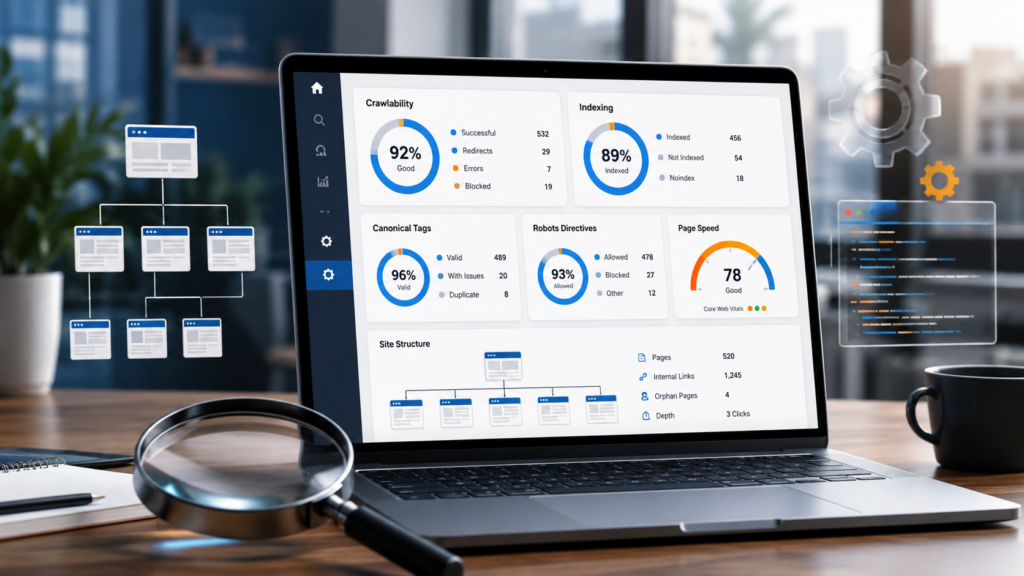
If an important URL cannot be crawled, processed or indexed correctly, fix that condition before investing heavily in content promotion.
Start with the URL itself.
Inspect its HTTP response. A normal indexable page usually needs a successful response rather than an unintended redirect, 404, 5xx response or access restriction.
Then inspect crawler directives.
robots.txt controls crawler access. It is not the correct mechanism for reliably removing an HTML URL from Google Search. Google explicitly notes that a disallowed URL can still appear when Google discovers it through links elsewhere. If you want an accessible page excluded from Google’s index, noindex is the relevant directive, and Google must be able to crawl the page to see it.
That creates a common technical contradiction:
robots.txt blocks page → Google cannot fetch page → Google cannot see page-level noindex
Next, inspect canonicalisation.
Google defines a canonical URL as the representative URL it selects from a group of duplicate or substantially similar pages. A rel=”canonical” element is a signal of preference, not an instruction that forces Google to choose the URL you specify.
If your intended service page declares another URL as canonical, fixing headings and backlinks before fixing the canonical relationship wastes effort.
Then check internal discovery.
Google recommends making important pages reachable through crawlable internal links. A sitemap can help Google discover URLs, but submitting one does not guarantee crawling or indexing.
The practical technical sequence is:
URL response → robots access → rendered content → robots meta → canonical → internal links → sitemap → Search Console index state
Do not move to keyword density. There is no useful keyword-density calculation for a page that Google has selected out of the index.
Establish an SEO Baseline Before You Change the Page
Record how the page performs before optimisation, otherwise you cannot separate improvement from normal ranking variation.
Google Search Console should provide the first dataset because its Performance reporting connects Google Search queries with pages, impressions, clicks and other search-performance dimensions.
Start at the page level.
Identify the important URL. Then inspect the queries producing impressions for that page.
You are looking for patterns.
A page may receive 40,000 impressions from loosely related queries and 900 impressions from the commercial query the business actually cares about. Reporting only the total impression count hides that difference.
Separate visibility into meaningful query groups, such as:
brand queries, commercial queries, informational queries, location queries and problem queries.
Then connect those groups with business outcomes.
The useful measurement chain is not:
ranking → traffic
It is:
SEO change → Google recrawling/reprocessing → impressions → ranking distribution → clicks → qualified visits → conversion → revenue or lead value
This baseline also protects successful pages from unnecessary editing.
Google’s core-update guidance specifically cautions against drastic changes when a page has experienced only a small position decline and recommends deeper assessment for larger losses.
A page ranking second does not automatically need a “2026 content refresh” because a content tool produced a lower optimisation score.
How Do You Choose Keywords You Can Realistically Rank For?
Choose search queries based on intent, business relevance, competitive feasibility and potential value—not search volume alone.
Search volume answers only one question: estimated demand.
It does not tell you whether the query can produce the outcome you need.
Consider a roofing company targeting “roof.”
The term may describe the broader entity, but the business objective is usually attached to narrower commercial needs such as roof repair, roof replacement, emergency roofing or a location-qualified service.
That relationship can be expressed as:
keyword → intent → SERP → business relevance → ranking feasibility → potential outcome
For each target query, inspect its attributes.
What is the user trying to accomplish?
What page type dominates the results?
Are the top results service pages, products, category pages, guides, calculators, videos, forums or local results?
How strong are the competing websites?
Does your website have a credible reason to publish the page?
Can your business satisfy the implied need if the ranking produces traffic?
A query with lower estimated volume can have greater business value when the intent is substantially closer to conversion.
Likewise, a high-volume informational keyword can be useful when it establishes a relevant entry point into a broader customer journey.
There is no universal requirement to choose one or the other.
The correct target depends on the macro context of the website.
Why Should Search Intent Be Analysed Before Content Optimisation?
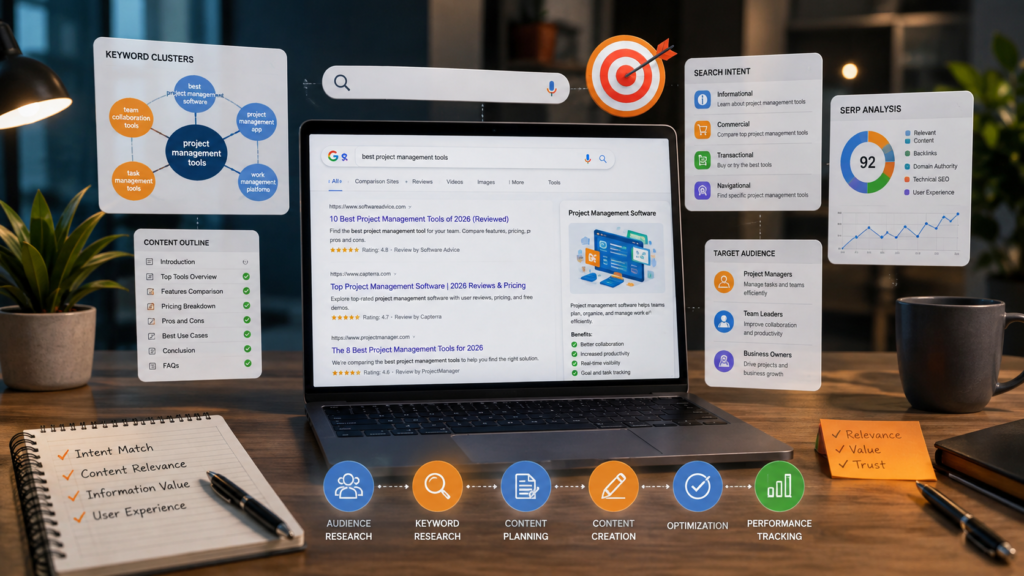
Search intent determines what kind of result the user expects; a page can be technically strong and still underperform when its purpose does not match that expectation.
Search intent describes the task behind the query.
Common intents include informational, commercial, transactional, navigational and local needs. Examples include learning how canonical tags work, comparing SEO software, purchasing running shoes, finding Google’s Search Console, or locating an emergency plumber nearby.
The sequence is:
query → probable intent → current SERP → expected page type → content requirements
Do not stop at keyword semantics.
Inspect what Google currently returns.
If a query produces mostly product-category pages, publishing a 5,000-word definition article may satisfy the topic but fail the transaction.
If a query produces detailed tutorials, a thin service page may have the opposite problem.
SERPs can also change.
That is why search-intent optimisation is not a one-time label stored permanently inside a spreadsheet. It is an observed relationship between the query, the user need and the results currently being selected.
Google’s ranking systems include language-understanding systems that can connect words with concepts rather than requiring every page to reproduce the exact wording of every possible search variation.
So stop trying to create a different article for every synonym.
Build the best destination for the underlying intent.
How Should You Analyse the Google SERP?
Analyse the SERP to identify what successful results satisfy, where they differ, and which useful requirement remains underserved.
Do not perform competitor analysis by counting words.
A 3,900-word page does not establish that you need 4,100 words.
Inspect the result as a system.
Start with the ranking URLs and classify their intent.
Then examine the content types, information structure, entities, evidence, media, freshness, authorship, references, backlinks and SERP features.
The central question is:
What is this result doing for the searcher that my page currently does not do?
Sometimes the answer is depth.
Sometimes it is the opposite.
A competing article may answer a simple question in 700 useful words while your page forces the reader through 3,500 words of generic context.
Sometimes the missing value is evidence.
A page explaining Core Web Vitals can repeat definitions from other sites, or it can show a real performance trace, identify the LCP element, document the code change and show measured field data afterwards.
Those pages cover the same topic.
They do not deliver the same information value.
What Makes Content Worth Ranking in 2026?
Content becomes more competitive when it satisfies the intent accurately and contributes useful information, evidence or utility beyond what a searcher can already obtain from interchangeable results.
Google’s current people-first guidance asks creators whether their material provides original information, research, analysis or substantial additional value. Its newer generative-AI guidance goes further and explicitly recommends valuable, non-commodity content for AI-enabled Search experiences.
That makes “write high-quality content” too vague to be useful.
Define the value.
Original value can come from first-party research, observed data, field experience, screenshots, documented tests, expert analysis, calculations, templates, tools, datasets or case studies.
For example, an article about increasing Google rankings could repeat:
Improve your content and build backlinks.
That statement is not necessarily incorrect. It is simply weak.
A stronger version identifies the condition:
If a Search Console URL already receives strong impressions in positions 11–20, compare the queries, intent, missing subtopics, internal-link support and competing-page evidence before publishing another article for the same keyword cluster.
The second answer tells the reader what to observe, what the observations mean and what to do next.
That is information gain in practical terms.
Does Content Need to Be Longer to Rank?
No fixed content length guarantees higher rankings. Write enough to satisfy the task completely without padding the page with unrelated information.
Google’s current generative-AI guidance explicitly says there is no ideal page length and rejects the idea that content must be artificially broken into small “AI-friendly” chunks.
The correct length depends on the information need.
“Which HTTP code indicates a permanent redirect?” may require a concise response.
“How should a 500,000-URL ecommerce website manage faceted navigation?” requires substantially more context.
Word count is therefore an attribute of the solution, not the objective.
How Do You Demonstrate E-E-A-T Without Faking It?
Demonstrate experience, expertise, authority and trust through verifiable evidence, transparent authorship and accurate sourcing rather than repeatedly claiming that the website is an expert.
E-E-A-T is useful as a quality framework. It should not be treated as one numerical Google score that a plugin can measure.
Experience can appear through direct testing, photographs, screenshots, observations, methodology or documented work.
Expertise can appear through accurate explanations, credentials, specialist review and correct use of domain terminology.
Authority can develop through recognised authors, legitimate citations, references, links and reputation.
Trust requires the strongest foundation: accurate information, clear ownership, accessible business information, source transparency and honest representation of claims.
Research into web credibility supports the broader human side of this problem. Stanford’s Web Credibility Project, based on several years of research involving more than 4,500 participants, found that verifiability, visible expertise, clear organisational identity and professional presentation can influence how people assess website credibility. A separate Stanford-led study had 2,684 participants evaluate live websites and documented how users formed credibility judgements from observable site characteristics.
That is a user-trust finding, not proof of a Google ranking factor.
The distinction matters.
For claims about Google’s Search systems, use Google documentation.
For claims about human information behaviour and credibility, use appropriate research.
For claims about your SEO results, use your own evidence.
That source hierarchy is more defensible than attaching “according to research” to every paragraph.
How Should You Optimise On-Page SEO?
On-page SEO should make the page’s purpose, subject, structure and relationships unambiguous to users and search engines.
Begin with the title element.
A title should accurately describe the page and distinguish it from other URLs on the site. Google can generate title links from several sources, which means the HTML title is important input but not absolute control over what appears in the SERP.
The H1 should establish the primary subject.
The opening paragraph should answer the primary question quickly.
Subheadings should divide the subject into meaningful subordinate questions.
Body content should cover the entities, properties, processes and conditions required to answer those questions.
Images should support understanding rather than fill empty space. Google recommends descriptive filenames and alt text and uses surrounding page context, captions and other signals to understand image subject matter.
Internal anchor text should describe the destination. Google recommends concise, relevant anchor text and warns against forcing keywords unnaturally into links.
Meta descriptions deserve attention for a different reason.
Google primarily generates snippets from page content but may use a page’s meta description when it provides a more accurate description. That makes the meta description useful for communicating the result proposition, but you should not treat it as a magic ranking field.
The semantic sequence becomes:
title → H1 → direct answer → supporting entities → evidence → contextual internal links → relevant media → conversion path
That is more useful than calculating whether the keyword appears 1.7% or 2.1% of the time.
How Do You Build Topical Authority Without Creating Cannibalisation?
Build topical coverage by assigning distinct search needs to appropriate pages and connecting those pages through a coherent site architecture.
A topic is a broader semantic entity.
It contains narrower subjects, properties, questions and processes.
For example:
SEO → technical SEO → crawling → robots.txt
and:
SEO → content SEO → search intent → SERP alignment
These are hierarchical relationships.
A site can therefore have one broad SEO hub supported by specialised pages about technical SEO, internal linking, keyword research and Search Console.
But more URLs do not automatically create more authority.
Creating:
how-to-rank-higher-google
rank-higher-on-google
improve-google-ranking
increase-google-rankings
google-ranking-tips
as five near-identical guides may fragment the same search intent instead of strengthening it.
That is where keyword cannibalisation becomes an architecture problem.
Ask whether two URLs genuinely serve different user needs.
If they do, preserve the distinction and make their relationship clear.
If they repeatedly target the same query set, offer substantially the same answer and compete against each other, evaluate whether consolidation would create a stronger primary destination.
The objective is not “one keyword per page.”
The objective is:
one clear purpose per useful page.
How Important Are Internal Links for Google Rankings?
Internal links help Google discover pages, understand relationships between pages and interpret destination context, while also helping users move through the site.
Google explicitly recommends linking important pages from at least one other page and using relevant, descriptive anchor text. There is no documented universal number of internal links every page must contain.
That means “add five internal links” is not a strategy.
The useful relationship is:
source page → contextual statement → descriptive anchor → target page
Consider a technical SEO guide explaining pages excluded by noindex.
A contextual link to a dedicated Technical SEO Audit page has a clear relationship.
By contrast, linking the phrase “Google rankings” to an unrelated pricing page simply because the pricing page needs more internal links weakens user context.
Architecture matters as well.
Important commercial pages should not sit five layers deep behind pagination with no meaningful contextual references.
A coherent structure can connect:
topic hub → specialist guide → service → case study
or:
service → location page → related service → supporting guide
The correct architecture depends on the website’s macro context.
Internal links should express those relationships instead of creating a web of repeated exact-match anchors.
Does Page Speed Affect SEO?
Page experience matters, but perfect performance scores cannot compensate for an irrelevant or unhelpful page.
Google says Core Web Vitals are used by its ranking systems while also making clear that passing performance thresholds does not guarantee top rankings. Google currently defines good Core Web Vitals as Largest Contentful Paint within 2.5 seconds, Interaction to Next Paint below 200 milliseconds, and Cumulative Layout Shift below 0.1.
Those metrics represent different attributes.
LCP measures loading performance.
INP measures interaction responsiveness.
CLS measures visual stability.
But page experience extends beyond those three measurements.
Secure delivery, usable mobile presentation, limited intrusive interruptions and a clear distinction between primary content and distracting elements also affect the quality of the user experience, even though Google explicitly warns against treating page experience as one single ranking signal.
So fix meaningful performance problems.
Do not spend three weeks moving LCP from 2.51 to 2.49 seconds while a key category page is canonicalised to the wrong URL.
Priority still depends on the bottleneck.
Does Structured Data Help You Rank Higher?
Structured data helps Google understand explicitly marked information and can make eligible pages available for supported rich-result features, but implementing schema does not guarantee enhanced visibility or higher rankings.
Google recommends JSON-LD when suitable and requires structured data to represent the visible content accurately. It also states that correct markup makes a page eligible for supported rich results rather than guaranteeing that Google will display them.
Choose schema from the entity actually represented by the page.
A product page may use relevant Product properties.
A business may provide Organization or LocalBusiness information where appropriate.
A breadcrumb trail may use Breadcrumb structured data.
Do not stack unrelated schema types because an SEO plugin gives you the option.
Structured data should describe reality.
It should not invent it.
Do Backlinks Still Matter in 2026?
Links remain useful for discovery, relevance and authority, but the objective should be earning legitimate references rather than accumulating third-party authority scores.
Google says it uses links to discover pages and as a signal when determining relevance. Its Search documentation also distinguishes normal editorial links from paid placements and user-generated links that may require appropriate rel attributes.
The mistake is translating this into:
more backlinks = better rankings
A link has properties.
Who published it?
Why does the link exist?
What page contains it?
What does the surrounding context discuss?
Where does it point?
Was the placement editorial, sponsored, manipulated or automatically generated?
A relevant citation from an industry publication to an original study is not equivalent to 500 sitewide footer links purchased because a spreadsheet labels the domains “DR 70+.”
Google’s spam policies explicitly prohibit manipulative link practices and other attempts to game ranking systems.
Better link acquisition begins with an editorial reason to reference the page.
That reason can be original data, useful statistics, a technical tool, a new study, a detailed case study, specialist commentary or another asset that genuinely helps the referring publisher’s audience.
The relationship becomes:
useful asset → legitimate discovery → editorial citation → referral/authority value
rather than:
money → metric → backlink quantity
Can AI-Generated Content Rank on Google?
Yes. Google does not prohibit content merely because AI assisted its production; the risk comes from low-value, inaccurate or scaled content created primarily to manipulate Search.
Google’s current generative-AI guidance says generative tools can assist with research and structure. It also warns that producing many pages without adding value can violate its scaled content abuse policy.
The production method is therefore not the useful quality test.
Evaluate the output.
Is it accurate?
Is it original enough to justify another page?
Was specialist information verified?
Does it include evidence?
Does it satisfy an existing user need?
Can a reader tell who is responsible for it?
If AI produces the same summary that hundreds of competing pages already contain, editing the grammar does not create information gain.
Use automation where it increases production efficiency.
Do not confuse production efficiency with publishing value.
How Do You Rank in AI Overviews and AI Mode?
Use normal SEO foundations and produce distinctive, useful source material; Google does not require special AI schema, llms.txt, AI-only formatting or separate GEO tactics for visibility in its generative Search features.
Google’s current guidance for generative AI features says pages supporting AI Overviews and AI Mode must be indexed and eligible to appear in ordinary Google Search with a snippet. It also says a site must be included in Search generative AI features in Search Console to be eligible for display in generative AI features on Google Search. Beyond those eligibility conditions, there are no special AI-specific technical requirements for inclusion.
Google also documents query fan-out.
For complex questions, its generative systems may issue multiple related queries across subtopics and retrieve supporting information from a broader group of relevant resources.
That has an important content-strategy implication, but not the one sometimes advertised.
It does not mean:
create 40 thin pages for every possible fan-out query.
Google explicitly warns against creating separate content for large numbers of query variations primarily to manipulate Search.
Instead, strengthen the semantic network where separate user needs genuinely exist.
A pillar page can define the macro subject.
Supporting pages can answer narrower problems.
Case studies can provide first-party evidence.
Tools can solve repeatable tasks.
Images and videos can explain information that text handles poorly.
Internal links can describe relationships between those resources.
That architecture helps both conventional searchers and users exploring a topic through AI-enabled Search.
Do You Need llms.txt for Google?
No. Google says llms.txt does not help or hurt visibility or rankings in Google Search.
Google’s 2026 generative-AI optimisation guidance states that Google Search does not use llms.txt as a special visibility mechanism. The same guidance rejects special AI markup and arbitrary “chunking” as requirements for generative Search.
If another service uses such a file, that is a separate implementation decision.
Do not add it because someone promises it will increase Google AI citations.
Is AEO or GEO Replacing SEO?
Not for Google Search.
Google’s current documentation says optimising for generative Search remains SEO because those experiences are rooted in its core Search ranking and quality systems. Google also advises businesses to evaluate third-party AEO, GEO and SEO claims against official Search guidance.
New terminology can describe emerging workflows.
It does not create new Google requirements by itself.
Are Organic Rankings and Google Maps Rankings the Same?
No. Organic web rankings and local Google results overlap in places, but they are not the same search environment.
A local service business may have an organic service page, a Google Business Profile and visibility in Google Maps.
Google states that local results are mainly determined by relevance, distance and prominence/popularity.
That means a plumber attempting to improve map visibility cannot solve every local-ranking problem by publishing another national blog article.
Local businesses should make their business information complete and accurate, clearly describe services, maintain useful location-relevant website pages, collect legitimate customer feedback and ensure users can understand what the company does and where it operates.
Organic content still matters.
But proximity creates a local-search constraint that a normal informational article does not have.
Treat Google Maps SEO as a connected specialist topic rather than mixing its entire optimisation process into a general organic-ranking guide.
How Should Ecommerce Sites Approach Google Rankings?
Ecommerce SEO requires the same Search foundations, but category architecture, product information, variants, faceted navigation and commercial search intent create additional technical and semantic constraints.
A product website can contain thousands of URLs generated by filters, colours, sizes, categories, sorting parameters and product variants.
Those URLs create different canonicalisation and crawling conditions than a 50-page service website.
Google’s ecommerce documentation specifically discusses product-variant URLs and recommends clear URL structures so that product relationships can be understood. Product structured data can also make eligible pages available for merchant-listing experiences.
So do not apply a blog-first SEO strategy to every ecommerce ranking problem.
For a commercial query, a category or product page may be the correct primary asset.
The informational article should support the transaction rather than replace it.
How Do You Know Whether Your SEO Changes Worked?
Measure SEO at query, page and business-outcome levels rather than using one ranking metric as the final result.
Google Search Console provides query and page performance data, including impressions and clicks. Google also recommends using Search Console to diagnose performance declines and prioritise work.
Start with visibility.
Did impressions increase for the intended query group?
Then examine position.
Did the page move from positions 21–50 into 11–20, or from the bottom of page one into the top positions?
Then examine clicks and CTR.
A ranking gain that produces no additional clicks may indicate a low-demand query or a SERP in which other features capture attention.
Then examine qualified site behaviour.
Did the visits reach relevant service, product or conversion pages?
Finally, measure the outcome.
Leads, purchases, revenue, booked calls and qualified enquiries are examples of business outcomes.
The complete feedback loop is:
optimisation → recrawl/reprocessing → impressions → ranking → click → qualified session → conversion → revenue
That last step matters because ranking first for the wrong query is not a successful SEO outcome.
How Should You Measure AI Search Visibility in 2026?
Use Google’s Search Console reporting rather than trying to infer AI visibility from third-party rank trackers alone.
Google’s newer generative-AI optimisation documentation describes a Generative AI performance report in Search Console for understanding discovery through generative Search experiences. Google is currently rolling these dedicated reports out to a subset of websites, so the report may not yet be available to every Search Console property.
This area is evolving quickly.
Google’s older AI-features documentation also describes AI-feature traffic as part of Search Console’s overall Web performance reporting, so publishers should use the latest Search Console interface and documentation available to their property rather than assuming one historical reporting setup remains permanent.
The more important principle is stable:
do not evaluate 2026 SEO through “ten blue links” alone.
Measure organic search results, relevant search features, AI-assisted discovery and business outcomes according to the search journey your audience actually uses.
Why Are Your Rankings Stuck Even After You “Did SEO”?
Rankings usually stay stuck because the work improved something that was not the primary constraint.
This happens constantly.
A page ranks seventeenth.
The team buys links.
Nothing meaningful happens.
They buy more links.
But the SERP is dominated by comparison pages while their URL is a product landing page.
The link campaign addressed authority.
The unresolved constraint was intent.
Another site rewrites an article from 2,000 words to 5,000 words because a content tool recommends more entities.
The page does not move.
URL Inspection then shows Google selected another canonical.
The content team addressed semantic coverage.
The unresolved constraint was canonicalisation.
A third site improves its Lighthouse score from 81 to 100.
Rankings remain unchanged.
Its article still contains no original evidence and five established competitors satisfy the same query more completely.
The team addressed laboratory performance.
The unresolved constraint was competitive value.
This is why ranking work should follow a dependency model:
eligibility → intent → relevance → information value → internal support → external authority → experience → measurement
Not every page needs improvement in every category.
Find the constraint.
Then change the variable connected to it.
Why Did Your Google Rankings Suddenly Drop?
A ranking decline should be diagnosed from the affected queries and pages before you assume an algorithm penalty.
Start with the date.
Then identify whether the loss affects the entire domain, one directory, one template, several related pages or one URL.
Compare the queries before and after the decline.
Check index status.
Review deployments, migrations, canonical changes, noindex changes, redirects, JavaScript changes, navigation edits and content revisions.
Then examine competitor and SERP changes.
Only after establishing the timing should you compare the decline with confirmed Google updates.
Google recommends waiting at least one full week after a core update finishes before performing a formal before-and-after analysis. It also recommends separating different Search types and avoiding drastic changes when a decline is small.
The diagnostic sequence is:
date of decline → affected directory → affected pages → affected queries → index state → technical changes → content changes → internal-link changes → competitor/SERP changes → confirmed Google update → corrective action
There is also a current reason to avoid casual update speculation.
As of August 19, 2026, Google’s Search Status Dashboard lists an August 2026 spam update that began on August 18, 2026 and is active. The dashboard also records March and May 2026 core updates and March and June 2026 spam updates.
If traffic moves during an active update, document the movement.
Do not rewrite half the website because rankings changed for 24 hours.
What SEO Spam Should You Avoid in 2026?
Avoid strategies whose main purpose is manipulating search rankings rather than providing legitimate user value.
Google’s current spam policies for Google Web Search cover practices including link spam, scaled content abuse, expired-domain abuse, cloaking, doorway abuse, scraped content and site-reputation abuse.
The scaled-content rule is especially relevant to AI-assisted publishing.
The issue is not whether humans or models typed the words.
The issue is whether large numbers of pages were produced primarily to manipulate Search while providing little added value.
That distinction should also influence programmatic SEO.
Programmatic publishing can be useful when every generated page represents genuine differentiated data or user utility.
For example, a database containing verified location-specific regulatory information can support thousands of distinct pages because the underlying attributes differ meaningfully.
Changing only a city token inside the same generic text is a very different proposition.
Scale is not the value.
The underlying information is.
Should You Update Old Content to Improve Rankings?
Update content when you can identify a meaningful accuracy, intent, evidence, usability or competitiveness gap—not because an arbitrary number of months has passed.
A refresh can improve a declining page.
It can also damage one.
Suppose a page ranks because it contains a concise answer, an important example and a section that aligns precisely with the dominant intent.
A writer then performs a “comprehensive update,” removes the example, changes the heading hierarchy, merges sections and inserts unrelated keyword entities.
The content is newer.
The result may be worse.
Before changing a successful page, record:
current queries → ranking sections → backlinks → internal links → conversions → SERP intent
Then identify the gap.
Update outdated dates and factual claims when freshness matters.
Add missing evidence when competitors provide stronger proof.
Consolidate overlapping pages when multiple URLs serve the same purpose.
Improve the page when the searcher’s need has evolved.
Do not refresh content merely to change its publication date.
When Should You Consolidate Content Instead of Publishing More?
Consolidate when several pages substantially overlap in purpose and a single stronger destination would satisfy the search intent more clearly.
Check query overlap first.
If two pages receive impressions for substantially the same queries, inspect whether they genuinely serve different tasks.
A page explaining “what technical SEO is” and another offering a “technical SEO audit service” can coexist because their purposes differ.
Two long-form articles titled “Technical SEO Guide” and “Complete Technical SEO Guide” may have much less justification.
Where overlap is harmful, choose the strongest destination.
Move useful unique information into it.
Update internal links.
Use an appropriate redirect when an obsolete URL is removed permanently.
Then monitor the new query distribution.
Content pruning should not become mass deletion.
The goal is a clearer information system, not a smaller page count for its own sake.
How Long Does It Take to Rank Higher on Google?
There is no fixed ranking timeline because Google must recrawl and reprocess changes, and competitive difficulty varies substantially by page, query, website and market.
Google explicitly says not every site change will produce a noticeable Search impact and recommends iterating when changes do not achieve the intended result.
A title adjustment on an established page can be processed under very different conditions from launching a new website in a competitive financial market.
The variables include crawl frequency, index state, existing authority, competitive strength, search demand, quality of the change and how much the SERP itself changes.
Do not promise:
“Page one in 30 days.”
Measure progress through intermediate signals.
Indexation.
Impressions.
Query expansion.
Ranking movement.
Clicks.
Qualified traffic.
Conversions.
Those observations tell you whether the page is moving through the system even before the final business target is reached.
Can a Small Website Outrank a Large Competitor?
Yes, but a smaller site usually needs a narrower advantage rather than trying to replicate the larger competitor’s entire content footprint.
A large site may have broader authority, stronger backlink acquisition, established demand and thousands of relevant pages.
Copying all of them is unlikely to remove that disadvantage.
Find where specificity creates an advantage.
A local company can provide actual local data.
A specialist can provide technical expertise that a general publication lacks.
A software company can publish real product data.
A contractor can document before-and-after work.
A niche publisher can maintain a dataset larger publishers do not have.
A small website cannot manufacture ten years of brand history in one quarter.
It can produce an answer that is more specific, more current, better evidenced or more useful for a narrowly defined search need.
That is the competitive opening.
When Does DIY SEO Stop Being Efficient?
DIY SEO becomes inefficient when the ranking problem involves several interacting systems, the cost of implementation errors is high, or the site owner cannot determine which constraint is actually responsible for lost visibility.
A small site with ten indexable pages can often diagnose basic issues using Search Console and Google’s documentation.
A large ecommerce platform with millions of parameterised URLs, rendering dependencies, faceted navigation and international variants creates a different technical problem.
The same applies after a major migration or unexplained traffic collapse.
Complexity changes the economic calculation.
You are not only asking:
“Can I learn how to fix this?”
You are asking:
“Is learning, testing and implementing this internally the most efficient use of time and risk?”
Google itself recommends evaluating SEO consultants and third-party tools critically. It warns against guaranteed first-place promises and notes that third-party tools do not have access to Google’s internal ranking data.
That should be the standard whether you hire an agency, consultant or use software.
When Does an SEO Audit Make More Sense?
An SEO audit is useful when you need to identify which technical, content, architectural or authority problem should be fixed before investing in broader SEO execution.
A useful audit should not produce 180 pages of warnings with no priority.
It should answer:
What is preventing the site’s important URLs from performing?
Which evidence supports that diagnosis?
Which issue has the highest expected business impact?
What depends on that fix?
What should be changed?
How will the result be measured?
That changes the audit from a software export into a decision system.
For a business with limited resources, prioritisation is usually more valuable than the number of issues found.
A broken canonical affecting the highest-revenue category can deserve immediate action.
Thirty missing meta descriptions on low-value archive pages may not.
If your website has rankings but you cannot determine whether technical SEO, search intent, content quality, internal linking or authority is the primary constraint, start with an SEO audit before expanding the content calendar.
A Practical SEO Priority Framework
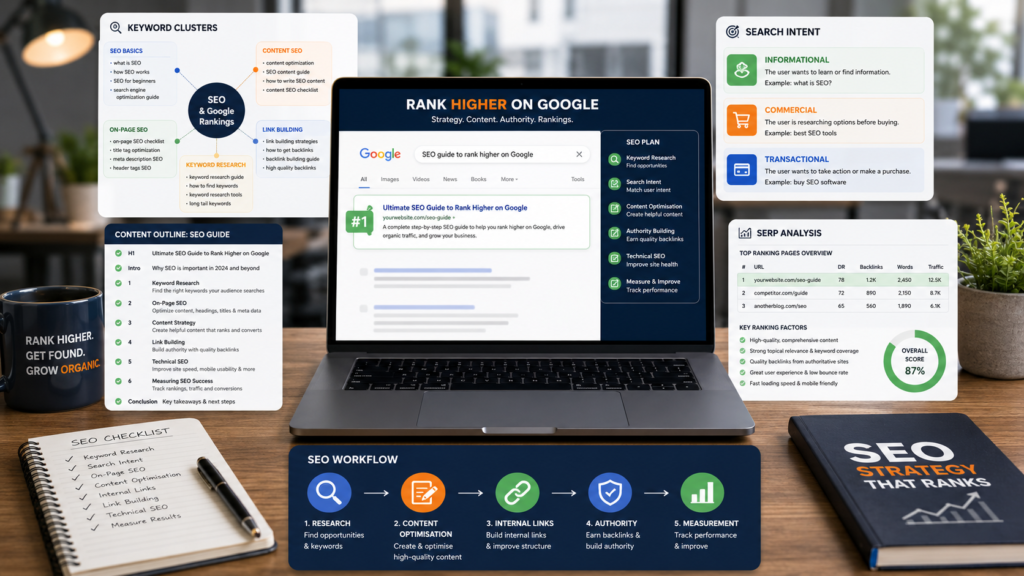
You do not need 200 equally weighted tasks.
Use dependency and impact.
First, establish eligibility. Important pages should be discoverable, crawlable, indexable and canonicalised correctly.
Second, establish demand and intent. The page needs a real query set and the correct purpose for that query.
Third, improve the result itself. Add useful information, evidence, expertise, clear structure and accurate on-page signals.
Fourth, strengthen the website around it. Improve site architecture, relevant internal links and supporting topical resources.
Fifth, address competitive authority. Earn legitimate references where the SERP and market justify them.
Sixth, improve meaningful user-experience constraints. Fix loading, responsiveness, mobile and accessibility problems that interfere with the page.
Finally, measure the business effect. Track rankings, visibility, clicks and conversions rather than declaring success when a tool’s SEO score reaches 100.
That gives you a repeatable system:
diagnose → prioritise → implement → measure → reassess
Frequently Asked Questions
What is the fastest way to rank higher on Google?
The fastest useful action is to identify the page’s actual limiting factor; fixing indexation can matter more than content, while an already indexed page may instead require stronger intent alignment, information value or authority.
Can you pay Google to rank higher organically?
No. Google states that payment does not make it crawl a site more frequently or rank a webpage higher in organic Search.
Does Google use keyword density?
Do not optimise toward a fixed keyword percentage; Google recommends using the words people search for naturally in descriptive locations such as titles, headings, link text and alt text.
Do backlinks guarantee first-page rankings?
No. Links can support discovery, relevance and authority, but rankings depend on many systems and a stronger backlink profile cannot guarantee visibility for a page that fails the query intent.
Is Domain Authority a Google ranking metric?
No third-party authority score should be treated as Google’s internal ranking data; Google says third-party SEO tools do not have access to its internal ranking information.
Does an XML sitemap guarantee indexing?
No. A sitemap helps discovery, but Google explicitly says it does not guarantee that submitted URLs will be crawled or indexed.
Can robots.txt remove a webpage from Google?
Not reliably. A blocked URL can still be discovered and appear in Search; use the appropriate index-control method when the objective is removal from Google’s index.
Does schema markup directly increase rankings?
Structured data can help Google understand marked entities and enable eligibility for supported rich results, but correct markup does not guarantee a rich result or a higher organic position.
Can AI-generated content rank?
Yes, provided the content meets Google’s quality and spam requirements; large-scale AI publishing without added value can violate scaled-content-abuse policies.
Do I need llms.txt to appear in Google AI Overviews?
No. Google says it does not use llms.txt as a special ranking or visibility mechanism for Google Search, including its generative AI experiences.
Do I need GEO or AEO instead of SEO in 2026?
No separate replacement is required for Google Search; Google’s current guidance says foundational SEO practices remain applicable to AI Overviews and AI Mode.
What should I check first if rankings suddenly drop?
Identify the exact decline date, affected URLs and queries first, then inspect indexation, technical changes, content changes, competitors and confirmed Google updates before making major revisions.
How often should SEO content be updated?
Update a page when accuracy, intent, evidence, usefulness or competitive conditions materially change rather than following a fixed refresh interval.
Can a new website rank without hundreds of backlinks?
Yes, but competitive feasibility depends on the query, search intent, content value, existing competition and authority requirements rather than a universal backlink count.
Conclusion
To rank higher on Google in 2026, fix the right problem in the right order.
Start with crawlability and indexing. Then improve search intent alignment, content quality, internal links, authority, and page experience.
AI Overviews and AI Mode do not replace SEO fundamentals. Focus on useful, original, trustworthy content that satisfies real search demand.
Diagnose → optimise → measure → improve.
The goal is not rankings alone. It is more qualified traffic, leads, sales, and revenue from Google.