
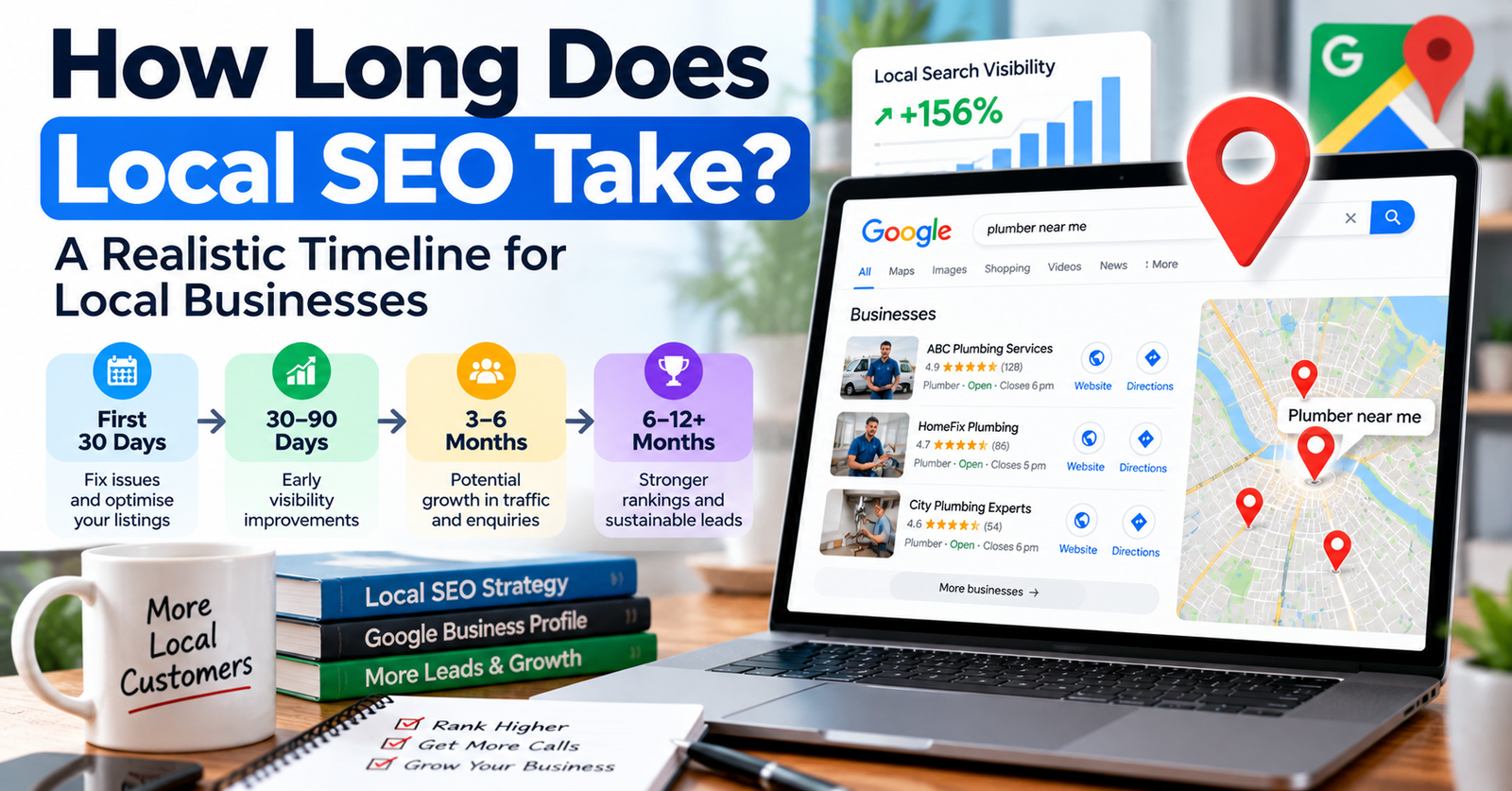
A practical planning window for local SEO is 3–6 months to evaluate meaningful progress in search visibility and customer enquiries not a guaranteed time to rank. Some businesses see measurable changes within the first 30–60 days, especially after correcting a clear technical or Google Business Profile issue. Competitive businesses may need 6–12 months or longer to build consistent visibility and qualified leads.
The right timeframe depends on the outcome you are measuring. Indexing a service page, gaining visibility across a town and generating profitable new customers are three different milestones, each requiring different evidence.
However, the timeline depends on what you consider a result.
Getting your plumbing business listed on Google Maps is one result. Appearing for “emergency plumber near me” is another. Receiving enough qualified calls to justify your SEO investment is a different outcome entirely.
These results do not necessarily happen at the same time.
Google needs to discover, crawl and index relevant website pages. Its local ranking systems also evaluate how closely a business matches a search, its geographic distance from the searcher and its prominence.
An established business with an indexed website, accurate Google Business Profile and existing customer reviews starts from a different position than a newly launched company with no search visibility.
So, rather than treating six months as a guaranteed deadline, it helps to understand what should be measured at each stage and when a lack of progress becomes a reason to investigate.
How Long Does Local SEO Take to Show Results?
Most local businesses should allow 3–6 months to assess meaningful SEO progress, while stronger positions in competitive locations may require 6–12 months or longer.
The distinction is between initial visibility and sustained customer acquisition.
An early increase in search impressions means Google is showing your pages more often. It does not necessarily mean more people are contacting your business.
Similarly, an improvement from position 15 to position 8 for a relevant local keyword represents ranking progress. Whether that improvement generates calls depends on search demand, click-through behaviour, local competition and the quality of the landing page.
Google’s SEO Starter Guide explains that changes can take anywhere from hours to several months to affect Google Search. The search engine does not provide a fixed ranking timetable.
Historical industry research helps explain why estimates vary. In BrightLocal’s 2014 local search ranking survey, 78% of participating experts estimated that a new business in a competitive market could achieve significant ranking improvements within 3–9 months.
Important evidence limitation: this was an expert-opinion survey conducted in 2014, not a study tracking current campaigns from launch to customer acquisition. It does not establish that a particular percentage of businesses will rank within that period today. The 3–6 month estimate in this article is therefore a practical review window, not a statistically verified industry average. Your own baseline, competition and campaign records are more useful for setting expectations.
For planning purposes, the following ranges are useful:
| Timeframe | Possible SEO development | Evidence of progress |
| First 30 days | Technical corrections and Business Profile improvements | Indexed pages, resolved errors, accurate business information |
| 30–90 days | Early movement in local search visibility | Relevant impressions, clicks and tracked ranking changes |
| 3–6 months | Potential growth in local traffic and enquiries | Qualified calls, form submissions and bookings |
| 6–12 months | Further development for competitive searches | Broader ranking coverage, attributed customers and revenue |
| 12+ months | Ongoing competitive improvement and maintenance | Sustained search visibility and financial performance |
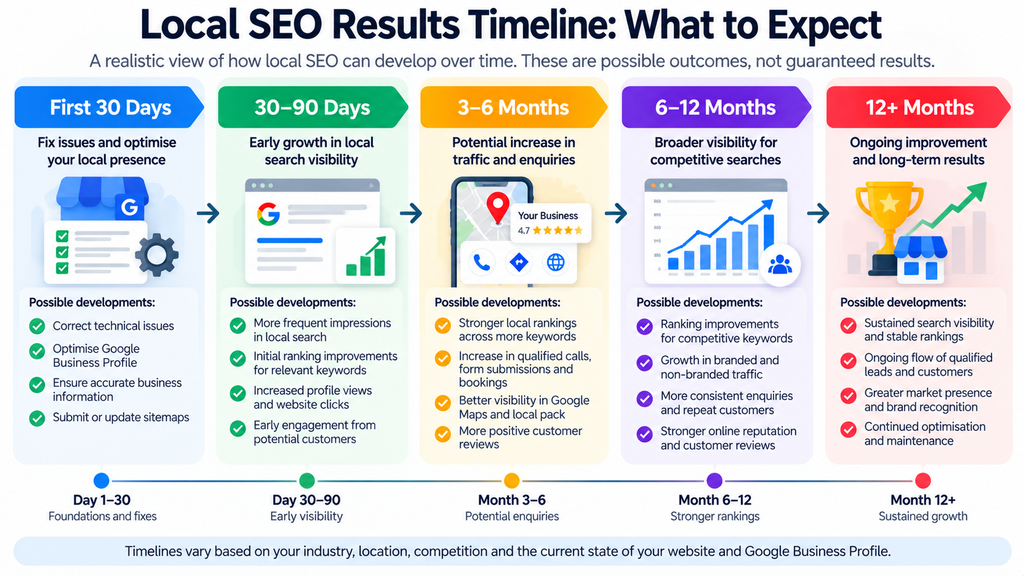
These are evaluation windows, not deadlines by which each outcome must occur.
Can Local SEO Show Results Within 30 Days?
Yes, some local SEO improvements can become visible within
30 days, especially when an identifiable technical or listing problem is corrected.
Consider a business that already has an established website but an incorrect Google Business Profile category.
Correcting the category may help Google understand which searches are relevant to that business. The outcome still depends on the other businesses competing for those searches.
A previously blocked service page might also become eligible for indexing after a technical correction. Once Google processes the change, the page has an opportunity to appear in search results.
Neither improvement guarantees an immediate ranking increase.
The important question during the first month is whether foundational problems have been identified and corrected, rather than whether every target keyword has reached page one.
What Counts as a Meaningful Local SEO Result?
A meaningful local SEO result is a measurable improvement connected to a business objective, such as qualified enquiries, appointments or acquired customers.
Search visibility and business performance are related, but they are not interchangeable.
For example, suppose a roofing company’s non-branded organic impressions increase from 1,000 to 1,500 in a comparable reporting period.
That represents a 50% increase in impressions.
If the same company receives no additional quote requests, the visibility improvement has not yet demonstrated increased customer acquisition.
The next investigation should examine which queries generated the impressions, whether users clicked through and whether the landing pages matched their needs.
For service businesses, qualified leads generally provide a more useful commercial measure than impressions alone.
What Is the Local SEO Timeline Month by Month?
A local SEO campaign usually starts with technical and business-information improvements, then progresses through search relevance, ranking evaluation and customer acquisition measurement.
The sequence is not strictly linear. Google can process individual changes at different times, and some ranking improvements may occur before every planned task is complete.
The following timeline explains what a business owner should reasonably expect an SEO provider to work on and report.
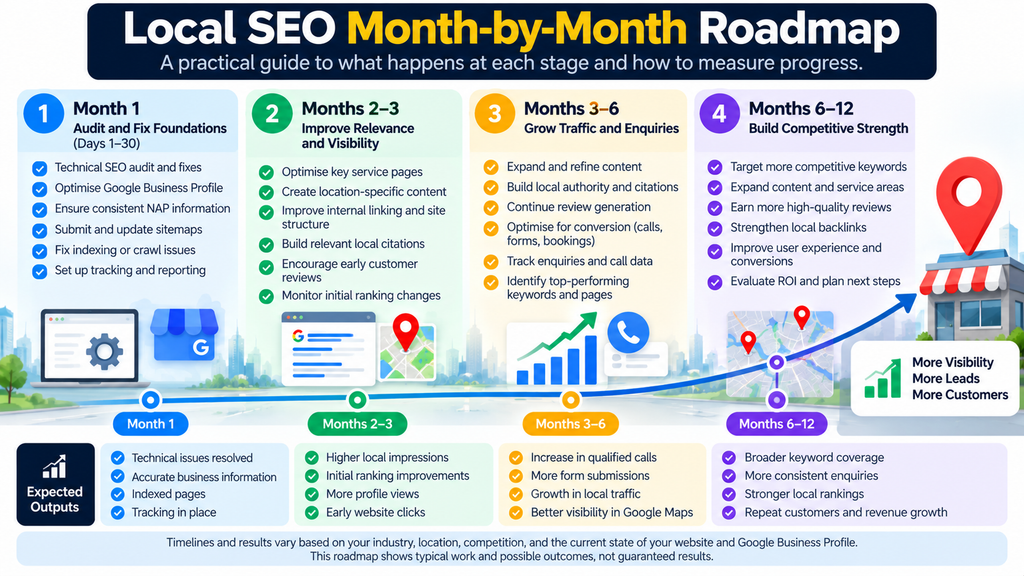
Month 1: What Happens During the First 30 Days?
The first month should establish the business’s starting position and resolve problems that prevent Google from understanding or accessing its website and Business Profile.
An effective local SEO audit begins with three questions.
Can Google access and index the website’s important pages? Does the business provide accurate information about its services and location? And which competing businesses currently appear for the searches that matter?
For a heating company in Manchester, the audit should examine actual service demand, including boiler repairs, boiler servicing and emergency heating work.
A page targeting boiler repairs needs to explain that service accurately. Merely repeating “boiler repair Manchester” throughout the page does not establish useful relevance.
Google Search Console can reveal indexing problems, organic search queries and existing impressions. Google Business Profile provides information about the business listing and eligible customer interactions.
The first-month deliverable should be a documented baseline with identified issues, completed corrections and a plan for the next reporting period.
A usable baseline records the date and source of each measure: non-branded organic clicks and impressions in Search Console; Business Profile interactions reported by Google; local rankings for a defined set of queries and geographic sample points; and qualified enquiries recorded in the business’s own systems. Note whether tracking was already reliable before the campaign began.
What to request by day 30: a list of priority pages checked for indexability, the Business Profile fields reviewed, the specific fixes completed, baseline screenshots or exports and the next three priorities. If a provider reports only that it has “started building authority” without showing what was changed, the report does not establish meaningful progress.
Months 2–3: When Do Local Rankings Start Improving?
Some businesses begin seeing measurable ranking movement during months two and three as Google processes relevant website and Business Profile improvements.
This phase usually concentrates on improving service-page relevance, correcting inaccurate business information and strengthening the connection between the business’s real services and the searches it wants to appear for.
Consider an electrician with one generic services page.
If the company genuinely provides consumer unit replacements, electrical inspections and emergency electrical repairs, those services may require clearer explanations on the website.
Each page should address a distinct service need.
For example, an electrical inspection page can explain the inspection process, the type of property covered, the resulting report and how customers arrange the service.
That provides search engines with relevant information while helping potential customers understand what they are buying.
Performance should be reviewed by query and page rather than through a single average ranking number.
An increase in impressions for relevant non-branded terms can indicate progress even when enquiry volume has not yet changed.
How to interpret the first 90 days: if important pages remain unindexed, investigate technical eligibility and Google’s indexing reports before creating more pages. If pages gain relevant impressions but few clicks, examine the actual queries, average positions and how the pages appear in search. If rankings improve only close to the business premises, review the geographic tracking grid rather than assuming the improvement applies to the entire city. Compare like-for-like periods; individual daily ranking movements are too variable to establish a trend.
Months 3–6: When Should Local SEO Start Generating Leads?
Months three through six are a practical period for evaluating whether improved local visibility is producing additional qualified enquiries.
At this stage, a business should have enough reporting history to examine trends across website visits, profile interactions and recorded enquiries.
Suppose a local plumbing business receives 20 organic enquiries during one reporting month compared with 12 during its original baseline month.
That is an increase of eight enquiries, or approximately 67%.
Before attributing the change to SEO, examine seasonal demand, paid advertising, branded searches and any changes in call or form tracking.
An increase in enquiry volume does not automatically prove an increase in acquired customers. Some calls may concern unavailable services or areas outside the company’s operating radius.
That is why the quality of enquiries matters.
A useful monthly report should establish which searches are gaining visibility, which pages attract relevant visitors and whether those visitors are turning into actual business opportunities.
For example, a report should distinguish 40 clicks on a Business Profile’s call button from 25 connected calls and 12 qualified enquiries—illustrative numbers that represent separate events, not interchangeable conversions. Profile performance, call tracking and customer records may each be needed to establish what actually happened. Use consistent definitions and avoid double-counting the same customer across phone, form and booking channels.
If search visibility improves but leads remain unchanged, the next priority may be landing-page relevance, contact friction or conversion problems rather than simply publishing more content. If qualified enquiries increase but completed jobs do not, investigate response time, pricing, service availability and the sales process as well.
Months 6–12: How Long Does It Take to Rank for Competitive Local Keywords?
Competitive local searches may require 6–12 months or longer to develop stronger, more consistent rankings, depending on the starting position and competing businesses.
A company targeting “personal injury solicitor London” faces a different competitive environment from a business targeting a specialised repair service in a smaller town.
The difference is not simply population size.
The relevant variables include the number of strong competitors, their service-page coverage, website prominence, customer reputation and geographic relationship to searchers.
By month six, a business should be able to examine completed work and compare its present search visibility against the original baseline.
This does not mean every business should rank in the Google Maps top three by that point.
It means the campaign should have enough evidence to support an informed decision about what is working, what is not working and which objectives remain realistic.
For some businesses, further growth will involve improving pages that already receive impressions. Others may need to address technical problems, weak service relevance or geographic limitations.
What Happens After 12 Months of Local SEO?
After 12 months, local SEO should be evaluated as an ongoing customer acquisition channel rather than a collection of isolated ranking tasks.
Established rankings can continue generating enquiries, but they are not permanent.
Competitors can improve their websites, businesses can change location, customer demand can shift and Google can update its ranking systems.
A business with several successful service pages may focus on maintaining accurate information and improving conversion performance.
Another company may expand coverage to additional genuine services or operating areas.
The objective is not continuous content production for its own sake. It is maintaining relevance, discoverability and measurable commercial value.
What Factors Affect How Long Local SEO Takes?
Local SEO timelines vary because Google evaluates local relevance, geographic distance and business prominence while organic website performance depends on additional search and technical considerations.
Google identifies relevance, distance and prominence as the main considerations for local results in its local ranking guidance.
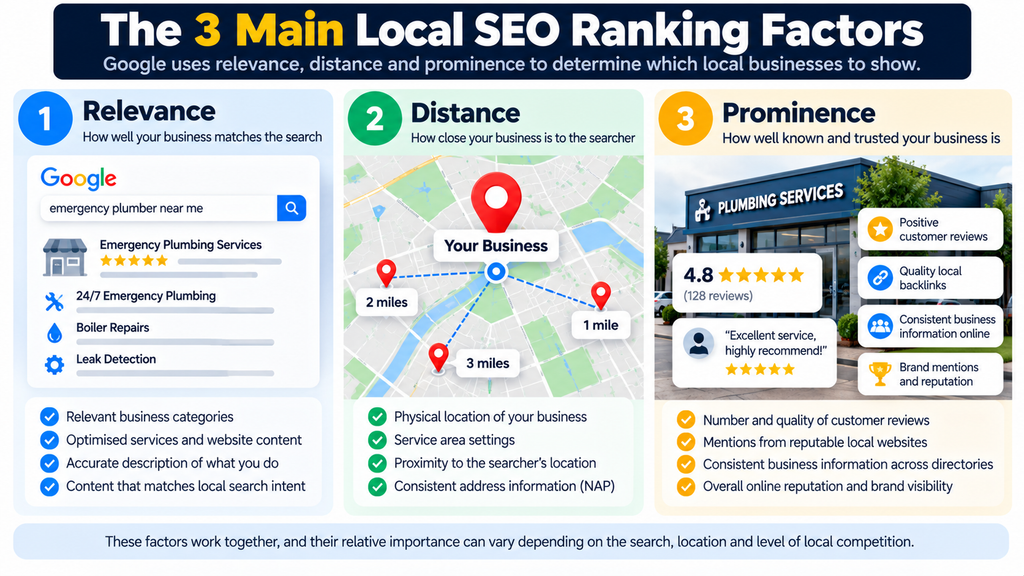
These concepts explain why two businesses paying for similar SEO work can experience different outcomes.
How Does Local Search Competition Affect Ranking Time?
Higher competition can increase the work required to improve local rankings because several relevant businesses may be competing for the same search demand.
Competition should be examined at the query and geographic level.
For example, “emergency plumber London” and “emergency plumber in a specific London neighbourhood” can produce different search results.
A company might rank strongly close to its premises but have limited visibility across the wider city.
The useful comparison is not simply how many plumbers operate in London. It is which businesses appear for the targeted search, where they are located and what evidence of relevance and prominence they have.
This includes their business categories, relevant webpages, legitimate backlinks and customer reviews.
A competitor analysis provides a starting benchmark. It cannot calculate a guaranteed number of days until a business overtakes another listing.
Does Google Business Profile Optimisation Make Local SEO Faster?
Google Business Profile optimisation can improve the accuracy and relevance of a business listing, but it does not eliminate geographic or competitive ranking constraints.
A Google Business Profile connects a real-world business with information that customers use in Search and Maps.
Its attributes include the business name, primary category, address or service area, opening hours, available services and customer reviews.
Each attribute serves a particular purpose.
A relevant primary category helps identify the type of business. Accurate opening hours help customers determine availability. Genuine customer reviews provide information about previous customer experiences.
Google recommends providing complete and detailed business information because it helps its systems match businesses with relevant searches.
However, adding services or publishing more photos does not guarantee placement in the Local Pack.
A business located several miles from a searcher may still face a distance disadvantage compared with a similarly relevant nearby competitor.
Does Website Authority Affect Local SEO Results?
An established website with relevant content, legitimate backlinks and existing search visibility may have advantages over a newly launched website, although age alone does not guarantee rankings.
The term “website authority” is commonly used in SEO, but it should not be confused with a single official Google metric.
Third-party tools may calculate proprietary scores to estimate a website’s relative link strength. Those scores are not equivalent to Google’s internal ranking calculations.
What matters for a local SEO assessment is whether the website has useful service information, can be indexed and has credible references from other websites.
For example, a landscaping company may have legitimate links from suppliers, local organisations and industry publications.
Those references can contribute to the website’s online prominence when they are relevant and naturally earned.
Buying large quantities of unrelated links does not create the same value and can introduce search-spam risks.
How Do Customer Reviews Affect Local Rankings?
Genuine customer reviews contribute to business reputation, and Google confirms that review quantity and positive ratings can help local ranking performance.
Review signals should be evaluated alongside the experience of the customer.
A business with a high review count may appear more established, but the number alone does not guarantee that it will outrank every competitor.
Customers also examine whether reviews describe the services they are considering and whether the business responds appropriately.
For example, a customer choosing a roofing contractor may look for evidence of completed roof repairs, communication quality and reliability.
Review acquisition should therefore form part of normal customer service.
Businesses can request authentic feedback from eligible customers. They should not purchase reviews, manufacture feedback or offer incentives that violate Google’s policies.
Does Business Location Affect How Quickly You Rank?
Business location directly affects local search visibility because distance is one of Google’s principal local ranking considerations.
A physical shop, dental practice or restaurant may appear more prominently to nearby searchers than to people farther away.
Service-area businesses also need to describe their actual operating areas accurately.
Adding more city names to a website does not change the business’s physical location.
For example, a plumber based in Croydon may serve other parts of London, but that service coverage does not guarantee strong Google Maps rankings throughout the capital.
This distinction matters when an agency proposes ranking a single Business Profile across a large geographic area.
How Long Does Google Maps SEO Take Compared With Website SEO?
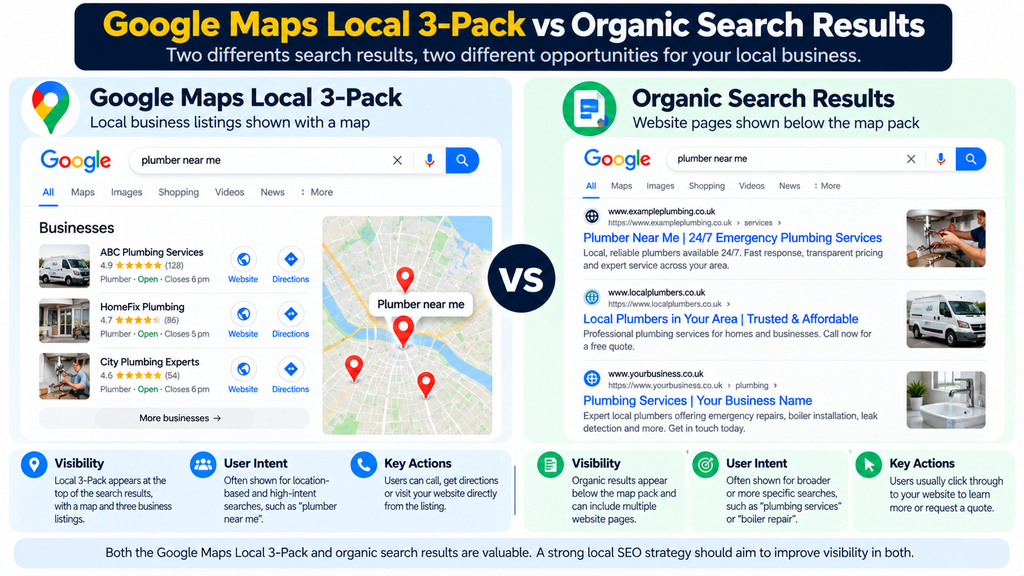
Google Maps and website SEO can improve at different rates because they involve distinct search results, ranking contexts and performance measures.
Google Maps and the Local Pack display relevant business listings. Standard organic search displays indexed website pages.
A business can perform well in one search surface without holding an equivalent position in the other.
For example, a dental practice may have an informative webpage ranking organically for “dental implants Birmingham” while its Business Profile appears outside the top three map results for a search conducted several miles from the clinic.
The webpage’s organic relevance does not remove the distance consideration affecting local listings.
How Long Does It Take to Reach Google’s Local 3-Pack?
There is no fixed timeframe for reaching the Google Local 3-Pack, and a top-three position at one location does not guarantee the same position elsewhere.
A business might appear in the top three results near its premises but rank lower from another part of the same city.
This is why a single manually checked ranking can be misleading.
A geographic rank-tracking grid can sample positions at several points around a location.
For example, a 5 × 5 grid contains 25 measurement points. If a business appears in the top three at 10 of those points, its observed top-three coverage is 40% for that sampled query and grid.
That figure describes geographic coverage within the chosen sample. It is not a Google-provided ranking score.
Repeat measurements using the same query, locations, device settings where available and methodology to assess changes over time.
Keep Maps and website reporting separate. A map-grid result describes a Business Profile’s observed position at sampled coordinates. Search Console reports website search performance, not the exact positions of that Business Profile on Maps. Business Profile Performance reports eligible interactions, but a call-button click does not confirm that a call connected or became a paying customer. Bring those datasets together only after checking what each metric measures and whether attribution overlaps.
Does Local SEO Take Longer for a New Business?
A new business may need longer to establish competitive local visibility because it often starts without indexed service pages, search history, customer reviews or relevant online references.
However, a new business is not automatically disadvantaged in every local market.
A newly opened specialist service provider in an area with limited relevant competition may gain visibility relatively quickly.
An established business can also have serious problems that delay improvement.
For example, years of duplicate pages, inaccurate listings or unresolved indexing errors may require substantial corrective work.
A new business with a properly configured website may have fewer legacy problems.
New Business vs Established Business: What Changes?
| Business condition | New business | Established business |
| Website indexing | May need initial discovery and indexing | May already have indexed pages |
| Customer reviews | Often limited or absent | May have an existing review history |
| Online references | May have few relevant links or citations | May already have local references |
| Search performance | Limited historical data | Existing impressions and clicks may be available |
| Main SEO requirement | Establish an accurate and relevant presence | Correct weaknesses and develop existing visibility |
These differences help explain the starting position, not a fixed number of months required for success.
Can You Speed Up Local SEO Results?
Local SEO progress can sometimes be accelerated by correcting high-impact relevance, indexing and business-information problems before investing in broader content or link development.
The fastest useful action depends on what is currently preventing the business from appearing for relevant searches.
If Google cannot index an important service page, additional backlinks will not fix the underlying access problem.
If a Business Profile has the wrong business category, publishing unrelated blog articles will not correct that mismatch.
A practical order of work is:
- Check technical accessibility. Confirm that important pages can be crawled and indexed and that canonical URLs are configured appropriately.
- Correct business information. Verify Business Profile details and fix inaccurate information on relevant business listings.
- Improve service relevance. Create or revise pages that accurately answer the needs of customers searching for the company’s actual services.
- Strengthen legitimate reputation signals. Request genuine customer reviews and obtain relevant references where there is a real business relationship.
- Measure the effect. Compare search visibility and qualified enquiries after changes have been processed.
This is a prioritisation framework, not a prescribed Google ranking sequence.
Can Publishing More Location Pages Improve Rankings Faster?
Location pages can support local organic visibility when they provide distinct, useful information about genuine locations or service areas.
Creating dozens of near-identical pages with substituted city names does not automatically improve geographic relevance.
Consider a cleaning company serving Manchester, Salford and Stockport.
A useful page for each area could explain the actual services available, local operating arrangements, service limitations and relevant customer information.
If every page contains the same text with only the location changed, the pages provide little additional value.
Google’s people-first content guidance prioritises helpful, original information over material created mainly to attract search traffic.
The goal should be to answer a distinct customer need, not to maximise the number of indexed URLs.
How Do You Know Whether Local SEO Is Working?
Local SEO is working when comparable performance data shows relevant improvements in discoverability, engagement or customer acquisition that can reasonably be connected to the optimisation activity.
A ranking report alone cannot establish financial value.
The measurement process should connect four stages: search visibility, customer interaction, qualified enquiry and acquired customer.
Google Search Console helps evaluate website search performance.
Google Business Profile Performance reports eligible business interactions.
Website analytics and customer relationship management records can provide further information about form submissions, confirmed phone enquiries, appointments and sales.
These measurement systems serve different purposes.
What Should You Measure During the First 90 Days?
During the first 90 days, track completed work, relevant search impressions, organic clicks and changes in geographic visibility against the original baseline.
A useful report separates branded from non-branded searches and shows where the figures came from. A simple month-by-month summary can include:
| Metric | Baseline | Current period | What to investigate |
| Non-branded organic clicks | Record actual value | Record actual value | Are visitors arriving through relevant service queries? |
| Relevant service-page impressions | Record actual value | Record actual value | Are the right pages gaining discoverability? |
| Local 3-Pack coverage on a fixed grid | Record sampled percentage | Record sampled percentage | Is visibility improving in target neighbourhoods? |
| Qualified enquiries | Record deduplicated count | Record deduplicated count | Are contacts genuine prospects for the services offered? |
| Acquired customers | Record verified count | Record verified count | Is growth translating into completed business? |
This is a reporting template, not a set of expected results. Record seasonality, campaign changes and known tracking gaps beside the numbers. Avoid adding Search Console clicks to Business Profile interactions as though they were the same metric.
Someone searching for a business by its exact name already knows the brand.
Someone searching for “emergency electrician Leeds” may be discovering a provider for the first time.
Increasing visibility for non-branded service queries is particularly relevant when the business wants to reach new customers.
Use consistent reporting periods and note changes in demand.
For example, comparing December boiler-repair searches with June searches without considering seasonality may lead to misleading conclusions.
What Should You Measure After Six Months?
After six months, evaluate qualified enquiries, acquired customers and attributable financial return alongside search rankings.
Suppose a business increases organic clicks by 40% but receives the same number of leads.
The result suggests greater website engagement from search, but it does not establish improved lead generation.
The next review should investigate the searches driving traffic, the services customers request, landing-page conversion performance and tracking accuracy.
If qualified leads rise but sales remain unchanged, examine lead handling and conversion from enquiry to customer.
These distinctions prevent the business from investing indefinitely in activity that looks successful on a dashboard but produces little commercial value.
Why Is Local SEO Not Working After Six Months?
Local SEO may show limited progress after six months because of unresolved technical problems, weak query relevance, geographic constraints, intense competition or inadequate performance measurement.
Six months without improvement deserves investigation.
It does not automatically mean that the campaign has failed, and it does not justify accepting indefinite delays without evidence.
The first question is what has actually changed.
If a business has no increase in relevant impressions, inspect whether its pages are indexed, whether search demand exists and whether its content matches the targeted searches.
If impressions have increased but clicks remain low, review the queries, ranking positions and search-result presentation. Check whether growth is coming from queries the business can actually serve.
If website visits increase but enquiries do not, test whether the page clearly explains the service, location, availability and next step. Check mobile usability and whether phone numbers, forms and booking links work.
If qualified enquiries increase but customers do not, review lead handling, response time, geographic eligibility and conversion from enquiry to sale.
Use this as a diagnosis, not a fixed ranking formula: each pattern suggests a place to investigate; none proves a single cause without supporting data.
A website that receives visitors searching for domestic roof repairs will struggle to generate suitable enquiries if the company only performs large commercial roofing projects.
That is a relevance problem, not necessarily a lack of authority.
What Are the Warning Signs of a Poor Local SEO Campaign?
A campaign warrants closer review when the provider cannot demonstrate completed work, explain changes in performance or connect reported improvements to relevant business objectives.
For example, an agency might report that keyword rankings have improved without identifying which keywords, locations or dates were measured.
A rise in rankings for the company name may be less commercially significant than improved visibility for a service query that attracts new customers.
Likewise, a report showing increased organic traffic without distinguishing relevant visitors from unrelated searches provides an incomplete picture.
A business should be able to request the original baseline, implemented changes, performance comparisons and the reasoning behind future priorities.
The absence of guaranteed rankings is normal. The absence of transparent reporting is a separate concern.
Should You Change SEO Agencies After Six Months?
Consider reviewing or replacing an SEO provider when documented work, reporting quality and measurable progress do not justify continued investment.
An agency should be able to explain what was changed, what the available data shows and which issues remain unresolved.
Before changing providers, distinguish between factors the agency can control and those it cannot.
An agency can improve page content and correct technical errors. It cannot move the business closer to every searcher or guarantee a particular Google ranking.
A second opinion or independent audit may help establish whether the existing strategy addresses the most important problems.
Is Local SEO Worth Paying for If Results Take Six Months?
Local SEO can justify a multi-month investment when the expected value of additional customers exceeds the total cost of acquiring them.
The relevant financial measure is not simply how much traffic the campaign generates.
It is how much incremental business can reasonably be attributed to organic search and Google Business Profile interactions.
A local service business should establish its average customer value, contribution margin, lead-to-customer conversion rate and monthly SEO cost.
These figures help determine the enquiry volume required to recover the investment.
How Do You Calculate Local SEO Return on Investment?
Local SEO ROI compares the financial contribution attributable to the campaign with the cost of delivering it.
Consider a hypothetical plumbing company paying £600 per month for local SEO over six months.
Its total investment is £3,600.
Suppose the campaign generates 30 additional qualified leads. If 40% become customers, the company acquires 12 customers.
If each acquired customer generates an average contribution of £450 after direct service costs, the resulting contribution is £5,400.
| Financial measure | Illustrative result |
| Monthly SEO cost | £600 |
| Six-month SEO investment | £3,600 |
| Additional qualified leads | 30 |
| Lead-to-customer conversion rate | 40% |
| Additional acquired customers | 12 |
| Contribution per customer | £450 |
| Total attributed contribution | £5,400 |
| Net contribution after SEO cost | £1,800 |
| ROI | 50% |
The calculation is:
ROI = (Attributed contribution − SEO cost) ÷ SEO cost × 100
In this example, (£5,400 − £3,600) ÷ £3,600 × 100 = 50%.
This is an illustrative financial model, not an industry average or a forecast.
The result assumes reliable attribution and excludes any other costs not already represented in the model. In particular, the 30 leads must be additional leads attributable to the campaign, rather than the business’s total leads during the period. The £450 figure is contribution after assumed direct job costs, not necessarily net profit after overhead.
For an ongoing campaign, also track cumulative contribution minus cumulative SEO spend by month. The campaign reaches estimated break-even when that cumulative difference first becomes zero or positive; a positive result in one month alone is not the same as recovering all previous investment.
When Does Local SEO Start Paying for Itself?
Local SEO reaches financial break-even when its accumulated attributed contribution equals its accumulated investment.
The break-even date depends on the cost of the campaign, the number of new customers, their contribution value and the accuracy of attribution.
For example, a business with a high-value repeat service may require fewer new customers to recover its SEO expenditure than a business with low-value, one-off transactions.
That does not mean the high-value business will rank faster.
Ranking speed and investment recovery are different measurements.
Is Local SEO Better Than Google Ads for Getting Customers Quickly?
Google Ads can generate paid search exposure once eligible campaigns begin serving, while local SEO usually requires more time to build measurable organic visibility.
However, paid visibility depends on targeting, bids, budgets, competition and ad eligibility. It does not guarantee enquiries.
Local SEO does not charge the business for each organic click, but optimisation still requires labour, tools and ongoing investment.
For a business that needs immediate lead opportunities, paid search may provide an additional acquisition channel while organic visibility develops.
The appropriate comparison is the cost of acquiring qualified customers through each channel, rather than assuming one channel is universally cheaper.
Should You Hire a Local SEO Agency or Manage SEO Yourself?
Hiring a local SEO agency is most relevant when the business lacks the time, technical expertise or internal capacity to implement and measure the required work.
Some activities can be handled directly by a business owner.
For example, maintaining accurate opening hours, supplying service information and requesting legitimate customer reviews do not inherently require an external agency.
Technical website corrections, complex location-page planning, competitor analysis and conversion attribution may require specialist support.
The decision should follow an assessment of the actual work needed.
A small business with one location and a technically sound website may have a different requirement from a company operating 20 branches across several cities.
What Should a Local SEO Agency Deliver in the First 90 Days?
An agency should provide a documented baseline, verifiable optimisation work and performance reporting during the first 90 days.
By day 30, the business should understand its main technical issues, relevant search queries and competitive starting position.
By day 60, agreed corrections and content improvements should be identifiable.
By day 90, the provider should compare current performance with the baseline and explain the next priorities.
The business should not need to rely on vague assurances that Google will eventually reward the work.
Although rankings cannot be guaranteed, completed deliverables and measurement methods can be verified.
What Should You Ask Before Hiring a Local SEO Agency?
Ask how the agency measures business outcomes, prioritises technical work and determines whether its strategy is producing relevant progress.
A useful discussion should cover the business’s actual services, operating locations, current search visibility and cost of acquiring customers.
Request examples of how the agency reports non-branded visibility, qualified enquiries and completed optimisation tasks.
If case studies are supplied, check whether they include a meaningful baseline, reporting dates and the specific outcomes measured.
A screenshot showing a number-one ranking without its query, location and date provides limited evidence.
How Can a Local SEO Audit Help You Estimate Your Timeline?
A local SEO audit can identify the conditions affecting your current visibility and support a prioritised action plan, but it cannot predict an exact Google ranking date.
The strongest reason to request an audit is uncertainty about what is slowing progress.
A business that already ranks for several relevant services may require conversion improvements rather than a complete new content strategy.
Another company may have important service pages excluded from indexing.
A third may be targeting geographic locations where its Business Profile has limited visibility because of distance.
Those situations require different actions.
An audit should establish the search queries that matter, the business’s existing performance and the obstacles that can realistically be addressed.
What Happens During a Local SEO Audit?
A local SEO audit examines the website, Google Business Profile, relevant competitors and measurable search performance to determine which improvements should receive priority.
For an established business, historic data can help distinguish a recent decline from a long-standing visibility problem.
For a new business, the assessment may focus more heavily on establishing the technical and geographic foundations.
The resulting recommendations should identify which changes are necessary, why they matter and how their effects will be evaluated.
How Do You Know Whether You Need an SEO Audit?
An independent audit is useful when your business has limited non-branded visibility, inconsistent local rankings or several months of SEO expenditure without clear performance evidence.
You do not need to wait six months if a specific problem is already apparent.
For example, an important service page that Google cannot index should be investigated when the problem is discovered.
Likewise, a suspended Business Profile or inaccurate business information requires attention independently of the campaign’s age.
If the main concern is whether continued SEO investment is justified, the audit should include available lead and revenue data alongside search performance.
Before committing to another three months of SEO spending, ask for a baseline-to-current performance review. It should identify the searches and locations being measured, changes already implemented, any unresolved indexing or Business Profile issues, qualified enquiries gained and the next actions worth prioritising.
Request a local SEO performance audit if you need an independent assessment of that evidence and a practical priority list—not a promise of a particular Google Maps position.
Frequently Asked Questions About Local SEO Timelines
Can Local SEO Work in One Month?
Local SEO can show initial improvements within one month, but substantial ranking and lead-generation growth is not guaranteed in that period.
Does Local SEO Always Take Six Months?
No. Six months is a planning and evaluation milestone, not a minimum waiting period or guaranteed completion date.
How Long Does Google Business Profile Optimisation Take?
Basic Business Profile updates may be completed within days, but verification, review processes and ranking effects can require different amounts of time.
Can a New Business Rank on Google Maps?
Yes. An eligible new business can appear on Google Maps, although its visibility depends on relevance, distance and prominence.
Does Having More Reviews Guarantee Better Rankings?
No. Reviews can contribute to local prominence, but they do not override every other ranking consideration.
Why Do My Local Rankings Change Between Locations?
Local rankings can change between locations because Google considers the distance between a business and the person searching.
Can Local SEO Rankings Drop After They Improve?
Yes. Local search positions can change as competitors, search conditions and Google’s ranking systems evolve.
How Often Should I Review Local SEO Results?
Monthly reporting and periodic deeper evaluations provide a practical way to assess search visibility, leads and investment performance.
Can an SEO Agency Guarantee Top-Three Google Maps Rankings?
No. Google does not provide a way to purchase or guarantee improved local ranking positions.
Final Verdict: How Long Should You Give Local SEO Before Expecting Results?
Allow approximately 3–6 months to evaluate meaningful local SEO progress and consider 6–12 months or longer for difficult competitive objectives.
That does not mean doing nothing during the first three months.
The first 30 days should establish what needs fixing. The following 60–90 days should provide evidence of completed improvements and any emerging search visibility changes.
By six months, the business should have a clearer understanding of whether its search presence is improving and whether additional visibility is translating into qualified customer enquiries.
The exact outcome will vary with the market, the business’s starting position and the quality of the implementation.
If you are paying for local SEO and cannot identify which problems have been corrected, which searches are improving or whether more qualified customers are contacting your business, the appropriate next step is a performance review.
The goal is not simply to rank higher. It is to develop local search visibility that produces measurable business value.
To make the next decision, answer three questions with actual records: What changed? Where did visibility improve? Did more qualified customers result? If the first two answers are clear but the third is not, investigate conversion and attribution. If none is clear, review the strategy and reporting before increasing the budget.


