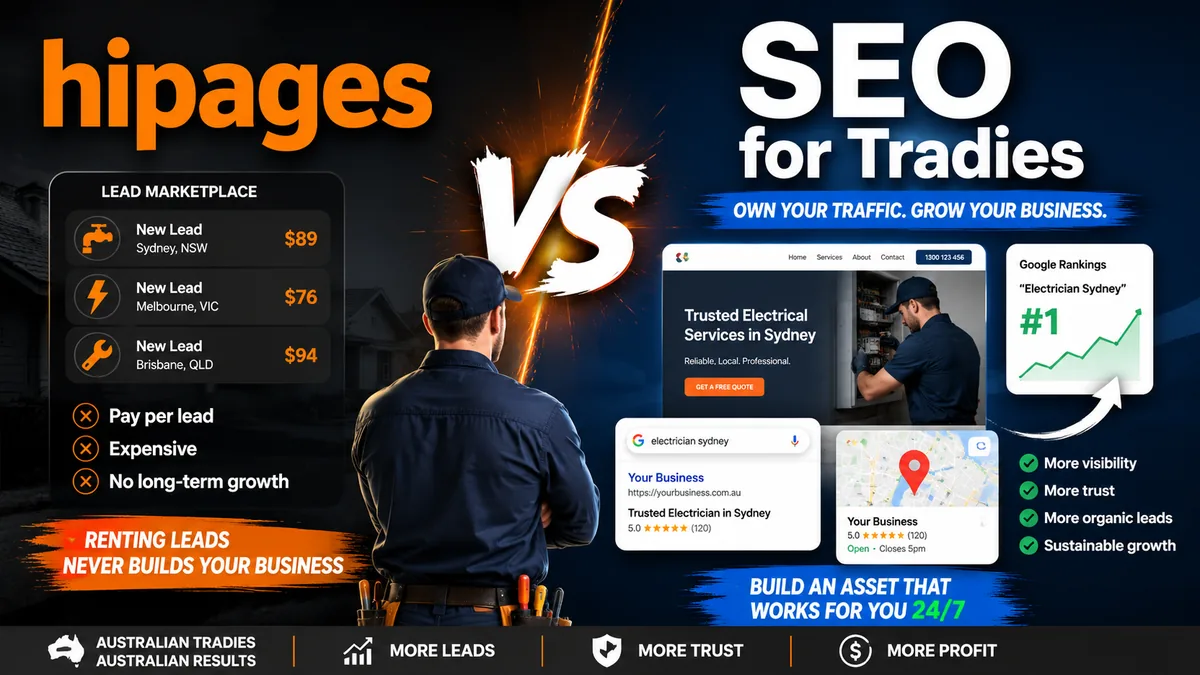
hipages gives tradies faster access to paid marketplace leads, while SEO builds owned Google visibility for direct enquiries. The better option depends on lead urgency, job margin, close rate, local competition, and how much control the trade business wants over future enquiries.
For Australian tradies, the decision is not only about “more leads.” It is about profitable booked jobs. A plumber, electrician, roofer, builder, painter, or landscaper can receive enquiries from hipages, Google Search, Google Maps, referrals, Google Ads, Facebook groups, and local directories. Each channel has a different cost model and risk level.
hipages works as a third-party lead marketplace. Homeowners post jobs, local tradies receive lead invitations, and tradies can choose whether to accept or decline a lead. hipages states that up to three tradies can accept and connect with a customer.
SEO works as an owned search visibility system. Google explains SEO as helping search engines understand content and helping users find a site through Search. For tradies, that means improving a website, Google Business Profile, service pages, suburb pages, reviews, technical SEO, and local authority.
The practical answer is clear: use hipages when short-term lead flow is needed, and build SEO when the business wants long-term direct enquiries from Google.
What Is the Main Difference Between hipages and SEO?
The main difference is ownership: hipages rents access to marketplace demand, while SEO builds visibility through assets the tradie controls.
hipages is a platform-mediated lead source. The homeowner enters the platform, describes the job, and receives responses from local tradies. The tradie gets access to the opportunity, but the customer journey starts inside hipages.
SEO is an owned acquisition system. The tradie controls the website, service pages, suburb pages, Google Business Profile, review strategy, calls-to-action, tracking, and customer data. These assets help the business appear when users search for services such as “emergency plumber near me,” “electrician in Brisbane,” or “roof repair Sydney.”
The difference can be measured across 5 decision variables:
| Decision Variable | hipages | SEO |
|---|---|---|
| Demand source | Posted job requests | Google Search and Google Maps |
| Asset ownership | Platform profile | Website, content, GBP, reviews |
| Lead type | Marketplace lead | Organic enquiry |
| Competition | Other tradies can quote | Other businesses compete in rankings |
| Long-term value | Depends on platform access | Can compound through owned assets |
The factual proposition is this: hipages can create fast access to job opportunities, but SEO can create durable visibility for service and location searches.
How Does hipages Work for Tradies?
hipages works by connecting customers who post jobs with tradies who can accept leads, contact customers, and quote for the work.
The hipages lead process has 5 main steps:
- A potential customer posts a job.
- Lead invitations are sent to professional tradies.
- The tradie chooses to accept or decline the lead.
- Up to three tradies can accept and connect with the customer.
- Connected tradies try to convert the lead into a booked job.
hipages describes a lead as an invitation from a potential customer. Its lead credit page explains that customers post jobs, lead invitations are sent to tradies, and up to three tradies can accept and connect with a customer.
This model can help tradies who need immediate enquiry flow. Examples include a new plumber with no Google rankings, an electrician with empty calendar slots, a painter entering a new suburb, or a landscaper testing demand in a new service area.
The limitation is that a lead is not the same as a sale. A tradie still needs to respond quickly, qualify the job, quote profitably, and win the customer against other providers.
How Does SEO Work for Tradies?
SEO helps tradies appear in Google Search and Google Maps when local customers search for trade services.
For tradies, SEO connects the trade business with people already searching for a service. Searchers may use commercial terms, emergency terms, suburb terms, or price terms. Examples include “blocked drain plumber Parramatta,” “24 hour electrician Melbourne,” “roof restoration Brisbane,” “house painter near me,” and “landscaper Gold Coast.”
Google’s SEO Starter Guide says SEO helps search engines understand content and helps users find a site through Search. This means tradie SEO must make the business, service, location, proof, and conversion path clear.
A strong tradie SEO system includes these assets:
- Website pages for services, such as plumbing repairs, switchboard upgrades, roof repairs, house painting, landscaping, and renovations.
- Location pages for suburbs, cities, and service areas.
- Google Business Profile for local visibility in Search and Maps.
- Reviews that help customers assess trust.
- Technical SEO that supports crawling, indexing, page speed, and mobile usability.
- Internal links that connect service pages, suburb pages, FAQs, and proof pages.
- Tracking through Google Search Console, Google Analytics 4, call tracking, and quote forms.
Google says local results are mainly based on relevance, distance, and prominence. This makes Google Business Profile, local content, reviews, and reputation important for service-area tradies.
Why Do Tradies Compare hipages and SEO?
Tradies compare hipages and SEO because both can generate enquiries, but they differ in cost, lead quality, speed, control, and long-term value.
The comparison usually starts when a tradie asks one of these questions:
- Am I paying too much for leads?
- Are these leads turning into booked jobs?
- Why am I competing with several tradies for the same customer?
- Can I get direct enquiries without relying on a platform?
- Should I invest in SEO before stopping hipages?
- Which channel gives better long-term customer acquisition cost?
The correct metric is not “number of leads.” The correct metric is profitable booked jobs. A channel that produces 40 leads but only 2 profitable jobs may perform worse than a channel that produces 10 leads and 5 profitable jobs.
The comparison should include 6 commercial variables:
| Variable | Why It Matters |
|---|---|
| Lead cost | Shows how much the opportunity costs |
| Close rate | Shows how many leads become jobs |
| Average job value | Shows revenue potential |
| Job margin | Shows whether the job is profitable |
| Lead source ownership | Shows dependency risk |
| Repeat work potential | Shows lifetime value |
The decision is therefore not “which channel gives more leads?” The better question is: which channel gives profitable jobs with acceptable risk and control?
hipages vs SEO Comparison Table
hipages is stronger for fast lead access, while SEO is stronger for owned visibility, direct enquiries, and long-term control.
| Dimension | hipages | SEO |
|---|---|---|
| Channel type | Paid lead marketplace | Organic search acquisition |
| Demand source | Homeowner job posts | Google Search and Google Maps |
| Lead ownership | Platform-mediated | Business-owned |
| Initial speed | Faster | Slower |
| Competition type | Quote competition | Ranking competition |
| Main asset | hipages profile | Website and Google Business Profile |
| Trust signals | Platform reviews, profile, response speed | Google reviews, website proof, photos, licenses |
| Cost model | Membership, credits, lead access | Content, technical SEO, GBP, citations, links |
| Best use case | Short-term pipeline | Long-term direct enquiries |
| Main risk | Platform dependency | Slow execution or poor SEO provider |
The comparison proposition is direct: hipages can help fill short-term gaps, but SEO can reduce long-term dependency on rented lead platforms.
Cost Comparison: hipages Leads vs SEO Investment
The useful cost metric is cost per booked job, not cost per lead.
hipages states that memberships start from $129 + GST per month and include credits that tradies use to accept leads and contact customers. It also says the number of credits required for a lead depends on location, job size, and demand.
This means the true cost depends on 4 variables:
- Monthly membership or package cost.
- Credits used to accept leads.
- Close rate from accepted leads.
- Profit margin from booked jobs.
Use this formula:
Cost per booked job = total channel spend ÷ booked jobs
Use this second formula:
Lead-to-sale rate = booked jobs ÷ total leads
Example calculation:
| Channel Scenario | Leads | Close Rate | Booked Jobs | Spend | Cost Per Booked Job |
|---|---|---|---|---|---|
| hipages low close rate | 20 | 10% | 2 | $800 | $400 |
| hipages better close rate | 20 | 25% | 5 | $800 | $160 |
| SEO early stage | 10 | 30% | 3 | $1,200 | $400 |
| SEO mature stage | 40 | 30% | 12 | $1,200 | $100 |
These numbers are calculation examples. They are not fixed market prices. The method matters more than the sample values.
A tradie should review cost by booked job type. For example, blocked drain work, switchboard upgrades, roof repairs, repainting projects, landscaping packages, and renovations have different job values and margins.
Lead Quality: Shared Leads vs Direct Organic Enquiries
Lead quality depends on intent, competition, urgency, budget, trust, and the customer’s stage in the buying process.
A shared marketplace lead usually starts with a posted job. The customer may compare several tradies by price, availability, profile, reviews, and response speed. This can work when the tradie responds quickly and the job has enough margin.
A direct organic enquiry usually starts with a Google search. The customer searches for a service, clicks a website or Google Business Profile, reviews the business proof, and contacts the tradie directly. The lead may still compare options, but the tradie controls more of the conversion path.
Search intent changes lead quality. Emergency intent often has higher urgency. Examples include “emergency plumber near me,” “after-hours electrician,” and “roof leak repair.” Commercial intent shows readiness to compare providers. Examples include “roof repair quote,” “house painter cost,” and “landscaper near me.”
The practical lead-quality matrix is:
| Lead Quality Factor | Why It Matters | Example |
|---|---|---|
| Urgency | Increases response value | Burst pipe repair |
| Budget fit | Protects margin | Roof restoration quote |
| Scope clarity | Reduces wasted quoting time | Switchboard upgrade |
| Trust need | Affects conversion | Home renovation |
| Competition level | Affects pricing power | Shared marketplace job |
| Response speed | Affects booking chance | Same-day plumbing call |
The factual answer is simple: SEO can create more direct enquiries, while hipages can create faster shared lead opportunities.
Which Channel Works Faster?
hipages usually works faster for immediate lead access, while SEO usually takes longer because Google must crawl, index, evaluate, and rank business assets.
hipages can be useful when a tradie needs work quickly. The platform already has job-posting users. The tradie can create or improve a profile, receive invitations, accept relevant leads, and respond to customers.
SEO has a longer time-to-result curve. Google needs to discover pages, process content, understand entities, evaluate relevance, and compare the business against competing websites and Google Business Profiles. Google’s documentation explains that SEO supports crawling, indexing, and content understanding.
A realistic execution timeline is:
| Timeframe | hipages Activity | SEO Activity |
|---|---|---|
| Week 1 | Accept selected leads | Audit website and GBP |
| Month 1 | Measure lead quality | Fix crawl, index, and page issues |
| Months 2–3 | Track booked-job cost | Build service and suburb pages |
| Months 4–6 | Keep profitable lead types | Improve rankings, reviews, and calls |
| Months 6–12 | Use selectively | Build compounding local visibility |
The decision rule is this: use hipages when lead speed is the main constraint; use SEO when long-term acquisition cost and control are the main constraints.
Which Channel Gives More Control?
SEO gives more control because the tradie owns the website, service pages, content, review process, conversion path, and customer data.
hipages gives access to platform demand. That access can be useful, but the visibility environment is controlled by the platform. The tradie must operate inside the platform’s profile structure, lead-credit system, customer flow, and competition rules.
SEO gives the tradie more control over the commercial journey. The business can decide which services to target, which suburbs to prioritize, how to explain pricing, what proof to show, what call-to-action to use, and how to track enquiries.
Owned SEO assets include:
- Service pages for plumbing, electrical work, roofing, painting, landscaping, and building.
- Suburb pages for priority local areas.
- Google Business Profile details, services, photos, reviews, and posts.
- Case studies for completed jobs.
- Project galleries with before-and-after photos.
- Quote forms and call tracking.
- CRM follow-up for repeat work and maintenance reminders.
Customer ownership matters because repeat work can reduce future acquisition cost. Examples include annual electrical checks, gutter maintenance, roof inspections, repainting cycles, garden maintenance, and plumbing maintenance plans.
Which Channel Builds More Trust?
Both channels need trust signals, but SEO gives the tradie more space to prove experience, legitimacy, and service quality.
hipages trust signals include profile completeness, platform reviews, response speed, recommendations, trade category, and past job activity. These signals help customers compare tradies inside the marketplace.
SEO trust signals are broader. A tradie website can show licenses, insurance information, service guarantees, real project photos, Google reviews, before-and-after images, team details, service-area coverage, pricing guidance, and case studies.
Stanford’s Web Credibility Guidelines are based on three years of research involving more than 4,500 people. They recommend making information easy to verify, showing that a real organization exists, highlighting expertise, and avoiding errors. These principles apply directly to tradie websites because customers must trust the provider before allowing work at their property.
A tradie SEO page should include these credibility elements:
- Visible phone number.
- Clear service areas.
- License or registration details where relevant.
- Public liability insurance information where available.
- Google review signals.
- Real job photos.
- Case studies for larger projects.
- Clear quote process.
- Warranty or workmanship information.
- No exaggerated ranking or award claims.
The trust proposition is this: customers need verification before enquiry, especially for high-cost or property-risk work.
hipages Pain Points for Tradies
The main hipages pain points are paid lead access, quote competition, inconsistent lead quality, fast-response pressure, and lower control over customer acquisition.
These pain points do not mean hipages cannot work. They mean the tradie must measure profitability instead of only measuring lead volume.
Common hipages pain points include:
- Paying for leads that do not become booked jobs.
- Competing with other tradies for the same customer.
- Handling customers who compare mainly by price.
- Receiving vague job descriptions.
- Spending time on jobs that do not match margin targets.
- Responding too slowly and losing the opportunity.
- Depending on a third-party platform for enquiry flow.
- Building reputation inside the platform instead of building direct brand search.
The most important commercial issue is close rate. If 20 accepted leads produce 2 booked jobs, the channel behaves differently from 20 accepted leads producing 8 booked jobs. The same lead cost can create different business outcomes.
A tradie should evaluate hipages with 5 numbers:
| Metric | Question It Answers |
|---|---|
| Accepted leads | How many opportunities were purchased or accepted? |
| Booked jobs | How many leads became paying jobs? |
| Average job value | How much revenue did each job produce? |
| Gross margin | How much profit remained after costs? |
| Cost per booked job | How much was paid to win each job? |
The factual answer is this: hipages should be kept only when the booked-job economics remain profitable.
SEO Pain Points for Tradies
The main SEO pain points are slow initial results, technical complexity, content requirements, review collection, tracking difficulty, and provider quality risk.
SEO is not a quick replacement for a lead platform. A tradie with no rankings, weak reviews, thin website pages, poor technical setup, and no suburb targeting may need several months of structured work before SEO becomes a reliable lead source.
The main SEO execution requirements are:
- Crawlable website structure.
- Indexable service and location pages.
- Clear page titles and meta descriptions.
- Mobile-first page layout.
- Fast loading speed.
- Google Business Profile optimization.
- Accurate business name, address, and phone details.
- Review collection and response process.
- Internal links between service, suburb, and proof pages.
- Quote forms and phone-call tracking.
Google says local ranking is based mainly on relevance, distance, and prominence. That means SEO for tradies needs accurate services, local relevance, and reputation signals.
The agency risk is also real. Poor SEO providers may sell vague retainers without clear deliverables. A tradie should ask for measurable work, such as technical fixes, service page improvements, Google Business Profile updates, suburb page creation, internal linking, citation cleanup, content briefs, and reporting from Google Search Console.
The factual answer is this: SEO works only when the website, Google Business Profile, content, technical foundation, and tracking system are built correctly.
Best Option by Trade Type
The best channel depends on job value, urgency, service area, quote complexity, and trust requirements.
Different trades should not evaluate hipages and SEO the same way. A small urgent plumbing repair has a different acquisition model from a home renovation, roof restoration, or commercial landscaping project.
| Trade Type | hipages Use Case | SEO Use Case |
|---|---|---|
| Plumber | Overflow jobs and urgent repair leads | Emergency plumbing, blocked drains, hot water pages |
| Electrician | Small repair jobs and quick callouts | Switchboard upgrades, emergency electrician pages |
| Roofer | Quote requests and inspection leads | Roof repair, roof leak, roof restoration pages |
| Builder | Early project enquiries | Renovation, extension, and project proof pages |
| Painter | Residential quote requests | House painting and suburb landing pages |
| Landscaper | One-off local projects | Project galleries and service-area pages |
For high-urgency trades, such as plumbers, electricians, and locksmiths, speed matters. The customer may call the first credible provider who can solve the issue.
For high-ticket trades, such as builders, roofers, and landscapers, proof matters. The customer often wants project examples, photos, insurance details, licenses, warranties, and a clear quote process before enquiring.
The decision rule is this: use lead platforms for urgent pipeline gaps, and use SEO to build service-specific and suburb-specific demand over time.
hipages Alternatives for Tradies
hipages alternatives include SEO, Google Ads, Airtasker, ServiceSeeking, Facebook groups, local directories, referrals, supplier links, and Google Business Profile optimization.
A tradie should compare alternatives by lead intent, cost control, ownership, and repeat business potential.
| Alternative | Best Use | Main Risk |
|---|---|---|
| SEO | Long-term direct enquiries | Slower initial growth |
| Google Ads | Immediate search visibility | Cost stops when ads stop |
| Airtasker | Small task-based jobs | Price competition |
| ServiceSeeking | Quote-based leads | Shared lead environment |
| Facebook groups | Local visibility | Inconsistent intent |
| Referrals | High-trust leads | Low predictability |
| Local directories | Citation and discovery support | Limited volume |
| Supplier links | Authority and referral support | Requires relationships |
Google Ads can generate immediate paid search visibility. SEO can build unpaid search visibility over time. Referrals can produce high-trust enquiries, but referral volume is hard to control. Facebook groups can work for local awareness, but enquiry intent can vary.
The strongest marketing mix usually includes more than one channel. Examples include SEO for direct demand, Google Ads for urgent services, referrals for trust, and selective marketplace use when the booked-job economics work.
When Should Tradies Use hipages?
Tradies should use hipages when they need job opportunities quickly, can respond fast, and can maintain profit after lead costs and quote competition.
hipages is most suitable when the business has a short-term demand problem. Examples include a new tradie with no Google rankings, a small business entering a new service area, a slow seasonal period, or an operator with unused capacity.
Use hipages when these conditions are true:
- The business needs enquiries now.
- The trade has capacity to quote quickly.
- The owner can answer calls and messages fast.
- The job types have enough margin.
- The business tracks accepted leads, booked jobs, and revenue.
- The platform leads support cash flow while owned channels are still building.
Do not rely on hipages without tracking. A lead channel can appear active while producing weak profit. The correct test is booked-job profitability.
A simple decision rule is:
| Use hipages if… | Avoid or reduce hipages if… |
|---|---|
| You need short-term leads | Leads do not become profitable jobs |
| You can respond quickly | You miss calls or respond late |
| You know your close rate | You do not track booked jobs |
| You have strong margins | Lead costs consume profit |
| You are building SEO in parallel | You depend only on platform leads |
The direct answer is this: hipages is a short-term lead access tool, not a complete long-term acquisition system.
When Should Tradies Invest in SEO?
Tradies should invest in SEO when they want direct enquiries, stronger local authority, suburb-level visibility, and lower dependency on paid marketplaces.
SEO is most suitable when the business has repeatable services, clear service areas, customer proof, and the ability to handle ongoing enquiries. Examples include plumbers targeting emergency and maintenance jobs, electricians targeting switchboard upgrades, roofers targeting leak repairs, painters targeting house painting, and builders targeting renovations.
Invest in SEO when these conditions are true:
- Customers search Google before calling.
- The business serves multiple suburbs or local areas.
- The trade has repeatable services.
- The website can explain services clearly.
- Google reviews can support trust.
- The business can collect job photos and project proof.
- Calls and quote requests can be tracked.
- The owner wants lower channel dependency over time.
SEO is not suitable when the business needs leads immediately and has no budget for website work, content, tracking, or review collection. It is also not suitable when the business expects guaranteed rankings. Google states that businesses cannot request or pay for better local ranking in organic local results.
The direct answer is this: SEO is the better investment when the goal is owned local demand rather than rented lead access.
Best Hybrid Strategy: Use hipages While Building SEO
The strongest staged strategy is to use hipages for short-term lead flow while building SEO assets that reduce platform dependency over time.
This hybrid strategy prevents a common mistake. Many tradies stop one channel before the next channel is mature. That creates a lead gap. A safer method is to measure hipages profitability while building the SEO foundation.
Use this sequence:
- Track every hipages lead.
- Record accepted leads, booked jobs, revenue, margin, and close rate.
- Keep only job categories with acceptable profit.
- Build core service pages on the website.
- Optimize Google Business Profile categories, services, photos, and descriptions.
- Create suburb pages for priority locations.
- Add real project photos and proof.
- Request Google reviews after completed jobs.
- Add call tracking and quote-form tracking.
- Reduce hipages spend only when organic enquiries become reliable.
The transition should be data-led. If hipages produces profitable booked jobs, keep it as part of the mix. If SEO starts producing direct enquiries at a lower cost per booked job, increase SEO investment and reduce platform dependency.
The direct answer is this: do not quit hipages emotionally; reduce it only when SEO data supports the decision.
90-Day SEO Roadmap for Tradies Moving Beyond hipages
A 90-day SEO roadmap should fix technical issues first, then build local relevance, then improve conversion tracking and trust signals.
The first 90 days should not focus only on blog posts. Tradies need commercial pages that match how customers search for local services.
| Timeline | Main Objective | Actions |
|---|---|---|
| Days 1–30 | Build the foundation | Audit website, set up GSC and GA4, fix crawl issues, optimize GBP |
| Days 31–60 | Build local relevance | Create service pages, suburb pages, citations, and internal links |
| Days 61–90 | Improve conversion | Add reviews, proof, quote forms, call tracking, and case studies |
Days 1–30 should focus on technical and local basics. Fix indexability, page speed, mobile usability, broken links, missing titles, weak service pages, and incomplete Google Business Profile fields.
Days 31–60 should focus on relevance. Build pages for services such as blocked drains, switchboard upgrades, roof repairs, house painting, landscaping, and renovations. Build pages for suburbs where the business actually works.
Days 61–90 should focus on conversion and proof. Add before-and-after photos, job examples, licenses, insurance details, FAQs, service guarantees, quote forms, and click-to-call buttons.
The direct answer is this: tradie SEO should build service relevance, local relevance, technical accessibility, and conversion proof in sequence.
How Should Tradies Measure Which Channel Works?
Tradies should measure booked jobs, revenue, margin, close rate, and cost per booked job for every channel.
Lead volume alone is incomplete. A channel that generates many weak leads can waste more time than a channel that generates fewer qualified enquiries.
Track these metrics every month:
| Metric | Why It Matters |
|---|---|
| Leads | Shows enquiry volume |
| Booked jobs | Shows actual sales |
| Close rate | Shows sales efficiency |
| Average job value | Shows revenue quality |
| Gross margin | Shows profitability |
| Cost per booked job | Shows acquisition efficiency |
| Missed calls | Shows lost opportunities |
| Quote follow-up rate | Shows sales process quality |
| Repeat jobs | Shows lifetime value |
| Google organic clicks | Shows SEO visibility |
| Google Business Profile calls | Shows local search performance |
Use this reporting table:
| Channel | Leads | Booked Jobs | Revenue | Spend | Cost Per Booked Job | Profit Quality |
|---|---|---|---|---|---|---|
| hipages | ||||||
| SEO | ||||||
| Google Ads | ||||||
| Referrals |
The decision rule is this: keep the channel that creates profitable booked jobs, not the channel that only creates activity.
Common Mistakes Tradies Make With hipages and SEO
The most common mistake is measuring leads instead of profitable booked jobs.
hipages mistakes include:
- Accepting too many low-margin leads.
- Responding slowly.
- Not tracking close rate.
- Quoting without qualifying the job.
- Competing mainly on price.
- Not asking booked customers for reviews.
- Not moving customer data into a CRM.
- Treating platform visibility as owned visibility.
SEO mistakes include:
- Optimizing only the homepage.
- Creating thin service pages.
- Ignoring suburb-level search demand.
- Leaving Google Business Profile incomplete.
- Not collecting reviews.
- Publishing generic blog content instead of commercial service content.
- Ignoring technical SEO.
- Not tracking calls and quote forms.
- Hiring providers without clear deliverables.
A strong tradie marketing system needs both acquisition and conversion. Acquisition brings enquiries. Conversion turns enquiries into jobs. Operations turns jobs into reviews, referrals, and repeat work.
The direct answer is this: a tradie should fix tracking, response speed, review collection, and website conversion before judging any lead channel.
Final Verdict: hipages, SEO, or Both?
Most tradies should use hipages only when short-term lead access is profitable, but they should build SEO if they want owned visibility, direct enquiries, stronger trust, and long-term growth.
The final decision depends on business stage:
| Situation | Recommended Channel |
|---|---|
| Need jobs this week | hipages |
| Need long-term direct leads | SEO |
| New business with no rankings | hipages plus SEO foundation |
| Established tradie with reviews | SEO |
| High-ticket project work | SEO with proof pages |
| Emergency services | SEO, Google Ads, and selective hipages |
| Low-margin jobs | SEO or referrals before paid shared leads |
| Multi-suburb business | SEO with suburb pages |
Choose hipages if the business needs immediate job opportunities and can convert marketplace leads profitably.
Choose SEO if the business wants direct Google enquiries, stronger local visibility, more control, and lower dependency on third-party platforms.
Use both if the business needs cash flow now and wants a stronger acquisition system later.
The final answer is this: hipages can support short-term pipeline, but SEO is the stronger long-term acquisition asset for tradies who want direct local demand.
FAQs About hipages vs SEO for Tradies
Is hipages worth it for tradies?
hipages is worth it if booked jobs produce enough margin after lead costs, response time, and quote competition are measured.
Is SEO worth it for tradies?
SEO is worth it if the tradie wants direct Google enquiries, stronger local visibility, and lower long-term dependency on paid marketplaces.
Which gets leads faster, hipages or SEO?
hipages usually gets leads faster, while SEO usually takes longer because rankings, reviews, and authority need time to build.
Which gives better leads, hipages or SEO?
SEO can generate more direct enquiries, while hipages can generate faster shared marketplace leads.
Can SEO replace hipages?
SEO can replace hipages over time if organic enquiries become consistent, measurable, and profitable.
What is the best strategy for new tradies?
New tradies can use hipages for short-term work while building SEO assets such as a website, Google Business Profile, reviews, and service pages.
How do tradies get leads without hipages?
Tradies can get leads without hipages by improving Google Business Profile, building service pages, targeting suburbs, collecting reviews, using Google Ads, and increasing referrals.
What should a tradie track before choosing a channel?
A tradie should track leads, booked jobs, close rate, average job value, gross margin, channel spend, and cost per booked job.
Does Google Business Profile matter for tradies?
Google Business Profile matters because local customers use Google Search and Maps to find service-area businesses, and Google evaluates local results through relevance, distance, and prominence.
What is the safest marketing mix for tradies?
The safest marketing mix uses short-term channels for immediate demand and SEO assets for long-term direct enquiries.
Ready to Reduce Dependence on Shared Leads?
A tradie SEO review identifies the website, Google Business Profile, service page, suburb page, review, and tracking issues that limit direct enquiries from Google.
Request a Tradie SEO Review if you want to compare your current lead cost against your organic search opportunity.