

Choosing the right SEO company means finding a provider that understands your business, can prove its technical expertise, explains exactly what it will do and measures results that matter to your revenue. Before signing a contract, examine its previous work, speak to clients, assess its proposed strategy and compare the cost against clearly defined deliverables.
An SEO agency can improve your website’s organic search performance. That does not mean every agency can deliver what your business needs.
You might speak to one provider charging £300 a month and another asking for £3,000. Both may promise better rankings, more traffic and higher visibility. Neither proposal tells you enough to make a hiring decision until you know who will perform the work, which problems they will solve and how success will be measured.
Google’s guidance on hiring an SEO recommends reviewing previous work, checking business references, understanding proposed methods and being cautious of guaranteed rankings.
The real question is not whether an agency can make your traffic graph go up. It is whether the agency can identify search opportunities that are commercially relevant to your business and execute a credible plan to pursue them.
How to choose an SEO company in seven steps
If you are comparing agencies now, use this process before committing to a contract:
- Define the commercial goal. Decide whether you need qualified enquiries, booked appointments, profitable ecommerce sales or another measurable outcome.
- Identify the problem first. Establish whether the main constraint is technical, content-related, local visibility, conversion measurement or limited implementation capacity.
- Shortlist suitable providers. Compare approximately three agencies or specialists with experience relevant to your website and business model.
- Verify their evidence. Ask for comparable case studies, dated work records, credible client references and explanations of what actually caused the reported changes.
- Challenge the proposed strategy. Request a prioritised roadmap that names the problem, evidence, deliverable, owner and method of validation for each major recommendation.
- Compare the complete cost and contract. Account for agency fees, development, content, third-party costs, access permissions, asset ownership and exit terms.
- Make a documented decision. Score the evidence consistently, reject serious warning signs and agree on a practical first-90-day plan.
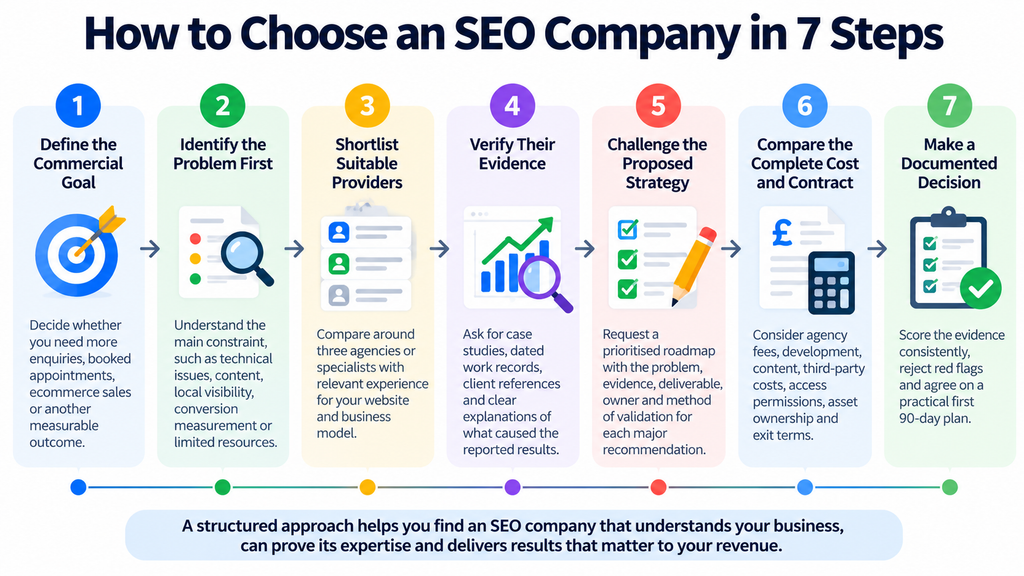
A high-quality provider should make these steps easier, not pressure you to skip them.
Do You Need an SEO Company?
You need an SEO company when improving organic search performance requires expertise, time or implementation resources that your business does not currently have.
An SEO company is a professional service provider specialising in search engine optimisation. Its responsibilities may include diagnosing technical problems, improving existing webpages, researching search demand, creating content strategies and measuring organic search performance.
However, not every business needs a monthly SEO retainer.
Consider a small service business with a five-page website. Its Google Business Profile may be incomplete, important service information may be missing and its contact forms may not work reliably. Some of these problems can be corrected without committing to an ongoing agency contract.
Now consider an online retailer with 30,000 product URLs, multiple category filters, duplicate page versions and inconsistent indexation. That business may need an experienced technical SEO specialist who understands crawling, canonicalisation, rendering and ecommerce platform limitations.
The difference is the complexity of the work, not simply the size of the company.
When should you hire professional SEO help?
Hire professional SEO support when a documented search performance problem requires capabilities your team cannot provide effectively.
Start by identifying the actual constraint.
If your website receives search impressions but few clicks, investigate whether the pages appear for relevant queries and whether their titles, descriptions and search appearances accurately represent the content.
If visitors reach your website but rarely enquire or purchase, examine search intent, landing-page relevance and conversion tracking before assuming that more traffic will solve the problem.
If Google cannot access important URLs, technical issues such as blocked resources, incorrect redirects, canonical signals or indexability directives may require specialist attention.
These problems involve different expertise. A business should understand which problem it needs solved before purchasing services.
Should you hire an SEO agency, consultant or in-house specialist?
Choose an agency for coordinated delivery across several SEO disciplines, a consultant for defined specialist expertise or an in-house employee for ongoing internal ownership.
An independent SEO consultant may be suitable for a technical audit, migration review or strategic assessment. The consultant can identify problems and recommend changes, but your team may still need to implement those recommendations.
A specialist SEO agency may provide technical analysts, content strategists, digital PR professionals and account management under one contract. That broader capability is useful when the work requires several disciplines.
An in-house SEO specialist can work directly with developers, product managers and marketing teams. This may be appropriate when SEO is a continuous operational priority.
Do not judge the delivery model by headcount alone. Ask which specialists will work on your website, how much time they will allocate and who is responsible for getting recommendations implemented.
| Your situation | Sensible starting option | What to verify |
| One defined technical problem or migration review | Independent specialist or project-based agency | Relevant specialist experience and a clear deliverable |
| Multiple SEO disciplines require coordinated delivery | SEO agency | Named team, implementation capacity and accountability |
| SEO needs continuous collaboration with internal teams | In-house specialist, potentially supported by an agency | Ownership, cross-team access and the skills needed |
| Small website with a few identifiable problems | Focused audit or short project | Whether an ongoing retainer is necessary |
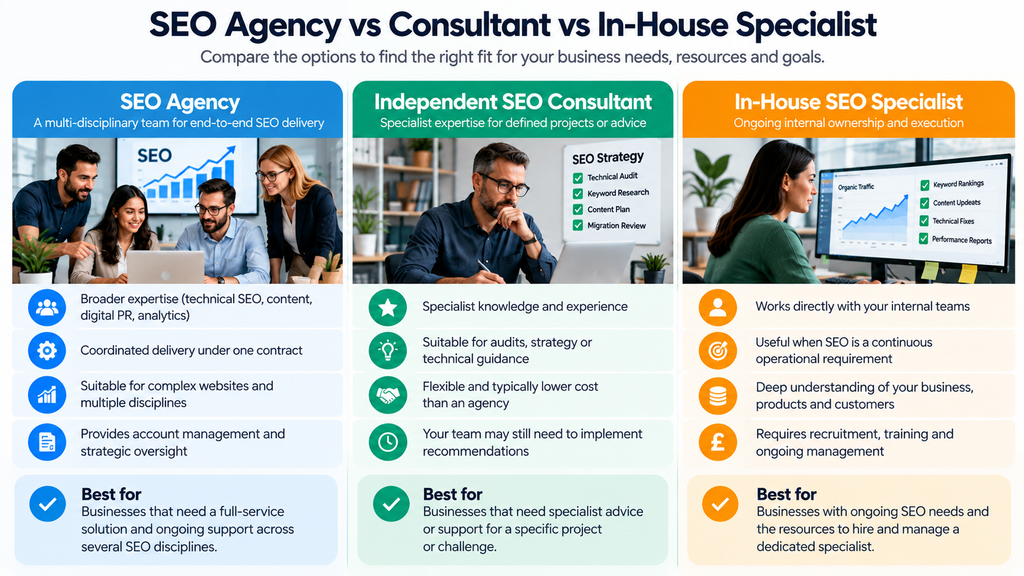
These are starting points, not fixed rules. Complexity, internal resources and the actual scope should determine the choice.
A 20-person agency that assigns your account to an inexperienced coordinator may be less suitable than a smaller provider with direct specialist involvement.
What SEO Goals Should You Define Before Hiring an Agency?
Define your business objectives, current performance and success metrics before asking an SEO agency to recommend a strategy.
An SEO provider cannot assess commercial priorities properly without knowing how your business acquires customers.
For a local plumbing company, the objective may be more qualified calls and booked jobs from a defined service area. For a SaaS business, it may be product demos and qualified sales opportunities. For an ecommerce store, it may be profitable organic sales from product and category pages.
These objectives require different website structures, keyword strategies and performance measures.
An agency that begins by asking how many keywords you want to rank for is gathering only part of the information needed.
It should also want to know which services generate profit, which customers are valuable, where you operate, what your sales process looks like and what your current marketing costs are.
How do you measure your website’s current SEO performance?
Establish a performance baseline using organic search data, website analytics and customer acquisition records.
Google Search Console provides information about organic search clicks, impressions, queries and indexing. Google Analytics helps measure website sessions and user actions. Customer relationship management systems, such as HubSpot or Salesforce, can help connect enquiries to sales outcomes.
These sources answer different questions.
Search Console shows how your website performs in Google’s search results. GA4 helps explain what visitors do after arriving. A CRM can help determine whether an enquiry becomes a qualified opportunity or paying customer.
Suppose a business currently receives 4,000 monthly organic sessions and 80 enquiries.
Its organic visitor-to-enquiry conversion rate is:
80 ÷ 4,000 × 100 = 2%
Now suppose an agency increases organic sessions to 6,000, but enquiries remain at 80.
Traffic has increased by 50%, while the enquiry conversion rate has fallen to approximately 1.33%.
That result requires investigation. The additional traffic may come from informational queries that attract people who are not looking to buy. Alternatively, there may be issues with tracking, landing-page relevance or conversion experience.
An increase in organic traffic is measurable progress, but it is not automatically evidence of increased business value.
Which SEO services does your business actually need?
The services you purchase should address diagnosed website problems and support your commercial objectives.
SEO services fall into several related categories.
Technical SEO addresses the conditions that affect how search engines discover, crawl, render and index webpages. Typical work includes analysing redirects, canonical tags, XML sitemaps, robots.txt rules, internal links and JavaScript rendering.
On-page SEO improves individual webpages through clearer content, relevant search terminology, page titles, headings and internal navigation.
Content strategy identifies customer questions and search intents that existing webpages do not adequately satisfy. The work may involve improving service pages, developing product information or publishing original research relevant to prospective buyers.
Off-page SEO concerns signals and references beyond your own website, including relevant editorial links, brand coverage and digital PR.
Local SEO focuses on geographically relevant searches and business information, including Google Business Profile, local landing pages and location-specific customer needs.
Your agency does not need to sell every service. It needs to explain which ones matter for your website, why they matter and how the work will be prioritised.
What Should You Look for in an SEO Company?
A reliable SEO company should demonstrate relevant experience, verifiable results, technical competence, a credible strategy, transparent delivery and measurable business accountability.
These selection criteria are connected.
Experience without verifiable outcomes provides limited assurance. A technically strong proposal is not useful if the agency cannot implement it. Detailed monthly reports have limited value when they exclude the metrics that matter to your business.
The task is to establish whether the provider can diagnose your situation, deliver the agreed work and explain its contribution to commercial performance.
How do you evaluate an SEO company’s experience?
Evaluate experience by examining the problems an agency has solved, the websites it has worked on and the results it can substantiate.
Years in business provide background, but they do not prove competence in your particular market.
An agency may have spent ten years optimising local service websites without handling a large ecommerce migration. Another may have strong experience with Shopify, Magento or international websites but limited knowledge of local Google Maps visibility.
Ask for examples that match your requirements.
If you operate a dental practice, request evidence involving local organic visibility, appointment enquiries and location pages. If you sell industrial equipment, examine the agency’s experience with technical product content, B2B search behaviour and long sales cycles.
Industry experience is useful because it can reduce the time needed to understand customer terminology, common purchase questions and market constraints.
However, it should not be treated as an absolute requirement. An agency with demonstrable expertise in a similar business model may be capable of transferring that knowledge to your industry.
The useful question is:
What have you solved that is technically and commercially similar to the problem we have?
A competent specialist should be able to explain the original problem, the approach selected, any constraints encountered and what happened after implementation.
How can you verify SEO case studies and previous results?
Verify SEO case studies by checking the starting position, work completed, measurement period and commercial outcomes.
Agency websites frequently feature traffic charts and percentage increases. Those figures need context.
Imagine an agency claims it increased organic traffic by 180%.
Before accepting that figure as evidence, determine whether the growth occurred over three months or two years. Ask whether it came from branded searches, seasonal demand or newly published informational pages.
A credible case study should explain the client’s website condition before the work began and the changes that followed.
For example, consider an illustrative ecommerce project where a store had 8,000 product URLs, fragmented category navigation and multiple duplicate URL patterns.
The agency could document how it identified indexation issues, consolidated redundant URLs, revised internal navigation and improved category content. Its performance report should then compare relevant organic landing pages, search clicks and revenue across a defined period.
The evidence should also acknowledge other influences, such as seasonal demand, advertising changes or a website redesign.
This matters because a before-and-after chart alone does not establish causation.
Ask whether the agency can provide a reference from a client whose project resembles yours. Client confidentiality may limit access to raw analytics, but the agency should still be able to explain its work and obtain permission for appropriate verification.
A case study is stronger when its results can be checked and its limitations are clear.
Ask the agency what evidence would weaken its own claim. For example, growth that started before the engagement, changes in analytics configuration, a seasonal peak or increases concentrated in irrelevant queries would all affect the strength of its explanation. A provider willing to discuss these alternatives is giving you a more useful assessment than one presenting every improvement as proof of its own work.
How can you check whether an agency’s case study proves its claims?
A practical verification process begins by asking the agency to separate what it did from what happened afterwards.
For an illustrative case study claiming 180% organic traffic growth, request the comparison dates, the organic landing pages responsible for the increase and the work completed during that period. Ask whether the figures include branded searches, seasonal peaks or a website migration. Then establish whether qualified enquiries or sales improved alongside traffic.
| Claim or evidence | What to request | What to check |
| “Organic traffic grew 180%” | Reporting dates and analytics definitions | Consistent periods, seasonality and tracking changes |
| “Our strategy caused the growth” | Dated change log and implementation records | Whether the changes plausibly explain the trend |
| “We improved commercial performance” | Qualified-lead or sales reporting | Actual business outcomes, not visits alone |
| “We fixed indexation problems” | Affected URL examples and validation results | Whether important pages became eligible for indexing |
A client may reasonably restrict access to confidential dashboards. In that situation, ask for anonymised evidence, a walkthrough of the methodology and, where possible, a reference who can confirm the nature of the work. Do not mistake an impressive chart for proof of causation.
How do you assess technical SEO expertise?
Assess technical SEO expertise by asking the agency to diagnose a specific website problem and explain how it would verify the proposed solution.
A proposal that says “we will optimise your technical SEO” does not identify a deliverable.
Ask what the agency will inspect, what data it needs and how it separates high-priority issues from minor warnings.
A technically competent team should understand the relationship between crawlability and indexability. A URL that search engines can crawl is not necessarily indexed. Likewise, appearing in an XML sitemap does not guarantee that Google will index a webpage.
An agency should also understand canonicalisation, redirects, HTTP status codes, mobile rendering, internal links and structured data where relevant.
Website performance provides another useful test.
Google’s Core Web Vitals measure loading performance, responsiveness and visual stability. Its recommended good thresholds are a Largest Contentful Paint of 2.5 seconds or less, Interaction to Next Paint of 200 milliseconds or less and Cumulative Layout Shift of 0.1 or less.
These values are documented in Google’s Core Web Vitals guidance.
However, passing these thresholds does not guarantee rankings. An agency should examine page experience alongside content relevance, indexing, architecture and other important factors.
Ask the specialist to explain which technical issues would be addressed first and why.
An experienced professional should be able to distinguish a problem preventing important pages from being indexed from a minor audit warning that has little practical impact.
A useful technical assessment can also reveal whether the agency understands why an audit warning matters. Suppose an ecommerce website has thousands of URLs excluded from Google’s index. A weak recommendation would be to make every excluded URL indexable. A stronger response would distinguish intentionally excluded filters, duplicate URL variants and redirects from valuable canonical category or product pages that are missing.
Ask the agency to select three representative URLs, identify the signals it would inspect and describe how it would validate a fix. The quality of that reasoning is often more informative than the number of warnings in an automated audit.
Core Web Vitals should also be assessed using an appropriate real-user data source and reporting context. Google’s good thresholds are evaluated at the 75th percentile of page visits, with mobile and desktop considered separately where data is available. A single laboratory test is useful for diagnosis but does not necessarily describe the experience of typical visitors.
What should an SEO content strategy include?
An SEO content strategy should identify the information prospective customers need, map that information to suitable webpages and establish how the content supports business objectives.
Keyword research is one component of this process, not the entire strategy.
Consider a company selling commercial heat pumps.
Someone searching “what is a commercial heat pump” may be researching the technology. A person searching “commercial heat pump installation cost” is investigating purchasing requirements. Someone searching “commercial heat pump installer Manchester” may be looking for a provider.
These queries share a subject but represent different search intents.
A useful content strategy recognises those differences and develops an appropriate page for each distinct information need.
The agency should also evaluate existing content before recommending new articles.
If a website already has three pages targeting nearly identical purchase questions, producing a fourth may create unnecessary overlap. Updating, consolidating or clarifying the existing pages may be more appropriate.
Ask to see a content brief produced for another project.
It should define the intended audience, primary search intent, relevant entities, factual requirements, page purpose and relationships to other useful pages.
For commercial content, it should also explain how the page helps someone evaluate a service or make a purchasing decision.
Publishing 20 generic articles each month is not evidence of an effective content strategy.
Google’s guidance on helpful, reliable, people-first content emphasises original information, substantial value, accuracy and content created primarily to help readers.
How should an SEO agency build backlinks?
An SEO agency should acquire relevant links through legitimate editorial opportunities rather than creating links primarily to manipulate search rankings.
Backlinks are links from external websites to your own pages. They can help search engines discover content and may contribute to how linked pages are evaluated.
However, the value and risk of a backlink depend on more than the linking website’s reported authority score.
Metrics such as Domain Authority and Domain Rating are third-party measurements. They are not official Google ranking scores.
Ask an agency how it selects websites, what editorial relationship justifies the link and whether placements involve payment or other compensation. Clarify who controls the placement, whether the linking publisher makes an independent editorial decision and how paid or sponsored relationships are disclosed.
For example, a manufacturer may earn coverage from an industry publication by contributing original technical data. A local business may receive a relevant citation from a legitimate professional association.
Those situations differ from buying hundreds of links across unrelated websites.
Google’s spam policies identify link schemes intended to manipulate rankings as prohibited practices.
An agency promising a fixed quantity of high-authority backlinks each month should be able to explain the acquisition method. If it will not disclose where links come from or how they are obtained, you cannot properly assess the risk.
Paid placements require a further distinction. Advertising, sponsorship and editorial link acquisition are not interchangeable. Google allows paid advertising links when they are appropriately qualified, generally using rel=”sponsored” (or rel=”nofollow”), rather than passing ranking credit as though they were independent editorial endorsements. See Google’s guidance on qualifying outbound links.
Ask whether the agency uses sponsored placements, earned editorial coverage or a combination. Request examples of the disclosures and link attributes used. Be wary of a provider that describes paid ranking-passing links as risk-free simply because they appear on real websites.
How do you evaluate an SEO company’s reporting?
A useful SEO report should connect completed work, search performance and business outcomes over a defined measurement period.
Reports should explain what changed, why the change matters and what will happen next.
A monthly report might show organic clicks, impressions and non-branded search visibility alongside enquiries, purchases, qualified leads and attributable revenue.
Those measurements must be interpreted correctly.
Impressions are useful for understanding visibility. Clicks indicate that search users selected a result. Website sessions represent visits measured by analytics software. Leads and sales capture different stages of commercial performance.
These quantities are related but not interchangeable.
Ask how the agency handles discrepancies between Search Console and GA4. The platforms use different collection methods, definitions and reporting processes, so their totals may not match.
Also ask how the agency separates branded from non-branded demand where practical.
If more people search directly for your company after a major advertising campaign, your organic traffic may increase even if the agency has made no material improvement to non-branded visibility.
A credible reporting process should account for this possibility rather than attributing every positive movement to SEO.
How do you know whether SEO is generating a return on investment?
SEO return on investment should be assessed using attributable business value and the total cost of obtaining that value.
For a basic financial assessment:
SEO ROI = (Attributed profit − SEO cost) ÷ SEO cost × 100
Consider a hypothetical business investing £2,000 per month in SEO.
Over six months, its agency fees total £12,000. If the business attributes £30,000 in additional gross profit to SEO during the same period, the simplified ROI calculation is:
(£30,000 − £12,000) ÷ £12,000 × 100 = 150%
This example assumes the £30,000 is genuinely incremental, attributable gross profit and that £12,000 captures the relevant SEO costs.
Real calculations are more complicated.
A customer may interact with organic search, paid advertising, email and direct visits before buying. Revenue attribution models can assign credit differently, while some leads may convert months after their first website visit.
The agency should explain its measurement assumptions and avoid presenting estimated or attributed revenue as guaranteed incremental profit.
How do you distinguish attributed revenue from incremental SEO value?
Revenue recorded against organic search is not necessarily revenue caused by an SEO campaign. Customers may already have been searching for your brand, and an attribution model may give organic search credit even when another channel influenced the purchase.
| Measure | What it helps you understand | Important limitation |
| Organic revenue | Sales associated with organic sessions | Not the same as profit or incremental growth |
| Organic gross profit | Profit contribution associated with those sales | Can include demand that existed before the engagement |
| Estimated incremental profit | Additional profit plausibly associated with the work | Depends on a credible comparison and assumptions |
| Estimated SEO ROI | Financial benefit relative to total SEO investment | Changes when attribution or cost assumptions change |
For a defensible ROI estimate, document your baseline, the time period, how leads or sales are attributed, and the costs included. Where practical, compare similar time periods, account for other marketing activity and distinguish newly created demand from branded demand that might have arrived regardless of the agency’s work.
What Questions Should You Ask an SEO Company Before Hiring?
Ask questions that reveal how the agency thinks, who performs the work and what evidence supports its recommendations.
The sales presentation is not enough. You need to speak to someone who will be responsible for the account.
A particularly useful question is: “What would you change on our website first, and why?”
The answer should refer to your website’s circumstances rather than repeat a standard list of SEO services.
If the agency recommends publishing dozens of articles before reviewing your existing landing pages, ask how it established that content volume is the priority.
If it recommends an expensive technical rebuild, ask which problems justify the investment and how the changes will be validated.
The following questions help expose differences between proposals.
| Question | What the answer should establish |
| What have you achieved for a business similar to ours? | Relevant experience and verifiable results |
| What would your first 90 days involve? | Priorities, dependencies and deliverables |
| Who will personally work on our website? | Responsibility and specialist involvement |
| How do you decide which SEO tasks matter most? | Diagnostic reasoning and prioritisation |
| How do you acquire backlinks? | Methodology and compliance with spam policies |
| How will you measure qualified leads or revenue? | Commercial measurement capability |
| What work is excluded from your fee? | Scope and additional expenditure |
| What happens if we end the agreement? | Ownership, access and exit arrangements |
There is another question worth asking:
“If our organic traffic increased by 50% but sales stayed the same, what would you investigate?”
A useful answer should address search intent, landing-page quality, conversion tracking, lead qualification and attribution.
The agency should not automatically describe the campaign as successful or unsuccessful without examining the evidence.
How should you evaluate an agency’s AI search services?
Some agencies now offer answer engine optimisation (AEO), generative engine optimisation (GEO) or other AI-search visibility services. Treat these as claims that need investigation rather than evidence of superior expertise.
Ask which search experiences the provider is targeting, what changes it recommends and what official documentation supports those recommendations. Establish whether proposed work improves useful content, accessibility and discoverability, or whether the agency is selling speculative tactics as proven requirements.
Measurement also needs scrutiny. Request a clear explanation of what the agency can observe, what is estimated and which outcomes it cannot control. An agency cannot credibly guarantee that a specific brand or webpage will be cited in every AI-generated answer. Google’s guidance on hiring an SEO advises site owners to evaluate AI-optimisation recommendations against official search guidance.
Ask whether the agency’s AI-search plan is based on documented search requirements or unverified assumptions. It should be able to explain how any recommended changes improve discoverability, content usefulness or technical accessibility, and which measurements are reliable enough to use in decision-making.
What Are the Red Flags of a Bad SEO Company?
The clearest warning signs are guaranteed rankings, undisclosed methods, unverifiable performance claims, manipulative link building and contracts with unclear responsibilities.
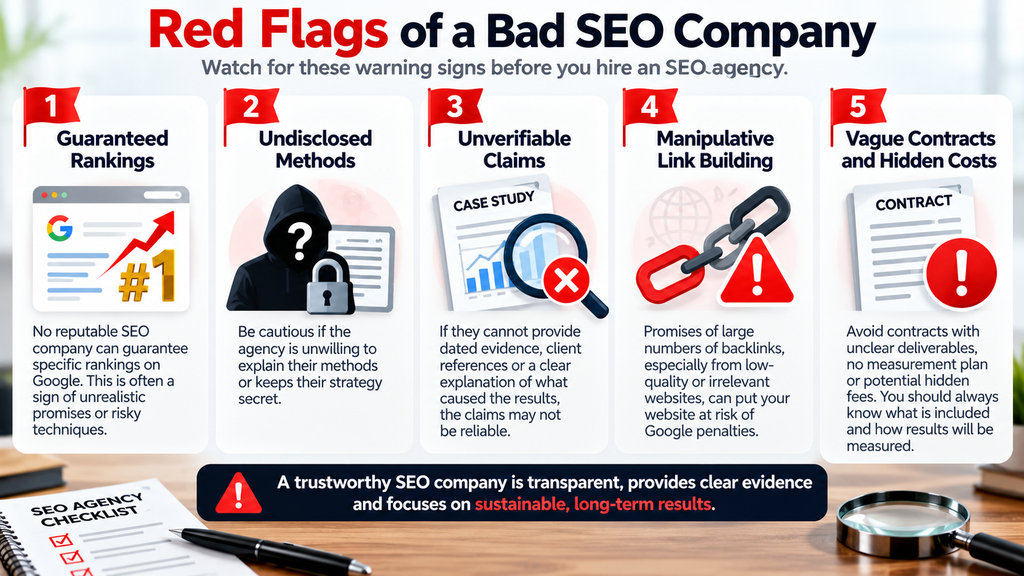
Google does not sell guaranteed positions in organic search results. A company claiming special access to Google’s ranking systems should be asked to substantiate that claim.
Promises of immediate results also deserve scrutiny. Some technical changes can be implemented and validated quickly, but ranking and commercial effects depend on the website, competition, implementation and search engine processing.
Another warning sign is a provider that discusses only rankings.
A keyword ranking report may show that your website moved from position 18 to position 7 for a particular query. That information is useful, but it does not establish how many qualified visitors arrived or whether additional sales occurred.
Low-quality link packages create a different risk.
A proposal promising 500 links for £199 may be supplying placements from irrelevant websites, link networks or automated publishing systems. Quantity does not establish editorial quality or compliance.
Be equally cautious of vague monthly deliverables.
If the agreement simply states “ongoing SEO optimisation,” ask which tasks will be completed, who approves them and how implementation will be documented.
These questions are not accusations. They are basic due diligence before providing an external provider with money, website access and responsibility for search performance.
How Much Does an SEO Company Cost?
The cost of hiring an SEO company depends on the scope of work, website complexity, specialist resources, implementation requirements and contract structure.
SEO providers generally charge through monthly retainers, fixed-price projects, hourly consulting or combinations of these models.
A monthly retainer may cover continuous technical work, content planning, reporting and ongoing optimisation.
A fixed-price project may cover a defined technical audit, site migration or content assessment.
Hourly consulting can be appropriate when the business needs advice, training or specialist troubleshooting rather than managed implementation.
The quoted price alone cannot tell you which arrangement is better.
Consider two hypothetical proposals.
Agency A charges £500 per month. Its work covers keyword monitoring, one monthly report and limited on-page recommendations.
Agency B charges £2,500 per month. Its scope includes technical implementation, content development, analytics configuration and specialist meetings.
These packages are not equivalent.
However, Agency B is not automatically the right choice. A small website that requires only a focused audit may not need that scope.
How do you compare SEO pricing without overpaying?
Compare the cost of the work required, not simply the monthly fee or number of services advertised.
Ask each agency to separate strategy, implementation, content production, reporting and third-party expenses.
Also establish whether developer time is included. An agency may identify technical issues but expect your development team to implement every recommendation.
That distinction affects the total project cost and the likelihood that work will be completed.
The same applies to content.
Does the monthly price include research, drafting, subject-matter expert review, editing, publishing and updating? Or does it include only a list of article topics?
A proposal is commercially useful when the responsibilities and exclusions are explicit.
What costs are commonly excluded from an SEO quote?
Ask for a total-cost estimate rather than comparing retainers alone. Developer implementation, subject-matter expert interviews, content editing, design, translation and third-party software may be additional expenses.
For example, a hypothetical £2,000 monthly agency fee plus £600 in content-production costs and £400 in developer time gives a monthly project cost of £3,000, not £2,000. That is an arithmetic illustration, not a market-rate benchmark.
Use the same cost categories when comparing providers and ask which costs are fixed, optional or subject to approval. Market-average pricing claims should be supported by a current, geographically relevant survey rather than inferred from illustrative packages.
Are long-term SEO contracts necessary?
A long-term contract is not inherently necessary, but the agreement must reflect the work, implementation requirements and commercial risk involved.
Some projects involve substantial initial research and infrastructure changes. Other engagements require ongoing maintenance and content production.
The contract should establish the duration, renewal process, notice period and consequences of early termination.
For example, a six-month agreement with clearly documented monthly deliverables may provide greater certainty than an indefinite agreement with vague obligations.
The relevant question is whether the commitment is proportionate to the work and whether both parties understand their responsibilities.
How Do You Compare SEO Agency Proposals?
Compare SEO agency proposals against a common set of business requirements, deliverables, evidence standards and commercial conditions.
Start by giving each shortlisted agency the same brief.
Explain the website’s business model, primary products or services, target markets, current challenges and desired outcomes.
You do not need to prescribe every SEO activity. The purpose is to see how each agency diagnoses the situation.
A proposal should identify the current problem, recommend a response, explain the expected mechanism of improvement and specify how the work will be measured.
Suppose one agency recommends producing 12 articles per month while another recommends correcting product category architecture before expanding content.
These are different strategic hypotheses.
To evaluate them, examine the evidence presented.
Has the first agency established that missing content is limiting commercially relevant search coverage?
Has the second demonstrated that the current site architecture prevents important URLs from being discovered or indexed effectively?
A proposal becomes credible when its recommendations follow from observed conditions.
What should a professional SEO proposal contain?
An SEO proposal should define the baseline, scope, responsibilities, implementation sequence, expected deliverables, measurement plan and commercial terms.
The proposed roadmap should distinguish tasks under the agency’s control from outcomes affected by external conditions.
For example, completing a technical audit is a deliverable. Increasing non-branded clicks by 40% is a potential performance outcome.
The agency can commit to delivering an audit by an agreed date. It cannot guarantee that Google will produce a specified increase in traffic.
That distinction should be clear before the contract is signed.
How do you identify a generic SEO proposal?
A proposal is insufficiently tailored when it recommends activities without connecting them to your website’s identified problems.
Generic proposals commonly use the same deliverables for every client, regardless of business model.
A local electrician, a national law firm and a large ecommerce retailer do not necessarily need the same balance of local optimisation, technical development and content production.
Ask the provider to explain which recommendations are specific to your website.
If the agency cannot identify why a task matters or how it would determine whether the task was completed successfully, the recommendation needs further justification.
How Do You Shortlist and Score SEO Companies?
Shortlist approximately three suitable providers and evaluate each using consistent criteria supported by evidence.
Three is a practical comparison set, not a requirement. It is large enough to reveal differences in strategy and scope without making the selection process unnecessarily complex.
Begin with agencies that have relevant experience and can meet your budget and operational requirements.
Then assess their proposals against the same criteria.
| Evaluation criterion | Suggested weight | Evidence required |
| Strategy and technical expertise | 25% | Relevant diagnosis and prioritised roadmap |
| Verified case studies and experience | 20% | Documented work and client references |
| Business goals and measurement | 20% | KPI framework and conversion tracking |
| Transparency and communication | 15% | Reporting samples and assigned responsibilities |
| Pricing and contracts | 10% | Itemised scope and clear terms |
| Industry understanding | 10% | Relevant market and customer knowledge |
| Total | 100% |
These weights are an illustrative evaluation framework, not an independently validated prediction of agency performance.
Rate each category from 1 to 5, where 1 means insufficient evidence and 5 means strong evidence.
Multiply each rating by its assigned weight and divide by 5. Add the results to produce a score out of 100.
For consistency, apply this evidence rubric before assigning a rating:
| Score | Standard of evidence |
| 1 | No credible evidence, or an unresolved serious concern |
| 2 | Some relevant claims, but limited verification or major gaps |
| 3 | Adequate evidence of capability, with important uncertainties |
| 4 | Strong, relevant evidence with only minor questions outstanding |
| 5 | Directly verified evidence closely matching your requirements |
Do not award a higher score merely because a proposal is polished. Record the evidence supporting each rating. If a provider cannot disclose confidential client data, consider an anonymised walkthrough or permitted reference rather than assuming that confidentiality itself proves a lack of competence.
Do not allow a high overall score to compensate for a serious unresolved problem, such as undisclosed link-building practices, missing ownership provisions or evidence that the agency cannot complete the agreed work.
The score helps structure the comparison. It does not replace professional judgement or contractual due diligence.
What does a completed agency scorecard look like?
The following example applies the weights above to three hypothetical agencies. Each category is rated from 1 (insufficient evidence) to 5 (strong verified evidence).
| Criterion (weight) | Agency A | Agency B | Agency C |
| Strategy and technical expertise (25%) | 5 | 3 | 4 |
| Verified case studies and experience (20%) | 4 | 3 | 3 |
| Business goals and measurement (20%) | 4 | 4 | 3 |
| Transparency and communication (15%) | 4 | 3 | 4 |
| Pricing and contracts (10%) | 3 | 5 | 4 |
| Industry understanding (10%) | 4 | 3 | 4 |
| Weighted score / 100 | 83 | 68 | 72 |
For Agency A, the calculation is (5 × 25 + 4 × 20 + 4 × 20 + 4 × 15 + 3 × 10 + 4 × 10) ÷ 5 = 83. The other agencies score 68/100 and 72/100, respectively.
A score of 5 should require demonstrable, relevant evidence, not merely a persuasive sales pitch. A score of 1 means there is no credible evidence; a score of 3 means the agency meets the basic requirement but material questions remain.
Treat serious issues such as manipulative links, insecure account access and unacceptable ownership terms as separate pass-or-fail checks. A high numerical score must not override them.
Should you pay for an SEO audit before choosing an agency?
A paid independent SEO audit can be useful when the potential engagement is expensive, technically complex or difficult to assess from sales proposals alone.
An audit may help establish whether the website’s actual problems match the services being recommended.
For example, an ecommerce business planning a substantial SEO retainer could commission a focused review of crawlability, indexation, category architecture and organic revenue measurement.
The audit should produce findings, supporting evidence, priorities and implementation recommendations.
It should not simply generate hundreds of automated warnings without explaining their significance.
Before granting access, use appropriate permission levels. Google recommends read-only Search Console access during an initial assessment rather than immediately giving a prospective provider broader control.
What Should an SEO Agency Contract Include?
An SEO agency contract should define the scope of services, payment terms, responsibilities, intellectual property rights, access permissions, reporting obligations and termination procedure.
Pay particular attention to the ownership of assets created or managed during the engagement.
Your website, domain registration, analytics properties, content and business accounts should not become inaccessible because the agency relationship ends.
Contractual ownership can vary by agreement and jurisdiction, so the rights and transfer obligations should be written explicitly.
For example, clarify whether research documents, content briefs, source files and commissioned articles are included in the intellectual property transferred to your business.
Also define who controls technical changes.
An agency should not make significant production changes without the agreed approval process. This is particularly important for redirects, robots.txt directives, canonical tags, site migrations and other work that can affect large numbers of URLs.
For account security, keep the business as the primary owner of its domain, hosting, analytics and Search Console properties wherever the platform supports that arrangement. Give the agency the minimum permissions needed for its role, use individual accounts where possible and document who can approve significant technical or billing changes.
What happens if you change SEO companies?
Changing SEO providers should involve a documented handover of access, completed work, outstanding tasks, performance data and agreed assets.
Before the previous engagement ends, identify active projects and dependencies.
For example, an unfinished website migration may involve redirect mappings, test results, staging environments and developer instructions. Losing those records could delay implementation or create unnecessary risk.
Check the accounts and services used during the engagement, including Search Console, GA4, Google Business Profile, analytics dashboards, content systems and third-party platforms.
Revoke unnecessary permissions after the handover is complete.
Changing agencies does not inherently cause a ranking decline. However, uncoordinated website changes or the loss of important technical information can create problems.
What Should an SEO Company Deliver in the First 90 Days?
A useful first 90-day SEO plan should establish the current condition of the website, prioritise the work, implement agreed improvements and create a reliable measurement process.
The exact schedule depends on the website’s complexity, available resources and approval requirements.
Days 1–30: Audit, measurement and strategy
The first month should establish what is wrong, what matters and what the agency intends to change.
The agency should review organic search performance, important landing pages, indexation, technical architecture, existing content and commercially relevant competitors.
It should also validate how enquiries, purchases or other key business actions are tracked.
At the end of this phase, the client should understand the main problems, proposed solutions, implementation responsibilities and order of priority.
A long audit document is not necessarily more useful than a concise report containing well-supported findings and actionable recommendations.
Days 31–60: Implementation and content improvements
The second phase should convert approved recommendations into measurable work.
Depending on the audit, this may involve correcting canonical tags, improving internal links, revising category content, fixing redirects or developing commercially relevant landing pages.
The agency should document what was changed and whether the implementation passed its validation checks.
If the client must supply developer time, product expertise or content approval, those dependencies should be visible.
A task that remains in a recommendation document has not been implemented.
Days 61–90: Validation and performance review
The third phase should verify completed work, assess early performance signals and refine the roadmap.
Useful evidence may include corrected indexation problems, improved relevant search coverage, newly published pages, functioning conversion tracking and changes in organic search activity.
Commercial outcomes may take longer to become apparent.
Google’s search systems need time to discover, process and reassess changes, and some competitive searches require sustained work.
The first 90 days should therefore establish whether the project is being executed competently, not force a premature revenue guarantee.
How Long Does an SEO Company Take to Deliver Results?
SEO results can take several months, and the timeline depends on the site’s condition, competitive environment, work completed and how search engines process changes.
There is no fixed period after which every SEO investment becomes profitable.
Some technical corrections can produce observable changes relatively quickly. Newly developed content may require more time to establish visibility, particularly in competitive markets.
A business entering a new market has different starting conditions from an established website with existing search demand and strong organic visibility.
Ask agencies to separate implementation milestones from performance forecasts.
An implementation milestone might be the correction of identified redirect errors by the end of a specified month.
A performance forecast might estimate potential growth in qualified organic traffic over a longer period.
The first is substantially more controllable than the second.
A trustworthy provider should explain that distinction instead of using a guaranteed ranking date to close the sale.
How Do You Make the Final Decision?
Hire the SEO company that provides the strongest verified evidence of relevant competence, a feasible implementation plan and contract terms that protect your business.
Do not choose solely because the sales presentation was polished, the agency ranks highly for its own website or its proposal promises the greatest percentage increase.
Examine what is actually being purchased.
Does the agency understand the economic value of your customers? Has it demonstrated relevant technical or strategic work? Can you identify who will implement the recommendations? Are the expected deliverables documented? Will reporting distinguish search visibility from qualified customer acquisition?
The answers should be specific enough to support a real purchasing decision.
Before signing, speak to the person who will manage or perform the work. Review the contract with particular attention to ownership, cancellation and additional costs.
If material questions remain unanswered, request clarification before committing.
The final selection should reflect demonstrated capability and commercial fit, not an unsupported promise of rankings.
Frequently Asked Questions About Choosing an SEO Company
How do I know if an SEO company is legitimate?
A legitimate SEO company should provide verifiable business information, relevant client references, clear service descriptions and transparent contract terms.
Is it worth paying an SEO company?
Paying an SEO company can be worthwhile when the proposed work addresses a genuine search opportunity and its expected business value justifies the cost.
Can an SEO company guarantee Google rankings?
No SEO company can credibly guarantee a specific organic Google ranking because rankings depend on factors beyond the agency’s direct control.
Is a small SEO agency better than a large one?
Agency size does not establish quality; relevant expertise, delivery capacity and accountability determine suitability.
Should I hire a local SEO company?
Hire a local SEO specialist when geographic search visibility is central to your business, but do not treat office proximity as proof of competence.
What is the most important question to ask an SEO agency?
Ask what the agency would prioritise for your website, why that work matters and how it would measure the outcome.
How do I know whether my SEO agency is doing a good job?
Evaluate completed deliverables, the quality of implementation, relevant search performance and progress toward agreed business outcomes.
What should I do if my SEO agency is not delivering results?
Review the contract, verify completed work, investigate performance data and request an evidence-based explanation before deciding whether to revise or end the engagement.
Should I choose the cheapest SEO company?
Choose the lowest-cost suitable provider only after confirming that its expertise, scope, responsibilities and deliverables meet your requirements.
How many SEO companies should I compare?
Comparing three qualified providers is a practical starting point, provided each receives the same brief and is evaluated using consistent criteria.
Final Checklist Before Hiring an SEO Company
A hiring decision should not depend on trust alone. It should be supported by evidence you can inspect.
Before entering an agreement, confirm that you understand the business problem being addressed, the services being purchased, the people responsible for delivery and the performance measures that will be used.
Make sure the agency has explained its methods and provided relevant evidence of previous work. Check the contract for hidden costs, approval responsibilities, ownership rights and termination conditions.
Use this final pass-or-fail check before signing:
- Evidence: Can you verify at least one relevant example of completed work and understand its limitations?
- Execution: Do you know who will perform the work, who will implement changes and which deliverables are included?
- Measurement: Is there an agreed baseline and a plan to measure qualified leads, sales or another meaningful outcome?
- Cost: Are total fees, third-party expenses, additional implementation costs and cancellation obligations clear?
- Control: Will your business retain appropriate ownership and access to its website, domain, data and commissioned assets?
- Risk: Has the agency disclosed its link-building methods, major dependencies and any material uncertainties?
If an essential answer is missing, get it in writing before committing.
Most importantly, establish what success means for your business.
Higher rankings and increased traffic may be valuable indicators, but the commercial purpose of SEO is to attract relevant prospective customers and support measurable business results.


