
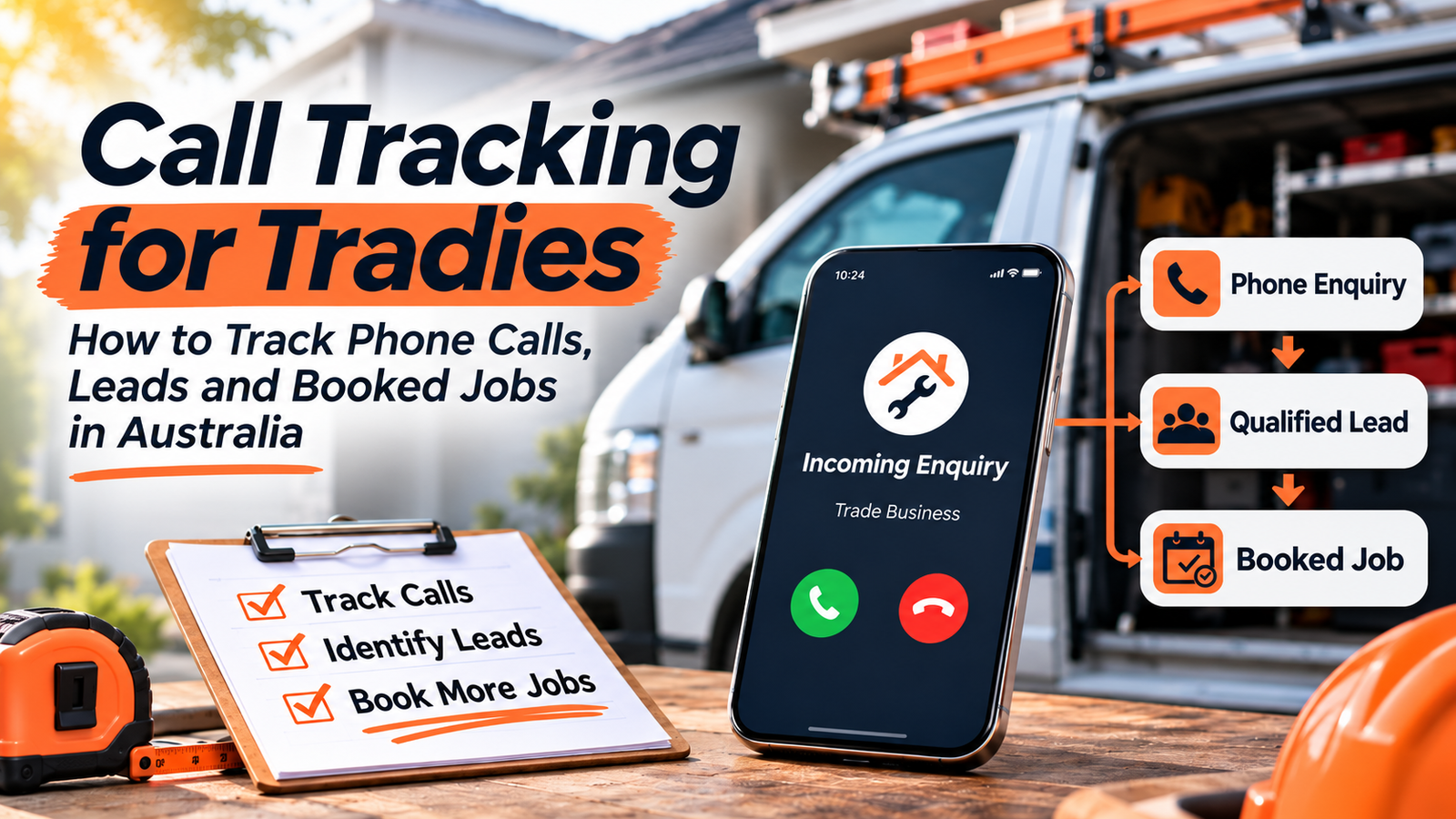
Getting more phone calls doesn’t always mean getting more customers.
Imagine a Sydney electrician spending A$2,000 per month on Google Ads. The advertising dashboard reports 50 phone conversions, suggesting an acquisition cost of just A$40 per conversion.
But after checking the telephone records, customer enquiries and job bookings, the electrician discovers that only 21 enquiries were qualified and nine became booked jobs.
The actual cost per booked job is A$222.22, not A$40.
Neither calculation is necessarily wrong. They measure different outcomes.
Call tracking for tradies helps Australian plumbing, electrical, roofing, building and other trade businesses understand where phone enquiries originate, which enquiries become genuine leads and which marketing activities generate booked jobs.
A properly organised call tracking process connects five stages:
Marketing source → Phone enquiry → Qualified lead → Booked job → Revenue
This guide explains how to:
- Track enquiries from Google Ads, Google Business Profile, organic search and other marketing channels.
- Set up website phone-click tracking and telephone call attribution.
- Distinguish genuine customer opportunities from repeat calls and irrelevant enquiries.
- Link telephone enquiries to quotations, booked jobs and revenue.
- Identify attribution mistakes that make marketing reports unreliable.
- Evaluate call tracking software and Australian privacy requirements.
- Apply a five-stage Call Tracking Data Quality Audit to your business.
You’ll also find worked financial examples, practical troubleshooting scenarios and a 30-day implementation plan.
Methodology note: The analytical frameworks and diagnostic procedures in this guide are proposed practical methods. All numerical business scenarios are hypothetical illustrations, not verified client results, industry benchmarks or statistically validated findings.
What Is Call Tracking for Tradies?
Call tracking is the process of identifying where incoming telephone enquiries originate and measuring what happens after someone contacts a business.
For an Australian trade business, enquiries may come from:
- Google Ads campaigns
- Organic Google Search results
- Google Business Profile and Google Maps
- Facebook and Instagram advertising
- Online trade directories
- Referrals and repeat customers
- Vehicle signage and offline advertising
Consider a Melbourne plumber who receives calls from two homeowners.
The first homeowner clicked a Google Ad while searching for an emergency hot water repair. The second found the plumber’s business through an organic search result for blocked drains.
Without a tracking system, both calls may simply appear in the business’s mobile phone history.
With suitable call attribution, the plumber may identify the source of each enquiry and record whether it resulted in an inspection, quotation or job.
However, identifying the marketing source is only the first step.
The real commercial value comes from connecting those calls with qualified opportunities and completed work.
Call Tracking vs Lead Tracking: What’s the Difference?
Call tracking measures telephone activity and marketing attribution. Lead tracking measures whether enquiries progress into genuine sales opportunities and customer bookings.
A customer may tap a phone button without completing a call. Another may call three times about the same quotation. A supplier may telephone about an existing order.
These interactions should not all be counted as new customer leads.
| Measurement stage | What it means |
| Phone click | A website visitor selects a telephone link |
| Connected call | A telephone connection is established |
| Answered call | A person or answering service answers |
| Unique new enquiry | A distinct prospective customer opportunity is identified |
| Qualified lead | The enquiry meets agreed business criteria |
| Booked appointment | An inspection or consultation is scheduled |
| Accepted quote | The customer approves proposed work |
| Booked job | The work is confirmed in the scheduling system |
| Completed job | The work has been performed |
| Invoiced revenue | The customer has been billed |
| Collected revenue | The business has received payment |
These are different measurement stages, not interchangeable conversion types.
For example, 30 phone clicks do not prove that 30 conversations occurred. Similarly, 20 answered calls do not necessarily represent 20 new customers.
A reliable system records each stage separately.
Why Call Tracking Matters for Australian Trade Businesses
Many tradies spend much of their working day onsite.
A plumber may be repairing a leaking pipe, while an electrician is completing a switchboard upgrade. During that time, potential customers may be calling about new jobs.
If the business only monitors how many calls it receives, several problems can go unnoticed.
Problem 1: Advertising reports overstate lead volume.
Google Ads may report phone-related conversions even though some interactions do not represent qualified new customers.
Problem 2: Repeat callers inflate enquiry numbers.
A homeowner who calls three times about one quotation may appear as three telephone interactions.
Problem 3: Missed enquiries receive no follow-up.
A potentially valuable enquiry may be lost because nobody is responsible for returning the call.
Problem 4: Marketing attribution disappears after the initial enquiry.
The advertising platform records the call, but the job-management system does not retain the acquisition source.
Problem 5: Marketing budgets are allocated using call volume rather than commercial results.
One campaign may generate more calls but fewer profitable jobs than another.
Call tracking can help businesses investigate these problems before making advertising and operational decisions.
Original Analysis: Why Call Conversion Reports Can Misrepresent Acquisition Costs
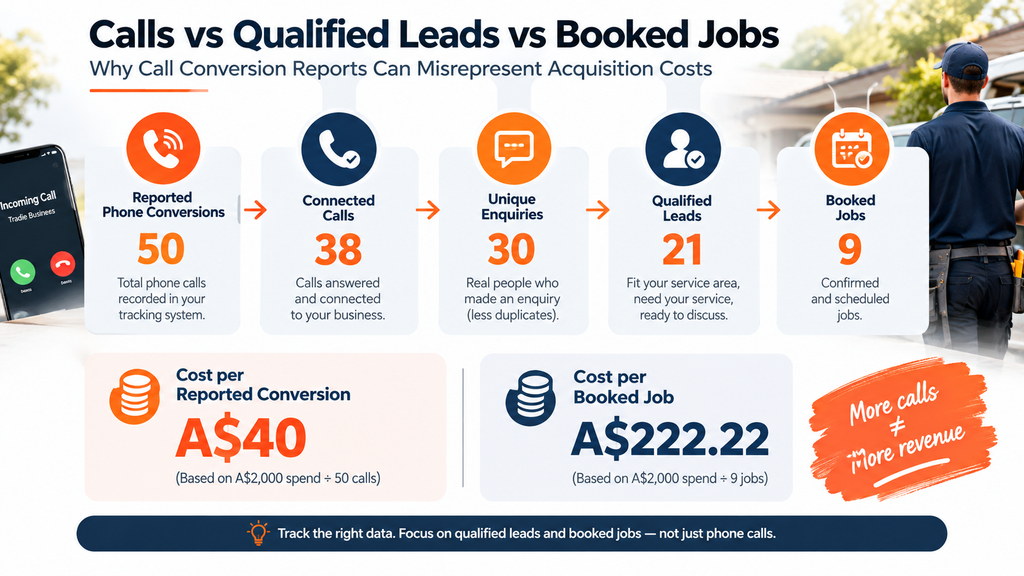
Consider a hypothetical Sydney electrical contractor spending A$2,000 on Google Ads during a month.
The business initially reports 50 phone-related conversions.
Its advertising cost per reported conversion is:
A$2,000 ÷ 50 = A$40
After reconciling Google Ads reporting with telephone logs and customer records, the business produces the following results.
| Measurement | Monthly result |
| Reported phone-related conversions | 50 |
| Verified connected calls | 38 |
| Unique new enquiries | 30 |
| Qualified new opportunities | 21 |
| Booked jobs | 9 |
| Advertising spend | A$2,000 |
Illustrative example. The figures represent progressively narrower measurement stages.
Finding 1: Cost per Reported Conversion Is Not Cost per Qualified Lead
The campaign reports 50 conversions, but only 21 opportunities meet the business’s qualification criteria.
Cost per qualified lead = A$2,000 ÷ 21 = A$95.24
The original A$40 figure measures reported phone conversions, not qualified leads.
Both numbers may be useful, provided their definitions are clear.
Finding 2: Cost per Booked Job Reveals a Different Business Outcome
Of the 21 qualified opportunities, nine become booked jobs.
Cost per booked job = A$2,000 ÷ 9 = A$222.22
The same campaign therefore produces three different acquisition measurements:
| Metric | Result |
| Cost per reported phone conversion | A$40 |
| Cost per qualified lead | A$95.24 |
| Cost per booked job | A$222.22 |
A business focusing only on phone conversions may underestimate the advertising expenditure associated with acquiring booked work.
Finding 3: Qualification and Booking Rates Help Locate Problems
Of the 30 unique new enquiries, 21 qualify.
Qualified lead rate = 21 ÷ 30 × 100 = 70%
Of the 21 qualified opportunities, nine become booked jobs.
Booking conversion rate = 9 ÷ 21 × 100 = 42.9%
These results suggest two areas to investigate.
A high number of unqualified enquiries may indicate irrelevant search terms, unsuitable service-area targeting or misleading landing-page expectations.
Qualified enquiries that fail to become bookings may indicate quotation delays, availability problems, price objections, competitor selection or inconsistent follow-up.
The calculations do not establish the cause. They identify where further investigation could be valuable.
Practical takeaway: Measure qualified leads and booked jobs alongside call volume. Each metric answers a different commercial question.
How Does Call Tracking Work?
Call tracking commonly uses dedicated telephone numbers, call forwarding and attribution software.
A customer calls a tracking number, which forwards the call to the business’s existing mobile phone, office telephone or answering service.
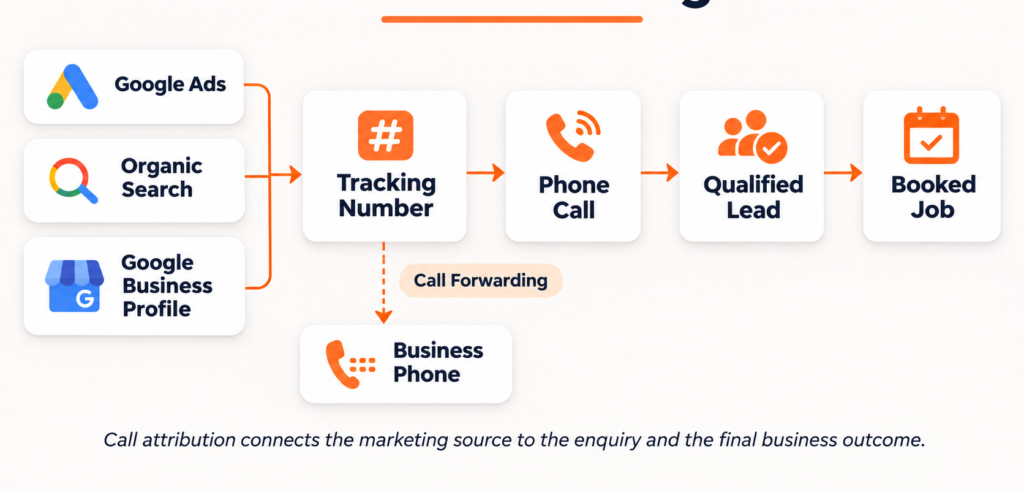
Depending on the provider and configuration, the platform may record:
- The marketing source or campaign
- The tracking number called
- Call date and time
- Call duration and connection status
- Answered and missed calls
- Supported website session information
- Customer or opportunity identifiers
For example, a Brisbane plumbing company might assign one tracking number to supported Google Ads website visitors and another to organic search visitors.
Both numbers can forward to the same office phone.
The system uses the tracking number and configured attribution rules to associate the interaction with a marketing source.
What Is Dynamic Number Insertion?
Dynamic Number Insertion (DNI) automatically changes the telephone number displayed to eligible website visitors based on source or session information.
A website using DNI might display different tracking numbers depending on how someone arrived.
| Visitor source | Displayed number | Attribution category |
| Google Ads | Tracking number A | Paid search |
| Organic Google Search | Tracking number B | Organic search |
| Facebook Ads | Tracking number C | Paid social |
| Direct website visit | Tracking number D | Direct |
This example illustrates channel-level number assignment. Actual implementations depend on the tracking provider.
All numbers may forward to the same business telephone destination.
Channel-Level vs Session-Level Tracking
There are two common approaches.
Channel-level call tracking associates dedicated tracking numbers with marketing channels.
For example, one number represents paid search, while another represents organic website traffic.
This can help businesses compare broad source categories.
Session-level call tracking uses a pool of tracking numbers to associate supported calls with individual website sessions.
Depending on the platform and available information, this may provide more detailed campaign, keyword or landing-page attribution.
However, session-level tracking introduces additional requirements.
The number pool must be suitable for concurrent website traffic. Number assignments and reuse periods must also be managed carefully.
Saved phone numbers, repeat customers, visitors switching devices and incomplete attribution information can make individual customer journeys difficult to reconstruct.
Consequently, call tracking should be treated as an attribution method with measurable limitations rather than a perfect record of every marketing interaction.
Can Tradies Keep Their Existing Phone Number?
Yes.
Compatible tracking numbers can forward calls to an existing mobile or office number.
Before purchasing a service, check whether the provider supports the Australian number types and routing arrangements your business requires.
The Australian Communications and Media Authority (ACMA) provides information about geographic, mobile, 1300, 1800 and other number categories.
Also check who controls the tracking numbers, whether portability is supported and what happens if you cancel the service.
How to Set Up Call Tracking for Your Trade Business
The most useful setup is one that connects marketing interactions with actual business outcomes.
Step 1: List Your Marketing Sources
Start with the channels that currently generate enquiries.
These may include Google Ads, Google Business Profile, organic search, social media advertising, trade directories, referrals and vehicle signage.
For each source, record:
- Whether telephone enquiries can be attributed automatically
- Whether a dedicated number is available
- Whether customer-source information must be entered manually
- Which system will hold the original attribution record
Do not assume that every enquiry without an identified source came from Google.
Use an Unknown classification when attribution cannot be established.
Step 2: Define What Counts as a Lead
Before installing software, establish consistent rules.
For example, a qualified electrical lead might require:
- A genuine enquiry about electrical services
- A property inside the business’s service area
- Work the business is licensed and equipped to perform
- A reasonable opportunity to provide the service
A supplier calling about materials does not ordinarily represent a new customer lead.
A homeowner asking for work outside the business’s operating area may be a genuine enquiry but not a qualified opportunity for that business.
Keep enquiries with insufficient information separate from confirmed disqualifications.
Step 3: Configure Call Forwarding
Select the tracking numbers and destination phones.
Test whether calls reach the correct person or answering service.
Include:
- Normal business hours
- After-hours routing
- Answered and missed calls
- Call transfers
- Callbacks
- Caller identification
- Multiple locations or teams, where relevant
A call reaching a tracking number does not necessarily mean it reached a staff member.
Step 4: Track Website Phone Clicks with Google Tag Manager and GA4
Google Tag Manager can be configured to measure clicks on website telephone links using the tel: protocol.
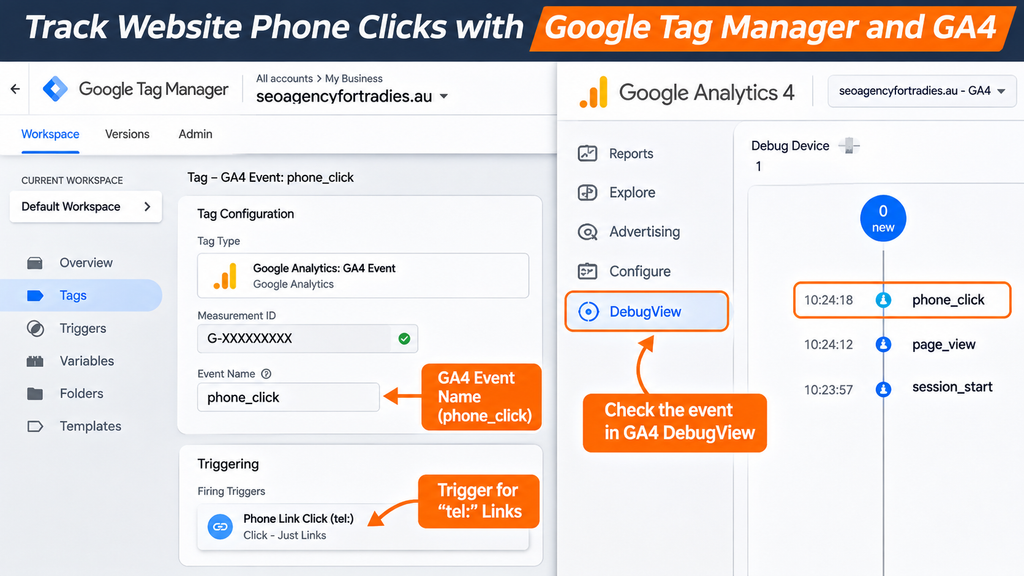
A basic process is:
- Open your website’s Google Tag Manager container.
- Enable the built-in Click URL variable.
- Create a new Just Links trigger.
- Set the condition to Click URL starts with tel:.
- Create a Google Analytics: GA4 Event tag using the site’s configured Google tag.
- Name the event phone_click.
- Attach the telephone-link trigger.
- Test the interaction using GTM Preview.
- Verify the event in GA4 DebugView.
- Publish the configuration after successful testing.
| GTM setting | Example configuration |
| Trigger type | Just Links |
| Trigger condition | Click URL starts with tel: |
| Tag type | Google Analytics: GA4 Event |
| Event name | phone_click |
| Initial validation | GTM Preview |
| Analytics validation | GA4 DebugView |
This method is suitable for conventional telephone links.
JavaScript-generated buttons, embedded widgets or other custom contact elements may require different event triggers.
Avoid sending complete customer telephone numbers or other unnecessary personal information to analytics platforms.
Important: A phone_click event indicates that a telephone link was selected. It does not establish that a call connected or that anyone answered.
What If Your GA4 Phone-Click Event Isn’t Working?
Use the following diagnostic process.
| Problem | Possible cause | What to check |
| Trigger doesn’t activate | Telephone button is not a normal tel: link | Inspect the button’s actual interaction |
| Trigger activates but GA4 shows no event | Tag configuration or consent restrictions | Test in GTM Preview and GA4 DebugView |
| Event fires twice | Duplicate tags or triggers | Review active GTM tags and other installed tracking code |
| Some telephone buttons aren’t tracked | Different page templates or button implementations | Test header, footer, mobile and service-page buttons |
| Calls appear in telephone logs but no clicks appear | Customer dialled manually or called from another surface | Distinguish website clicks from telephone-system calls |
A successful implementation should be tested on the actual website, not assumed to work because the configuration was published.
Step 5: Connect Enquiries to Job Records
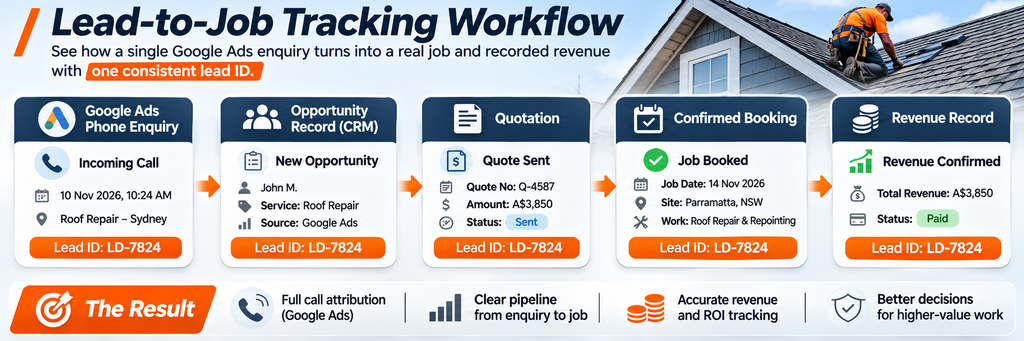
Assign every genuine new opportunity a unique identifier.
That identifier should link the initial enquiry with follow-up calls, quotations, bookings and financial records.
A simple lead record might contain:
| Field | Example |
| Opportunity ID | LEAD-1042 |
| Original source | Google Ads |
| Campaign | Hot Water Installation |
| Service requested | Hot water system replacement |
| Service location | Parramatta |
| Qualification status | Qualified |
| Quoted value | A$3,200 |
| Booking status | Won |
| Booked value | A$2,950 |
| Invoiced revenue | Pending |
| Collected revenue | Pending |
Illustrative record.
Australian trade businesses may use job-management tools such as ServiceM8, Tradify or Simpro.
Before choosing an integration, confirm that the specific systems can transfer the required lead identifiers, acquisition information and job outcomes.
Do not assume that software integration automatically preserves original attribution.
Step 6: Test the Entire Lead-to-Job Journey
Run a controlled test that follows the complete process.
Check that:
- The appropriate number appears for the test visitor.
- The call reaches the business.
- The tracking system records the expected source.
- The call status is correct.
- The enquiry receives a unique opportunity ID.
- The opportunity can be connected to a quote or booking.
- The original source remains available in the job record.
- Test interactions are excluded from production performance reports.
Repeat these tests after significant website, telephone, advertising or integration changes.
How to Track Phone Calls from Google Ads
Google Ads supports several phone-related conversion methods.
These methods do not all measure the same activity.
According to Google’s official phone call conversion documentation, the available approaches include calls from ads, calls to numbers displayed on websites, mobile website phone clicks, call ad or asset click interactions, and imported call outcomes.
| Tracking method | What it can measure | Important limitation |
| Calls from ads | Eligible calls from call-enabled ads or assets | A call-duration threshold does not prove lead qualification |
| Calls to website numbers | Supported calls after an advertising interaction using website call tracking | Requires correct tagging and eligible forwarding-number setup |
| Mobile website phone clicks | Telephone-link or button selections following eligible ad interactions | Clicks do not verify completed calls |
| Call ad or asset clicks | Supported or estimated call-related conversion interactions | May not represent verified conversations |
| Imported phone conversions | Eligible later call outcomes matched through supported records | Requires compatible tracking, identifiers and import configuration |
How to Configure Google Ads Call Conversion Tracking
Open the conversion management area under Goals in Google Ads.
Choose the phone-related conversion action that matches your objective.
For calls originating directly from advertisements, review call assets, call reporting and the relevant call-conversion settings.
For calls to numbers displayed on your website after eligible ad interactions, configure the required Google tag, website call tracking and number replacement.
Google provides website call conversion setup instructions.
Confirm that the conversion action and displayed telephone number work as expected before relying on the results.
Does Call Duration Prove That a Lead Is Qualified?
No.
Call-duration settings can help filter certain interactions, but they cannot independently determine whether someone genuinely intends to purchase a service.
For example:
- A supplier might spend five minutes discussing an invoice.
- A customer might book an emergency plumbing visit in less than a minute.
- An existing customer might telephone for a lengthy warranty discussion.
Call duration is useful contextual information, not a substitute for documented qualification.
Can Google Ads Track Booked Jobs?
Under supported configurations, Google Ads can import eligible call outcomes recorded in another system.
For example, a homeowner may contact an electrician after interacting with an advertisement, request a quotation and approve the work several days later.
If the business records the necessary call and conversion information and meets Google’s matching requirements, the later outcome may be eligible for import.
Google’s phone call conversion import instructions describe requirements involving supported call tracking, Google forwarding numbers, call details and conversion records.
Not every CRM booking can be imported automatically.
Before implementing this process, confirm:
- That the original call was tracked using an eligible Google Ads method
- That the required matching details were captured
- That the booked-job outcome is recorded consistently
- That conversion timestamps and values follow the required format
- That imported conversions do not duplicate existing conversion actions
Critical reporting rule: If the same customer interaction is represented by both an initial call conversion and a later imported booking, configure primary and secondary conversion actions deliberately.
Otherwise, the advertising platform may treat multiple stages of one journey as equivalent acquisition outcomes.
How to Track Calls from Google Business Profile and Google Maps
Google Business Profile can generate direct phone enquiries from customers searching for local services.
However, its call performance metric should not be treated as the number of verified telephone conversations.
Google explains in its Business Profile performance documentation that the Calls metric represents clicks on the profile’s call button.
For example, 40 reported call-button interactions do not prove that 40 callers spoke with the business.
Some people may cancel before the call connects, while others may telephone about existing jobs.
Can You Use a Tracking Number on Google Business Profile?
A tracking-number implementation must comply with Google’s business representation guidelines.
Google requires a business phone number to be under the business’s direct control and to connect to the represented business location. Its guidelines also restrict inappropriate redirection and favour local numbers where possible.
Before changing your published telephone number, review the Google Business Profile guidelines.
Check that the proposed tracking-number arrangement satisfies these requirements, remains reliable and does not interfere with customers contacting the business.
Website Dynamic Number Insertion and replacing a permanently published Business Profile number are different implementations.
How to Track Calls from Organic Google Search
A compatible website call tracking platform can associate supported calls with visits originating from organic search.
Google Search Console can separately show organic visibility, search queries, clicks and landing-page performance.
However, Search Console does not independently verify completed telephone calls or booked jobs.
To understand whether SEO for tradies in Australia generates commercial outcomes, connect supported organic enquiries with qualified lead and booking records.
Original Analysis: Five Attribution Scenarios That Can Mislead Marketing Reports
Even when call tracking is installed correctly, marketing reports can be distorted by how customer interactions are classified.
The following scenarios demonstrate common attribution problems and proposed rules for handling them.
These are analytical examples, not findings from a real business audit.
Scenario 1: A Customer Calls Three Times About One Job
A Sydney roofing customer initially calls for a roof repair quotation.
The customer later calls to ask about materials and again to confirm the proposed repair date.
The telephone platform records three interactions.
If the business counts every call as a new lead, it reports three opportunities instead of one.
Recommended approach: Associate the related interactions with one opportunity ID while retaining all three call records.
This preserves telephone activity data without inflating new lead acquisition.
Scenario 2: A Google Ads Customer Returns Through Organic Search
A Brisbane homeowner first discovers a plumbing business through a Google Ad.
The homeowner doesn’t call immediately.
Two days later, the customer searches for the business name, visits through an organic result and contacts the company.
Which channel deserves credit?
The answer depends on the reporting model.
Under a first-touch model, Google Ads may receive acquisition credit.
Under a last-touch model, organic search may receive the credit.
Recommended approach: Store the original known acquisition source separately from the latest known interaction source.
Where attribution is incomplete, record that uncertainty rather than reconstructing an unsupported customer journey.
The aim is not to declare one model universally correct. It is to make the model and its limitations explicit.
Scenario 3: A November Enquiry Becomes a December Booking
An electrician receives a qualified enquiry on 27 November.
The customer accepts the quotation and books the job on 8 December.
A November report based only on bookings created in November may fail to credit the original enquiry.
A December report may show a booking without the marketing cost that generated it.
Recommended approach: Maintain two reporting views.
| Reporting method | Purpose |
| Calendar-period reporting | Shows calls, bookings and revenue activity during a specific month |
| Acquisition-cohort reporting | Follows enquiries acquired during a specific period through later outcomes |
Both views are useful.
Calendar-period reporting supports operational management. Cohort reporting helps assess the eventual results of acquired opportunities.
Scenario 4: A Booked Job Gets Cancelled
A customer confirms a A$4,000 renovation job.
The booking system marks the opportunity as won.
A week later, the customer cancels.
If the marketing report still treats the original A$4,000 booking as realised revenue, the business may overstate its financial performance.
Recommended approach: Record booking, cancellation, completion, invoicing and payment as separate statuses.
Booked value should not automatically be treated as earned or collected revenue.
Scenario 5: A Lead Has No Reliable Marketing Source
A customer phones a Melbourne electrician, but the CRM contains no original source information.
The employee assumes the enquiry came from Google because most calls usually originate there.
This introduces unsupported attribution.
Recommended approach: Record the acquisition source as Unknown.
If later evidence reliably establishes the source, update the record and document the basis for the correction.
Do not distribute unknown enquiries across channels without clearly identifying the method as an estimate.
What These Five Scenarios Reveal
Call tracking accuracy depends on more than telephone software.
It also depends on consistent definitions, customer identifiers, attribution rules and job-management procedures.
An organisation can have detailed call reports while still making incorrect decisions if customer opportunities and business outcomes are recorded inconsistently.
The Five-Stage Call Tracking Data Quality Audit
The following framework is designed to help Australian tradies evaluate whether their tracking information is sufficiently reliable for business reporting.
It examines five areas:
- Marketing source attribution
- Telephone interaction verification
- Lead qualification
- Booking attribution
- Revenue reconciliation
Each category receives 0, 1 or 2 points, producing a maximum score of 10.
This is a proposed operational checklist, not a scientifically validated accuracy index or Australian industry standard.
Stage 1: Marketing Source Attribution
Can the business identify the recorded source of each opportunity or explicitly classify it as Unknown?
Check whether source information is preserved when an enquiry enters the CRM or job-management system.
Do not confuse a populated source field with independently verified accuracy.
Stage 2: Call Verification
Can the business distinguish telephone-link clicks, connected calls, answered calls and missed calls?
Compare website analytics with telephone system logs.
Investigate unexplained differences rather than assuming both platforms should always display identical totals.
Stage 3: Lead Qualification
Does the business apply written lead qualification criteria consistently?
Review whether enquiries are correctly marked as qualified, unqualified, duplicates or awaiting assessment.
Stage 4: Booking Attribution
Can a customer opportunity be traced from the initial enquiry to quotation and booking records?
Check that repeat interactions do not create duplicate acquisitions.
Confirm that the original known source remains available.
Stage 5: Financial Reconciliation
Can booked opportunities be linked to relevant financial records?
Where applicable, distinguish quoted value, booked value, completed work, invoiced revenue, collected revenue and direct delivery costs.
How to Score the Audit
| Audit category | 0 points | 1 point | 2 points |
| Source attribution | Source status absent | Sources recorded inconsistently | Sources consistently recorded, with evidence or explicit Unknown status |
| Call verification | No reliable interaction distinction | Partial call-status information | Call clicks and telephone statuses distinguishable and testable |
| Lead qualification | No agreed criteria | Criteria exist but application is inconsistent | Documented rules and consistent classification |
| Booking attribution | No opportunity linkage | Some quotes or jobs can be linked | Consistent opportunity identifiers and traceable outcomes |
| Financial reconciliation | No linked financial outcomes | Incomplete matching | Applicable job financial records can be reconciled |
Interpreting the Score
| Total score | Proposed interpretation |
| 0–3 | Major measurement gaps |
| 4–6 | Partially reliable tracking |
| 7–8 | Good tracking foundations with remaining weaknesses |
| 9–10 | Strong documented tracking foundations |
The score indicates the presence and consistency of measurement controls.
It does not mathematically establish the accuracy of individual channel attribution.
Worked Example: Auditing 20 Opportunities
Suppose a plumbing business reviews 20 unique new opportunities.
The review finds:
| Audit measure | Sample result |
| Total unique opportunities examined | 20 |
| Opportunities with usable source information | 12 |
| Opportunities linked to telephone records | 17 |
| Opportunities with documented qualification outcomes | 15 |
| Opportunities with traceable booking or closure outcomes | 14 |
Hypothetical audit sample.
Source-data completeness is:
12 ÷ 20 × 100 = 60%
Telephone-record linkage is:
17 ÷ 20 × 100 = 85%
Qualification documentation completeness is:
15 ÷ 20 × 100 = 75%
These percentages identify different weaknesses.
They should not be averaged into a universal tracking accuracy rate.
For example, a source field might be present but contain an incorrect channel. That is a different problem from a missing source field.
How to Make the Audit More Reliable
For repeatable results:
- Define the sample period and selection method.
- Review unique opportunities rather than arbitrarily selected repeat calls.
- Use the same scoring criteria for every assessment.
- Document exceptions and unresolved records.
- Have another responsible team member review disputed classifications where practical.
- Record corrective actions and test whether they work.
The sample should also include enquiries that never booked, rather than only successful jobs.
Practical takeaway: A call tracking dashboard can look complete even when the underlying customer records are unreliable. Audit the records before making major marketing budget decisions.
How to Avoid Duplicate Leads and Incorrect Attribution
A duplicate lead is not necessarily a duplicate phone call.
A customer may contact a trade business several times while discussing one job.
A practical opportunity record should contain:
- A stable opportunity identifier
- Customer relationship information
- Original known acquisition source
- Relevant later marketing interactions
- Service requested
- Qualification status
- Quotation and booking status
- Financial outcomes
For example:
| Interaction | Original known source | Opportunity ID |
| Initial Google Ads call | Google Ads | LEAD-1042 |
| Follow-up call | Google Ads | LEAD-1042 |
| Quote clarification | Google Ads | LEAD-1042 |
| Confirmed booking | Google Ads | LEAD-1042 |
This structure retains the distinction between interactions and opportunities.
If the same customer requests another genuinely independent job later, that job may require a new opportunity record linked to the existing customer.
Customer identity and opportunity identity should not automatically be treated as the same thing.
How to Track and Recover Missed Calls
Missed-call tracking helps identify unanswered telephone attempts and organise follow-up.
However, not every missed call is a lost sales opportunity.
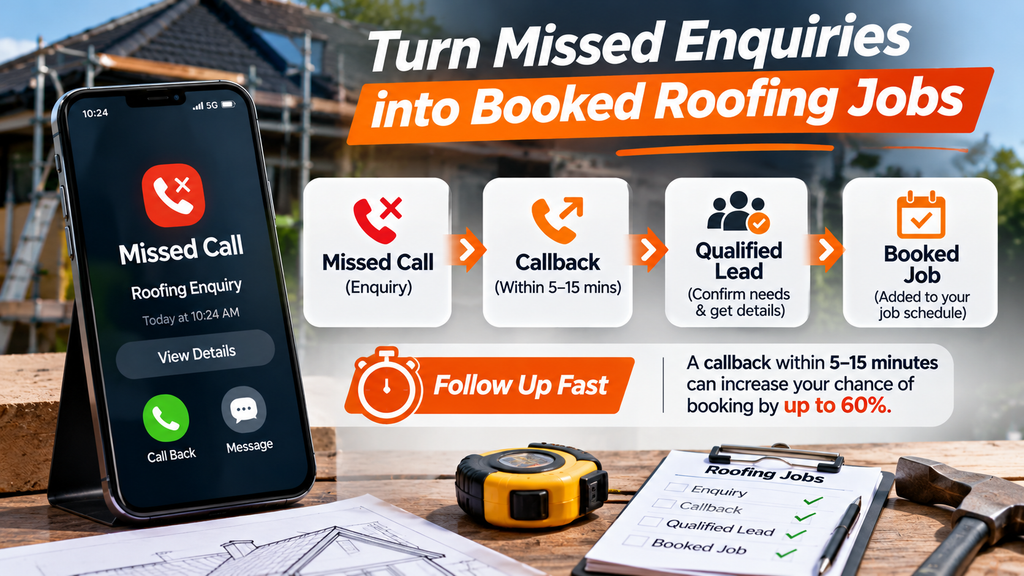
Some calls may be spam, repeat enquiries or existing-customer administration.
A practical missed-call recovery workflow includes five steps.
Step 1: Capture the missed interaction.
Record the time, available caller details, supported source information and destination number.
Step 2: Identify duplicates and unrelated calls.
Check whether the caller already has an open opportunity.
Step 3: Assign follow-up responsibility.
Ensure a specific person or team owns the callback.
Step 4: Prioritise urgent enquiries.
An emergency plumbing request may require faster attention than a routine maintenance quotation.
Step 5: Record the actual outcome.
Distinguish callback attempts, successful contact, qualification and booked work.
Original Analysis: Measuring Missed-Call Recovery
Consider a hypothetical plumbing company with 20 eligible missed-call attempts.
After reviewing duplicates and unrelated interactions, the business identifies 15 unique new enquiries requiring follow-up.
| Recovery stage | Result |
| Eligible missed-call attempts | 20 |
| Unique new enquiries requiring follow-up | 15 |
| Enquiries receiving a callback attempt | 15 |
| Enquiries successfully contacted | 11 |
| Qualified opportunities | 8 |
| Booked jobs | 5 |
Successful contact rate:
11 ÷ 15 × 100 = 73.3%
Booking rate among successfully contacted enquiries:
5 ÷ 11 × 100 = 45.5%
The follow-up workflow is associated with five booked jobs.
However, the example does not prove that all five bookings were caused by the callback process.
Some customers might have called again or booked through another route.
To evaluate incremental recovery impact, a business would need an appropriate comparison method and sufficient observations.
The immediate operational benefit is that missed enquiries receive documented follow-up instead of disappearing from the business’s records.
Which Call Tracking Metrics Should Tradies Measure?
A useful report should show the progression from telephone activity to commercial outcomes.
| Metric | Calculation | Business purpose |
| Call answer rate | Answered calls ÷ Eligible inbound calls × 100 | Evaluate phone handling |
| Qualified lead rate | Qualified enquiries ÷ Assessed new enquiries × 100 | Assess enquiry quality |
| Booking conversion rate | Booked opportunities ÷ Qualified opportunities × 100 | Evaluate sales outcomes |
| Cost per qualified lead | Advertising spend ÷ Qualified leads | Measure qualified acquisition cost |
| Cost per booked job | Advertising spend ÷ Booked jobs | Measure booking acquisition cost |
| Revenue-to-ad-spend ratio | Attributed revenue ÷ Advertising spend | Compare revenue with ad investment |
| Source-data completeness | Opportunities with usable source data ÷ Sampled opportunities × 100 | Identify attribution gaps |
| Missed-call contact rate | Successfully contacted missed enquiries ÷ Unique missed enquiries requiring follow-up × 100 | Evaluate callback execution |
Use consistent definitions, reporting periods and attribution rules.
Do not compare one campaign’s phone clicks with another campaign’s qualified leads as though they represent the same conversion action.
Original Financial Analysis: Which Campaign Produces More Valuable Work?
Consider a hypothetical Brisbane plumbing company spending A$2,400 monthly across two Google Ads campaigns.
One campaign promotes emergency plumbing, while the other promotes hot water services.
Campaign Results
| Metric | Emergency plumbing | Hot water services |
| Advertising spend | A$1,200 | A$1,200 |
| Connected calls | 36 | 24 |
| Qualified leads | 18 | 19 |
| Booked jobs | 9 | 11 |
| Invoiced revenue | A$4,050 | A$12,100 |
| Cost per qualified lead | A$66.67 | A$63.16 |
| Cost per booked job | A$133.33 | A$109.09 |
| Revenue-to-ad-spend ratio | 3.38 | 10.08 |
Hypothetical figures, not industry benchmarks or verified campaign results.
Emergency plumbing generates more telephone calls.
Hot water services generates more qualified leads, booked jobs and attributed invoiced revenue.
On revenue alone, hot water services appears more attractive.
However, revenue is not the same as profit.
Comparing Financial Contribution
Assume the campaigns have the following direct job delivery costs.
| Financial measure | Emergency plumbing | Hot water services |
| Invoiced revenue | A$4,050 | A$12,100 |
| Assumed direct delivery costs | A$1,600 | A$8,000 |
| Contribution before advertising | A$2,450 | A$4,100 |
| Advertising spend | A$1,200 | A$1,200 |
| Contribution after advertising | A$1,250 | A$2,900 |
Hot water services still produces a higher contribution after the stated costs.
But these figures exclude additional business overheads and assume that the attributed revenue and costs are recognised on a consistent basis.
The company should also investigate job capacity, payment collection, cancellations and the reliability of the attribution data.
Should the Business Move Its Entire Advertising Budget?
Not immediately.
One month of results is not enough to establish that additional spending will produce outcomes at the same rate.
Before reallocating budget, assess:
- Whether each campaign used identical lead qualification rules
- Whether job revenue and costs were attributed consistently
- Whether the business can service additional work
- Whether cancellations or unpaid invoices affect the results
- Whether the performance difference persists over a longer period
- Whether increasing spend changes the cost per acquired job
Practical takeaway: The campaign generating the most calls is not necessarily the one generating the highest commercial contribution.
Which Call Tracking Software Is Suitable for Australian Tradies?
The most suitable call tracking software depends on your marketing channels, Australian telephone number requirements, attribution needs and job-management workflow.
Providers worth investigating may include Delacon, WildJar, CallRail and CallTrackingMetrics.
However, provider availability, Australian number coverage, pricing and integrations can change.
Do not assume all products offer equivalent Australian features or direct integrations with the same job-management platforms.
Call Tracking Software Evaluation Checklist
| Requirement | What to verify |
| Australian telephone numbers | Suitable number types and availability |
| Call forwarding | Reliable routing to existing phones |
| Dynamic Number Insertion | Supported channel or session attribution |
| Number pool management | Assignment and reuse settings |
| Google Ads integration | Call tracking and eligible conversion workflows |
| GA4 integration | Supported event and reporting options |
| Job-management integration | Actual compatibility with required fields |
| Missed-call features | Alerts, callback workflows and reporting |
| Call recording | Availability, access controls and legal suitability |
| Number control | Portability and cancellation arrangements |
| Data management | Security, access, retention and export controls |
| Pricing | Subscription, numbers, usage, forwarding and add-ons |
How to Compare Providers
Ask each provider to demonstrate one complete example.
A customer clicks a Google Ad, calls the business, receives a quotation and later books the work.
Can the system show the original supported source and connect the telephone interaction with the booking record?
Also ask what happens when:
- The customer calls back several times
- The call is missed
- The caller saves a tracking number
- The number pool is busy
- The business changes its CRM
- The service is cancelled
A demonstration of these situations is often more useful than a generic feature list.
Google Ads vs GA4 vs Dedicated Call Tracking
| System | Main role | Limitation |
| Google Ads | Eligible advertising-related call conversions | Doesn’t automatically establish booked work |
| GA4 | Website telephone-link engagement and configured analytics events | Basic phone-click tracking doesn’t verify completed calls |
| Google Business Profile | Profile call-button interactions | Doesn’t verify answered conversations |
| Dedicated call tracking software | Supported call routing, statuses and attribution | Setup and ongoing cost |
| CRM or job-management system | Opportunities, quotations, bookings and job outcomes | May not preserve marketing sources automatically |
For many businesses, the strongest reporting comes from combining compatible systems rather than relying on one platform.
How Much Does Call Tracking Cost in Australia?
Call tracking costs depend on the provider, number type, subscription plan, call volume, forwarding and optional features.
A practical cost formula is:
Monthly cost = Subscription + Number rental + Call usage + Add-ons + Allocated implementation cost
For example:
| Cost component | Hypothetical monthly cost |
| Software subscription | A$50 |
| Tracking numbers | A$40 |
| Call usage and forwarding | A$35 |
| Additional features | A$20 |
| Total | A$145 |
These are fictional budgeting assumptions, not current provider quotations.
Is Paid Call Tracking Worth It?
The decision should depend on the problem being solved.
A sole trader with limited advertising expenditure might begin by combining GA4 phone-click events, telephone logs and manual enquiry records.
A larger plumbing or electrical business running multiple campaigns may require dedicated call attribution and job-management integration.
Paid software becomes more useful when the business can act on its information.
For example, tracking may reveal that a campaign generates irrelevant calls or that a particular office workflow leaves qualified enquiries without follow-up.
The value comes from improving decisions and operations, not merely collecting more data.
Is Call Tracking Legal in Australia?
Call tracking can be lawful in Australia, but businesses must distinguish between recording telephone metadata and recording conversations.
Telephone metadata may include call time, duration, source and connection status.
Call recording, transcription and automated conversation analysis can introduce additional privacy and surveillance-law obligations.
Does the Privacy Act Apply to Small Trade Businesses?
The Australian Privacy Act 1988 applies to covered organisations.
The Office of the Australian Information Commissioner (OAIC) explains that most small businesses with annual turnover of A$3 million or less are not covered, although exceptions apply.
Certain activities and business arrangements can create obligations regardless of turnover.
Businesses should assess their own circumstances rather than assuming that all small tradies are exempt.
Do You Need Consent to Record Customer Calls?
The legal requirements depend on the relevant state or territory laws and the circumstances of the conversation.
For example, New South Wales regulates listening devices and the recording of private conversations under the Surveillance Devices Act 2007.
Before enabling call recording or transcription, review:
- Which laws apply to the business and the conversations
- Whether and how legally effective notice or consent must be obtained
- Whether recordings will be stored or processed overseas
- Who can access the recordings and transcripts
- How long the information will be retained
- How unnecessary records will be securely deleted
- Whether automated transcription or analysis changes the compliance requirements
A generic call-recording announcement should not be assumed to satisfy every legal requirement.
Where appropriate, seek advice specific to the relevant Australian jurisdictions.
Practical Privacy Controls
Even where particular privacy obligations do not apply, businesses should protect customer information.
Useful controls include restricted access, documented retention periods, secure storage, staff training and procedures for correcting or deleting records when appropriate.
Do not collect or retain more personal information than reasonably necessary for the business purpose.
A 30-Day Call Tracking Implementation Plan
A staged implementation makes it easier to identify mistakes before relying on the reports.
| Timeline | Priority | Deliverable |
| Days 1–7 | Review current reporting | Source inventory and qualification policy |
| Days 8–14 | Configure tracking | Tested telephone and website measurement |
| Days 15–21 | Connect job records | Consistent lead-to-booking workflow |
| Days 22–30 | Audit and improve | Data quality report and corrective actions |
Week 1: Establish the Baseline
Document every major marketing channel and current telephone handling process.
Define qualified and unqualified opportunities.
Review existing records for missing sources and duplicate leads.
Deliverable: A written measurement policy and list of tracking gaps.
Week 2: Configure Call Tracking
Implement appropriate tracking numbers and forwarding.
Configure website analytics events where required.
Test call routing, website number display, missed-call recording and attribution.
Deliverable: A working, tested measurement configuration.
Week 3: Connect Opportunities with Bookings
Create or standardise opportunity identifiers.
Preserve known acquisition sources through quotation and job-management workflows.
Train staff to classify enquiries consistently.
Deliverable: A traceable lead-to-job process.
Week 4: Validate the Results
Review a sample of recent opportunities.
Apply the five-stage Call Tracking Data Quality Audit.
Investigate missing attribution, duplicate opportunities, inconsistent statuses and unmatched bookings.
Assign responsibility for resolving the identified problems.
Deliverable: An audit score, documented findings and a prioritised improvement plan.
Five Questions Your Business Should Answer After 30 Days
- Which marketing channels produce identifiable new enquiries?
- How many of those enquiries qualify as genuine sales opportunities?
- How many qualified opportunities become booked jobs?
- How much attributable revenue do those jobs generate?
- Which tracking gaps still prevent reliable reporting?
The objective is not perfect attribution.
It is to develop a sufficiently consistent and transparent measurement process to support better business decisions.
When Should You Get Professional Call Tracking Help?
Professional support may be worthwhile when a business receives enquiries from several channels but cannot reliably associate them with booked work.
For example, an electrical contractor may use Google Ads, local SEO, Google Business Profile and multiple service-area pages.
The advertising dashboards report conversions, but the job-management system does not preserve enough information to identify which enquiries produced paying customers.
Before hiring a specialist, ask how the proposed approach will:
- Distinguish phone clicks from connected calls
- Identify qualified new opportunities
- Reduce duplicate lead reporting
- Preserve known marketing attribution
- Link enquiries with quotations and booked jobs
- Reconcile commercial outcomes
- Validate the tracking implementation
Where website functionality, mobile contact elements or analytics installation are also problematic, a technical SEO review for tradies may help identify related implementation issues.
Need Help Understanding Which Google Enquiries Become Paying Jobs?
If your trade business receives search traffic and telephone enquiries but cannot confidently connect them with booked work, reviewing your marketing reporting and customer workflow is a useful starting point.
SEO Agency for Tradies provides SEO services for Australian trade businesses.
Explore our SEO services for Australian tradies to learn more.
Frequently Asked Questions
What Is Call Tracking for Tradies?
Call tracking helps trade businesses identify where supported telephone enquiries originate. When linked with lead and job records, it can help reveal which marketing sources contribute to qualified opportunities and booked work.
Can Google Analytics 4 Track Actual Phone Calls?
GA4 can measure configured website telephone-link clicks and receive supported call-related events. However, basic phone-click events do not independently prove that a telephone conversation occurred.
How Do You Track Phone Calls from Google Ads?
Use an appropriate Google Ads phone conversion method for eligible calls from ads, calls to website numbers, website telephone-link clicks or supported imported outcomes. Select the method according to the interaction or business result you need to measure.
Can Call Tracking Work with an Existing Mobile Number?
Yes. Compatible tracking numbers can forward incoming calls to an existing mobile or office telephone. Check Australian number support, forwarding reliability and number-control arrangements with your provider.
Does Call Tracking Affect Local SEO?
Call tracking does not inherently harm local SEO. However, the business must maintain accurate, reliable contact information and follow Google’s Business Profile requirements. Avoid unsupported assumptions that any tracking-number configuration is acceptable.
How Do You Know Which Calls Become Booked Jobs?
Assign genuine new opportunities unique identifiers. Preserve the original known acquisition source and link each opportunity with its quotations, booking records and relevant financial outcomes.
How Often Should Call Tracking Be Audited?
Monthly reconciliation is a reasonable starting point. Additional testing is useful after changes to website contact elements, advertising tags, telephone routing or CRM integrations.
Is Call Recording Required?
No. Source attribution and telephone metadata can often be measured without recording conversation audio. The available capabilities and legal requirements depend on the chosen system and implementation.
Is Call Tracking Worth It for a Small Tradie Business?
It can be worthwhile where it addresses a meaningful measurement or call-handling problem. Smaller businesses may begin with basic website analytics, phone logs and manual lead records before investing in dedicated attribution software.
Conclusion
Effective call tracking for Australian tradies is about measuring business outcomes, not simply counting telephone calls.
A reliable process distinguishes website phone clicks from connected calls, identifies genuine new opportunities and preserves marketing attribution through quotation, booking and financial records.
The Five-Stage Call Tracking Data Quality Audit provides a practical starting point for identifying unreliable measurement.
The attribution scenarios and financial examples also demonstrate why call volume alone can be misleading.
A campaign generating fewer calls may produce more qualified leads, more bookings or stronger financial contribution.
Before increasing advertising expenditure, make sure your tracking information can answer the questions that matter:
Where do your best enquiries come from, which opportunities become paying jobs and what does it cost to acquire that work?
Those answers create a stronger foundation for decisions about advertising, customer follow-up and business growth.


