
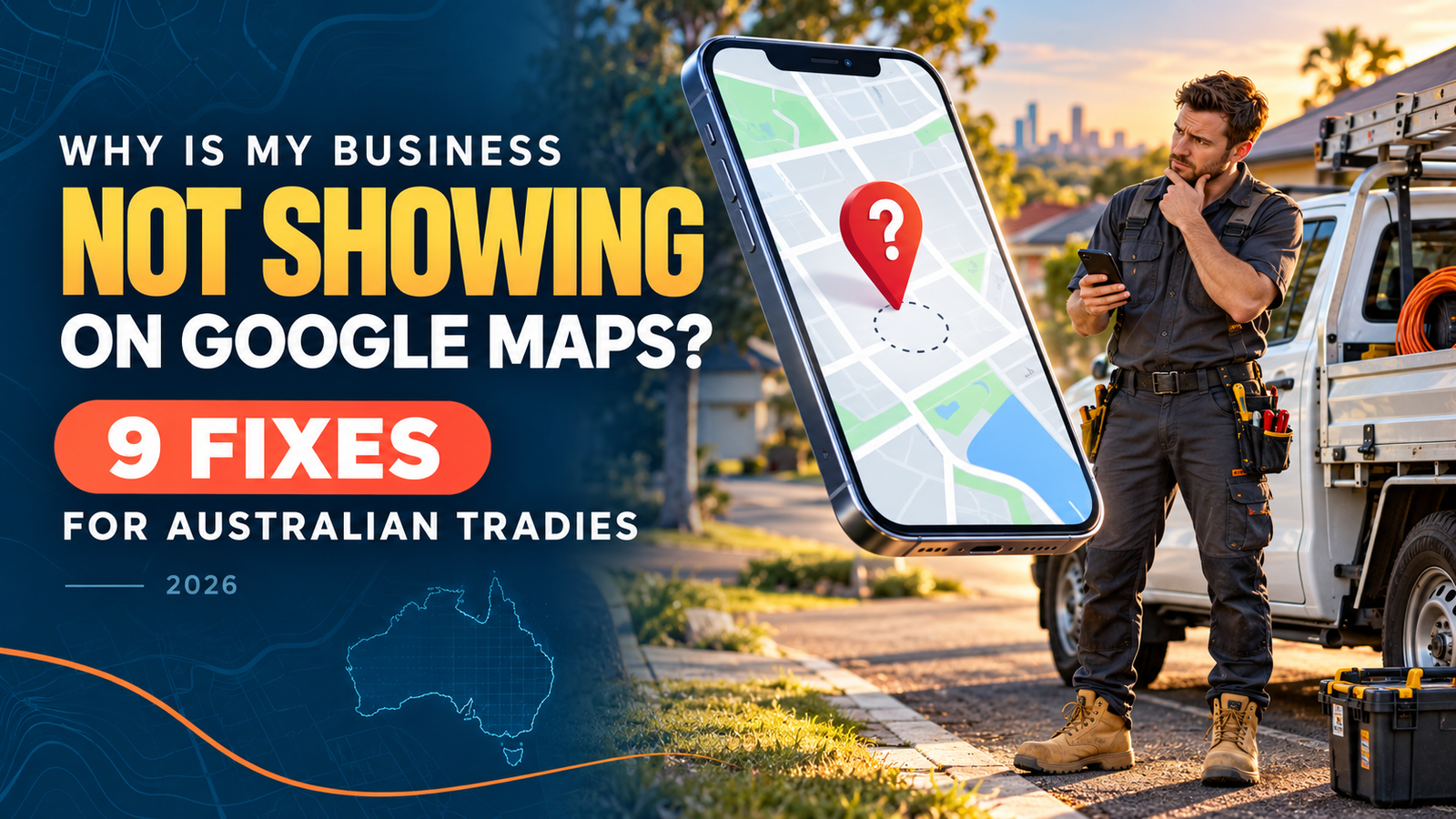
Your trade business may be missing from Google Maps because its Google Business Profile is unverified, suspended, duplicated or incorrectly configured. If customers can find it by name but not for “plumber near me”, you have a local ranking problem instead.
You might have an ABN, a website, a signwritten ute and years of completed jobs. None of those automatically makes your business visible in Google Maps. Google still needs an eligible, accurate Business Profile, and its local search system decides which businesses appear for each customer’s query and location.
Google generally requires businesses to make in-person contact with customers during their stated hours to qualify for a Business Profile. An eligible tradie who visits customers can have a profile, but online-only businesses and lead-generation agents are not eligible. See Google’s business eligibility guidelines.
So before changing your business name or paying someone to “get you to number one”, work out which of two things is happening: is the listing actually missing, or is it visible but not ranking for your trade? That answer determines what to fix next.
Guidance checked: 26 October 2026. This article covers Australian service-area and eligible storefront trade businesses, including electricians, plumbers, builders, roofers, carpenters and landscapers.
Why can’t customers find your business on Google Maps?
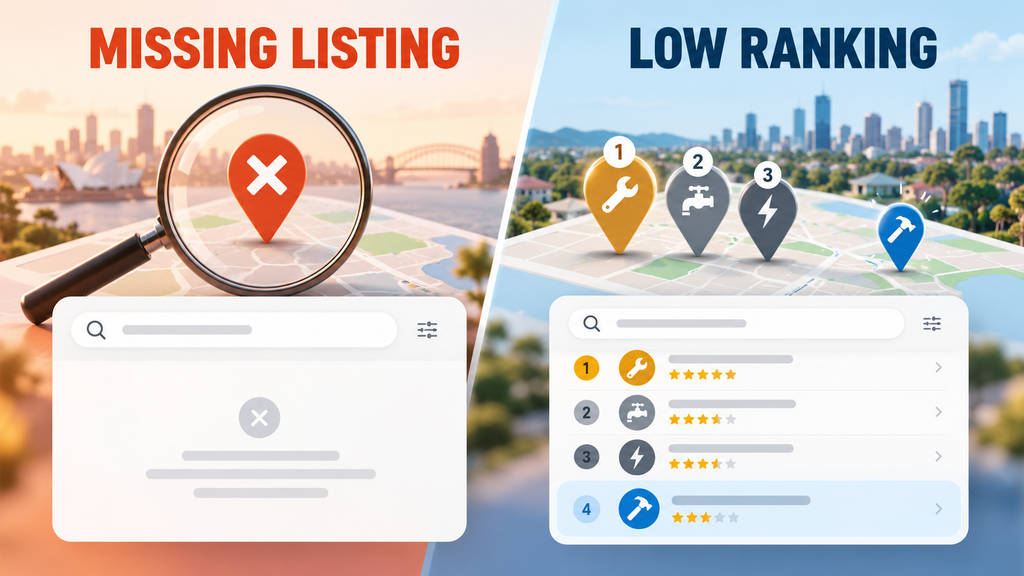
A listing can be absent because Google cannot publish it, or it can be difficult to find because its local ranking is low.
These are different search-visibility states. A Business Profile that is unverified or suspended needs a profile-level remedy. A verified profile that appears under its own name but not for emergency electrician Sydney needs a relevance, location and prominence review.
Start with your genuine trading name. Search Google Maps for Business Name + Suburb, then repeat on Google Search.
In the Google Account that manages your business, search my business and inspect the management panel for a verification request, restriction or pending change.
Finally, compare a service query such as blocked drain plumber Parramatta from the location where a customer would actually search.
| What the customer sees | Likely issue | Correct next move |
| No result for the exact business name and suburb | Missing, unverified, restricted or duplicate profile | Check ownership, verification and profile status |
| A profile by name, but not for “electrician near me” | Local search relevance, distance or prominence | Review business category, service information and competitive visibility |
| A profile in one suburb, but not another | Location-sensitive rankings, not necessarily a listing error | Examine the real operating base and nearby search conditions |
| A listing that vanished after an edit | Possible processing delay, re-verification or policy action | Check the edit history and management notices |
One search is not a ranking study. Results can differ by search location, query wording and device.
But this test prevents an expensive mistake: buying “Maps SEO” for a profile that is still awaiting verification.
Google’s official references are Find your business on Google and Tips to improve your local ranking on Google.
The first problem: Google does not recognise or publish the right business profile
Fix 1: Has someone already created or claimed your Google Business Profile?
Find and claim the correct existing profile before creating a new one.
Google Business Profile is the business-information record that powers how eligible businesses manage their presence on Google Search and Maps.
An existing record may already show your trading name, work number, service area or customer reviews, even if nobody at the business currently controls it.
This catches out trade businesses more often than the owner expects.
A former employee may have used a personal Gmail account. An agency may have created a second listing. Or a profile may exist but be unverified.
Creating another entry does not solve ownership of the original and can introduce a duplicate problem.
Search the exact trading name, previous names and the phone number associated with the business.
If an unverified result exists, use Google’s claim process and complete verification.
If another person owns a verified result, request ownership rather than opening a competing listing.
Google’s current duplicate-and-ownership guidance gives the existing owner three days to respond to that request. The available next step depends on the response and account status.
For a service-area business without a customer-facing premises, Google’s ownership request route is different: contact Business Profile support and select Transfer ownership of listing. See Request ownership of a Business Profile.
For a carpenter who builds decks, pergolas and fences under one business name, those are services of one business, not automatic grounds for three profiles.
Google’s Add or claim your Business Profile instructions explain the claim route, and its duplicate-profile guidance covers ownership conflicts.
What confirms the fix?
The legitimate profile is accessible to an authorised business owner, and you are no longer trying to manage the same business through unrelated listings.
Fix 2: Is your business verified, or is Google still asking for proof?
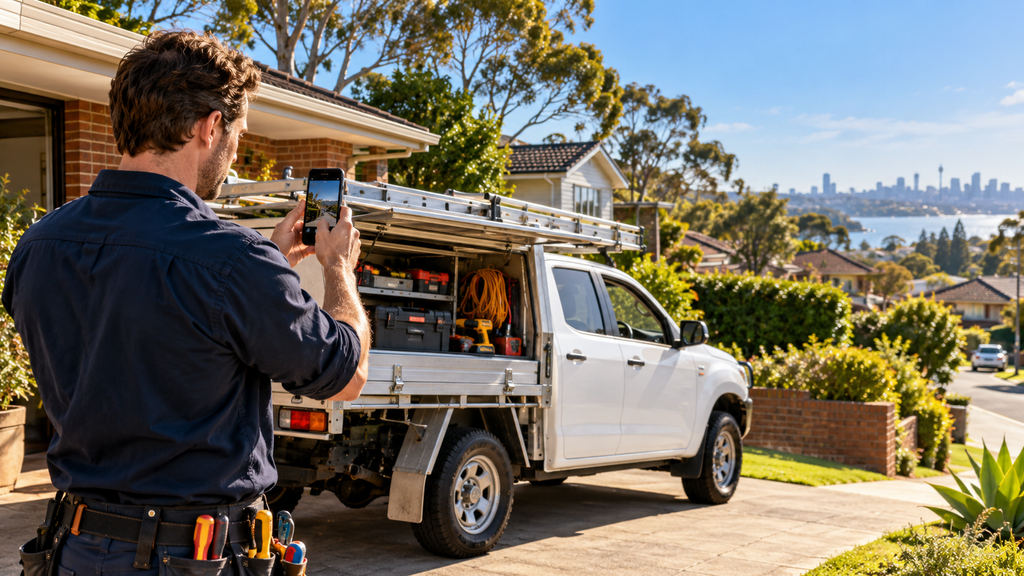
Finish the verification method Google offers inside the Business Profile.
Verification confirms that someone authorised to represent the business controls the profile.
An ABN establishes a business registration context in Australia. It is not a substitute for Google’s own verification decision.
If Google asks a mobile plumber or electrician for a business video, it is checking three things: where the business operates, whether the business exists and whether the person filming is authorised to manage it.
That is why a video of the owner talking to camera may fail even when the business is genuine.
Google currently requires a video-verification recording to be live, continuous, unedited and at least 30 seconds long, captured and uploaded through the Business Profile on a mobile device.
A Penrith electrician could show a recognisable street sign near the operating address, the tools and equipment used on jobs, and access to a branded work van.
A plumber working from home can show location markers in the immediate neighbourhood without publicly exposing the residential address.
Do not record other people’s faces, bank information or identity numbers.
After upload, Google says the review may take up to five working days.
If the result is unsuccessful, read the reason shown in the profile and make the next video address the missing evidence.
Randomly repeating the same recording will not correct a missing location or management signal.
Follow Google’s Verify your business with a video recording instructions.
What confirms the fix?
The management panel shows successful verification and the business becomes eligible to display its managed information in Search and Maps.
Verification does not guarantee a first-page ranking for a broad service query.
The second problem: Google’s rules or duplicate records are blocking visibility
Fix 3: Has Google suspended or disabled your profile?

Read the restriction, correct the underlying policy issue and submit an eligible appeal.
A suspended or disabled Business Profile may disappear from public results until the issue is resolved.
The answer is not to start again with a spouse’s account or a new Gmail address.
Check the Google Account that manages the listing and open the restriction details.
Possible problems include a misleading business name, an ineligible virtual office or inaccurate location information.
Do not guess that every disappearance is a suspension. Confirm the status before appealing.
Prepare business evidence before opening the appeal flow.
Depending on the issue, Google accepts supporting material such as business registration, an applicable trade licence, tax documentation or a utility bill.
The name and address on the evidence should match the business identity being appealed.
For some appeals, Google’s current process requires optional evidence to be uploaded within 60 minutes after submission.
Google says appeal reviews and decisions can take up to five working days, and advises against submitting multiple appeals while one is pending.
An Australian roofer whose real-world name is Smith Roofing should not change the profile name to Smith Roofing Cheapest Roof Repairs Brisbane 24/7 merely to target keywords.
Google’s policy requires the genuine business identity, with trade category, services, hours and service area in their proper fields.
Read the business representation guidelines and appeals instructions before making changes.
What confirms the fix?
Google approves reinstatement or removes the relevant restriction, and the public listing can be found again.
Filing an appeal alone does not mean the profile has been restored.
Fix 4: Are two Google listings competing for the same business identity?
Resolve the duplicate rather than trying to optimise both profiles.
Google’s one-profile-per-business rule is about real business identity, not the number of jobs or services a tradie offers.
A duplicate profile may be excluded from Maps and Search.
That does not prohibit profiles for genuinely separate eligible business locations. Google allows a service business to have a profile for each location when those locations have separate staff and separate service areas. Creating extra profiles merely to target more suburbs or services is different.
Consider a Geelong tiler with an older listing holding legitimate customer reviews and a newer listing showing the correct mobile number.
The right task is to establish which profile represents the business, who controls it and whether Google can merge eligible duplicates.
It is not safe to delete whichever profile looks less polished.
Removing a profile can also remove content and managers, and merge requests are reviewed by Google.
When there is an existing verified listing owned by another account, first use the ownership request.
When Google has incorrectly identified two genuinely distinct, eligible businesses as duplicates, use the appeal or support route appropriate to that status.
A business that has relocated should normally update its existing profile rather than create a fresh one for the new address.
See Resolve duplicate profiles and ownership issues.
What confirms the fix?
One accurate business identity represents the operation, with legitimate access and no competing duplicate record.
A merged profile may retain reviews, but Google warns that some review replies can be lost.
The third problem: your location and business information do not match how you operate
Fix 5: Are you a service-area business showing the wrong address or coverage?
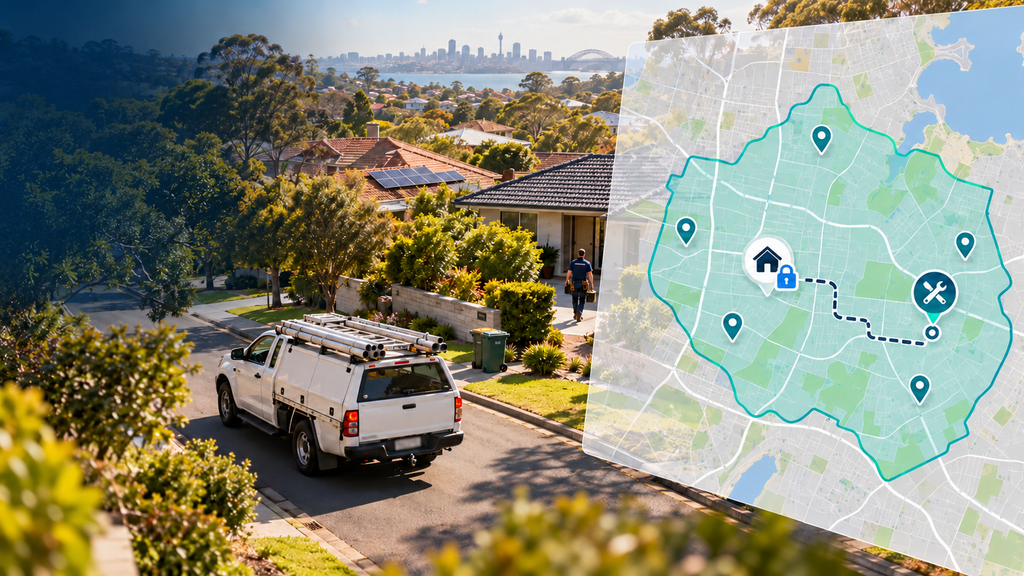
Hide the street address when customers do not visit your premises, and specify the genuine service areas where you travel to them.
Google calls this a service-area business, or SAB.
Plumbers, mobile electricians and roof repairers commonly fit the model because they carry out work at customer properties.
The distinction matters.
A Melbourne electrician working from a residential address may be eligible for one service-area profile with the home address hidden.
A trade showroom that receives customers during stated hours, has staff present and meets Google’s signage requirements may qualify as a storefront or hybrid business.
A rented postal address or an unstaffed virtual office does not become an eligible shopfront simply because it appears on a website.
In the Business Profile, open Edit profile → Location.
If customers never attend the operating address, remove its public display and enter genuine service areas.
Google currently allows up to 20 areas, described by cities, postcodes or similar geographic units.
It generally advises keeping the overall boundary within about two hours’ driving time from the business base, although some business circumstances may justify more.
Approved service-area edits may take up to 48 hours to appear.
Here’s the part that catches people out: adding 20 suburbs does not make you rank in all 20 suburbs.
Service-area settings describe where you work. They do not override the searcher’s location, competitive relevance or prominence.
A Hobart tiler selecting every Tasmanian postcode is not creating a statewide ranking entitlement.
Google explains the distinction in Manage your service areas for service-area and hybrid businesses.
What confirms the fix?
The public profile shows the appropriate service-area representation without displaying an ineligible customer-facing address.
Test ranking separately.
Fix 6: Does your primary business category describe the work customers actually need?
Choose the most specific available primary category that represents the main business, then use services to describe individual jobs.
A category classifies the business. A service describes a task it performs.
Google uses categories to help match local searches, and category changes can require re-verification.
An electrical contractor whose main work is electrical installation should consider the Electrician category if it is the best match offered in Google’s picker.
Switchboard upgrades, fault finding and lighting installation belong in the services information.
A plumbing company can describe drain clearing, hot-water repairs and emergency callouts without inventing a separate profile for each job type.
Do not select every remotely related category in the hope of attracting more impressions.
Google advises using the fewest categories necessary to describe the core business.
Likewise, a business offering renovations and carpentry should select categories based on its genuine primary operation, not whichever broad phrase happens to have attractive search volume.
Google’s Manage your business category guide provides the editing method and eligibility cautions.
What confirms the fix?
The primary category accurately names the trade and the service descriptions provide enough detail for customers to understand what can be booked.
Search performance may change, but a category edit has no guaranteed ranking result.
Fix 7: Can a customer actually contact the right business from your profile?
Correct the business name, phone number, website, opening hours and service details before working on rankings.
Complete, accurate information helps Google understand a business and helps a customer make contact after finding it.
This is where a listing can be technically visible but still lose work.
A roofer with an old mobile number can appear on Maps and receive no usable enquiries.
An emergency plumber showing ordinary office hours may fail to communicate actual callout availability.
A builder linking to a dead website gives the customer no useful place to review services and completed projects.
Use the genuine trading name recognised on signage, stationery and the business website.
Record a phone number the team answers, the correct site URL, accurate regular and special hours, and work you genuinely undertake.
Keep essential name, address and phone details consistent across the business’s own website and relevant directories.
SEO practitioners call this NAP consistency—name, address and phone number—but Google does not publish a fixed ranking gain for achieving a particular citation count or NAP score.
Do not add suburbs and adjectives to the business-name field as a keyword strategy.
Dave’s Plumbing and Dave’s Plumbing Best Emergency Plumber Sydney Cheap 24/7 are not equivalent names unless the longer wording genuinely reflects how the business is known in the real world.
Google’s business representation guidelines prohibit unnecessary business-name additions and explain where location, hours and category information belongs.
What confirms the fix?
A customer looking at the public listing sees the correct identity, can reach the company and understands the services and operating hours.
That is a measurable usability outcome even before rankings move.
The fourth problem: your listing exists, but nearby competitors still appear first
Fix 8: Why are other plumbers, electricians or builders ranking above you?
Improve the profile’s relevance and genuine local reputation, while recognising that proximity remains part of Google’s ranking system.
Google says local results mainly depend on relevance, distance and prominence.
These are related influences, not a public formula with fixed percentages.
Relevance is the match between the search and the business.
A customer searching hot water repair Perth needs a business that actually provides that service.
Accurate categories, services and business information give Google clearer context.
Distance reflects how far a business is from the searcher’s location, or the location Google infers.
A genuine business near the searcher can therefore compete differently from the same company viewed 30 kilometres away.
Prominence concerns how well known the business is.
Google identifies signals including online reviews and links from other websites.
A tradie’s profile can be eligible and well configured yet lose a broad local query to another business with stronger relevant signals.
This does not prove that the competitor has paid Google or broken a rule.
Organic local ranking cannot be purchased from Google, and an SEO agency cannot legitimately guarantee first place.
For local reputation, invite customers who have actually received a service to leave honest reviews.
Respond to useful feedback without offering discounts, payments, free services or other incentives in exchange for any review. Do not selectively request only positive reviews or offer rewards for changing or removing negative reviews. See Google’s review content policy.
Publish genuine work photographs where you have permission, keep the business website useful, and describe actual service capability—for example, switchboard upgrades, blocked drains or roof leak repairs—without creating thin pages for dozens of suburbs where nothing distinct is offered.
There is research behind the importance of online reputation, but it needs a boundary.
A 2023 study by Shin, Xiang and Zach examined restaurant-related local searches across Google, Bing and Yelp and found that review information contributed to differences in search results.
That does not measure the effect of a five-star review on an Australian plumber’s ranking or reveal Google’s private weights.
Google’s own local ranking guidance is the direct source for the three ranking considerations.
See also the research paper Role of Online Reviews in the Local Search Context.
What confirms the fix?
Relevant service queries begin bringing qualified profile visibility and genuine enquiries from the areas you actually serve.
Measure search phrases and locations over time rather than taking one screenshot of a favourable ranking.
The fifth problem: visibility changed and nobody knows why
Fix 9: Did your listing disappear after an edit, a move or a sudden ranking drop?
Check recent profile changes and Google’s processing status before assuming the business has been penalised.
Google’s published timings vary by action.
Ordinary business-information edits can take up to three days to appear in search results.
Rankings for new businesses can take up to one month to establish.
Approved service-area edits may display sooner, while a verification or appeal follows its own review process.
Look at the sequence of events.
Did somebody change the category? Did the team move premises? Has a previous owner altered the phone number?
Did Google request verification again?
Was the profile restricted, or has it stayed visible under the exact name while fewer customers encounter it for general trade queries?
Each answer points to a different cause.
The Business Profile performance report can help separate exposure from action.
Where available, it shows search terms, views, website clicks and clicks on the call button.
That last metric is not proof of a completed conversation or a booked job.
Compare similar date ranges and note any advertising activity, because Google’s performance data can include both organic and paid interactions.
If your profile is still visible by name, don’t label every decline a suspension.
If it is no longer public and the management panel shows a policy restriction, follow the appeal route.
If the edit is pending, allow the relevant review period before making a series of conflicting changes.
See Find your business on Google and Understand your Business Profile performance and insights.
What confirms the fix?
You can identify whether the problem was a pending edit, verification state, restriction or genuine ranking change—and compare the relevant customer actions after resolution.
How long should an Australian tradie wait before escalating a Google Maps problem?
Wait for the relevant review period, not an arbitrary seven or thirty days.
Google’s current help pages state that video verification review and an eligible appeal decision can each take up to five working days.
Ordinary business information changes can take up to three days to display.
Approved service-area edits may take up to 48 hours.
New-business rankings can take up to one month to become established.
These are published indications, not guarantees of an approved appeal or a specific Maps position.
If the relevant period has passed and the problem remains, use the issue-specific Google support process.
A verified but poorly ranked profile needs a local visibility diagnosis.
A rejected verification needs the missing evidence.
A suspension needs policy correction and appeal.
They are not interchangeable requests.
Can you fix your Google Maps listing yourself, or should you hire a specialist?
Most owners can correct ordinary Business Profile information themselves; specialist assistance is more useful for unresolved ownership conflicts, complex restrictions or a documented local ranking problem.
Creating or claiming an eligible Business Profile is free.
Paying an agency is not a condition for Google Maps visibility.
For routine changes such as correcting hours, uploading authentic job photographs or selecting the appropriate trade category, start inside your own business account.
Keep primary ownership with the business rather than an employee’s personal email or a marketing supplier’s account.
An agency can receive an appropriate management role without taking ownership of your business identity.
Paid help makes more sense when you have evidence of an issue and a clear scope for fixing it.
For example, an agency may investigate a duplicate with two ownership accounts, prepare a compliant evidence checklist for an appeal, or analyse why a verified service-area business appears for ABC Plumbing Penrith but not for relevant nearby service queries.
What should a Google Maps visibility audit actually include?
A useful audit identifies the visibility state, documents the likely cause, recommends permitted actions and explains how results will be measured.
Before agreeing to a fee, ask for these four outputs in writing:
- Diagnosis: Is the business missing, restricted, duplicated, misconfigured or simply underperforming in local search?
- Evidence: What profile notices, public search observations, ownership records or performance changes support that conclusion?
- Remedy: Which action can the owner make, which action requires Google review and what remains uncertain?
- Measurement: Will success mean restored public visibility, corrected enquiries, improved relevant search discovery or more booked work?
Treat a promise of “guaranteed number one on Google Maps” as a warning.
Google says nobody can request or pay it for a better organic local ranking.
Avoid offers involving purchased reviews, fabricated locations or multiple listings for one operation.
Need someone to investigate the right issue? Request a Google Business Profile visibility audit that starts with the exact-name test and provides a written action plan.
Agree on the work, price and ownership access before authorising changes.
A reputable provider should tell you what it can control—and what only Google can decide.
Google Maps questions Australian tradies keep asking
Why is my verified business still not showing for “near me” searches?
Verification permits eligible business information to appear, but relevance, distance and prominence still determine whether the profile ranks for a customer’s service query.
Can I rank in every suburb listed in my service area?
No; service-area settings show where you work, while Google’s local results also depend on the searcher’s location, relevance and prominence.
Can a plumber run a Google Business Profile from home?
Yes, an eligible home-based plumber who visits customers can use a service-area profile and keep the residential street address hidden.
Does Google Ads fix a suspended Business Profile?
No; paid advertising does not reinstate a suspended profile or purchase a higher organic Google Maps position.
Should I set up another profile for electrical repairs, installations and switchboards?
Usually no; those services normally belong in one eligible electrical business profile rather than separate profiles for the same operation.
What if the previous marketing agency owns my Google listing?
Request ownership of the existing verified Business Profile using Google’s official process before attempting to replace or duplicate it.
Do more five-star reviews guarantee higher Maps rankings?
No; genuine reviews can contribute to prominence, but Google does not guarantee a particular ranking from a review count or rating.
Get the right Google Maps fix before spending money on SEO
First restore an accurate, eligible and publicly visible Business Profile. Then work on local rankings for genuine trade services and service areas.
That is the order.
If no listing appears for your exact trading name, check whether the right profile exists, whether it is verified and whether Google has flagged a duplicate or restriction.
If the listing is already public but missing from roofer near me or emergency plumber Brisbane, examine the category, services, distance and local reputation.
If visibility dropped after a change, check timing and status before editing again.
You don’t need a vague promise of “more SEO”.
You need to know what is preventing customers from finding or contacting the business, what can be corrected, and what evidence will show that the correction worked.
Start with that diagnosis, whether you handle it yourself or commission a specialist audit.


