

Air conditioning SEO helps HVAC companies appear in Google Search and Google Maps when nearby customers need installation, repair, servicing, maintenance, or replacement work. It connects each search with a relevant page, verified business information, operational proof, and a clear booking action.
The objective is not to attract everyone researching air conditioners. It is to attract homeowners, landlords, property managers, facilities managers, and commercial buyers who need a service the company provides in an area it can profitably cover.
The complete commercial sequence is:
Air conditioning need → search query → suitable page or Business Profile → verified contractor → call or form → qualified enquiry → quote → booked job
This distinction matters. A page can generate 5,000 visits and still fail commercially when most visitors are outside the service area, researching do-it-yourself repairs, looking for a product manual, or comparing the cheapest portable air conditioner.
A useful air conditioning SEO campaign measures calls, quote requests, scheduled appointments, accepted quotes, booked jobs, completed jobs, and revenue. Rankings and traffic remain diagnostic metrics. They are not the final business result.
Google states that its systems seek helpful, reliable, people-first content rather than pages created mainly to manipulate rankings. Google also asks whether a site has a clear primary purpose and whether the reader leaves with enough information to achieve a real goal. That guidance supports a focused HVAC page built around services, locations, evidence, and booking decisions rather than generic keyword coverage. Read Google’s people-first content guidance.
| SEO layer | Main asset | Commercial function |
|---|---|---|
| Local SEO | Google Business Profile | Generates Maps visibility and local actions |
| On-page SEO | Service and location pages | Matches specific service and geographic intent |
| Technical SEO | Crawlable, fast website | Allows users and search engines to access key pages |
| Content strategy | Cost, problem, system and decision guides | Supports commercial pages and captures early demand |
| Reputation | Reviews, licences and project evidence | Reduces perceived risk |
| Conversion optimisation | Calls, forms and booking tools | Turns visits into enquiries |
| Measurement | Analytics, call tracking and CRM data | Connects SEO activity with booked work |
Businesses that need a complete campaign can start with an SEO Audit for Tradies before committing resources to new pages, links, tracking systems, or Google Business Profile work.
What Is Air Conditioning SEO?
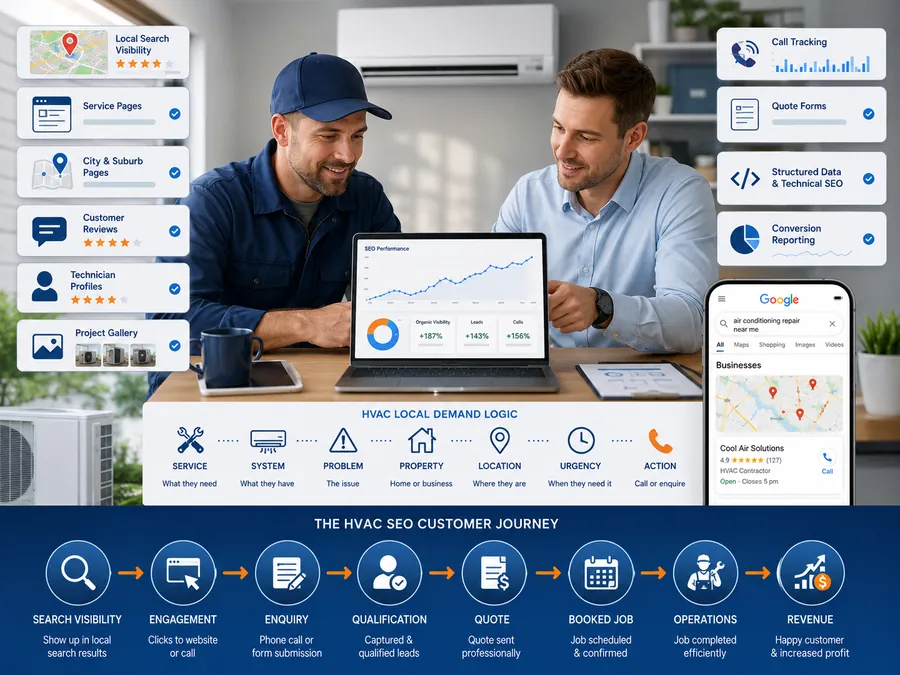
Air conditioning SEO is the process of improving the search visibility, local relevance, website quality, business evidence, and conversion pathways of an air conditioning or HVAC company.
It is a specialised form of search engine optimisation. Search engine optimisation is the broader discipline. Local SEO is the geographic specialisation. HVAC SEO is the industry specialisation. Air conditioning repair SEO, split-system installer SEO, ducted air conditioning SEO, and commercial HVAC SEO are narrower service-level applications.
The work can involve several digital assets. These include the company website, Google Business Profile, service pages, city pages, suburb pages, project galleries, technician profiles, customer reviews, directory listings, structured data, call tracking, and quote forms.
Air conditioning SEO differs from general website optimisation because local HVAC demand contains several connected variables:
Service + system + problem + property + location + urgency + action
A homeowner may search for “split system not cooling in Parramatta.” A landlord may search for “air conditioning repair for rental property.” A facilities manager may search for “commercial HVAC maintenance Sydney.” These searches relate to the same industry but require different information, proof, response processes, and conversion actions.
How does air conditioning SEO produce revenue?
It produces revenue when a relevant search leads to a qualified enquiry that becomes an accepted quote and completed job.
The causal chain must remain measurable. A ranking improvement is useful only when the page attracts the correct customer, the business answers the enquiry, the job fits the service area, and the quote is commercially viable.
A reliable reporting model separates the following values:
| Stage | Measured event |
|---|---|
| Visibility | Impression or Map Pack appearance |
| Engagement | Website visit, profile view or call-button click |
| Enquiry | Phone call, form or booking request |
| Qualification | Suitable service, area, timing and budget |
| Sales | Quote issued and accepted |
| Operations | Appointment booked and job completed |
| Financial outcome | Revenue, gross profit and acquisition cost |
This is the practical difference between SEO reporting and lead-generation reporting. One explains what happened in search. The other verifies whether search activity produced useful work.
Which Air Conditioning Businesses Need Different SEO Strategies?
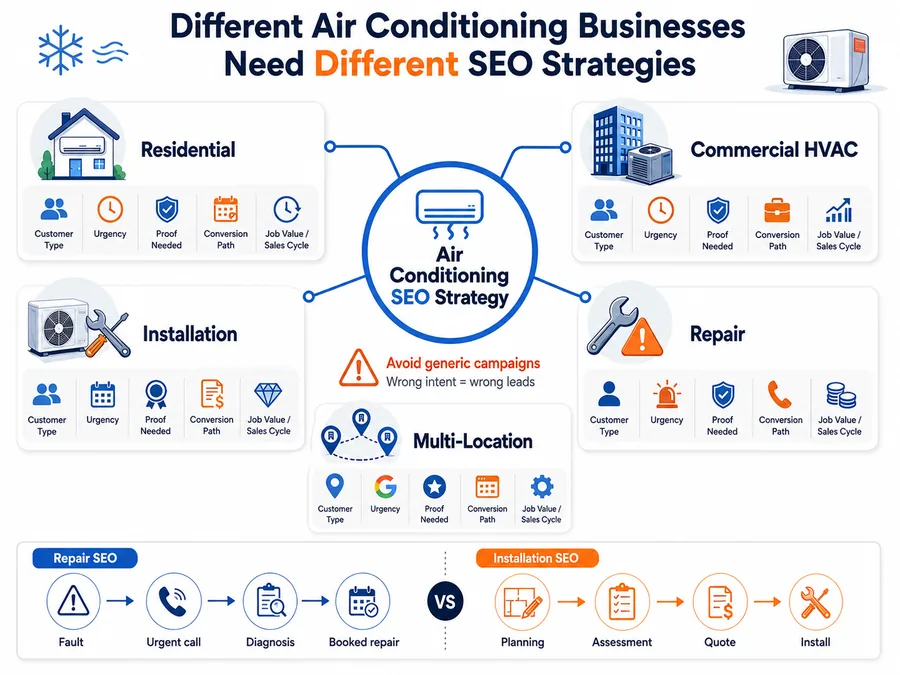
Residential contractors, commercial HVAC providers, installation specialists, repair businesses, and multi-location operators require different page structures because their customers, job values, proof requirements, and sales cycles differ.
A single generic campaign often creates intent dilution. It can attract emergency residential calls to a commercial maintenance contractor or send low-value repair enquiries to a company focused on ducted installations.
Residential air conditioning companies
Residential companies commonly serve homeowners, tenants, landlords, strata managers, and property managers. Their services may include split-system installation, ducted air conditioning, breakdown repairs, preventative servicing, reverse-cycle systems, cleaning, fault diagnosis, and replacement.
Their search journey is usually short when the system has failed. The customer wants to confirm four facts quickly:
- The contractor handles the exact problem.
- The contractor serves the property location.
- A qualified technician is available.
- The customer can call or book without friction.
Planned installation searches require more detail. The page must explain system selection, property assessment, sizing, zoning, energy efficiency, installation steps, warranties, financing, rebates where applicable, and quote requirements.
Commercial HVAC contractors
Commercial HVAC SEO targets facilities managers, property managers, building owners, operations managers, construction companies, procurement teams, and maintenance coordinators.
These buyers may search for rooftop-unit maintenance, VRF servicing, preventive maintenance contracts, office HVAC upgrades, retail air conditioning, warehouse climate control, or mechanical-services contractors.
Commercial buyers generally need stronger capability evidence. That can include licences, safety systems, technician capacity, equipment experience, response procedures, project scope, service-level arrangements, compliance records, reporting, and planned-maintenance processes.
The Australian Government reports that HVAC systems can account for up to 50% of a commercial building’s energy use and can dominate peak electricity demand. This makes energy performance, maintenance quality, controls, and equipment optimisation commercially relevant content rather than generic sustainability language. See the Australian Government HVAC equipment guide.
Multi-location and franchise operators
Multi-location businesses require branch-level governance. Each genuine branch may need its own Google Business Profile, landing page, local phone number, service territory, staff evidence, reviews, and performance reporting.
A branch is not a virtual office. Google requires businesses to represent real-world locations accurately. A co-working or rented address is not eligible merely because mail can be received there. A customer-facing location normally requires permanent signage and staff presence during stated hours.
Installation specialists and service contractors
Installation and repair represent different forms of demand.
| Dimension | Repair SEO | Installation SEO |
|---|---|---|
| Customer state | Existing system has a fault | Customer is planning a system |
| Typical urgency | Minutes to days | Days to months |
| Main action | Call or emergency booking | Assessment or quote request |
| Main evidence | Availability, diagnosis and reviews | Projects, brands, design and warranties |
| Information depth | Symptom, response and repair process | Sizing, options, cost and installation process |
| Lead value | Variable | Usually higher but requires qualification |
A company that wants both types of work needs separate pages and separate conversion paths. The website should not force an urgent repair customer through a long installation form or direct a planned installation prospect to an emergency phone-only page.
Why Is Air Conditioning SEO So Competitive?
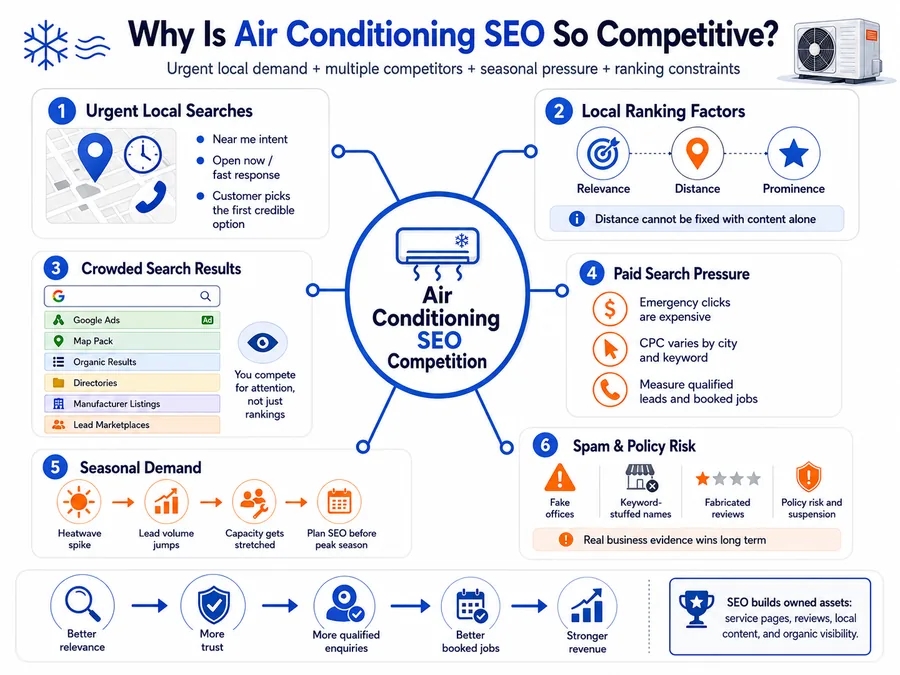
Air conditioning SEO is competitive because local demand is urgent, geographically restricted, seasonal, and commercially valuable.
The same search can trigger organic results, Google Maps, paid search advertisements, directories, manufacturer listings, and lead marketplaces. The contractor is not only competing for a ranking. It is competing for the customer’s first credible option.
Local searches concentrate attention
Searches such as “air conditioning repair near me,” “aircon technician open now,” and “ducted air conditioning installer Sydney” contain immediate geographic intent.
Google explains that local results are mainly determined through relevance, distance, and prominence. Relevance concerns how closely the business matches the search. Distance concerns the business or service location relative to the searcher. Prominence concerns how well known the business appears based on signals such as links, reviews, and broader web information. Read Google’s local-ranking guidance.
Distance cannot be rewritten with content. A business cannot create genuine proximity to every suburb by publishing hundreds of pages. It can improve relevance, business information, service-area evidence, website authority, reviews, and conversion quality.
Emergency searches create expensive competition
Emergency repair customers often contact the first credible company that confirms availability, location coverage, relevant experience, and a direct phone number.
Paid-search prices are auction-based, so no fixed cost-per-click applies across Australia. Costs vary by city, competition, device, time, keyword, bidding method, and advertiser quality. A useful SEO comparison therefore uses the actual account’s cost per qualified lead and cost per booked job rather than a generic industry CPC.
SEO does not eliminate the need for paid advertising. It reduces dependence on one acquisition channel and builds owned assets, including service pages, local content, reviews, and organic visibility. Companies using both channels can connect Google Ads for Tradies with organic query data, call outcomes, and capacity planning.
Seasonal demand changes lead volume
Cooling demand rises during hot weather, while reverse-cycle heating and maintenance searches can support quieter periods. Search demand can change faster than a company’s technician capacity.
The Australian Government reports that heating and cooling can account for 20% to 50% of energy used in Australian homes, depending on climate zone. This explains why efficiency, running costs, maintenance, and system selection remain commercially important customer concerns. See Australian household heating and cooling guidance.
The SEO calendar should therefore be planned before the seasonal peak. Publishing an emergency repair page during the first major heatwave leaves little time for crawling, indexation, testing, internal linking, review growth, and conversion improvement.
Local spam creates a distorted market
Some competitors use keyword-stuffed business names, fake offices, fabricated reviews, duplicate profiles, or service areas they cannot cover.
Copying those tactics increases suspension and policy risk. Google requires the profile name to reflect the real-world business name and prohibits virtual offices that do not meet eligibility requirements. It also prohibits fake engagement and rating manipulation.
A legitimate business can document suspected violations and use Google’s reporting processes. It must still build its own business evidence because a spam report does not guarantee a ranking increase.
How Do Customers Search for Air Conditioning Services?
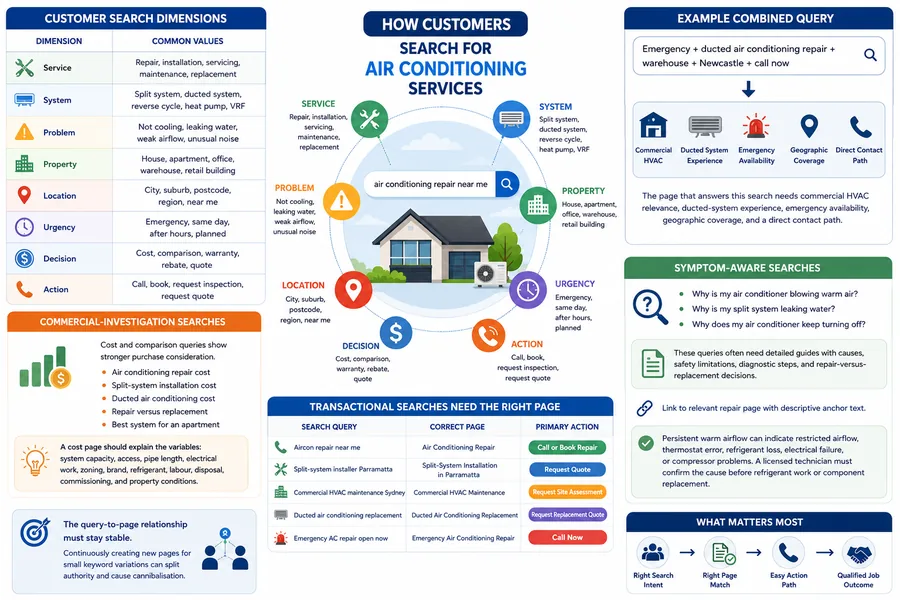
Customers combine a service need with a system, fault, property type, location, urgency, or commercial action.
The useful keyword model is not a flat list. It is a relationship between entities.
| Query dimension | Common values |
|---|---|
| Service | Repair, installation, servicing, maintenance, replacement |
| System | Split system, ducted system, reverse cycle, heat pump, VRF |
| Problem | Not cooling, leaking water, weak airflow, unusual noise |
| Property | House, apartment, office, warehouse, retail building |
| Location | City, suburb, postcode, region, near me |
| Urgency | Emergency, same day, after hours, planned |
| Decision | Cost, comparison, warranty, rebate, quote |
| Action | Call, book, request inspection, request quote |
This model creates queries such as:
Emergency + ducted air conditioning repair + warehouse + Newcastle + call now
The page that answers this search needs commercial HVAC relevance, ducted-system experience, emergency availability, geographic coverage, and a direct contact path. A general article about air conditioner maintenance is not an adequate result.
Symptom-aware searches
A customer may begin with a symptom rather than a service name. Common searches include “why is my air conditioner blowing warm air?”, “why is my split system leaking water?”, and “why does my air conditioner keep turning off?”
These queries can support repair pages, but they often deserve separate informational guides when the answer requires detailed causes, safety limitations, diagnostic steps, and repair-versus-replacement decisions.
The supporting guide must link to the relevant repair page with descriptive anchor text. For example:
Persistent warm airflow can indicate restricted airflow, thermostat error, refrigerant loss, electrical failure, or compressor problems. A licensed technician must confirm the cause before refrigerant work or component replacement.
This wording informs the customer without giving unsafe repair instructions.
Commercial-investigation searches
Cost and comparison queries show stronger purchase consideration. Examples include air conditioning repair cost, split-system installation cost, ducted air conditioning cost, repair versus replacement, and best system for an apartment.
A cost page should not publish a single unsupported price. It should explain the measurable variables, such as system capacity, access, pipe length, electrical work, zoning, equipment brand, refrigerant, labour, disposal, commissioning, and property conditions.
Transactional searches
Transactional searches require a service page, not a broad blog article.
| Search | Correct page | Primary action |
|---|---|---|
| Aircon repair near me | Air Conditioning Repair | Call or book repair |
| Split-system installer Parramatta | Split-System Installation in Parramatta | Request quote |
| Commercial HVAC maintenance Sydney | Commercial HVAC Maintenance | Request site assessment |
| Ducted air conditioning replacement | Ducted Air Conditioning Replacement | Request replacement quote |
| Emergency AC repair open now | Emergency Air Conditioning Repair | Call now |
The query-to-page relationship must stay stable. Continually creating new pages for small keyword variations can split authority and create cannibalisation.
How Should HVAC Keywords Be Mapped to URLs?
Map every keyword cluster to the URL that best satisfies its dominant intent, required evidence, and conversion action.
One page can target close synonyms when the user expects the same answer. “Air conditioning servicing,” “aircon service,” and “air conditioner maintenance service” may belong on one page if the company offers the same process and booking action.
Separate pages are justified when the searcher needs materially different information.
Repair and emergency intent
A general repair page can cover diagnosis, supported systems, common faults, standard availability, service areas, repair process, warranties, and booking.
An emergency page requires different information. It must state hours, response process, service limitations, dispatch area, contact method, and what happens after the call.
Maintenance intent
Maintenance can include routine servicing, preventative maintenance, annual plans, commercial maintenance agreements, filter cleaning, coil cleaning, drain checks, electrical inspection, refrigerant checks, and airflow testing.
A one-off residential service and a commercial planned-maintenance agreement should not share one primary URL when their buyers, scope, documentation, and contracts differ.
Installation intent
Installation pages can be divided by system only when the business has enough experience and evidence to support the distinction.
Relevant system types include split systems, multi-split systems, ducted air conditioning, reverse-cycle units, heat pumps, evaporative cooling, rooftop units, packaged systems, and VRF or VRV systems.
A page for each system needs unique specifications, eligible property types, installation steps, cost factors, proof, warranty details, and quote requirements. Replacing only the system name creates weak content.
Brand intent
Brand pages are justified when the contractor is authorised, trained, experienced, or otherwise legitimately connected with the brand.
A useful brand page can include supported models, installation experience, warranty process, servicing capability, common faults, genuine project evidence, and manufacturer references. It must not imply an authorised partnership that does not exist.
How is cannibalisation prevented?
Cannibalisation is reduced by assigning one dominant intent to one primary URL and consolidating pages that answer the same question.
A keyword map should record the following dimensions:
| Field | Example |
|---|---|
| Primary query | Ducted air conditioning installation |
| Search intent | Local transactional |
| Primary URL | /ducted-air-conditioning-installation/ |
| Supporting queries | Ducted AC installer, ducted system installation |
| Customer | Homeowner |
| Evidence | Projects, licences, brands, warranties |
| Conversion | Request installation quote |
| Internal links | Cost guide, location pages, contact page |
An On-Page SEO Service for Tradies can be used to audit titles, headings, page intent, internal anchors, metadata, and content overlap before more URLs are created.
How Should an HVAC Company Prioritise Profitable Services and Areas?
Prioritise services and locations by commercial value, operational capacity, genuine coverage, and search demand rather than keyword volume alone.
A keyword with 1,000 searches is not automatically better than a keyword with 100 searches. The smaller keyword may produce higher-value installations, shorter travel, stronger close rates, or recurring maintenance work.
Each service can be scored across the same dimensions:
| Dimension | Measurement |
|---|---|
| Demand | Relevant monthly impressions and queries |
| Job value | Average invoiced value |
| Profitability | Gross margin after labour and materials |
| Sales quality | Quote acceptance rate |
| Capacity | Available technicians or installation crews |
| Recurrence | Repeat servicing or maintenance potential |
| Geography | Travel time and route efficiency |
| Seasonality | Peak and off-season demand |
| Competition | Search and Maps difficulty |
| Operational fit | Brands, systems and property types supported |
The score is a business prioritisation tool, not a Google ranking factor.
Why does technician capacity matter?
Promoting a service that the company cannot fulfil creates missed calls, delayed appointments, negative reviews, paid-media waste, and poor customer experience.
Marketing and operations need a shared capacity view. The company should know how many emergency calls, standard repair appointments, installation assessments, and commercial visits it can accept during each period.
How many service areas should a company target?
Google allows a service-area or hybrid business to specify up to 20 service areas. Google also advises that the overall area generally should not extend beyond approximately two hours of driving time from the business base. Service areas are entered as cities, postcodes, or other defined places rather than a radius. Read Google’s service-area guidance.
That limit applies to the Business Profile configuration. It does not mean every company should publish 20 location pages or that all 20 areas are equally profitable.
A useful service-area model evaluates travel time, traffic, job margin, crew location, response promise, after-hours coverage, and nearby job density. An outer suburb may make sense for a $12,000 installation but not for a low-value diagnostic call.
Businesses seeking a broader location plan can use Local SEO for Tradies in Australia to connect service areas with real operating coverage.
How Should Google Business Profile Be Optimised?
Google Business Profile should describe the real business accurately, completely, and consistently while making the next customer action clear.
The profile is not a substitute for the website. It is a local discovery and decision asset that connects business identity, services, location data, reviews, images, hours, calls, and booking actions.
Select the correct business model
A service-area business visits customers but does not serve them at the listed address. A hybrid business serves customers at its address and also travels to customers. A storefront receives customers at a staffed, signed location.
Google states that a service-area business that does not serve customers at its address must remove the public address. It also generally permits one profile for the service area unless separate locations have separate staff and legitimate operations.
Complete the profile attributes
The core profile information should match the real operation:
| Attribute | Required decision |
|---|---|
| Business name | Real-world trading name without extra keywords |
| Primary category | Closest description of the core business |
| Secondary categories | Additional legitimate service categories |
| Phone | Number answered for that location |
| Website | Relevant business or location page |
| Hours | Actual staffed or contactable hours |
| Service areas | Areas genuinely served |
| Services | Repair, installation, servicing and other real offerings |
| Description | Clear business and service information |
| Photos | Real technicians, vehicles, systems and completed work |
| Booking link | Working appointment or quote process |
The fewest categories needed to describe the core business are preferable to adding unrelated categories. Google specifically directs businesses to choose the fewest categories needed to describe the operation.
Align the profile with website entities
The profile and website should use compatible service language. If the profile lists ducted air conditioning installation, the website should contain a crawlable page or section explaining that service.
This does not require exact-match repetition. It requires factual consistency across the business name, services, location, hours, phone number, website, and booking process.
A business needing profile-specific work can link readers to Google Business Profile Optimisation for Tradies.
How should local spam be handled?
Document the suspected violation before reporting it. Record the profile URL, business name, address evidence, signage evidence, duplicated locations, or review pattern.
Do not publish accusations on the company website. Submit factual evidence through the correct Google channel. Continue improving the legitimate profile because competitor removal and business improvement are separate processes.
How Should NAP Details and Citations Be Managed?
The business name, address, phone number, website, and location status must remain consistent across authoritative sources.
NAP consistency is not about forcing identical punctuation everywhere. It is about preventing conflicting business identities.
A citation audit should identify current and obsolete values, including:
- Old trading names
- Previous addresses
- Disconnected phone numbers
- HTTP or outdated domain URLs
- Closed branches
- Duplicate directory records
- Incorrect business categories
- Public addresses that should be hidden
- Listings created before a merger or acquisition
After a move or rebrand, update the primary sources first. These normally include the website, Google Business Profile, Apple Business Connect, Bing Places, major Australian directories, industry associations, manufacturer directories, and local business records.
The website should also provide clear canonical business information. Relevant locations can have separate contact details when each branch is genuine.
A citation does not become valuable merely because it exists. A supplier directory, trade association, chamber, manufacturer dealer directory, local publication, or recognised business platform can carry stronger contextual value than hundreds of low-quality directories.
How Should an Air Conditioning Company Build and Manage Reviews?
Request genuine reviews consistently after completed work, respond professionally, and never offer incentives or selectively request only positive feedback.
Reviews support two different functions. They give Google additional prominence and reputation information, and they help customers evaluate the contractor before making contact.
Google states that review count and positive ratings can contribute to local ranking. It also prohibits paid, incentivised, fabricated, pressured, or selectively solicited reviews. Businesses must not discourage negative reviews or require customers to include specific wording. Read Google’s review policy.
What is a compliant review workflow?
The workflow can begin when the job reaches a verified completion status.
- Confirm that the work is complete.
- Send the same neutral review invitation to eligible customers.
- Provide one direct review link.
- Send no more than a reasonable number of reminders.
- Monitor new reviews.
- Respond without exposing private information.
- Record recurring operational feedback.
Do not ask the customer to mention a suburb, technician, service, or five-star rating. Customers may naturally include those details, but the business should not dictate review content.
Why do review details matter?
Research from Northwestern University’s Medill Spiegel Research Center found that review presence, rating, quantity, and content can affect purchase probability. One product study found that five reviews were associated with a 270% higher purchase likelihood than no reviews. That result comes from retail data and must not be presented as an HVAC conversion benchmark. It does support the broader proposition that review availability can reduce information uncertainty. See Northwestern’s review research.
For an HVAC customer, useful review information can include the work completed, communication, punctuality, technician conduct, property conditions, and final outcome. Authentic variation is more credible than repeated keyword patterns.
How should negative reviews be answered?
Acknowledge the concern, protect customer privacy, explain the next resolution step, and move detailed discussion offline.
A useful response does not argue about every fact publicly. It identifies the complaint, provides a contact path, and states what the business will do next.
Negative feedback can also identify process defects, such as missed appointment windows, unclear call-out fees, weak handover, delayed quotes, or poor after-hours communication.
What Should Repair, Maintenance, and Installation Pages Contain?
Each major service needs a page that explains the exact work, eligible customer, system, process, proof, limitations, and booking action.
A thin page often lists a service name, two generic paragraphs, and a contact button. That structure does not answer the questions a homeowner or commercial buyer needs resolved before making contact.
Air conditioning repair pages
A repair page should identify the systems serviced, symptoms investigated, diagnostic process, standard availability, service area, repair limitations, parts process, warranty position, and booking method.
Relevant symptoms can include:
- Air conditioner not cooling
- Warm airflow
- Water leakage
- Weak airflow
- Unusual noise
- Short cycling
- Electrical tripping
- Frozen coil
- Thermostat failure
- Refrigerant loss
The page must not promise a diagnosis before inspection. The same symptom can have several causes.
Emergency repair pages
An emergency page needs operational facts above the fold:
| Required information | Customer question answered |
|---|---|
| Emergency hours | Can anyone respond now? |
| Service area | Will the technician travel here? |
| Supported systems | Can this company handle my unit? |
| Response process | What happens after I call? |
| Phone action | How do I reach dispatch? |
| Limitation | What work cannot be promised immediately? |
| Pricing basis | Is there an after-hours or diagnostic fee? |
“24-hour service” should appear only when a person or operational system genuinely handles enquiries 24 hours a day.
Maintenance pages
Maintenance pages should define the actual scope. “Full service” is too vague.
Possible actions include inspection, filter cleaning, coil cleaning, drain testing, electrical checks, temperature measurement, airflow testing, control inspection, refrigerant assessment, and operational reporting. The exact scope depends on the system and contractor.
Installation pages
An installation page should explain assessment, equipment selection, sizing, system design, zoning, installation, electrical requirements, commissioning, controls, warranty, maintenance, and customer handover.
Heating and cooling can represent 20% to 50% of household energy use in Australia, depending on climate. This makes efficiency claims commercially material. Pages should use verified energy-rating, manufacturer, and government information rather than unsupported phrases such as “cuts your bills dramatically.”
What trust evidence belongs on a service page?
Evidence can include verified licences, technician qualifications, manufacturer training, public liability insurance, project photographs, system details, customer reviews, warranty terms, and service limitations.
The evidence must relate to the service. A commercial rooftop-unit project does not prove experience installing residential multi-split systems unless the company can demonstrate both.
How Should Service-Area and Location Pages Be Built?
Create a location page only when the company genuinely serves the area and can provide distinct local information, proof, and operational relevance.
Changing a suburb name across 100 pages does not create local expertise.
Google’s current spam policies define doorway abuse as creating similar regional or city pages that funnel users toward the same useful destination. Google also treats scaled publication as abusive when many unoriginal pages are produced mainly to manipulate rankings rather than help users. Read Google’s spam policies.
What makes a location page unique?
A useful page can contain:
- Services actually available in that location
- Technician or branch coverage
- Typical response process
- Relevant housing or property types
- Local project examples
- Reviews connected with the area
- System types commonly installed
- Climate or environmental considerations
- Nearby areas served
- Local booking limitations
Not every page needs every attribute. Each claim must be true.
A coastal service area may have different corrosion considerations from an inland area. A high-density apartment district may create different access, strata, noise, and outdoor-unit placement requirements from detached suburban housing. These details are useful only when they reflect actual work experience.
Can a business rank without an office in every suburb?
Yes, a legitimate service-area business can build visibility without pretending to operate an office in every target suburb.
The company can use one eligible Business Profile, accurate service areas, service pages, selective location pages, local project proof, customer reviews, citations, relevant links, and consistent operational information.
It cannot manufacture proximity. Google still considers the searcher’s distance from the business, and content does not remove that factor.
How Should Informational Content Support Booked Work?
Informational content should answer a real customer decision and lead naturally to the correct service page.
A blog is not valuable because it contains many articles. It is valuable when each article supports a service, system, problem, location, or buying decision.
A focused Content Strategy for Tradies can organise these relationships before content is published.
Troubleshooting content
Troubleshooting guides can answer questions such as:
- Why is my air conditioner not cooling?
- Why is the indoor unit leaking water?
- Why does the system switch off repeatedly?
- What causes weak airflow?
- Why is the unit making a rattling noise?
The article must distinguish safe observations from licensed work. It should explain when the system can be checked by the occupant, when it should be switched off, and when a technician is required.
Cost and comparison content
Commercial-investigation topics include repair cost, installation cost, maintenance cost, ducted versus split-system air conditioning, and repair versus replacement.
The page should identify cost variables, not invent a national fixed price. It can also provide a quote checklist so the customer knows which details affect the estimate.
Regulatory and efficiency content
Pages about refrigerants, rebates, energy standards, or licences require dates, official sources, and scheduled review.
Australia began its HFC phase-down on 1 January 2018 and plans to reduce permitted bulk HFC imports to 15% of the baseline level by 1 January 2036. Existing equipment is not automatically required to be replaced because of that phase-down. Read Australia’s HFC phase-down guidance.
Australian rules also prohibit charging refrigeration or air conditioning equipment with a higher-global-warming-potential refrigerant than the equipment’s design refrigerant. For example, equipment designed for R32 cannot lawfully be charged with R410A.
These facts can support useful refrigerant content, but the page should state its jurisdiction, source date, and technical reviewer.
How should internal links be placed?
Internal links should identify the destination clearly.
Use anchors such as:
- SEO for Tradies in Australia
- Local SEO for Tradies in Australia
- Technical SEO Services for Tradies
- Google Business Profile Optimisation for Tradies
Avoid anchors such as “click here,” “read more,” or “this page” when a descriptive phrase fits naturally.
How Can an HVAC Company Demonstrate Experience and Expertise?
Show verified licences, named reviewers, technician experience, project evidence, service limitations, and factual sources.
E-E-A-T is not a single Google ranking factor. Google uses it as a framework for considering experience, expertise, authoritativeness, and trust, with trust treated as the most important component. Google also states that quality-rater guidelines do not directly control rankings.
For an HVAC website, trust can be demonstrated through verifiable attributes rather than self-declared expertise.
Licensing and authorisation
A Refrigerant Handling Licence is required for work that creates a risk of fluorocarbon refrigerant emissions, including installation, commissioning, decommissioning, servicing, and maintenance of relevant equipment. Different licence classes apply to different work. See the Australian Government Refrigerant Handling Licence requirements.
A business that buys, stores, or disposes of fluorocarbon refrigerant generally requires a Refrigerant Trading Authorisation issued by the Australian Refrigeration Council. See ARCtick Refrigerant Trading Authorisation guidance.
State and territory contractor, mechanical-services, plumbing, and electrical requirements can also apply. The website must not imply that one national refrigerant licence covers every type of building, contracting, or electrical work.
Technician profiles
A useful technician profile can state:
| Attribute | Verified value |
|---|---|
| Role | Refrigeration mechanic or air conditioning technician |
| Licence | Licence type and current status |
| Experience | Years and relevant systems |
| Training | Manufacturer or recognised technical training |
| Service scope | Installation, repair or maintenance |
| Market | Residential, commercial or mixed |
| Location | Branch or territory |
| Evidence | Named projects or documented work |
Do not publish a list of generic skills that cannot be verified.
Project evidence
A strong project record explains:
- Property type
- Existing problem
- System type
- Capacity or scope
- Work completed
- Location
- Access or design constraint
- Commissioning or testing
- Outcome
- Photographs
- Date
A photograph without context proves that equipment existed. It does not prove who selected, installed, tested, or maintained it.
How Should Technical SEO and Mobile Performance Be Improved?
Priority service pages must be crawlable, indexable, fast, stable, secure, and usable on a mobile phone.
Emergency air conditioning searches often happen on mobile devices. A slow page, shifting call button, broken form, or intrusive pop-up can lose the enquiry before the customer reads the service details.
Crawlability and indexation
A technical audit should verify:
| Technical element | Required condition |
|---|---|
| HTTP status | Important pages return a valid 200 response |
| Robots directives | Revenue pages are not blocked |
| Canonical tag | Points to the intended primary URL |
| XML sitemap | Contains indexable canonical URLs |
| Internal links | Important pages are not orphaned |
| Redirects | No unnecessary chains or loops |
| JavaScript | Core content and links remain accessible |
| Duplicate pages | Consolidated, redirected or excluded |
| Structured data | Valid and consistent with visible content |
A Technical SEO Service for Tradies can address these issues before the site expands its service or suburb architecture.
Core Web Vitals
Google’s current Core Web Vitals targets are:
| Metric | Good threshold | What it measures |
|---|---|---|
| Largest Contentful Paint | 2.5 seconds or less | Loading performance |
| Interaction to Next Paint | 200 milliseconds or less | Responsiveness |
| Cumulative Layout Shift | 0.1 or less | Visual stability |
The thresholds are assessed at the 75th percentile of page loads for mobile and desktop. Google recommends good Core Web Vitals, but it also states that page experience is broader than these three metrics and that strong scores do not guarantee rankings. Read Google’s Core Web Vitals guidance.
What usually slows an HVAC website?
Common causes include oversized hero images, uncompressed project galleries, video backgrounds, multiple font files, unused JavaScript, chat widgets, call-tracking scripts, review widgets, sliders, tag-manager bloat, and weak hosting.
The correct fix depends on measured field and laboratory data. Removing every tracking script may improve a test score but damage attribution. The objective is controlled loading, not a website with no commercial measurement.
Structured data
LocalBusiness structured data can describe business details such as name, address where applicable, telephone, opening hours, and departments. Google recommends using the most specific applicable subtype and ensuring markup reflects the visible page. Read Google’s LocalBusiness structured-data documentation.
Structured data helps search engines interpret information. It does not create eligibility for a fake location or compensate for missing visible content.
How Should Emergency and Planned Searches Be Converted?
Emergency, installation, and maintenance searches need separate conversion paths because the customer’s urgency and information requirements differ.
Emergency repair path
The emergency path should provide a visible phone number, service hours, coverage limits, supported systems, response process, and short fallback form.
The user should not need to open several accordions or scroll through a company history before finding the number.
A useful sequence is:
Search → emergency landing page → coverage confirmation → call → dispatch qualification → appointment
After-hours forms should state when the customer can expect a response. An automated confirmation is not the same as 24-hour technician availability.
Installation path
The installation path requires more qualification. The form can request:
- Suburb or postcode
- Property type
- Existing system
- Preferred system
- Number of rooms or zones
- Installation timeframe
- Access constraints
- Financing interest
- Contact preference
The form should not request technical values the customer is unlikely to know.
Maintenance path
Maintenance pages can offer a one-off service, annual reminder, preventive plan, strata programme, or commercial agreement.
The conversion action must reflect the scope. “Get a free quote” may be suitable for an installation but less useful than “Book an air conditioning service” for standard maintenance.
How Can Wrong-Area and Low-Quality Leads Be Reduced?
Qualify the customer by service, location, property, system, urgency, and commercial fit before the enquiry reaches the wrong team.
SEO cannot prevent every unsuitable enquiry. It can make eligibility clearer.
A landing page can state the genuine service areas, supported property types, systems serviced, minimum commercial scope, operating hours, and services not offered.
The form and call process should record:
| Qualification field | Example values |
|---|---|
| Service | Repair, installation, servicing, replacement |
| Location | Suburb and postcode |
| Property | House, apartment, office, warehouse |
| System | Split, ducted, rooftop, VRF |
| Urgency | Emergency, this week, planned |
| Customer | Owner, tenant, manager, builder |
| Job fit | Qualified, outside area, unsupported, duplicate |
Price shoppers are not automatically poor leads. A customer asking about cost may still be commercially suitable. The business should distinguish reasonable price investigation from enquiries that cannot meet the minimum job scope.
How Should Calls, Forms, Bookings, and Revenue Be Tracked?
Track the complete path from search source to completed job rather than reporting only clicks and rankings.
The measurement architecture can connect Google Search Console, Google Analytics 4, Google Business Profile performance, call tracking, forms, booking software, and the customer relationship or job-management system.
Define conversion events
A phone-number click is not necessarily a connected call. A connected call is not necessarily a qualified lead. A qualified lead is not necessarily a booked job.
Use separate events and CRM stages:
| Event | Definition |
|---|---|
| Phone click | User taps a telephone link |
| Connected call | Call reaches the tracking system |
| Qualified call | Suitable service and location |
| Form submission | Complete form received |
| Appointment | Visit or assessment scheduled |
| Quote | Price or proposal issued |
| Booked job | Customer accepts work |
| Completed job | Work reaches completed status |
| Revenue | Invoice or recognised sale |
| Gross profit | Revenue less direct job cost |
How should calls be attributed?
Dynamic number insertion can display a tracking number based on the visitor’s source while preserving the primary business number for direct and citation consistency.
The tracking system should record source, medium, campaign where relevant, landing page, call time, duration, disposition, service, location, and booking outcome.
Call recording and transcription must follow applicable privacy, consent, employment, and telecommunications requirements.
Which KPIs matter most?
The reporting hierarchy should move from diagnostic to commercial values:
- Search visibility
- Relevant organic visits
- Calls and forms
- Qualified enquiries
- Quotes
- Booked jobs
- Completed jobs
- Revenue
- Gross profit
- Cost per booked job
This model identifies where performance is failing. Strong visibility with weak clicks indicates a search-result or relevance problem. Strong calls with weak bookings indicates a qualification, pricing, availability, or sales problem.
How Should SEO Be Planned Around Seasonal Demand?
Publish and optimise before demand peaks, then use quieter periods to build maintenance, replacement, commercial, and efficiency demand.
A seasonal programme should combine historical Search Console data, Google Ads data, weather patterns, call volume, job-management records, crew capacity, and previous booking outcomes.
Pre-season work
Before the cooling peak, update repair, installation, servicing, location, rebate, warranty, and emergency pages. Check business hours, call routing, stock constraints, technician availability, and mobile performance.
Peak-season work
During peak demand, monitor missed calls, unsupported areas, booking delays, conversion rate, emergency-page speed, paid-search terms, and profile accuracy.
Do not continue increasing demand when the dispatch team cannot respond.
Off-season work
Off-season content can support preventive maintenance, reverse-cycle heating, planned replacement, commercial maintenance agreements, indoor air quality, energy efficiency, and early installation planning.
The objective is not to manufacture irrelevant demand. It is to serve real lower-season needs that match company capability.
How Should SEO, Paid Ads, Dispatch, and Call Teams Work Together?
All teams need the same service names, service areas, capacity data, and lead outcomes.
Marketing cannot optimise for booked work when the dispatch system uses different categories or the sales team does not record outcomes.
A shared taxonomy can standardise:
- Service type
- System type
- Customer type
- Property type
- Suburb
- Urgency
- Lead source
- Qualification reason
- Quote status
- Booking status
SEO and paid-search teams can compare query data. Paid search can reveal expensive or high-converting terms quickly. Organic search can reveal emerging questions, system modifiers, suburb demand, and pages with long-term potential.
Dispatch provides operational evidence. It can identify suburbs with excessive travel, services with weak margins, calls that cannot be fulfilled, and after-hours demand that exceeds capacity.
The feedback loop is:
Search data → campaign decision → enquiry → dispatch outcome → sales outcome → SEO and paid-search adjustment
Without this loop, marketing may report growth while operations report worse lead quality.
How Much Does Air Conditioning SEO Cost?
The cost depends on campaign scope, service complexity, website condition, geographic coverage, competition, content requirements, implementation, and measurement.
A solo technician serving one region does not require the same programme as a multi-crew company targeting several cities, residential installation, emergency repair, and commercial maintenance.
Common cost variables include:
| Variable | Lower-complexity case | Higher-complexity case |
|---|---|---|
| Services | 2–4 core services | Multiple residential and commercial divisions |
| Locations | One genuine market | Several branches or territories |
| Website | Healthy and crawlable | Migration, duplication and technical debt |
| Profiles | One Business Profile | Multiple branches |
| Content | Existing useful pages | New service, system and location architecture |
| Reputation | Stable review process | Weak, inconsistent or multi-branch reviews |
| Tracking | Basic calls and forms | CRM and revenue attribution |
| Implementation | Internal developer available | External technical implementation required |
No ethical provider can guarantee a specific ranking, lead count, or revenue figure. Google states that there is no way to request or pay for a better local ranking.
How should SEO return be calculated?
Use completed commercial outcomes where possible.
SEO return on investment =
(SEO-attributed gross profit − SEO investment) ÷ SEO investment × 100
Revenue alone can overstate performance because installation, equipment, labour, travel, warranty, and subcontractor costs differ by job.
A company comparing options can begin with an SEO Audit for Tradies to define scope before selecting a monthly campaign.
What Should an Air Conditioning SEO Case Study Prove?
A case study should show the starting condition, work completed, measurement method, commercial result, time period, and limitations.
A ranking screenshot alone is not enough.
The baseline can record website condition, service-page coverage, Maps visibility, review profile, tracked calls, forms, booked jobs, service areas, and attribution gaps.
The implementation section should name the work. Examples include restructuring service pages, correcting Business Profile information, improving mobile call paths, cleaning citations, publishing location proof, implementing call tracking, or connecting leads with the CRM.
The result should distinguish:
- Organic clicks
- Business Profile calls
- Qualified enquiries
- Quote requests
- Booked installations
- Repair jobs
- Maintenance customers
- Revenue
- Cost per booked job
The case study must also state whether paid ads, seasonality, business expansion, pricing changes, new staff, or improved call handling contributed to the result.
What Is a Practical 90-Day HVAC SEO Roadmap?
The first 90 days should establish measurement, fix the highest-impact problems, improve revenue pages, and create a controlled expansion plan.
| Period | Primary objective | Main work |
|---|---|---|
| Days 1–30 | Diagnose and measure | Technical audit, keyword map, GBP audit, tracking, service-area review |
| Days 31–60 | Improve commercial assets | Repair, maintenance, installation, location pages, reviews and conversion |
| Days 61–90 | Strengthen authority and attribution | Supporting content, citations, links, schema, CRM and reporting |
Days 1–30: establish the baseline
Confirm which services and areas the company wants to grow. Audit crawling, indexation, internal links, Google Business Profile, citations, reviews, page intent, call handling, forms, and analytics.
Build the keyword-to-URL map before writing content.
Days 31–60: improve commercial pages
Prioritise the pages closest to revenue. Repair, maintenance, installation, commercial, system, and genuine location pages usually come before broad educational publishing.
Add service evidence, local relevance, qualifications, pricing variables, warranties, FAQs, calls, forms, and internal links.
Days 61–90: expand and verify
Publish the first supporting guides. Correct priority citations. Add valid structured data. Improve Core Web Vitals where measured problems exist. Connect call and form data with quote and booking outcomes.
The first 90 days build the operating system. Competitive markets generally require ongoing improvement, testing, review growth, content updates, local authority, and technical maintenance.
Air Conditioning SEO Checklist
A complete campaign must align local visibility, website architecture, business evidence, conversion, and commercial reporting.
| Area | Verification question |
|---|---|
| Business Profile | Is the profile eligible, complete and accurate? |
| Services | Does each priority service have one clear primary URL? |
| Locations | Does every location page represent genuine coverage? |
| Reviews | Are reviews genuine, recent and answered professionally? |
| Trust | Are licences, insurance and technician claims verifiable? |
| Content | Does each article support a service or decision? |
| Technical SEO | Can Google crawl and index the intended pages? |
| Mobile | Can an urgent customer call without friction? |
| Performance | Do key pages meet acceptable real-user thresholds? |
| Tracking | Can calls and forms be connected with booked work? |
| Operations | Are promoted services aligned with crew capacity? |
| Compliance | Are refrigerant, licence and rebate pages current? |
Frequently Asked Questions About Air Conditioning SEO
What is air conditioning SEO?
Air conditioning SEO improves an HVAC company’s visibility in Google Search and Maps for relevant service, system, location, urgency, and quote-related searches.
How does HVAC SEO generate booked jobs?
It matches customer demand with relevant pages, accurate business information, trusted evidence, direct contact options, and tracking that connects the enquiry with a completed job.
How long does air conditioning SEO take?
The timeframe varies with competition, website condition, business history, implementation speed, service areas, content quality, and existing authority; no fixed ranking date can be guaranteed.
How can an HVAC company rank in the Google Local Pack?
Improve Business Profile relevance, maintain accurate information, build genuine reviews and prominence, support services through the website, and target areas the business actually serves.
Can a service-area business rank without displaying its address?
Yes, an eligible service-area business can hide its address and list genuine service areas when customers are not served at the business location.
How many suburbs should an air conditioning company target?
Target only suburbs supported by demand, operational coverage, profitability, unique evidence, and enough content value to justify a dedicated page.
Should repair, servicing, and installation have separate pages?
Yes, when they require different information, evidence, customer journeys, and conversion actions.
Should an HVAC website create a page for every brand?
No; create a brand page only when the company genuinely installs or services the brand and can provide distinct technical and project evidence.
How can an air conditioning company get more Google reviews?
Send a neutral review request after completed work, use a direct review link, treat eligible customers consistently, and avoid incentives or review gating.
How should negative reviews be answered?
Acknowledge the concern, avoid exposing private information, explain the resolution process, and continue detailed discussion through a private support channel.
Is SEO better than Google Ads for emergency searches?
Neither channel is universally better; Google Ads can provide immediate auction-based visibility, while SEO builds owned search assets and can reduce long-term dependence on paid traffic.
How can phone calls be attributed to SEO?
Use call tracking, dynamic number insertion, landing-page data, source information, call outcomes, and CRM records while preserving consistent primary business details.
What should be measured besides rankings?
Measure qualified calls, forms, appointments, quotes, booked jobs, completed jobs, revenue, gross profit, missed calls, booking rate, and cost per booked job.
How should seasonal demand affect an SEO campaign?
Publish before peak demand, monitor call and crew capacity during the peak, and develop maintenance, replacement, commercial, and efficiency demand during quieter periods.
How often should refrigerant, rebate, and efficiency pages be updated?
Review them on a defined schedule and whenever the applicable regulator, government programme, standard, manufacturer, or legislation changes.
How can an HVAC company reduce enquiries outside its service area?
State genuine coverage clearly, use postcode qualification, align website and profile areas, configure forms, and route unsupported locations before dispatch.
What makes an air conditioning location page unique?
A useful page combines real service availability, local conditions, project evidence, reviews, property context, technician coverage, and a location-specific booking path.
Which structured data can an HVAC website use?
Applicable types may include Organization, LocalBusiness, Service, BreadcrumbList, WebSite, WebPage, Article, and VideoObject when the visible content supports the markup.
Find the Search Gaps Costing Your HVAC Business Booked Work
An air conditioning SEO strategy must identify the services worth promoting, the locations worth targeting, the evidence customers need, and the conversion events that prove commercial value.
SEO Agency for Tradies does not need to publish hundreds of pages, fabricate offices, or report traffic without lead context.
A proper audit can show:
- Which repair, installation, and maintenance searches deserve priority
- Why the company is missing Google Maps visibility
- Which pages overlap or lack commercial depth
- Where reviews, licences, warranties, and project evidence are missing
- Why mobile visitors are not calling
- Which services and suburbs generate qualified work
- Whether calls and quote forms become booked jobs
Request an Air Conditioning SEO Audit and receive a practical review of your website, Google Business Profile, service areas, competitors, technical condition, content gaps, and lead tracking.


