Digital Marketing for Australian Roofers That Generates Qualified Local Enquiries
We help Australian roofing companies generate qualified calls, inspection bookings and quote requests through local SEO, Google Ads, conversion-focused websites and first-party tracking. Every campaign targets profitable roofing services and genuine service areas, then measures which enquiries become booked work.
Residential roofing, commercial roofing, roof restoration, re-roofing, emergency repairs and storm-damage campaigns require different keywords, landing pages, qualification rules and sales processes. We build around those differences instead of forcing every roofing company into the same marketing package.
Find out what's holding you back
Enter your number — we’ll call you with a free ranking report for your suburb.
We call within 2 business hours. No scripts. No pressure.
Businesses We Support Across Australia
We support trade and commercial service businesses with stronger local visibility, clearer lead generation and marketing systems connected to measurable commercial outcomes.





Attract
property owners
Convert
search demand into enquiries
Book
more roofing jobs
Track
revenue that matters
What Is Digital Marketing for Roofers?
Digital marketing for roofers is a customer-acquisition system that attracts property owners, converts their search demand into enquiries and tracks which enquiries become roofing jobs. It includes search engine optimisation, Google Business Profile management, paid advertising, website conversion, reputation management, content, automation and revenue attribution.
The service is narrower than general digital marketing. It focuses on roofing problems, roof systems, property types, service areas and buying intent. Examples include leaking roof repairs in Newcastle, roof restoration in Brisbane, COLORBOND re-roofing in Perth and commercial roof maintenance in Melbourne.
The current search landscape treats this topic as a commercial service rather than a general marketing lesson. Searchers are comparing providers, strategies, prices, evidence and lead-generation systems. The expected outcome is qualified roofing work—not impressions without enquiries or traffic without sales.
Our campaign model follows one measurable commercial path:
Search demand →
local visibility →
relevant page →
trust validation →
qualified enquiry →
inspection →
quote →
booked job →
attributed revenue
Why Roofing Marketing
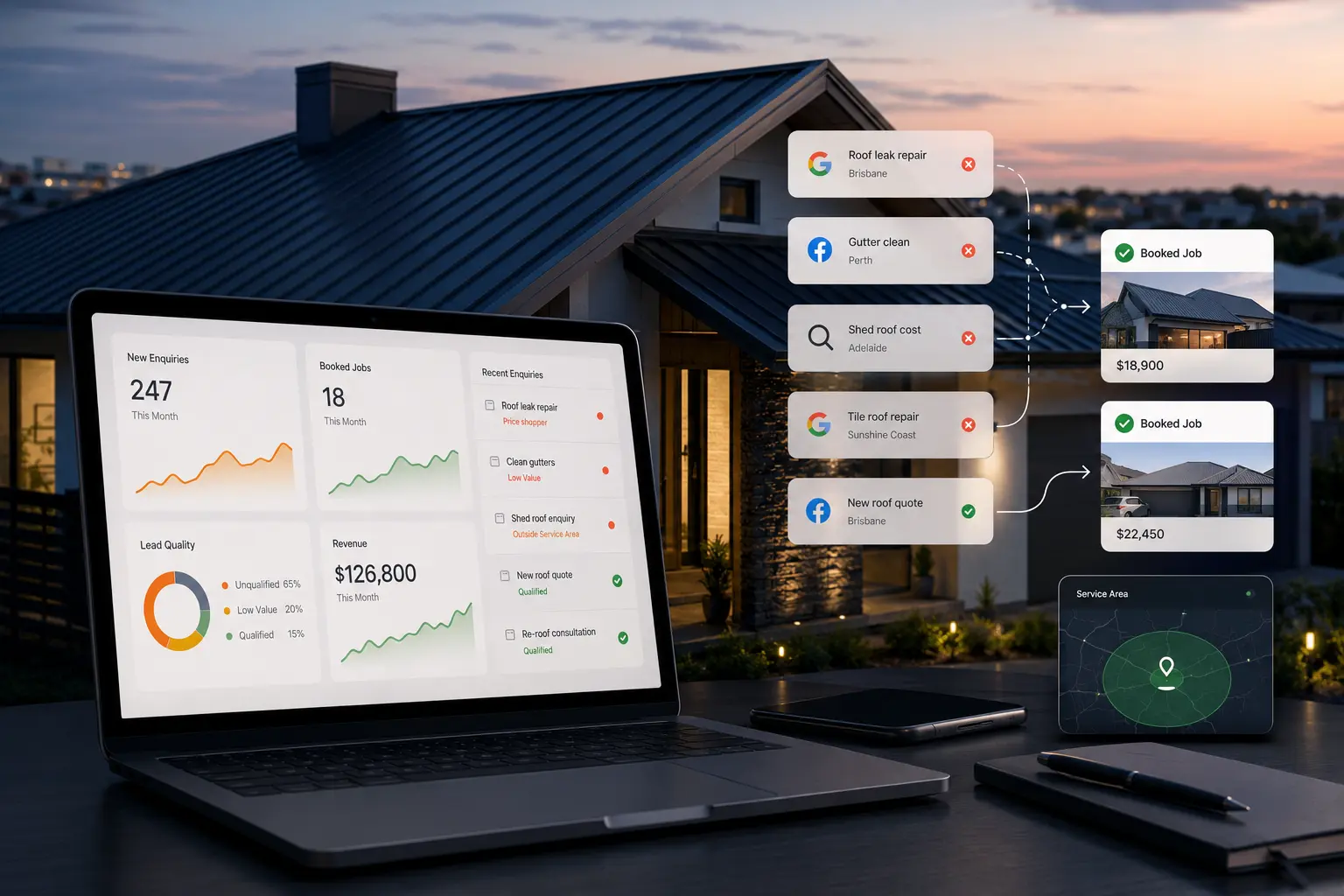
Most roofing campaigns fail because the targeting, landing page and sales process do not describe the same customer. The campaign may generate clicks or forms, but the business receives distant enquiries, small jobs, renters, suppliers, job seekers or people who never receive a response.
Broad Campaigns Attract the Wrong People
A campaign should connect a defined roofing service with a defined buyer in a defined location. Broad terms such as “roofing” can attract materials, employment, training and DIY searches. A query such as “roof replacement quote Parramatta” provides clearer service, location and purchase intent.
We separate emergency repairs, general repairs, restoration, replacement and commercial work. Each group receives suitable keywords, ad copy, landing pages and qualification rules.
Lead Volume Can Hide Low Commercial Value
A cheap lead is not automatically a useful lead. A minor gutter enquiry outside the service area may cost less than a full re-roofing enquiry but create no margin after travel and quoting time.
Campaigns should be judged through this sequence:
Marketing cost → qualified enquiries → inspections → quotes → booked jobs → gross profit
Three well-qualified replacement enquiries may create more value than twenty low-value requests.
Weak Local Visibility and Proof Reduce Conversions
Roofing is geographically constrained. Crews, travel time, inspections and job values determine where a company can work profitably. Local SEO therefore requires accurate Google Business Profile information, clear service pages, reviews, consistent business data and genuine location evidence.
Property owners also need proof because they cannot easily inspect roofing workmanship. Licences, insurance, roof-type experience, written scope details, project photographs and service-specific reviews provide more value than unsupported claims such as “quality workmanship.”
Website and Follow-Up Failures Waste Demand
A roofing website can rank and still fail commercially when phone numbers are hidden, mobile pages are slow, service areas are unclear or one page covers every service. A roof-leak visitor should reach a roof-leak page. A commercial buyer should see commercial capability.
Not every lead problem is a marketing problem. Calls may go unanswered, forms may sit in an inbox and quotes may receive no follow-up. Industry conversations repeatedly identify slow response as a major failure. One example involved 43 enquiries left untouched for more than three days.
A complete system must include missed-call recovery, lead notifications, inspection booking and quote follow-up.
missed-call recovery
lead notifications
inspection booking
quote follow-up
How Roofing Digital Marketing
A roofing marketing system works when each stage prepares the prospect for the next commercial action. Search visibility creates the opportunity, but relevance, trust, qualification and follow-up determine whether that opportunity becomes revenue.
1. Demand Is Mapped
We identify how customers search by service, location, urgency, roof material, property type and commercial intent. Emergency leaks, planned restoration, complete replacement and commercial maintenance are treated as different demand categories.
2. The Searcher Reaches the Correct Page
Each search group receives an appropriate destination. Restoration ads lead to restoration pages, commercial queries to capability pages and storm searches to urgent contact paths.
3. Trust Is Established
The visitor checks suitability and credibility. Reviews, photographs, licences, insurance and roof-system experience should support the promoted service.
4. The Enquiry Is Captured and Qualified
Calls, forms and bookings are checked against service area, job type, urgency, property type, roof material and value.
5. The Sales Outcome Is Recorded
The CRM records whether the enquiry was contacted, inspected, quoted, won or lost, connecting marketing with sales outcomes.
The strongest semantic relationship is not “marketing creates traffic.” It is search intent connects with location, channel, landing page, evidence, enquiry, qualification, booked job and measurable return.
Our Digital Marketing Services for Roofers
Our service combines search marketing, website conversion, reputation systems and sales attribution. Each component supports the same outcome: qualified roofing work in profitable service areas.
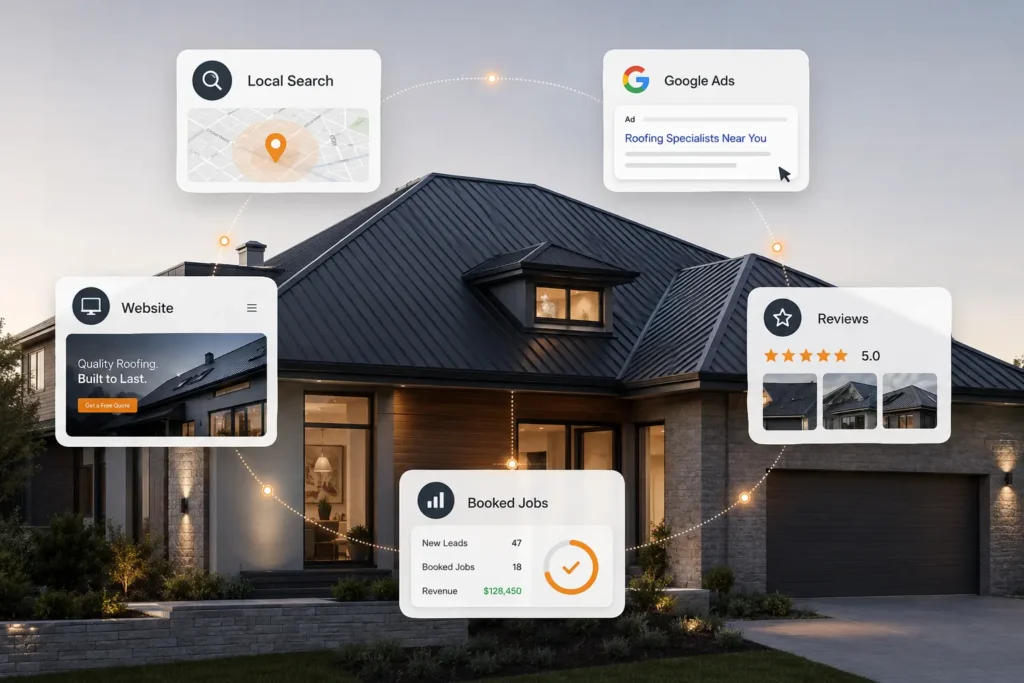
Roofing SEO and Local Search
Roofing SEO improves visibility for service, problem, material and location-based searches. We map demand before editing pages, then build an architecture for repairs, leaks, restoration, re-roofing, storm damage and commercial roofing.
Technical SEO supports crawling, indexing, internal linking, mobile performance and structured data. Local SEO covers Google Business Profile categories, services, areas, photographs, reviews and consistent business data.
Suburb pages are created only where the company genuinely works and has useful local evidence. A strong page may include completed projects, local roof types, common problems, photographs and customer feedback. Changing only the suburb name creates thin content.
Google Ads for High-Intent Roofing Searches
Google Ads captures immediate demand. Emergency leaks, repairs, restoration, replacement and commercial roofing are separated where search volume supports that structure.
Negative keywords reduce searches related to jobs, salaries, DIY work, training, tools and materials. Location settings follow genuine service areas, while ad schedules reflect the hours when someone can answer professionally.
Paid search can generate demand quickly, but it cannot repair a weak offer, slow website or unanswered phone.
A roofing website should explain the services, service areas, evidence and next action.
Conversion-focused design includes click-to-call buttons, short urgent forms, detailed project forms, galleries, reviews and mobile usability. Service pages, location pages, landing pages and case studies perform different jobs.
Content, Reviews and Project Proof
Useful content answers pre-quote questions about repair, replacement, restoration, materials, storm damage and warranties.
Project content should show the problem, work and result. Review systems should collect genuine feedback, never purchased or fabricated reviews.
CRM, Automation and Revenue Attribution
Automation may include missed-call texts, lead notifications, inspection reminders, quote follow-up and remarketing.
A simple pipeline is new enquiry → contacted → qualified → inspection → quote → won or lost. Tracking becomes useful when it connects with booked jobs and revenue.
new enquiry
contacted
qualified
inspection
quote
won or lost
Roofing Services We Can Market
We organise roofing demand under reactive work, planned work, roof systems and customer sectors. This keeps campaigns aligned with how customers search and how roofing businesses schedule crews.
Reactive Roofing Services
Reactive roofing services include emergency roof repairs, leaking roofs, storm damage, hail damage, wind damage, displaced tiles, damaged flashing and make-safe work.
Planned Residential Services
Planned residential services include roof inspection, roof restoration, roof replacement, re-roofing, roof painting, roof cleaning, rebedding, repointing, gutter replacement, fascia repair and downpipe work.
Material-Specific Services
Material-specific services may include COLORBOND steel, corrugated metal roofing, concrete tiles, terracotta tiles, waterproof membranes, flashing, valleys, ridge capping, gutters, fascia and skylights.
Commercial Roofing
Commercial roofing can include warehouses, retail properties, strata buildings, schools, factories and managed facilities. The buyer may be a facilities manager, strata manager, property manager, builder or procurement officer. These campaigns require commercial proof, capability information and longer sales tracking.
We only target services the roofing company actually provides. Adding unrelated entities for keyword coverage weakens relevance and trust.
Who
We Help
Our service is designed for roofing businesses with capacity for additional work and a need for better control over lead source, job type and service area.
Owner-Operator Residential Roofers
Owner-operators often manage roofing work, phone calls, inspections and quotes at the same time. They need a manageable flow of nearby enquiries, not fifty calls they cannot answer. Suitable priorities include Google Maps visibility, focused service pages, click-to-call improvements, review requests and missed-call recovery.
Growth-Stage Roofing Companies
Growth-stage companies may run several crews across repairs, restoration, re-roofing and guttering. They need predictable demand by service and territory, CRM integration and reporting that connects enquiries with quotes and booked work.
Restoration and Re-Roofing Specialists
These businesses need fewer but more valuable enquiries. Campaigns should explain the difference between repair, restoration and replacement while using strong project galleries, qualification forms and remarketing.
Commercial and Storm-Response Roofers
Commercial contractors need capability-led content, longer sales tracking and clear separation from residential demand. Storm-response companies need rapid paid visibility, accurate service zones, call-focused pages and capacity-based budget controls.
Provider-aware buyers look for roofing experience, transparent pricing, case studies, tracking, account ownership and realistic terms.
Digital Marketing for Roofers Across Australia
We support roofing marketing campaigns across Australian metropolitan and regional markets, but each campaign targets only the locations the roofing company genuinely serves.
Our Campaign Territories
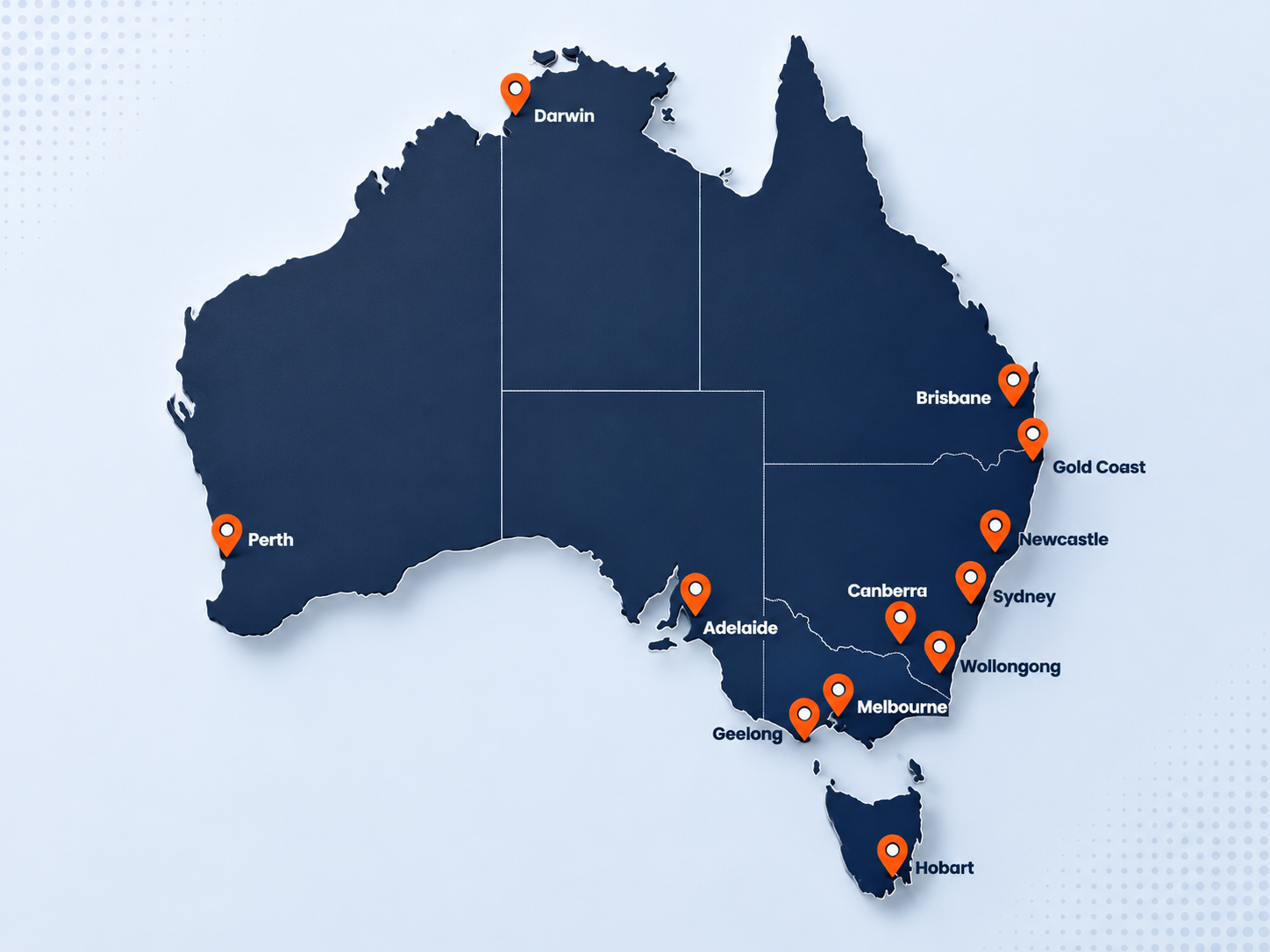
A national agency relationship does not mean the roofer should target nationally. Roofing remains a local or regional service because travel, inspections, crews, weather and project values limit practical coverage.
Campaign territories may include Sydney, Melbourne, Brisbane, Perth, Adelaide, Canberra, Hobart, Darwin, Newcastle, Wollongong, Geelong, Gold Coast, Sunshine Coast and selected regional markets.
We support roofing marketing campaigns across Australian metropolitan and regional markets, but each campaign targets only the locations the roofing company genuinely serves.
How We Filter Low-Quality Roofing Leads
Lead qualification separates a valid enquiry from a commercially suitable opportunity. The process reduces wasted travel, unsuitable inspections and enquiries for services the roofing company does not provide.
Qualification Form Captures Key Details
A qualification form may collect service, property type, suburb, roof material, urgency, decision-maker status and inspection timing. High-value projects may also request photographs.
Qualified vs. Unqualified Leads
A qualified restoration lead may be a homeowner in an approved suburb with an ageing tiled roof and a realistic intention to restore it within three months. An unqualified enquiry may come from a tenant outside the service area seeking a free insurance report for a service the company does not offer.
Filter Out Low-Value Enquiries
Negative keywords and form controls reduce job seekers, DIY users, product shoppers, suppliers and out-of-area enquiries. Urgent forms stay short; planned and commercial forms can collect more detail.
Speed and Clear Workflow
Speed still matters. The workflow should define who answers new calls, who receives form notifications and what happens after a missed call.
Smart Follow-Up Without Overpromising
A text message can confirm receipt, but it should not promise attendance before capacity is checked
Better lead quality. Less waste.
More profitable roofing jobs.
Our Roofing Marketing Process
Our process begins with job economics and ends with booked-work attribution. We do not increase content or ad spend before confirming what the business wants to sell and where it can operate profitably.
Step 1: Diagnose Demand and Capacity
We audit the website, Google Business Profile, ads, reviews, tracking and lead response, then identify preferred services, locations, job values and capacity.
Step 2: Map Search Intent
Keywords are grouped by service, location, urgency, material, property type and intent, then assigned to pages, campaigns or guides.
Step 3: Build Priority Assets
We create or improve the required pages, profiles, campaigns and tracking in priority order.
Step 4: Launch and Qualify
Campaigns launch with location controls, tracking, negative keywords and assigned response ownership. Early leads are reviewed for fit and value.
Step 5: Optimise for Booked Jobs
We compare lead quality, inspections, quotes, wins, job value and attributable revenue, then move resources towards stronger outcomes.
A clear process. Better leads.
More booked roofing jobs.
Common Roofing Marketing Mistakes
The most expensive mistakes occur when demand, targeting and business operations contradict one another.
Sending Every Visitor to the Homepage
The homepage explains the overall business. It cannot fully answer every service-specific requirement. Match leaks, restoration, replacement and commercial searches with relevant pages.
Mixing Services and Locations
Repairs, restoration and replacement differ in urgency, value and sales cycle. Combining them makes budget control difficult. Targeting distant suburbs can also remove the margin through travel and inspection time.
Creating Duplicate Suburb Pages
Replacing one suburb name with another does not create local value. Publish fewer pages with real projects, local roof types, photographs and customer evidence.
Treating Every Enquiry as Equal
A gutter repair, commercial replacement opportunity and emergency leak call do not carry the same value. Record service type, suitability, quote value and outcome.
Ignoring Missed Calls and Quotes
A high-intent lead can be lost after the phone rings. Assign response ownership, use missed-call recovery and follow up undecided quote recipients.
Using Stock Images and Vanity Reports
Stock photographs do not prove completed work, while a dashboard can show rising traffic without profitable jobs. Document real projects and connect marketing sources with inspections, quotes and booked work.
Your 30/60/90-Day Roofing Marketing Roadmap
The first 90 days establish measurement, launch priority assets and identify which demand can be scaled responsibly. The roadmap is an implementation sequence, not a ranking or revenue guarantee.
Establish the baseline
Record calls, forms, qualified leads, inspections, quotes, booked jobs, target services and capacity
Correct foundations
Complete audits, demand mapping, tracking setup, CRM stages and priority-page planning
Launch acquisition assets
Publish priority pages, restructure Google Ads, improve conversion paths and activate review and qualification systems
Optimise commercial performance
Review search terms, lead quality, quote rates, location profitability and booked-job attribution
Month one establishes the baseline, month two launches priority assets and month three uses enquiry and sales data to refine budgets, locations and conversion paths.
Why Choose Us for
We focus on turning local roofing demand into measurable sales opportunities rather than selling disconnected marketing tasks.
Roofing and Tradie Specialisation
Roofing has urgent and planned demand, local constraints and high trust sensitivity. We separate repairs, restoration, replacement, residential work and commercial opportunities.
Australian Market Context
We use Australian terminology and service-area structures while accounting for metropolitan competition, regional travel and storm demand.
Reporting Beyond Rankings
We use visibility as a diagnostic metric, not the final result. Reporting can include qualified calls, inspections, quotes, booked jobs and revenue.
Capacity-Based Campaign Management
When crews approach capacity, paid budgets can narrow by service, location or schedule while SEO and reputation work continue.
Transparent Asset Control
Your business should retain access to core websites, profiles, accounts, analytics, tracking data and content.
Explore Digital Marketing Packages for Roofers
Compare roofing marketing packages designed to improve local visibility, generate qualified enquiries and connect marketing activity with inspections, quotes and booked jobs
Frequently Asked Questions
The strongest strategy combines local SEO, Google Business Profile optimisation, service pages, paid search, project evidence, lead qualification and sales tracking. The exact mix depends on location, competition, job value and crew capacity.
SEO can generate enquiries when the website targets genuine services and locations with useful evidence. It does not guarantee rankings or jobs. Performance depends on competition, site quality, local prominence, content and follow-up.
Google Ads supports immediate demand, while SEO builds longer-term organic visibility. Many roofing companies use both. Paid search stops when spend stops, while SEO assets can continue attracting demand but require more time.
The cost depends on services, locations, channels, ad spend, website condition and tracking requirements. A useful proposal separates management, media, content, development and software costs.
We match service-specific demand with relevant pages or advertisements, then filter enquiries by location, service, property type, roof material and urgency. Tracking shows whether each lead was contacted, inspected, quoted and converted.
Suburb pages are useful when the business genuinely serves the area and can provide local evidence. Each page should contain unique projects, roof types, photographs or reviews rather than changing only the location name.
Yes. Paid campaigns can be reduced by budget, schedule, service or location. SEO, reviews and content can continue building future demand while immediate lead volume is controlled.
No responsible provider can guarantee a specific ranking, lead volume or revenue result. Competition, weather, pricing, capacity and sales follow-up affect performance. We define the work, measurement and optimisation process instead.
Find Out Which Roofing Services and Service Areas Can Generate More Profitable Jobs
Your roofing marketing campaign should target the services your business wants to sell, the locations your crews can serve profitably and the enquiries your team can convert.
Our Australia-wide roofing marketing plan identifies priority services, profitable locations, local search gaps, website conversion issues, weak lead tracking and the recommended actions for the first 90 days.
You receive a strategy based on your roofing services, crew capacity and commercial goals rather than a generic tradie marketing package.


