
Electrician Website Design Services Australia
Purpose-built electrician websites help Australian electrical contractors generate qualified calls, quote requests and local enquiries. We plan, write, design and develop mobile-first websites that present your services, licences, projects and service areas while giving you full control of the finished digital asset.
Find out what's holding you back
Enter your number — we’ll call you with a free ranking report for your suburb.
We call within 2 business hours. No scripts. No pressure.
Businesses We Support Across Australia
We support trade and commercial service businesses with stronger local visibility, clearer lead generation and marketing systems connected to measurable commercial outcomes.







Why Do Many Electrician Websites Generate Few Enquiries?
Conversion friction creates another loss point. A visitor may reach the website but leave because the phone number is hidden, the quote form requests unnecessary details or emergency availability is unclear. Mobile visitors seeking urgent electrical help require a direct path from the landing page to a phone call.
Trust problems can prevent contact even when the website ranks. Missing licence details, generic stock photographs, broken review widgets and vague guarantees create uncertainty. Electrical work involves property access, safety and regulated activities. Customers need verifiable reasons to proceed.
Local visibility also weakens when the website contains no genuine service-area structure. Mentioning dozens of suburbs in a footer does not establish meaningful geographic relevance. Each important location must connect to real service availability, nearby areas, local projects, relevant services and accurate business information.
A lead-generating electrician website resolves these problems through service architecture, local relevance, mobile contact paths, accurate credentials, authentic evidence and measurable conversion tracking.
Why Does an Electrician Need an Industry-Specific Website Designer?
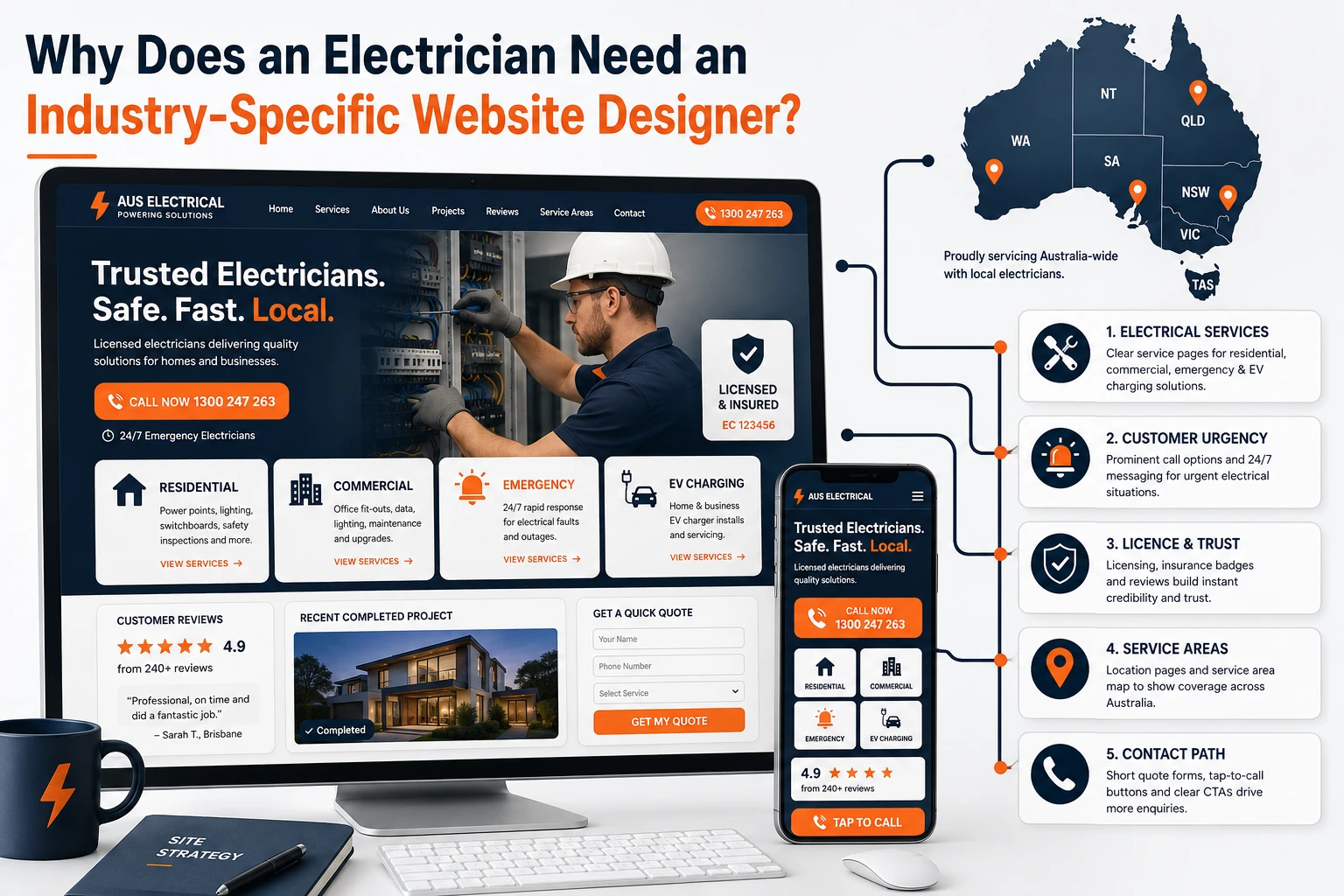
Which Electrical Businesses Are These Websites Built For?
New Electrical Business Owners
A new electrical business needs more than an online brochure. It needs a credible operating identity that supports customer verification, local discovery and direct enquiries.
The website can establish the business name, domain, professional email address, core services, service areas, licence information and contact process. A focused starter website normally includes a homepage, about page, service overview, priority service pages, areas-served section and contact page.
This option suits sole traders and owner-operators who previously relied on subcontracting, referrals or social media but now want to attract their own customers.
Growth-Focused Residential Electricians
Residential electrical companies often need a more consistent flow of work across selected services and suburbs. Their website must move beyond a single generic service page.
Dedicated pages can promote switchboard upgrades, electrical repairs, rewiring, smoke alarms, lighting, ceiling fans, safety switches and other commercially important services. Each page can explain the service, identify suitable property types, answer common questions and provide a direct quote path.
This structure helps the business pursue the work it wants rather than collecting unrelated or low-value enquiries.
Emergency and After-Hours Electricians
Emergency electrical customers usually require a rapid decision. The website must confirm whether the contractor handles the problem, serves the location and accepts calls at that time.
A dedicated emergency journey can include a visible phone number, sticky click-to-call control, service-radius statement, operating hours, licence information and verified reviews near the first contact action.
Claims such as “24/7,” “available now” or “guaranteed same-day service” must only appear when the business can consistently provide them. Australian businesses must be able to substantiate advertising claims and avoid creating a false impression about a service.
Commercial and Industrial Electrical Contractors
Commercial contractors require a capability-focused website rather than a residential call-out layout.
The website can present commercial maintenance, fit-outs, testing, three-phase power, data cabling, industrial systems and project delivery experience. It can also display industries served, safety credentials, licences, team capacity, fleet information and downloadable capability documents.
This approach helps builders, developers, strata managers, facility managers and procurement teams assess the contractor before making contact.
Specialist Electrical Contractors
Specialist businesses need a website that gives priority to their most valuable services.
These contractors may focus on solar systems, EV charger installation, battery storage, home automation, security systems, access control, data cabling or industrial automation. The website can explain technical capabilities without forcing customers to interpret industry jargon.
Service-specific case studies, installation photographs, qualification details and structured quote forms help filter enquiries and support a more informed sales conversation.
Electricians Replacing an Underperforming Website
An existing website may need more than a visual redesign. Common problems include inaccessible domains, slow hosting, missing administrator access, weak conversion tracking, outdated service pages and unclear SEO reports.
A replacement project can include a website audit, content migration, redirect planning, ownership recovery, tracking setup and a new service architecture. The objective is to preserve useful assets while removing technical and commercial restrictions.
What Is Included in Our Electrician Website Design Service?
The service covers website strategy, architecture, copywriting, design, development, testing and launch. The final scope depends on the number of services, locations, integrations and business requirements.
Service Area
Included Work
Strategy
Business discovery, audience research, competitor review, service analysis and conversion planning
Architecture
Sitemap, page hierarchy, service-page mapping, location-page planning and internal links
Homepage, service, location, trust, FAQ and conversion content
Design
Mobile-first layouts, visual hierarchy, brand application and responsive interfaces
Development
WordPress implementation, forms, call controls, reviews, galleries and integrations
SEO setup
Metadata, headings, crawl controls, sitemap, internal links and structured-data foundations
Measurement
GA4 setup, Search Console connection, form events and optional call tracking
Quality assurance
Mobile, browser, form, link, performance and indexing checks
Launch
Deployment, redirect review, analytics verification and administrator handover
Photography, branding, advanced booking systems, ongoing SEO and third-party software subscriptions can be added when required. They are not presented as standard inclusions unless they appear in the signed project scope.
What Pages Does an Electrical Contractor Website Need?
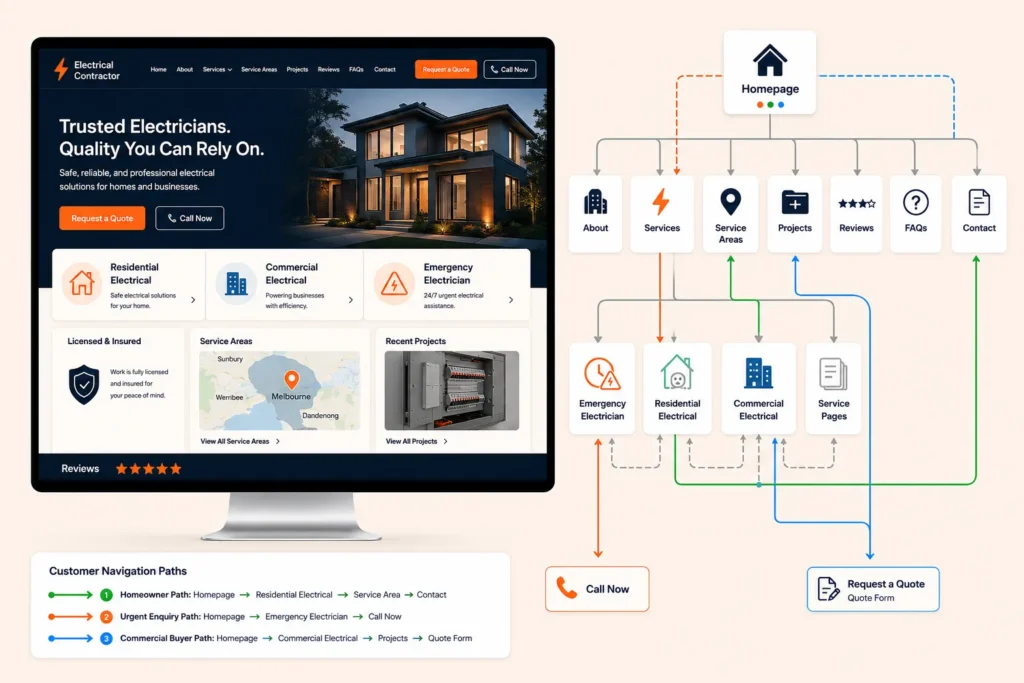
An electrical contractor website needs pages that represent the business, its services, operating locations and evidence. The correct number depends on the range of work and the customer groups being targeted.
A typical foundation contains a homepage, about page, service overview, priority service pages, service-area section, project portfolio, reviews, frequently asked questions and contact page.
Residential, commercial and emergency work should not be forced into one undifferentiated page when the business actively promotes all three. These service categories involve different buyers and contact behaviours.
A growing electrical website may use the following architecture:
Page Type
Primary Function
Homepage
Establish the offer, location, proof and main contact action
About
Present the business, team, experience and credentials
Services
Organise the complete electrical service range
Individual service page
Match one defined customer need with one service
Emergency page
Convert urgent visitors into immediate calls
Residential page
Present homeowner-focused electrical work
Commercial page
Present capability to business decision-makers
Service-area page
Confirm genuine geographic coverage
Project page
Document completed electrical work
Review page
Present verifiable customer evidence
Contact page
Provide phone, form, hours and service information
Industrial services, careers, industries served, capability statements and specialist installation pages should be added only when they support actual business operations.
How Does an Electrician Website Target Local Searches?
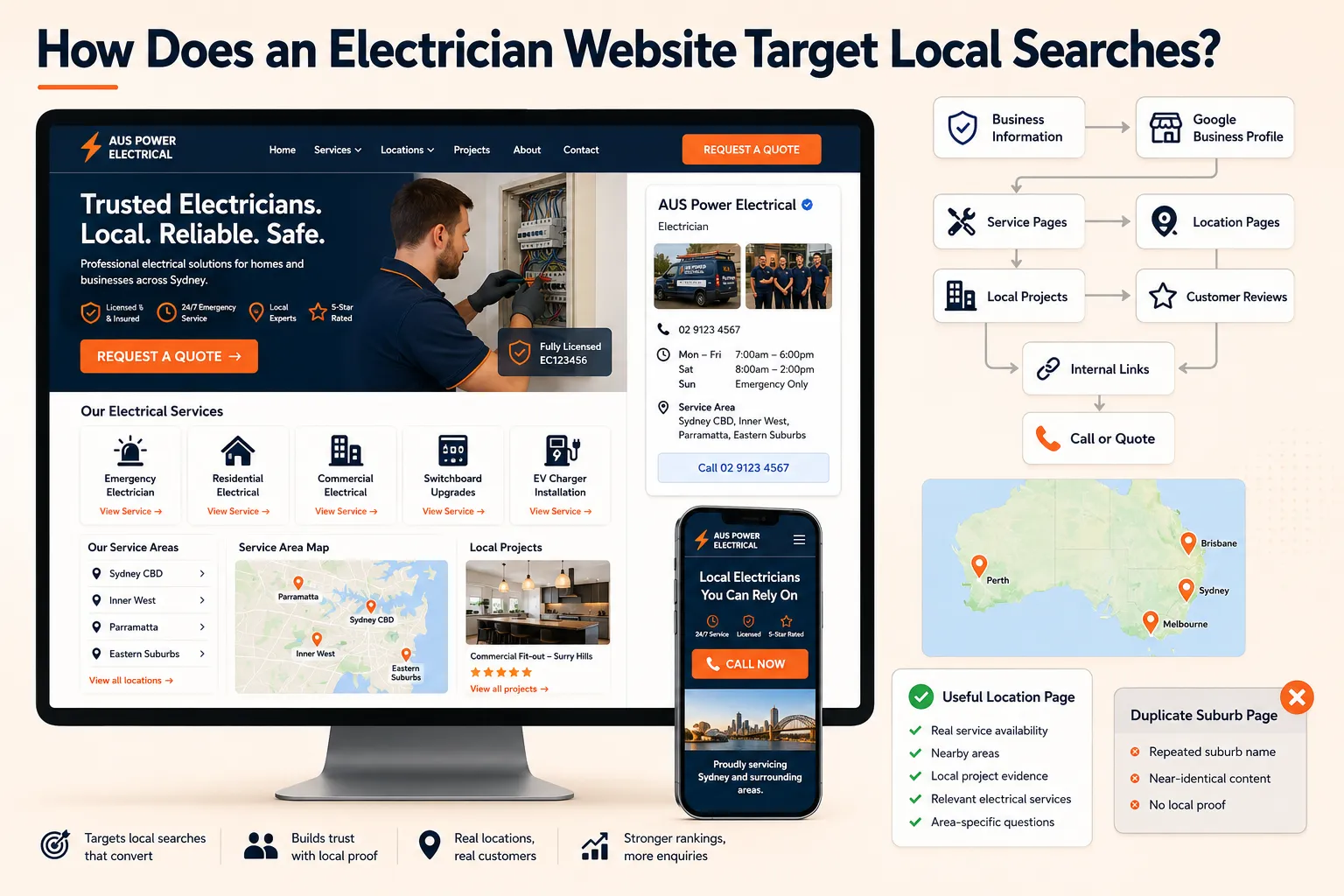
The website first establishes the electrical business as a defined entity. Its name, phone number, service information, operating hours and location details must remain consistent with the Google Business Profile and other verified business listings.
Google’s current spam policies identify doorway abuse as creating substantially similar pages for specific locations or queries that merely funnel visitors elsewhere. The same policies address scaled content created primarily to manipulate rankings rather than help users.
How Does the Website Convert Mobile Electrical Searches?
The website uses different conversion paths for urgent electrical problems and planned electrical projects. This distinction reduces unnecessary steps between the customer’s search and the correct contact action.
Emergency Search Journey
An emergency visitor needs to confirm three facts quickly: the contractor handles the fault, serves the location and can be contacted now.
The page therefore prioritises the phone number, click-to-call control, operating hours, service radius and trust information. Detailed explanations remain secondary to immediate contact.
Search → Emergency service confirmation → Location confirmation → Trust evidence → Phone call
Planned-Work Journey
A customer planning a switchboard upgrade, EV charger, lighting installation or commercial project requires more information before contacting the business.
The relevant page explains the service, property types, process, project evidence and factors that affect the quote. The final action can be a structured enquiry form rather than an urgent call.
Search → Service information → Project evidence → Credentials → Quote request
Both paths remain part of the same website, but they serve different levels of urgency and customer awareness.
How Will the Website Generate and Qualify Electrical Enquiries?
The website generates enquiries through visible contact controls and qualifies them through concise, relevant fields. A form should collect enough information to route the lead without creating unnecessary abandonment.
The standard quote form asks for the customer’s name, phone number, suburb or postcode, required service and job urgency. Email, preferred contact time, property type, message and photo upload can be added when they improve the quotation process.
Emergency forms remain shorter because the visitor’s primary requirement is rapid contact. Planned-project forms can collect more detail because the customer is prepared to explain the work.
Spam controls may include form validation, honeypot fields, rate limiting or a suitable verification service. Lead notifications can be sent to the business by email, SMS or CRM workflow.
Every form requires a confirmation message and a tested delivery path. A successful on-screen submission is not sufficient if the lead never reaches the electrician.
Can the Website Connect to Existing Business Systems?
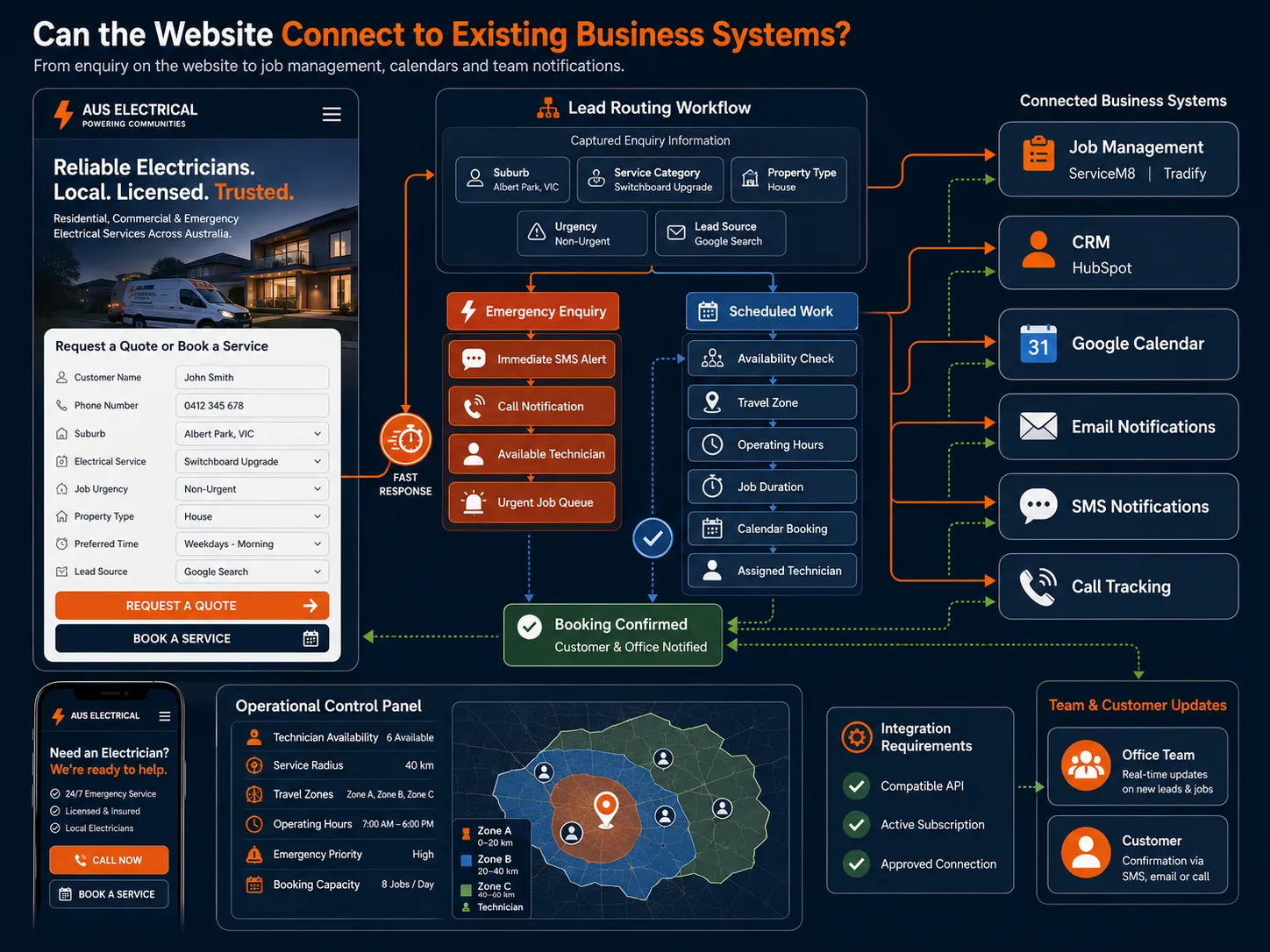
The website can connect enquiry forms and booking actions to compatible job-management, calendar, email, SMS or CRM systems. The integration must reflect the electrician’s existing workflow rather than add unnecessary software.
Common connections include ServiceM8, Tradify, HubSpot, Google Calendar, email notifications, SMS notifications and call-tracking platforms. Availability depends on the software’s current API, integration method and subscription level.
A structured workflow may route emergency enquiries differently from scheduled work. It may also record the customer’s suburb, service category, property type and lead source before notifying the appropriate person.
Online booking requires additional controls. Travel zones, technician availability, urgency, job type and operating hours must be considered before a customer receives a confirmed time. A generic appointment calendar may create operational problems when it ignores travel time or service complexity.
Third-party platform charges are identified before development. They are not hidden inside a broad “website integration” description.
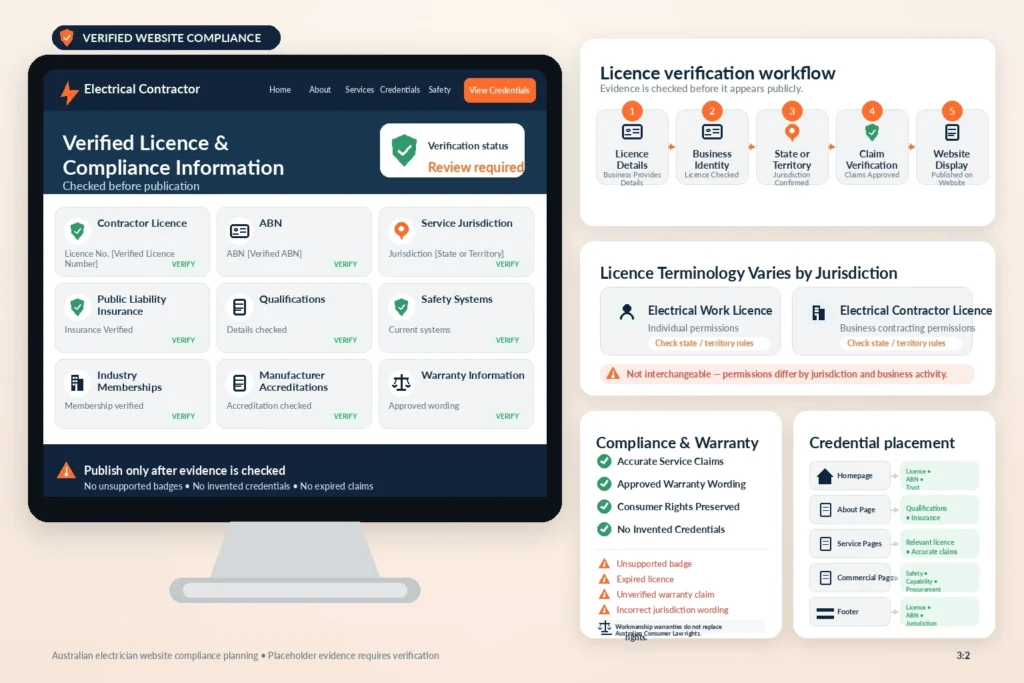
How Does the Website Present Electrical Licences and Compliance Information?
The website presents valid licence and business information in the locations where customers need to verify the contractor. It does not create or imply credentials the electrical business does not hold.
The homepage or footer can display the relevant contractor licence number, ABN and service jurisdiction. The about page can explain qualifications, insurance, industry memberships and manufacturer accreditations. Commercial pages can present safety systems, workforce capability and procurement documents.
Licence terminology must match the applicable state or territory. An electrical work licence and an electrical contractor licence may represent different permissions, depending on jurisdiction and business activity.
Warranty language must also remain accurate. A voluntary workmanship warranty does not replace rights that may apply under the Australian Consumer Law.
We therefore require verified licence details, precise service claims and approved warranty wording before publishing them.
What Evidence Builds Trust on an Electrician Website?
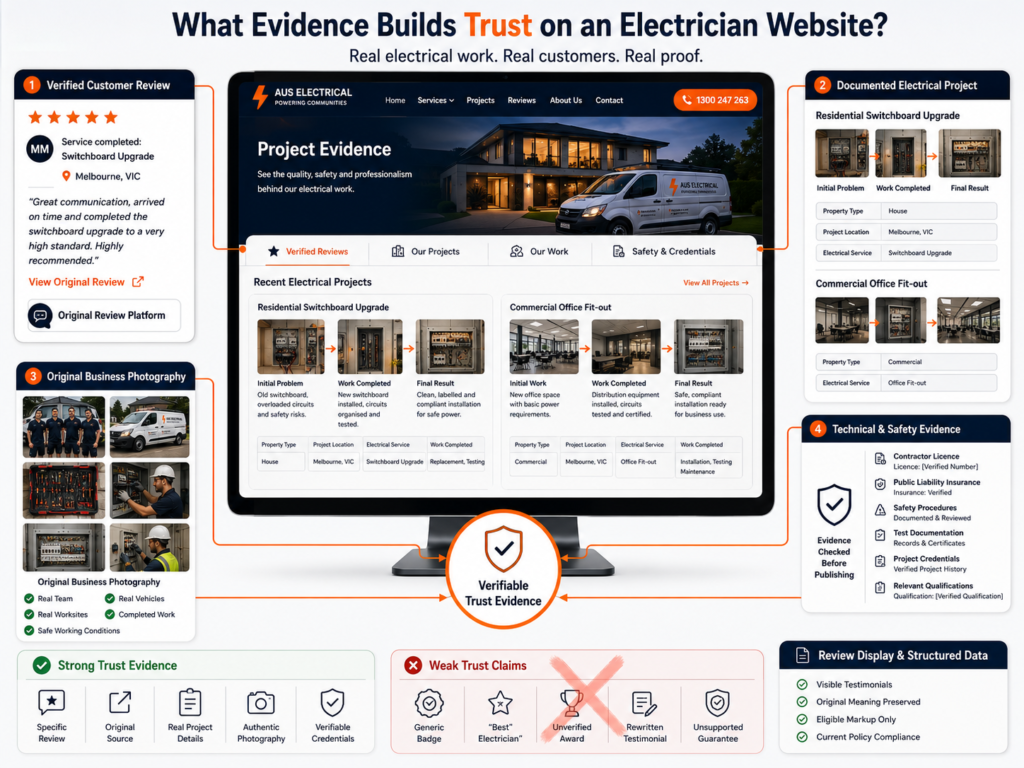
The strongest trust evidence is specific, verifiable and connected to the electrical work being promoted. Generic badges and unsupported claims provide little useful information.
Customer reviews are more persuasive when they identify the service completed and the experience received. Reviews can be linked to the original platform where possible. They should not be rewritten to change their meaning.
Project evidence can document the property type, location, initial problem, work completed and final result. Residential projects may show switchboards, lighting or EV chargers. Commercial projects may show fit-outs, distribution equipment, testing or maintenance work.
Original photography should show the real team, branded vehicles, tools, worksites and completed installations. Images must also present technically credible and safe working conditions.
Google restricts self-serving review markup for certain local-business review scenarios. Visible testimonials can still support users, but structured data must follow Google’s current eligibility and content policies.
What SEO Foundations Are Included in the Website Build?
The website includes the technical and on-page foundations required for search engines to crawl, understand and index its content. This launch setup is not presented as a substitute for an ongoing SEO campaign.
On-page work includes search-intent mapping, title tags, meta descriptions, heading structure, service-page optimisation, descriptive URLs, internal links and image alternative text.
Technical work includes indexability checks, canonical URLs, XML sitemap generation, redirect review, HTTPS, mobile usability and Search Console connection.
Google’s current guidance prioritises helpful, reliable and people-first information rather than pages created primarily to manipulate rankings.
How Is the Website Built for Performance and Reliability?
Performance work reduces delays, interaction problems and unexpected layout movement across mobile and desktop devices. It is part of website usability, not a ranking guarantee.
The current Core Web Vitals measure loading performance through Largest Contentful Paint, responsiveness through Interaction to Next Paint and visual stability through Cumulative Layout Shift.
The recognised “good” thresholds are:
Largest Contentful Paint
2.5 seconds or less
Interaction to Next Paint
200 milliseconds or less
Cumulative Layout Shift
0.1 or less
These thresholds apply at the 75th percentile of page visits when field data is available.
Performance work may include WebP or AVIF images, responsive sizing, caching, reduced scripts, optimised fonts and appropriate hosting configuration.
Security controls can include HTTPS, backups, software updates, firewall protection, malware monitoring and spam prevention.
Accessibility work can include keyboard navigation, readable contrast, visible focus states, labelled forms and meaningful alternative text.
Privacy requirements depend on the business and how it handles personal information. Organisations covered by Australian privacy requirements need a clearly expressed and current privacy policy explaining how personal information is managed.
How Will You Know Which Pages Generate Enquiries?
Measurement connects website activity to calls, forms and qualified leads. Traffic data alone does not show whether the website contributes to suitable electrical work.
Google Analytics 4 can record form submissions, call-button clicks and other defined conversion events. Google Search Console can show which queries and pages receive search visibility. Optional call-tracking software can connect phone enquiries to landing pages or campaigns.
A useful report can show:
- Calls and forms by landing page
- Enquiries by electrical service
- Enquiries by suburb or service area
- Mobile and desktop conversion activity
- Emergency and planned-work enquiries
- Organic, paid and referral sources
- Qualified and unsuitable leads
The business can then identify whether a service page generates enquiries, whether a suburb produces out-of-area calls or whether a form creates unnecessary friction.
The reporting objective is commercial clarity. Rankings and impressions remain useful diagnostic values, but they do not replace lead and job information.
How Much Does an Electrician Website Cost in Australia?
Industry-specific website structure
Service and location foundations
Clear calls, forms and tracking
Starter Electrician Website
- five core pages
- mobile-first design
- foundational copywriting
- click-to-call controls
- quote form
- licence display
- basic analytics
- launch SEO setup
Growth Electrician Website
- individual service pages
- a service-area structure
- project gallery
- review integration
- call and form tracking
- local SEO foundations
- CMS training
Commercial or Multi-Location Website
- industries-served pages
- project case studies
- team and fleet information
- safety credentials
- capability documents
- advanced lead routing
- multi-location architecture
Open the details below to review how website strategy, copywriting, revisions, development, service pages, location pages, hosting, maintenance, software, SEO and ownership are priced.
Website strategy: Included or itemised
Copywriting: State the number of pages
Design revisions: State the included rounds
Development: Define included functionality
Service pages: State the number included
Location pages: State the number included
Hosting: State monthly or annual cost
Maintenance: Optional or compulsory
Premium software: Identify third-party fees
Ongoing SEO: Quote separately
Ownership: Confirm in writing
Not Sure Which Package Fits?
Request a website review and receive a recommended page structure, scope, timeline and investment range.
What Is Included and What Requires a Separate Scope?
Included at Launch
- Discovery and planning
- Sitemap and page mapping
- Agreed copywriting
- Responsive design
- WordPress development
- Standard forms
- Foundational SEO
- Analytics setup
- Testing and launch
- Administrator handover
Optional Additions
- Professional photography
- Logo or brand redesign
- Additional service pages
- Additional location pages
- Google Business Profile management
- Advanced booking system
- Ongoing SEO campaign
- Google Ads management
- Managed maintenance
- CRM automation
Not Included Unless Stated
- Guaranteed rankings
- Guaranteed lead volume
- Unlimited revisions
- Unlimited content changes
- Advertising budget
- Third-party subscriptions
- Legal advice
- Licence verification
- Electrical certification
- Unapproved stock assets
Every proposal must identify page quantities, revision limits, integrations, third-party charges and post-launch responsibilities.
Who Owns the Electrician Website After Launch?
The electrical business should know who owns the domain, website, content, accounts and access credentials before signing the project agreement.
Our project scope must state the ownership position for:
- Domain registration
- Website files
- Database
- Written content
- Original photography
- Design assets
- Hosting account
- Administrator access
- Google Analytics
- Google Search Console
- Advertising accounts
- CRM integrations
- Premium software licences
Recommended ownership statement:
The client owns the approved website content and receives administrator access to the completed website after final payment. The domain should remain registered in the client’s name or business account. Hosting, maintenance and premium software terms are documented separately.
The agreement must also explain what happens when hosting or maintenance ends. The client needs to know whether the website can move, whether licences remain active and whether any transfer fee applies.
Ownership should not remain hidden inside technical terminology.
How Does the Electrician Website Design Process Work?
1. Complete the Discovery Session
We document the electrical business type, priority services, service areas, customer groups, current marketing channels, growth targets and operating capacity.
2. Research the Market and Search Intent
We review competing electrical businesses, customer search patterns, service terminology, location opportunities and conversion weaknesses.
3. Plan the Website Architecture
We assign a clear purpose to each page. Services, locations, projects, credentials and calls to action are connected through the sitemap and internal-link plan.
4. Write the Website Content
We prepare the agreed homepage, service, location, trust and FAQ content in Australian English. Technical concepts are explained in customer language without removing necessary electrical terminology.
5. Design the Mobile and Desktop Experience
We create the visual hierarchy, page layouts, contact controls, trust sections and image placements. The mobile journey receives priority because urgent electrical searches frequently require immediate contact.
6. Develop the Website and Integrations
We build the approved designs in WordPress, configure forms, apply responsive behaviour and connect the agreed analytics or business systems.
7. Test the Complete Website
We test mobile layouts, browsers, forms, phone links, tracking events, indexing controls, performance and key accessibility functions.
8. Launch and Transfer Access
We publish the website, verify redirects, submit the sitemap, confirm analytics and provide the agreed administrator access or training.
9. Review Performance
Where an ongoing service is included, we assess calls, forms, landing pages, service demand and conversion friction after launch.
What Happens During the First 90 Days?
The roadmap separates production from post-launch measurement. Actual timing depends on page count, approvals, photography and integration complexity.
Days 1–30: Strategy and Content
The first stage covers discovery, website audit, audience research, competitor review, service mapping, location planning, sitemap development, content collection and copywriting.
The main output is an approved structure that connects the electrical business’s preferred work with the pages required to promote it.
Days 31–60: Design, Development and Launch
The approved content moves into mobile and desktop layouts. Forms, calls to action, review sections, project evidence, analytics and agreed integrations are developed and tested.
The launch occurs after content, design, functionality and ownership responsibilities have been approved.
Days 61–90: Measurement and Improvement
Post-launch work can assess form delivery, phone interactions, page engagement, search indexing and early conversion behaviour.
Changes may include simplifying a form, strengthening a service page, correcting an indexing problem or improving a slow page template. Search growth is not guaranteed within a fixed 90-day period.
Recent Websites Built for Electrical Businesses

Metro Electrical Solutions
Residential, commercial & maintenance
Melbourne, Victoria
Electrical installations, repairs & maintenance
Outdated website with poor mobile experience and zero local visibility

PowerCore Electrical
Commercial & industrial
Brisbane, Queensland
Commercial electrical, fit-outs & compliance
Low-quality website with limited service information and weak lead flow
Why Choose SEO Agency for Tradies for Electrician Website Design?

Verified Reasons to Choose Us
500+ Tradies Ranked
We use real data from Google Search Console and Analytics to grow traffic, leads and jobs for tradies across Australia.
6+ Years of Experience
We focus on long-term SEO, not short-term tricks. Our strategies are built on experience, testing and real results.
Australia-Wide Service
We work with electricians in metro, regional and rural areas. Our team understands local search and service area targeting.
Transparent Tracking
You see what matters. We report on calls, forms, rankings and traffic so you know exactly how your website is performing.
Full Ownership Terms
You own the domain, website and content. We believe in clear terms and complete transparency from day one.
Electrician-Specific Architecture
We build websites around services, suburbs and customer intent with sitemaps, schema and conversion focused layouts.
Ready to get more calls and jobs from your website?
Frequently Asked Questions
The cost depends on the number of pages, copywriting, custom design, integrations, service areas and ongoing support. Our packages start from [insert verified price], while commercial and multi-location websites require a custom scope.
Most electrical businesses need more than a homepage and contact page. The correct structure normally includes core business pages plus separate pages for priority services, customer groups and genuine service areas.
The build includes agreed local SEO foundations, not an unlimited ongoing SEO campaign. Foundations may include service-area structure, metadata, internal links, Google Business Profile alignment and technical indexability checks.
We create location pages only when each page can provide useful and genuine local information. We do not recommend mass-producing near-identical pages by replacing one suburb name with another.
The schedule depends on page count, content approvals, photography and integrations. A confirmed launch range will be included in the proposal after the project scope is defined.
Yes, copywriting can be included for the agreed pages. We collect service, licensing, location and business information before writing and require the electrician to verify technical accuracy.
Ownership terms are documented before development begins. The agreement will explain domain ownership, website access, content rights, hosting arrangements and premium software licences.
Hosting requirements depend on the selected package and technical setup. Any compulsory hosting term, renewal cost or migration condition must be stated in the proposal.
Yes, a WordPress website can provide administrator access for approved content changes. Training and maintenance responsibilities are defined during handover.
Compatible forms and workflows can connect to supported job-management systems. The final integration depends on the platform’s available API, subscription and required automation.
Yes, phone numbers can use tap-to-call controls on compatible mobile devices. Emergency pages can also use a persistent contact bar where appropriate.
Form events, call clicks and optional call tracking can identify the landing pages and services that produce enquiries. CRM data is required to confirm which enquiries become booked work.
Yes, a redesign can preserve useful content while replacing weak structure, design or technology. The process may include migration, redirects, tracking and ownership recovery.
A custom website is better only when the business requires functionality or scalability that a simpler platform cannot provide efficiently. The decision should consider services, locations, integrations, ownership and maintenance.
No responsible provider can guarantee a specific organic ranking. We can implement search-focused architecture, technical foundations, useful content and measurement, but rankings depend on competition and multiple external signals.
Request an Electrician Website Growth Plan
Get a practical website plan based on your electrical services, service areas, current website and growth priorities.
We will review:
- Your existing website or current online presence
- The electrical services you want to promote
- Your target suburbs, cities or commercial markets
- The contact actions required for urgent and planned work
- The pages, content and integrations likely to be required
- Ownership, hosting and ongoing support requirements
You will receive a defined next step rather than a generic website quote.


