
Digital Marketing for Electricians That Turns Search Demand Into Booked Jobs
SEO Agency for Tradies builds and manages digital customer acquisition systems for Australian electrical contractors. We connect local SEO, Google Ads, service pages, reviews, call tracking and follow-up so qualified enquiries can be traced from the first search to the booked and completed job.
500+
Tradies Ranked
6+ Years
SEO Experience
Australia-Wide
Campaigns
Transparent
Tracking & Reporting
What Is Digital Marketing for Electricians?
Digital marketing for electricians is a customer acquisition system that helps an electrical business appear for relevant searches, demonstrate its capability, capture enquiries and measure which services, locations and campaigns produce booked work.
The system begins with the electrical services the business wants to sell. Examples include emergency fault repairs, switchboard upgrades, house rewiring, EV charger installation, commercial maintenance and electrical fit-outs.
Each service is then connected with the correct customer, search intent, service area, landing page and contact action. A homeowner searching for an emergency electrician needs a different message from a facility manager comparing commercial maintenance contractors.
The first customer may need an immediate phone response. The second may need a capability statement, project evidence and a scheduled consultation.
That distinction matters because electrical marketing is not one campaign. It is a network of local search assets, paid campaigns, service pages, evidence, conversion paths and follow-up processes.
The actual commercial path
Traffic and rankings support this path. They are not the final business outcome.
People-first content requirement
Google’s current people-first guidance recommends substantial, useful content that demonstrates expertise, includes original value and helps the reader complete a real objective. It also identifies trust as the most important element within E-E-A-T.
Why Do Electricians Need a Different Digital Marketing Strategy?
Electrical contractors need a specialised strategy because service urgency, customer type, job value, geographic coverage and operational capacity change how each campaign should be structured.
A sole trader looking for five additional residential jobs each month does not have the same marketing requirement as a 20-person contractor seeking commercial maintenance agreements.
The sole trader may need better Google Maps visibility, a faster mobile website and a system for recovering missed calls. The larger contractor may need multi-location SEO, CRM integration, tender tracking and revenue reporting by service division.
The market is also operationally demanding. Jobs and Skills Australia reports that 94% of electricians work full-time, with an average of 45 full-time hours per week. This helps explain why owner-operators often have limited time to answer every call, follow up every quote and manage multiple marketing channels.
A 2025 study of micro and small Australian businesses also found that owners understood the value of digital technology but were constrained by limited knowledge, time and resources.
The practical issue is therefore not simply visibility. It is whether the business can attract the right work and process the resulting demand.
Owner–operator
Better Google Maps visibility, a faster mobile website and a system for recovering missed calls.
Growing contractor
Multi-location SEO, CRM integration, capacity-aware campaigns and revenue reporting.
Commercial contractor
Capability content, tender tracking, project evidence and longer sales-stage measurement.
Why Do Marketing Clicks Fail to Become Electrical Jobs?
Clicks fail to become booked jobs when the campaign targets the wrong demand, the landing page fails to establish service relevance or the business does not respond and follow up effectively.
Here is where the money usually leaks.
An electrician may pay for a click from a customer outside the service area. Another visitor may need a service the contractor does not provide. A suitable prospect may call while the electrician is on-site, receive no answer and contact the next company.
A form enquiry may be received but left unassigned. A quote may be sent but never followed up. The marketing report may still count the original click as a conversion, even though no job was booked.
This creates four connected failures.
Marketing failure | What happens | Required correction | Commercial measure |
|---|---|---|---|
Discovery failure | The business is not visible in Google Maps or organic search | Improve local relevance, Business Profile completeness and website authority | Local visibility and qualified calls |
Targeting failure | Campaigns attract irrelevant services, locations or customer types | Segment services, areas, keywords and audiences | Qualified-lead rate |
Conversion failure | Visitors do not call, enquire or book | Improve mobile speed, proof, forms and calls to action | Visitor-to-lead rate |
Revenue failure | Leads are not tracked beyond the initial enquiry | Connect calls, quotes, bookings and completed jobs | Cost per booked job and revenue |
Commercial warning
The strongest electrician marketing programme corrects all four failures. Increasing traffic before fixing them can increase wasted spend rather than revenue.
What Is Included in Digital Marketing for Electricians?
Our service connects search demand, local visibility, paid advertising, website conversion, reputation, lead handling and revenue measurement within one managed acquisition system.
The work is not divided into disconnected activities. Each component supports the next customer action.
Demand and service mapping
Identify profitable services, customer types, search patterns and priority areas
Generic targeting and low-value enquiries
Demand by service, area and intent
Local SEO
Improve Google Business Profile, local pages, citations, reviews and local relevance
Weak Maps and suburb visibility
Local rankings, profile actions and qualified calls
Website architecture
Build service, location, project and conversion paths
Generic pages and weak topical coverage
Organic enquiries and page conversion
Google Ads
Segment campaigns by service, area, urgency and schedule
Irrelevant clicks and uncontrolled spend
Cost per qualified lead and booked job
Trust and reputation
Publish licences, project evidence, reviews and clear service information
Low confidence and price-only comparison
Conversion rate and review growth
Lead tracking and follow-up
Connect calls, forms, CRM stages, quotes and bookings
Missed calls and unmeasured lead loss
Response time, booking rate and revenue
Start with the operating model
The system starts with the electrical business model. Channels are selected after the target work, operating area and team capacity are understood.
How Does Demand and Service Mapping Work?
Demand mapping identifies which electrical services, customer segments and locations should receive marketing investment before pages or advertising campaigns are created.
We first separate the business into meaningful service categories.
Residential services may include fault finding, power-point installation, safety switches, smoke alarms, lighting, ceiling fans, house rewiring and switchboard upgrades.
Commercial services may include preventative maintenance, emergency lighting, data cabling, three-phase power, test and tag, tenancy fit-outs and scheduled site support.
Specialist services may include EV charger installation, solar electrical work, battery systems, energy monitoring, smart-home wiring and automation.
Each service receives attributes such as urgency, average value, margin, sales cycle, required qualification and operating radius.
Emergency fault repair
Urgency
Immediate
Switchboard upgrade
Sales action
Inspection and quote
EV charger installation
Customer segment
Homeowner or commercial property
Commercial maintenance
Sales cycle
Recurring or contract-based
Service area
Profitability
Priority, secondary or excluded
Field team
Capacity
Available, limited or full
Why the mapping matters
This prevents an emergency repair campaign from using the same keywords, landing page and call handling as a planned commercial installation campaign. It also prevents the business from promoting services that crews cannot deliver profitably.
How Does Local SEO Help Electricians Win Nearby Work?
Local SEO improves the connection between an electrical business, its verified services and the locations it genuinely serves across Google Search and Google Maps.
Google states that local results are mainly influenced by relevance, distance and prominence. Complete business information, accurate categories, reviews, links and detailed service information help Google and customers understand the business.
For an electrician, relevance means more than adding a city name to a page.
The website and Google Business Profile should confirm:
- Which electrical services are provided.
- Which customer and property types are served.
- Where the business genuinely operates.
- When the service is available.
- What qualifications and evidence support the claim.
- How the customer can request help.
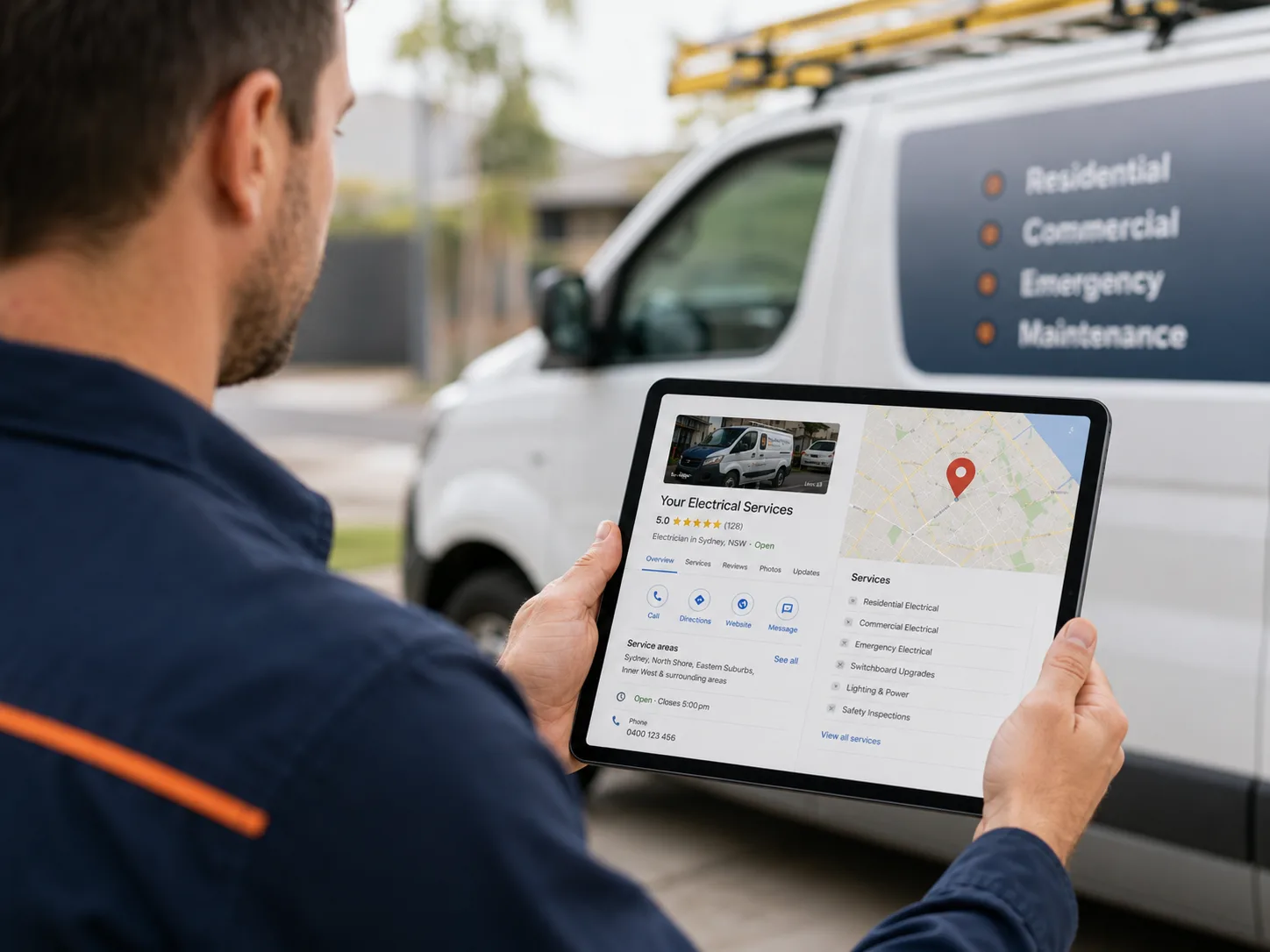
We optimise the Google Business Profile using accurate categories, services, opening hours, contact details, service areas, project photos and review responses.
We also improve the website entities that support the profile. These include service pages, suburb pages, project examples, licence details, business information and consistent contact data.
The objective is not to create hundreds of duplicated location pages. A useful service-area page should contain genuine operating information such as local availability, relevant services, travel coverage, project evidence and clear contact options.
Which Australian Service Areas Can Be Targeted?
We build campaigns for genuine Australian operating areas where the electrical contractor has the staff, licences, travel capacity and commercial reason to accept work.
Australia-wide strategy may cover major markets such as Sydney, Melbourne, Brisbane, Perth, Adelaide, Canberra, Hobart and Darwin. Regional cities and surrounding suburbs can also be targeted when the business genuinely services them.
Location selection should follow operating reality.
A suburb may show search volume but still be unsuitable because travel time is high, job values are low or the team cannot meet the expected response time.
We classify locations as:
Primary area
Strong service capacity and profitable demand
Dedicated local optimisation and campaign priority
Secondary area
Suitable work with lower demand or longer travel
Selective targeting
Expansion area
Planned future coverage
Research before active promotion
Excluded area
Unprofitable or unsupported location
Exclude from ads and avoid location-page claims
Budget protection
This protects campaign budgets and prevents enquiries from locations the business cannot service.
What Should an Electrician Website Include?
An electrician website should explain each priority service, establish local relevance, prove professional capability and provide a contact action that matches the customer’s urgency and decision stage.
A generic five-page website rarely provides enough separation between customer needs.
Someone with a burning smell near a switchboard is not completing the same journey as a homeowner researching an EV charger or a property manager sourcing a maintenance contractor.
The website architecture should connect broader service categories with specific services and customer problems.
Service architecture
The electrical services hub introduces the complete service range. Individual pages then cover hyponyms such as switchboard upgrades, fault finding, rewiring, smoke alarm installation, EV charger installation and commercial maintenance.
Service definition
What does the electrician do?
Problem triggers
Why might the customer need it?
Electrical systems
Which components are involved?
Customer types
Who normally requests the service?
Process
How is the work assessed and completed?
Safety context
Why can delay matter?
Location
Where is the service available?
Evidence
What verifies competence?
Contact action
What should the customer do next?
Match the action to the buying stage
The page should use the correct action verb. Emergency customers call. Planned-installation customers request a quote. Commercial buyers discuss scope, compliance and ongoing support. A generic “Contact Us” button does not reflect these different needs.
How Do Service Pages Build Semantic Relevance?
Service pages build relevance by connecting the electrical provider, customer problem, affected system, professional action, service area, evidence and expected outcome.
The semantic relationship should be explicit:
The electrical contractor diagnoses, repairs, installs, replaces, upgrades or maintains an electrical system for a defined customer within a genuine service area.
For example:
A licensed electrician inspects and upgrades an outdated switchboard for a homeowner whose existing board cannot safely support current electrical demand.
This sentence carries more useful meaning than repeating “switchboard electrician” several times.
The main entity is the switchboard upgrade. Its attributes include property type, existing condition, capacity, safety issue, assessment process, components, compliance, location and expected outcome.
Related problem entities may include tripping circuits, ceramic fuses, overloaded boards, burning smells, missing safety switches and new EV charger requirements.
Related outcome entities may include improved circuit protection, increased electrical capacity, clearer labelling and safer power distribution.
These relationships help customers understand the service and give search systems clearer contextual information.
Explicit semantic relationship
The electrical contractor diagnoses, repairs, installs, replaces, upgrades or maintains an electrical system for a defined customer within a genuine service area.
Electrician service example
A licensed electrician inspects and upgrades an outdated switchboard for a homeowner whose existing board cannot safely support current electrical demand.
How Should Google Ads for Electricians Be Structured?
Google Ads should be separated by electrical service, customer intent, location, urgency and operating schedule so the business pays for demand it can realistically convert.
One campaign should not mix emergency faults, ceiling fans, commercial fit-outs and apprenticeship searches.
Emergency campaigns usually need short conversion paths, mobile call actions and strict scheduling. Planned services need detailed landing pages, project proof and quote forms. Commercial campaigns need capability evidence and longer lead stages.
Each campaign should define:
Promoted service
Emergency repair, rewiring or EV charger installation
Search intent
Immediate help, planned quote or contractor comparison
Geographic target
Approved suburbs or service zones
Schedule
Staffed hours or verified after-hours availability
Conversion
Qualified call, quote request or consultation
Exclusions
Jobs, apprenticeships, courses, DIY and unsupported services
Negative-keyword controls
Negative keywords reduce exposure to irrelevant searches such as electrician jobs, apprenticeship programmes, salary information, wholesale supplies and DIY instructions. Location exclusions are equally important. An ad should not generate calls from areas the team cannot service.
Track call outcomes
Google Ads call reporting can show call duration, connection status and keyword-level call data. Businesses can also import call outcomes and revenue to identify which ads and keywords produce valuable customer actions rather than calls alone.
How Do We Improve Website Conversion?
We improve conversion by matching the page, proof and contact action with the visitor’s service need, location, urgency and level of purchase readiness.
The first requirement is clarity.
The second requirement is trust.
The third requirement is low contact friction.
Forms should collect information that helps qualification. They should not request unnecessary details that delay submission.
The final requirement is response.
Clarity
A visitor should be able to identify the service, coverage area, availability and next action without searching through several pages.
Trust
Useful evidence includes licence details, insurance, verified reviews, real project photos, team information, branded vehicles, service processes and written quote expectations.
Low contact friction
Emergency pages may require a prominent phone number and sticky mobile call button. Planned-project pages may need a short quote form that collects the service type, suburb, property type and preferred timing.
Response
A website cannot compensate for unanswered calls, unassigned enquiries or quotes that receive no follow-up.
How Are Missed Calls and Unconverted Leads Recovered?
Missed calls and unconverted enquiries are recovered through clear lead ownership, rapid responses, automated notifications, structured qualification and scheduled quote follow-up.
A useful lead process records the full status of each opportunity.
The system should record why an enquiry was lost. Common values include outside service area, unsupported service, no response, price objection, schedule conflict and competitor selected.
This information improves both marketing and operations.
If many leads are outside the service area, targeting needs correction. If qualified leads receive quotes but do not proceed, the issue may involve pricing, trust, communication or follow-up. If calls are regularly missed during active ad hours, campaign scheduling and call coverage need attention.
Call tracking, CRM data and job-management data should therefore work together.
Google Ads allows call conversions to be based on minimum call duration or imported offline outcomes. Imported outcomes provide a more precise connection between the original ad interaction and later actions such as quote requests or sales.
Operational diagnosis
When many leads fail at the same stage, the campaign data should change targeting, call coverage, qualification, pricing communication or follow-up.
How Do Online Reviews Support Electrician Marketing?
Genuine customer reviews strengthen trust by documenting the service, location, communication and result experienced by previous customers.
Review quantity alone is not sufficient. Recency, specificity, sentiment and authenticity also matter.
A useful review may mention a switchboard upgrade in Brisbane, an emergency fault repair in Melbourne or ongoing commercial maintenance in Sydney. The service and location details help future customers assess relevance.
Reviews should be requested consistently after completed work. The request must not pressure the customer to provide a positive rating.
The ACCC states that reviews must be independent and reflect genuine customer experience. Creating, commissioning or manipulating misleading reviews can breach Australian Consumer Law. Incentives must not depend on the review being positive and should be clearly disclosed.
Negative reviews should not automatically be suppressed. A factual response can clarify the record, show accountability and explain the next resolution step.
Specificity
Reviews should identify the service, location, communication and result experienced by the customer.
Authenticity
Reviews must reflect genuine customer experience and should never be manipulated.
Resolution
A factual response to a negative review can show accountability and the next resolution step.
How Does Our Electrician Marketing Process Work?
Our process moves from diagnosis to implementation and then to commercial validation. Each step has a defined entity, action and measurement requirement.
Diagnose demand and revenue leakage
We review current rankings, Google Business Profile visibility, ad search terms, service pages, calls, forms, response times, quotes and available job data. The objective is to identify where relevant demand is being lost.
Map services, customers and locations
We classify services by urgency, customer type, job value, margin, sales cycle and team capacity. We also identify primary, secondary and excluded service areas.
Build the required acquisition assets
We improve the website architecture, service pages, location pages, Google Business Profile, paid-search campaigns, conversion actions and trust evidence. Each asset receives a defined search intent and business role.
Connect lead handling and measurement
We configure calls, forms, CRM stages, booking actions and available revenue data. The reporting structure distinguishes enquiries from qualified leads and booked jobs.
Optimise using commercial evidence
We compare services, search terms, pages and locations using lead quality, booking rate, cost per booked job and attributed revenue. Investment is then increased, reduced or redirected according to performance and capacity.
What Happens During the First 90 Days?
The first 90 days establish measurement, correct high-impact problems, build priority assets and create enough data for evidence-based optimisation.
Days 1 to 30
Technical audit, demand mapping, GBP review, tracking, service and location prioritisation
Baseline data, approved priorities and implementation plan
Days 31 to 60
Service pages, location assets, campaign restructuring, conversion improvements and review workflow
Improved relevance, cleaner targeting and active lead capture
Days 61 to 90
Search-term analysis, call-quality review, CRO, quote-stage analysis and budget adjustment
Initial qualified-lead and booking insights
No fixed ranking promise
The first 90 days do not guarantee a fixed ranking or lead volume. SEO timing depends on the website’s current condition, competition, content coverage, authority and crawl history. Google Ads can generate demand sooner, but the result still depends on targeting, budget, landing-page quality and the business’s response process. The correct promise is implementation, measurement and continuous correction.
Which Electrician Marketing Mistakes Waste the Most Budget?
The most expensive mistakes are broad targeting, generic service pages, weak call handling and reporting that stops before the booked job.
Advertising every service
Budget is spread across unrelated job types
Prioritise services by demand, margin and capacity
Targeting every suburb
Calls come from unprofitable or unsupported areas
Use approved geographic zones and exclusions
Mixing emergency and planned work
Customer urgency and landing-page needs conflict
Build separate campaigns and conversion paths
Using one services page
Search intent and service evidence remain vague
Publish dedicated priority service pages
Counting every call as qualified
Spam, job seekers and wrong services distort results
Review call quality and CRM status
Ignoring missed calls
Paid and organic demand is lost after acquisition
Add ownership, text-back and response rules
Publishing duplicated suburb pages
Pages provide little local value
Use genuine service-area information and evidence
Reporting only traffic
Management cannot assess commercial return
Track quotes, bookings, revenue and acquisition cost
Measurement must extend beyond the website
A marketing campaign cannot correct operational problems it cannot see. Measurement must extend beyond the website.
How Are Results Measured?
Results are measured from visibility through revenue, with separate metrics for discovery, acquisition, sales progression and commercial return.
Visibility
Visibility metrics show whether the electrical business is being discovered. Examples include search impressions, organic rankings, Google Maps visibility, Business Profile interactions and website clicks.
Acquisition
Acquisition metrics show whether visibility creates enquiries. Examples include phone calls, quote forms, conversion rate, cost per lead and qualified-lead rate.
Sales progression
Sales metrics show whether enquiries become work. Examples include response time, inspection bookings, quote rate, quote acceptance, booking rate and close rate.
Commercial performance
Commercial metrics show whether the work justifies the marketing investment. Examples include cost per booked job, average job value, customer acquisition cost, marketing-sourced revenue and return on investment.
The measurement hierarchy
Rankings measure visibility. Leads measure response. Bookings measure conversion. Revenue and margin measure commercial value.
SunPeak Solar & Battery
A six-month SEO campaign improved search visibility for residential solar and battery service pages by separating service, commercial and local intent.
Residential solar and battery installation company
Brisbane, Queensland
January 2026 to June 2026
What was the starting problem?
Important service pages ranked between positions 18 and 42. The website generated 640 monthly organic users but did not clearly separate residential solar, battery installation, combined solar and battery systems, commercial solar or Brisbane location intent.
What work was completed?
We improved service, commercial, location, quote-request and Google Business Profile assets.
The work included title tags, headings, internal links, local entity coverage, mobile performance, technical SEO, service-area information, project evidence and quotation prompts.
Monthly organic users
Search Console clicks
Search impressions
Residential solar average position
Battery installation average position
Page-one keywords
Measured outcome
Monthly organic traffic increased by 73%. This case study verifies improved organic visibility and traffic for a specialist electrical service provider. It does not, by itself, prove booked-job or revenue growth because CRM, booking and revenue values were not supplied.
Why Choose SEO Agency for Tradies?
SEO Agency for Tradies combines Australian trade-industry positioning with in-house implementation, transparent measurement and campaign decisions based on services, locations and booked-work potential.

We work from the electrical business model
The strategy starts with job type, capacity, service area, margin and customer segment. This avoids a standard package that treats a sole trader, residential contractor and commercial electrical company as the same buyer. Research on small B2B firms supports this distinction. A 2022 study found that one-size-fits-all digital marketing practices are not appropriate across different B2B SME contexts.
We connect marketing with lead handling
Generating calls is not enough when those calls are missed, poorly qualified or left without follow-up. We connect acquisition data with available CRM, quote and booking stages so campaign decisions can reflect commercial outcomes.
We explain the work in plain language
Reports should identify what changed, why it changed and what result is being measured. A 2025 study involving 413 Australian SMEs found that client training improved relationship quality with outsourced digital marketing providers, with especially strong effects in transactional relationships.
We use verifiable claims
Campaign claims should be supported by search data, call records, CRM stages, reviews or project evidence. The ACCC requires advertising claims to be truthful, accurate and based on reasonable grounds. Businesses must be able to substantiate the claims they publish.
We do not guarantee rankings or revenue
No provider controls Google’s organic rankings, customer demand, competitors, pricing, staff capacity or sales performance. We define the work, measurement method, reporting frequency and known constraints before implementation.
How Much Does Digital Marketing for Electricians Cost?
The cost depends on the number of services and locations being targeted, market competition, website condition, paid-media scope, content requirements and tracking complexity.
A contractor targeting one city and three residential services requires a different campaign from a multi-crew company targeting several regions, emergency work, commercial maintenance and specialist installations.

Service coverage
One to three services
Multiple residential, commercial and specialist services
Geographic coverage
One primary area
Multiple cities, branches or regions
Website condition
Existing conversion-ready site
Rebuild or major architecture correction
Organic competition
Limited local competition
Established competitors with strong authority
Paid-search scope
One focused campaign
Multiple service and location campaigns
Tracking
Calls and forms
CRM, quote, booking and revenue attribution
Content evidence
Existing project assets
New case studies, photography and service content
Scope and economics
Marketing investment should also reflect electrical job economics. A campaign for small fault-repair callouts cannot use the same acceptable acquisition cost as a campaign for rewiring, commercial maintenance or EV charger projects. We provide a defined scope after reviewing the business’s services, coverage, current assets, available evidence and measurement requirements. Google Ads media spend is separate from campaign management unless the proposal states otherwise.
Is SEO or Google Ads Better for Electricians?
SEO builds owned search visibility over time, while Google Ads buys immediate access to selected search demand. Most established electrical contractors need the channels to perform different jobs.
Primary role
Build organic and local visibility
Capture immediate demand
Speed
Requires time to develop
Can launch after setup and approval
Cost model
Investment in assets and authority
Payment for advertising interactions
Control
Lower control over ranking timing
Higher control over keywords, areas and schedules
Long-term value
Pages can continue attracting demand
Traffic reduces when spend stops
Best use
Scheduled services, local authority and broad coverage
Urgent jobs, priority services and controlled testing
Main risk
Thin or unfocused content
Irrelevant clicks and poor conversion tracking
Use channels for different jobs
The decision should follow demand, budget, capacity and time horizon. An emergency electrician may require paid search for immediate call volume while SEO develops. A commercial contractor may rely more heavily on service content, case studies, local authority and longer-term lead nurturing.
Related Electrician Marketing Services
These pages should link using anchor text that matches each destination page title.
SEO for Electricians
Build organic visibility for electrical services, customer problems and commercially relevant searches.
Local SEO for Electricians
Improve Google Maps visibility, Google Business Profile relevance, reviews and local service-area coverage.
Google Ads for Electricians
Capture urgent and planned electrical demand using service, location, schedule and conversion controls.
Electrician Website Design
Create service pages, project evidence, mobile contact paths and conversion-focused website architecture.
Social Media Marketing for Electricians
Publish project work, team activity, safety information and service evidence without treating engagement as a substitute for booked jobs.
Electrician Lead Generation
Connect search demand, calls, forms, qualification, follow-up and booked-work measurement.
Frequently Asked Questions
Digital marketing can generate electrical enquiries when the campaign targets genuine services and locations, establishes trust, supports easy contact and tracks lead quality beyond the first click. Performance still depends on competition, budget, evidence, pricing, availability and lead response.
The appropriate strategy combines local visibility, service-specific pages, review evidence, conversion tracking and lead follow-up according to the contractor’s job mix and capacity. Emergency, residential, commercial and specialist contractors require different channel priorities.
Local SEO is important because most electrical work is delivered within a defined geographic area and customers commonly evaluate providers through Google Search and Google Maps. Google uses relevance, distance and prominence when producing local results.
An electrician website should include dedicated service pages, genuine service-area information, licences, project evidence, reviews, mobile call options, quote forms and clear response expectations. It should also separate emergency, planned, residential and commercial intent where those services are offered.
Separate pages are useful when each service has a distinct customer need, search intent, process, evidence requirement and conversion action. Examples include switchboard upgrades, house rewiring, EV chargers and commercial maintenance.
Electricians should create suburb pages only for genuine service areas where they can provide useful local information and accept work. Changing the suburb name on otherwise duplicated pages does not create meaningful local value.
Lead quality improves when campaigns target the correct service, customer, location, urgency and schedule while excluding job seekers, DIY searches and unsupported work. Call reviews and CRM statuses should then verify which enquiries were commercially suitable.
Electricians can reduce missed leads through staffed campaign schedules, call routing, missed-call text responses, lead ownership, response-time rules and scheduled quote follow-up. The business should record where each lead stopped progressing.
Emergency marketing should use tightly controlled locations, staffed hours, mobile call actions, immediate response expectations and pages focused on urgent electrical faults. It should not share the same conversion path as planned installations.
Commercial electricians need sector-specific service pages, project evidence, compliance information, capability documents and longer lead stages for meetings, tenders and maintenance agreements. Residential call messaging should not dominate commercial campaigns.
Calls can be attributed using Google Ads call reporting, website call tracking or third-party call-tracking systems connected with CRM outcomes. Google Ads can track calls by duration and can import later call outcomes for more precise measurement.
A qualified electrician lead requests an offered service, comes from an approved service area, matches the intended customer type and can be handled within the business’s schedule and commercial requirements. A form submission alone does not confirm lead quality.
Electrician SEO does not have one fixed timeline because progress depends on the website’s condition, competition, content coverage, local authority, technical issues and implementation speed. Early technical and conversion changes may occur before substantial ranking movement.
No agency can legitimately guarantee a specific organic ranking, lead volume or revenue result because search systems, competitors, customer demand and business operations remain outside its control. A provider can guarantee defined work, reporting and implementation standards.
Generate More Qualified Electrical Enquiries
Find where your electrical business is losing demand between Google visibility, customer contact, quote follow-up and the booked job.


